On this page
- Can a Leaking Roof Be Repaired, and How Urgent Is It?
- What Are the Signs of a Leaking Roof?
- Why Do Roofs Leak? Common Causes by Roof Type
- How Do You Find the Source of a Roof Leak?
- What Should You Do First During an Active Leak?
- How to Repair a Leaking Roof: Step-by-Step
- Should You Repair the Leak Yourself or Hire a Contractor?
- Patch Repair or Full Re-Waterproofing: Which Does Your Roof Need?
- How Much Does Leaking Roof Repair Cost in India?
- How Do You Stop Roof Leaks Coming Back?
- Most leaking roofs can be repaired. The right fix depends on the cause and the roof type.
- The ceiling stain is often not where the water gets in. Trace it upward and outward before you patch.
- During heavy rain, contain, don't repair: bucket, power off, tarpaulin once it is safe.
- A proper RCC repair runs: clean, fill cracks, seal joints, prime, coat, cure, then flood-test for 24–48 hours.
- In Bengaluru, finish repairs before September and October, the city's rainiest months.
Leaking roof repair means finding where rainwater enters the roof, sealing that point, and restoring the waterproof layer around it. This guide shows you how to identify the cause on RCC, metal-sheet and tiled roofs, then fix it step by step.
Can a Leaking Roof Be Repaired, and How Urgent Is It?
Yes, most leaking roofs can be repaired without replacing the roof. Act quickly, because every rain pushes more water into the slab.
A leak left alone spreads well beyond the ceiling stain:
- Steel corrosion: water reaches the reinforcement bars inside an RCC (reinforced cement concrete) slab, and rusting steel cracks the concrete around it.
- Damp walls: moisture runs down into walls, causing peeling paint, efflorescence (white salt deposits) and mould.
- Electrical risk: water near ceiling fans, lights and conduits can cause short circuits.
Water travels along the slab, the steel bars, rafters or tile battens before it drips. Patching the spot directly above the stain is the most common reason a repair fails.
Timing matters in Bengaluru. The city gets rain from both the southwest monsoon (June to September) and the northeast monsoon (October to December). Citizen Matters' review of 100 years of rain data found September and October are the wettest months, out of about 931 mm a year.
So plan permanent repairs for the dry months. If the roof is leaking right now, use a temporary fix and repair properly once the surface dries.
What Are the Signs of a Leaking Roof?
The clearest sign of a leaking roof is a ceiling stain or drip that appears or grows after rain. Other signs are easy to miss:
- Brown or yellow stains, damp patches or bubbling paint on the top-floor ceiling
- Drips from light fittings, fan hooks or the ceiling-wall corner
- A musty smell or black mould in upper corners
- White salt deposits (efflorescence) on the ceiling or upper walls
- Rust stains or exposed steel on the ceiling plaster
Before you climb onto the roof, rule out the two common lookalikes: a plumbing leak and condensation.
Roof leak, plumbing leak or condensation?
Check these before repairing| Check | Roof leak | Plumbing leak | Condensation |
|---|---|---|---|
| When it appears | During or after rain | Any time, often when taps or the tank are in use | Cool mornings, humid weather |
| Dry weather | Stain dries and stops growing | Stain keeps growing | Comes and goes with temperature |
| Where | Top-floor ceilings, parapet corners | Below bathrooms, tanks or pipe runs | Underside of metal sheets, cold surfaces |
| What to do | Trace the source on the roof | Call a plumber; check concealed pipes | Improve ventilation or insulate the sheet |
For dampness on walls rather than ceilings, see our guide to the causes of wall dampness.
Why Do Roofs Leak? Common Causes by Roof Type
Roofs leak when water finds a crack, an open joint or a worn waterproof layer, usually helped by water that stands too long. The likely cause depends on your roof type.
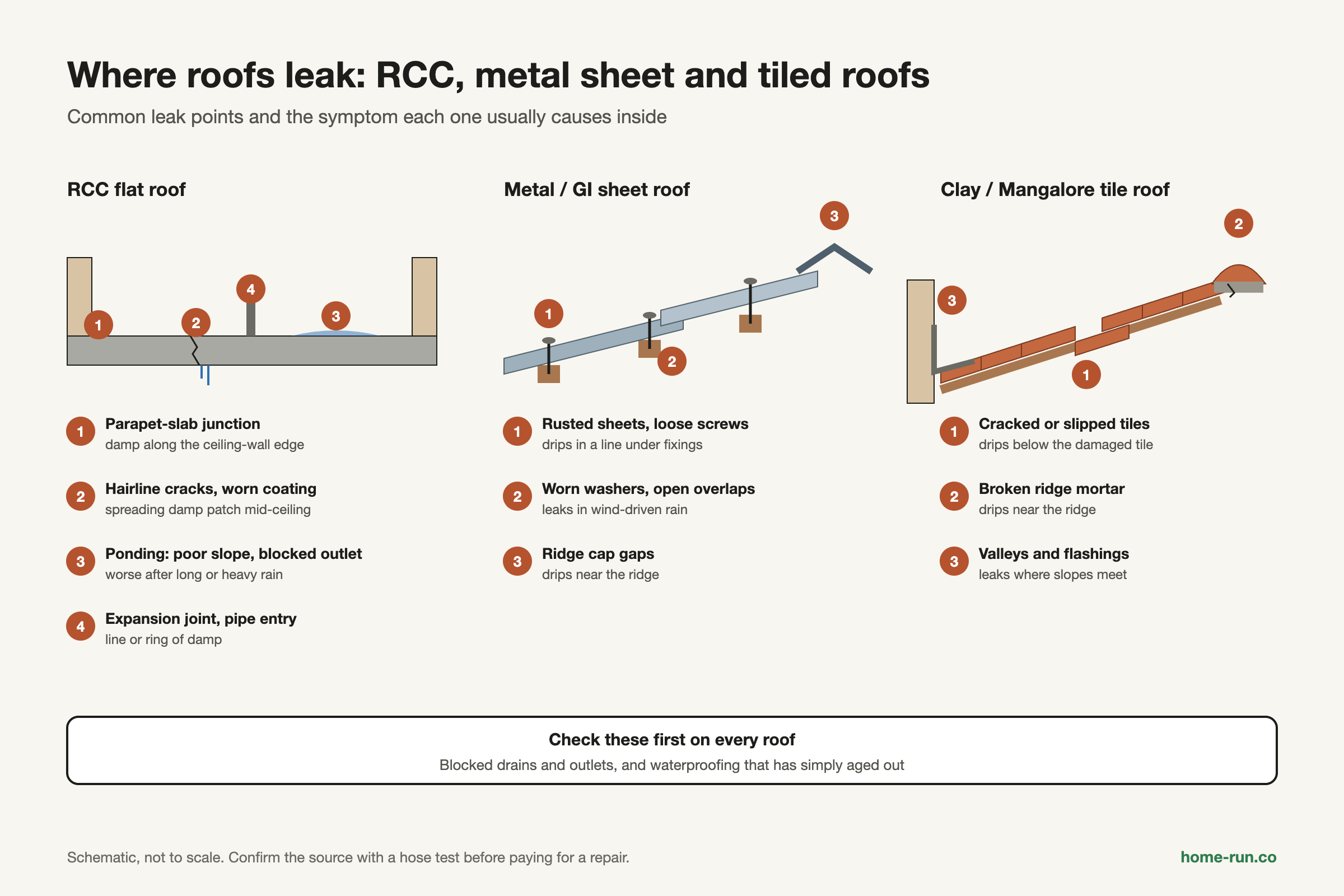
Leak symptom, likely cause and first fix by roof type
Indian homes| Roof type | Likely cause | Typical symptom | First fix |
|---|---|---|---|
| RCC flat roof | Hairline cracks, worn coating or brick bat coba | Spreading damp patch mid-ceiling | Fill cracks, recoat the area |
| RCC flat roof | Gap at the parapet-slab junction | Damp along the ceiling-wall edge | Seal the junction with a fillet and flexible sealant |
| RCC flat roof | Ponding from poor slope or blocked outlets | Leak worsens after long or heavy rain | Clear outlets, correct the fall |
| RCC flat roof | Failed expansion joint or pipe penetration | Line or ring of damp | Re-seal with flexible joint sealant |
| Metal / GI sheet | Rusted sheets, loose screws, worn washers | Drips in a line under fixings | Replace screws and washers, treat rust |
| Metal / GI sheet | Open overlaps or ridge cap gaps | Leaks in wind-driven rain | Seal overlaps, refix the ridge cap |
| Clay / Mangalore tile | Cracked or slipped tiles, broken ridge mortar | Drips near the ridge or valleys | Replace tiles, re-bed the ridge |
Why does a roof only leak sometimes? Usually because the defect sits above the normal waterline. Standing water reaches it only in long or wind-driven rain, or when an outlet blocks.
For seepage through walls and other entry routes, read our guide to water seepage causes and solutions.
How Do You Find the Source of a Roof Leak?
You find the source of a roof leak by working from the stain upward, then testing the roof in sections. Follow this order:
- Start inside. Mark every stain and drip on a sketch of the ceiling. Note which ones appeared after which rain.
- Measure across to the roof. Locate the same spot on the terrace, then look uphill of it, toward the higher side of the slope.
- Inspect the roof in daylight, when dry. Check cracks, the parapet-slab junction, expansion joints, pipe and cable entries, the water-tank base and every outlet.
- On sheet roofs, check the fixings. Look for rusted screws, cracked washers and lifted overlaps above the drip line.
- Hose-test the suspects. Wet one small zone at a time while someone watches inside.
- Call for a survey if needed. A contractor with a moisture meter can map damp in the slab when the leak still hides.
Never walk on a wet or mossy slab, and never step directly on asbestos-cement or polycarbonate sheets. Use a crawl board across the purlins, or leave sheet roofs to a professional.
What Should You Do First During an Active Leak?
During an active leak, protect people and wiring first, then contain the water. Do not attempt a repair while it is raining.
- Switch off the circuit for any fan, light or socket near the wet patch at the MCB (miniature circuit breaker)
- Move electronics, furniture and valuables away from the drip
- Catch the drip in a bucket, with a cloth inside to stop splashing
- If a ceiling bulges with trapped water, stay clear and call a professional
- Once the rain stops and it is safe, clear the roof outlets of leaves and debris
- Cover the suspect area with a tarpaulin weighted down with bricks or sandbags
When the surface is dry, a short-term patch can hold until the full repair:
- Waterproof tape or a bitumen patch over a small crack or hole
- Sealant in small cracks or around loose screw holes on sheets
- Tarpaulin for larger damaged areas or broken tiles
Tape, sealant and tarpaulins buy you time. They do not restore the waterproof layer, so book the proper repair for the next dry spell.
How to Repair a Leaking Roof: Step-by-Step
Leaking roof repair on a cracked RCC flat roof follows seven steps: mark, clean, fill, seal, prime, coat and test. Take coverage, coat count and drying times from your product's technical data sheet.
- Mark the problem areas. Chalk every crack, joint and outlet you found during the inspection.
- Clean the surface. Remove moss, dust, loose plaster and flaking old coating. Let the slab dry fully.
- Open and fill the cracks. Widen hairline cracks slightly so the filler can grip, then fill them with a polymer-modified repair mortar or crack filler.
- Seal joints and junctions. Treat the parapet-slab junction, expansion joints and pipe entries with a flexible sealant. Add a cement fillet at the parapet corner if there is none.
- Prime the surface. Apply the primer the coating maker specifies. Skipping it is a common reason coatings peel.
- Apply the waterproof coating. Brush or roll the coats the manufacturer specifies, turning the coating up the parapet wall. Cure as directed.
- Test it. Plug the outlets, flood the roof to about 2–4 inches (50–100 mm), and watch the ceiling below for 24–48 hours.
A falling water level or any new damp means the repair has a gap. Fix that area and test again.
If you see wide or growing cracks, the problem may be structural. Cracks wider than 1/8 inch (about 3 mm), sagging or a diagonal crack across the ceiling need an engineer's check before any coating.
How Do You Repair a Leaking Metal or GI Sheet Roof?
You repair a leaking metal or GI (galvanised iron) sheet roof by fixing its fastenings and joints. Replace rusted or loose screws with new roofing screws and sealing washers. Seal overlaps and ridge caps with a sealant made for metal roofs. Wire-brush rust spots, prime them, and replace any sheet that has rusted through.
How Do You Repair a Leaking Tiled Roof?
You repair a leaking tiled roof by replacing cracked tiles and re-setting slipped ones. Re-bed a crumbling ridge in fresh mortar, and clear leaves from the valleys.
Fixing a roof leak this week?
Get waterproofing coatings, crack fillers and cement delivered across Bengaluru with a GST invoice.
Should You Repair the Leak Yourself or Hire a Contractor?
Repair the leak yourself only when it is small, easy to reach and from one clear cause. Hire a waterproofing contractor for anything recurring, large or structural.
DIY repair
Small jobsPoint
- One or two hairline cracks you can see
- A blocked outlet or loose sheet screw
- Single-storey, flat, easy-to-reach roof
- Coating still sound elsewhere
- No guarantee needed
Professional contractor
Better for most leaksPoint
- Leak returns after a past repair
- Several leak points or a large area
- Rust stains, spalling or wide cracks
- Multi-storey, sheet or steep tile roof
- You want a written guarantee
Before you hire, ask every contractor these questions:
- Will you visit and inspect before giving a quote?
- Which system and brand will you use, and how many coats?
- How will you treat cracks, joints and the parapet junction?
- How long will you cure, and will you flood-test afterwards?
- Who gives the guarantee, the contractor or the maker, and what voids it?
Patch Repair or Full Re-Waterproofing: Which Does Your Roof Need?
A patch repair suits one or two clear leak points on a roof whose coating is otherwise sound. Full re-waterproofing suits an old, widely cracked or repeatedly leaking roof.
Choose full re-waterproofing if the coating is chalky, peeling or blistered across the roof. The same applies if the roof leaks in new places every monsoon, or water ponds over large areas.
For a side-by-side look at coatings, membranes and how long each lasts, read our guide to the permanent solution for roof leakage.
How Much Does Leaking Roof Repair Cost in India?
Leaking roof repair cost depends mainly on roof area and the system used. Published 2026 contractor rates start at about ₹25–60 per sq ft for acrylic or polymer coatings.
Published terrace waterproofing rates
₹ per sq ft, 2026| System | HouseYog (Mar 2026) | Aecord (Aug 2026) |
|---|---|---|
| Acrylic / polymer coating Common pick | ₹25–45 | ₹35–60 |
| APP / SBS membrane | ₹80–160 | ₹80–160 |
| Polyurethane (PU) coating | ₹140–300 | ₹140–300 |
Other cost drivers are crack and joint repair, removal of old coating, roof height and access, and local labour rates.
A spot repair of a few cracks costs far less than this. Replacing the roof costs far more, so treat full replacement as the last option.
How Do You Stop Roof Leaks Coming Back?
You stop roof leaks coming back with two inspections a year and clear drains. Here is a calendar that fits Bengaluru's two monsoons:
Repair window
Dry weather suits crack repair, recoating and curing.
Pre-monsoon check
Inspect cracks, joints and the parapet. Clear outlets and flood-test any fresh repair.
Watch after storms
Check outlets after heavy rain and note any new ceiling marks.
Peak rain
Keep outlets clear. Contain leaks; avoid repairs on wet surfaces.
Post-monsoon review
Map every leak from the season and book repairs for the dry months.
- Clear drain outlets, gutters and rainwater pipes before each monsoon
- Keep the roof free of stored junk, pots and debris that block water flow
- Trim branches that drop leaves onto the roof
- Recoat when the surface looks chalky, cracked or worn
- Fix ponding spots so water drains within a day after rain
If you collect roof water, keep the system clean too. Our guide to rooftop rainwater harvesting covers outlets and filters.