On this page
- What Is Metal Roofing?
- What Types of Metal Roofing Are Available in India?
- How Thick Should Roofing Sheets Be?
- What Are the Main Advantages?
- Metal Roofing vs Clay Tiles: Which Suits Your Home?
- How Much Does Metal Roofing Cost in India?
- What Are the Installation Steps?
- What Upkeep Does the Roof Need in Bengaluru?
- Most metal roofing in India is steel sheet with a zinc or aluminium-zinc coating, often pre-painted.
- Galvalume (55% aluminium, 43.4% zinc, 1.6% silicon) outlasts plain galvanized (zinc-only) steel.
- Buy by base metal thickness, not gauge or total thickness; 0.42 mm is a sound minimum for homes.
- Pre-painted Galvalume (PPGL) costs about ₹65–105 per sq ft at 0.47 mm, wholesale; retail runs higher.
- Check for the BIS Standard Mark and a test certificate: coated roofing steel falls under a mandatory Quality Control Order.
Metal roofing is a roof covering made of thin metal sheets or panels, usually coated steel, fixed over a frame of purlins. In India, the most common metal roofing is a colour-coated Galvalume steel sheet in a corrugated, trapezoidal or tile-look profile.
This guide covers metal roofing on its own: the metals and coatings, sheet thickness, cost, installation and upkeep. For every other sheet material, see our guide to types of roofing sheets.
What Is Metal Roofing?
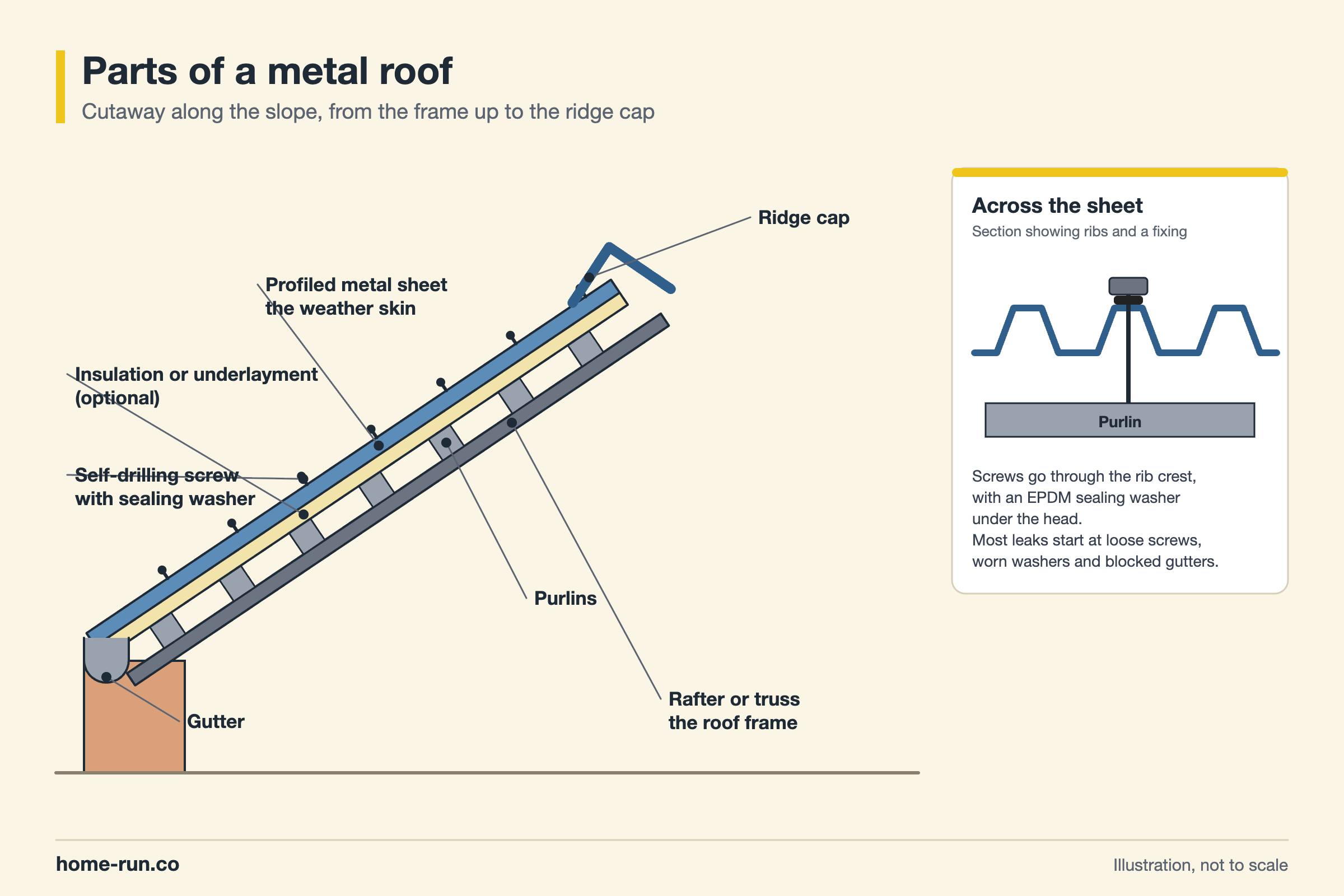
Metal roofing is a system of profiled metal sheets, fasteners, flashings and trims that sheds rain and blocks sun. The sheets rest on purlins, the horizontal steel or timber members of the roof frame.
Metal roofs cover sheds, factories, carports and terrace roofs in Indian homes. Pre-painted tile-profile sheets now also roof sloped homes and villas, in place of clay tiles.
- Panels or sheets: the profiled metal that forms the weather skin.
- Purlins and frame: the metal roofing structure that carries the sheets.
- Fasteners: self-drilling screws with sealing washers.
- Ridge caps, flashings and trims: seal the top, edges and openings.
- Underlayment or insulation (optional): cuts heat gain and rain noise.
What Types of Metal Roofing Are Available in India?
Metal roofing in India comes in five main metal-and-coating types, each with its own Bureau of Indian Standards (BIS) code. Coated steel dominates because it balances price, strength and life.
Types of metal roofing by material
Base metal, coating and Indian standard| Type | What it is | Indian standard | Best for |
|---|---|---|---|
| GI (galvanized iron) sheet Budget | Steel with a zinc-only coating | IS 277 | Sheds, temporary roofs |
| Galvalume sheet | Steel with an aluminium-zinc-silicon coating | IS 15961 | Industrial roofs, bare finish |
| PPGI sheet | Pre-painted galvanized steel | IS 14246 | Low-cost coloured roofs |
| PPGL sheet Default pick | Pre-painted Galvalume steel | IS 15965 | Homes, terraces, carports |
| Aluminium, copper or zinc | Non-ferrous sheet, no steel core | Product-specific | Coastal sites, premium homes |
Which sheet profiles can you choose?
- Corrugated: rounded waves; the classic, lowest-cost metal roof sheet.
- Trapezoidal: flat-topped ribs that span purlins further; the usual choice for sheds and terraces.
- Tile profile: pressed to look like Mangalore clay tiles, for sloped homes.
- Standing seam: concealed-fastener panels joined by raised seams; no screws pierce the weather skin.
- Stone-coated metal tiles: steel tiles finished with bonded stone chips, quieter in rain.
To compare these with RCC, clay and other roof forms, read our overview of types of roofs.
How Thick Should Roofing Sheets Be?
Residential metal roofing sheets should have at least 0.42 mm base metal thickness, which is the minimum BlueScope recommends for roofing. Indian dealers commonly sell 0.30 mm to 0.55 mm sheets, so always ask which thickness is being quoted.
Three thickness figures on one sheet
Example: 0.42 mm BMT, AZ150 coating| Term | What it measures | Example |
|---|---|---|
| BMT (base metal thickness) | Bare steel core only | 0.42 mm |
| TCT (total coated thickness) | Steel plus metallic coating | 0.47 mm |
| APT (after-painted thickness) | Steel, coating and paint | 0.50 mm |
Gauge is an old numbering system in which a higher number means thinner sheet: 24 gauge is about 0.64 mm, 26 gauge about 0.48 mm and 28 gauge about 0.40 mm. Charts differ slightly, so ask for thickness in mm (BMT) and coating mass (AZ or GSM) on the invoice instead.
What Are the Main Advantages?
The main advantages of metal roofing are long life, low weight, fast installation and full recyclability. A well-fixed metal roof lasts 40–70 years on average, against 15–30 years for asphalt shingles.
- Durability and longevity: coated steel and aluminium roofs last 30–50+ years; zinc and copper can last a century or more.
- Corrosion resistance: Nippon Steel rates Galvalume at three to six times the life of galvanized steel of equal coating mass. JSW claims up to three times for its own sheet.
- Light weight: metal puts far less load on walls and frames than clay tile or slate.
- Heat reflection: light, reflective finishes bounce back solar heat, so the room below stays cooler.
- Fast to fit: long sheets cover a roof in days, with no curing time.
- Environmental benefits: most metal roofs contain recycled metal and can be fully recycled at end of life.
For cooling, pick a light colour and ask for the Solar Reflectance Index (SRI). This Old House suggests an SRI of 29 or more for a high-performing cool metal roof.
Metal Roofing vs Clay Tiles: Which Suits Your Home?
Metal roofing beats clay tiles on weight, speed and leak-tightness, while clay tiles win on heat comfort, rain noise and traditional looks. RCC slabs remain the norm for flat roofs that will be used as terraces.
Metal roofing
Light and fastPoint
- Long sheets with few joints, so fewer leak paths
- Light load, so a slimmer steel frame
- Fitted in days, with no breakage in transport
- Needs insulation to control heat and rain noise
Clay tile roofing
TraditionalPoint
- Many small units and overlaps to maintain
- Heavy, so it needs a stronger frame
- Slower to lay; tiles crack if walked on
- Naturally cooler and quiet in heavy rain
Weighing a tiled roof instead? Our guide to clay roof tiles covers types and laying.
How Much Does Metal Roofing Cost in India?
Metal roofing sheets in India cost about ₹40–125 per sq ft, depending on coating, thickness and brand. The table shows April 2026 wholesale ranges from one North India dealer, Apex Metals, for 5–10 tonne orders.
Metal roofing sheet price per sq ft
Wholesale, April 2026| Sheet | 0.35 mm | 0.47 mm | 0.55 mm |
|---|---|---|---|
| Bare Galvalume, AZ70 | ₹40–50 | ₹50–65 | ₹60–75 |
| Bare Galvalume, AZ150 | ₹50–60 | ₹60–75 | ₹70–85 |
| PPGL, AM/NS India | ₹50–65 | ₹65–80 | ₹80–95 |
| PPGL, JSW Pragati | ₹55–70 | ₹70–85 | ₹85–100 |
| PPGL, Tata Durashine Premium | ₹65–85 | ₹85–105 | ₹100–125 |
Sheet price is only one part of the bill. Also budget for the steel frame, screws, ridge caps, flashings, gutters, insulation and labour.
Ask each supplier for price per sq ft at the same BMT, coating mass and paint system. A cheaper quote often means thinner steel or AZ70 coating instead of AZ150.
Roofing a terrace or shed?
Sheets, fasteners and sealants delivered across Bengaluru.
What Are the Installation Steps?
A metal roof is installed by building a level purlin frame, laying sheets from the eave against the prevailing wind, lapping them, and screwing them through the crests. Everest Industries' installation guide sets out the sequence below.
- Design the frame. Space purlins usually 1.2–1.5 m apart, as the sheet maker's span table allows for your load.
- Check slope and alignment. Measure the roof slope and make sure the purlins are straight and level.
- Cut sheets on the ground. Use a nibbler or metal shears, then remove burrs and swarf (metal filings).
- Start at the eave. Lay the first sheet at the end opposite the prevailing wind, so laps face away from wind-driven rain.
- Lap the sheets. Overlap sides by one corrugation, or as the maker specifies, and ends by 150–300 mm depending on pitch.
- Fix through the crests. Use self-drilling screws with sealing washers at every purlin and every second corrugation. Do not overtighten.
- Fit the ridge and flashings. Overlap ridge caps by at least 100 mm with foam fillers, and flash every vent and skylight.
Installers need a safety harness, helmet, gloves and non-slip shoes. Walk on boards laid across purlins, never directly on the sheets. In India, skilled crews are easy to find for trapezoidal sheet work but scarce for standing seam, so check past jobs first.
What Upkeep Does the Roof Need in Bengaluru?
A metal roof in Bengaluru needs an inspection before the southwest monsoon in June and again after the northeast monsoon ends. Most leaks start at loose screws, worn washers and blocked gutters, not in the sheet itself.
- Leaves, dust and debris are cleared from valleys, gutters and downpipes.
- Screws are tight, and cracked or hardened washers are replaced.
- Laps, ridge caps and flashings are resealed where sealant has cracked.
- Scratches and cut edges are touched up with paint made for metal roofing.
- Copper or wet cement does not touch the steel sheets, since both speed up corrosion.
- Rust spots are cleaned and primed before the rains, not after.
Already dealing with a leak? See our guide to a permanent solution for roof leakage.
Red flags when buying roofing sheets
- No BIS Standard Mark: coated roofing steel must carry it under the Steel and Steel Products Quality Control Order, 2024.
- No test certificate: the dealer cannot show BMT, coating mass and paint system.
- Thickness quoted as TCT only: a "0.47 mm" sheet may have as little as 0.42 mm of steel.
- Unprinted sheets: genuine sheets carry the brand, thickness and coating along the back.
- Chalky or peeling paint: poor paint system, or old stock stored in the sun.