


On this page
- What Are TMT Bars and Why Do They Matter in Construction?
- Which TMT Bar Grade Is Best: Fe 415, Fe 500, Fe 550 or Fe 600?
- Where Is TMT Steel Used, and What Makes It Better?
- How Do You Check TMT Bar Quality and Spot Fake Bars?
- How Much Does Each TMT Bar Size Weigh?
- What Decides TMT Bar Price, and How Do You Compare Rates?
- How Should You Store, Lap and Protect Steel Bars on Site?
- Ready to Buy TMT Bars? What Should You Check Before Ordering?
- TMT bars are thermo-mechanically treated steel bars that reinforce concrete in footings, columns, beams and slabs.
- The grade number is the minimum yield strength in N/mm² under IS 1786:2008; a D suffix means higher ductility.
- Fe 500D is the usual pick for homes; follow your structural drawings for the final grade.
- Bar weight per metre is roughly d² ÷ 162 kg, which matters because steel is sold by weight.
- Check rolled-in marks, the BIS licence and the mill test certificate on every delivery.
TMT bars are thermo-mechanically treated steel reinforcement bars, also called sariya, that are placed inside concrete to carry the tension concrete cannot take. A water-quenching step during rolling gives each bar a hard outer layer and a softer, ductile core, so it is strong yet bends before it breaks.
What Are TMT Bars and Why Do They Matter in Construction?
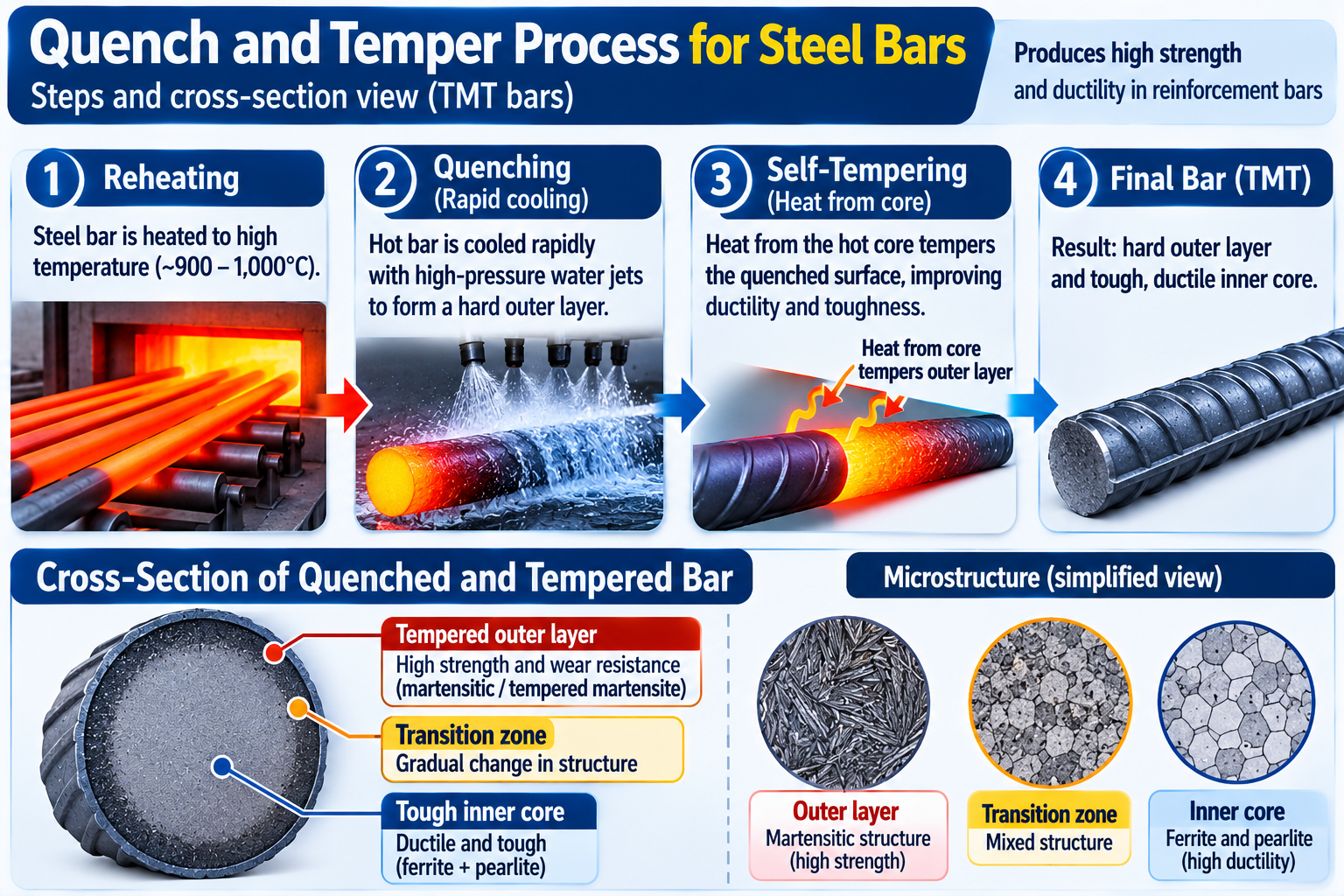
TMT bars are ribbed steel rods that reinforce concrete. TMT stands for Thermo-Mechanically Treated, which names the way the bar is made, not a quality level.
Is TMT steel or iron? It is steel, an alloy of iron with a little carbon. The "Fe" in grade names is iron's chemical symbol, not a brand.
Hot rolling
A heated steel billet is rolled down to the final diameter, with ribs pressed onto its surface.
Quenching
Water sprays chill the surface fast, turning the outer layer very hard.
Self-tempering
Heat flowing out from the hot core softens that hard skin slightly, making it tough instead of brittle.
Cooling in air
The core cools slowly and stays soft and ductile, giving the hard-outside, tough-inside bar.
Older cold-twisted deformed (CTD) bars gained strength by being twisted at room temperature, which cut their ductility. TMT bars get strength from heat treatment instead, so they keep more ability to stretch and bend.
Which TMT Bar Grade Is Best: Fe 415, Fe 500, Fe 550 or Fe 600?
For most homes, Fe 500D is the best default; higher grades make sense only when your structural engineer specifies them. The grade number is the minimum yield strength, the stress at which the bar starts to stretch permanently.
TMT bar grades under IS 1786:2008
Minimum values; confirm against the current BIS text| Grade | Yield strength (N/mm²) | Tensile strength (N/mm²) | TS/YS ratio | Elongation (%) |
|---|---|---|---|---|
| Fe 415 | 415 | 485 | 1.10 | 14.5 |
| Fe 415D | 415 | 500 | 1.12 | 18.0 |
| Fe 500 | 500 | 545 | 1.08 | 12.0 |
| Fe 500D Default pick | 500 | 565 | 1.10 | 16.0 |
| Fe 550 | 550 | 585 | 1.06 | 10.0 |
| Fe 550D Heavier loads | 550 | 600 | 1.08 | 14.5 |
| Fe 600 | 600 | 660 | 1.06 | 10.0 |
Fe 500D
Typical houseStrength with extra stretch.
- 16% minimum elongation
- Widely stocked in common sizes
- Suits low-rise homes and villas
Fe 550D
Taller or long-spanMore strength, slightly less stretch.
- 14.5% minimum elongation
- Can reduce steel in heavy members
- Use when the design calls for it
In an earthquake, a bar must stretch and absorb energy before it snaps. That depends on elongation and the TS/YS ratio, not on yield strength alone. This is why D grades are preferred in seismic zones, and why Fe 600 is not a blanket upgrade.
Buy the grade written on your structural drawings. If none is written, ask the engineer before you order rather than picking the highest number.
Where Is TMT Steel Used, and What Makes It Better?
TMT bars go wherever concrete has to resist bending or pulling: footings, columns, beams, slabs, staircases, retaining walls and RCC parapets, plus bridges and industrial structures.
- High strength for their weight, so less steel can carry the same load
- Ductile core lets the frame bend and give warning before failure
- Ribs grip the concrete so steel and concrete act together
- Can be bent on site without cracking when the grade is right
- Low-carbon grades are easier to weld (lower carbon equivalent)
Bars only work with good concrete around them. For mix proportions, see our guide to the M20 concrete ratio.
How Do You Check TMT Bar Quality and Spot Fake Bars?
Check every lot for rolled-in marks, a valid BIS licence and a mill test certificate before you accept it. Re-rolled or unbranded bars sold at unusually low rates are a real risk.
- No brand, grade or size rolled into the bar at regular intervals
- Uneven or patchy rib pattern along the length
- Cracks, laps or heavy flaking rust on the surface
- A sample cracks when bent and straightened back
- Weight per metre clearly short of the d² ÷ 162 figure
- BIS standard mark with a licence number (CM/L) you can check on the BIS Care app or website
- Manufacturer's test certificate matching the grade and heat number
- Diameter checked with a vernier at a few points
How Much Does Each TMT Bar Size Weigh?
A TMT bar weighs about d² ÷ 162 kg per metre, where d is the diameter in mm. Since you pay by weight, this lets you check a delivery and convert rods to tonnes.
TMT bar weight by diameter
Calculated from d² ÷ 162, 12 m bar| Diameter | kg per metre | kg per 12 m bar | Bars per tonne |
|---|---|---|---|
| 8 mm | 0.395 | 4.74 | 211 |
| 10 mm | 0.617 | 7.41 | 135 |
| 12 mm | 0.889 | 10.67 | 94 |
| 16 mm | 1.580 | 18.96 | 53 |
| 20 mm | 2.469 | 29.63 | 34 |
| 25 mm | 3.858 | 46.30 | 22 |
Total steel for a house depends on its structural design. Use your engineer's bar bending schedule for the order, not a per-square-foot rule of thumb.
What Decides TMT Bar Price, and How Do You Compare Rates?
TMT bar prices move often and vary by city, brand, grade, diameter, GST and freight, so compare quotes on the same day and on the same basis.
- Per kg vs per tonne: convert every quote to one unit.
- GST and delivery: check whether each is included.
- Same grade and size: an Fe 500 quote is not comparable with Fe 550D.
- Brand and certification: national brands such as Tata Tiscon, JSW and SAIL usually cost more than unbranded bars; the gap pays for traceable quality.
Some sellers price bars per piece but quote per-kg rates on paper. Weigh a few bars against the table above before you settle the bill.
Branded TMT bars, delivered in Bengaluru
Get today's rates on BIS-marked TMT bars with a GST invoice and site delivery.
How Should You Store, Lap and Protect Steel Bars on Site?
Store TMT bars off the ground, covered and sorted by size and grade, and follow the engineer's drawings for laps and concrete cover.
- Stack bars on timber or concrete supports, clear of soil and standing water.
- Cover them against rain and tag each stack with diameter and grade.
- Take lap lengths and cover from the drawings or IS 456, and stagger laps between adjacent bars.
- Ask the engineer before using bars with heavy, flaking rust; light surface rust is treated differently.
Near the sea or in very humid conditions, ask about corrosion-resistant (CRS) bars. Their protection comes from the steel's composition, unlike epoxy-coated bars, which rely on a surface coating.
Ready to Buy TMT Bars? What Should You Check Before Ordering?
Confirm the grade and sizes with your engineer, then compare like-for-like quotes and verify every delivery.
- Grade and diameters taken from the structural drawings
- Quantities from the bar bending schedule
- Quotes compared per kg, with GST and delivery shown
- BIS mark, rolled-in grade and test certificate checked on delivery
- Covered, raised storage ready before the truck arrives