On this page
- What Causes Dampness in Walls, and Why Does the Cause Matter?
- What Are the Warning Signs of Dampness in Walls?
- How Does Rising Damp From the Ground Affect Walls?
- Why Do Roofs, Terraces and External Walls Let Rain In?
- Can Plumbing and Bathroom Leaks Cause Damp Walls?
- How Do Condensation and Poor Ventilation Make Walls Damp?
- Which Cracks and Drainage Problems Let Water Into Walls?
- How Do You Find Which Cause Is Behind Your Damp Wall?
- How Can You Prevent Dampness in Walls Once You Know the Cause?
- Dampness in walls comes from five main sources: ground water, rain, plumbing leaks, condensation and cracks.
- Repainting a damp wall fails because the water source is still active.
- Rising damp only affects the lower part of ground-floor walls.
- A patch that worsens in the monsoon points to rain entry; a year-round patch near a bathroom points to a leak.
- Find the cause first, then pick the fix that matches it.
Dampness in walls is unwanted moisture inside plaster and masonry that keeps spreading until its source is stopped. Most cases come from one of five causes: rising ground water, rain, plumbing leaks, condensation or cracks.
What Causes Dampness in Walls, and Why Does the Cause Matter?
Dampness in walls is caused by water entering the wall from the ground, the weather, pipes or indoor air. The cause matters because each one needs a different fix.
A familiar story: the wall is repainted, then bubbles again within one monsoon. The water behind the paint never stopped.
Paint, putty and anti-fungal washes treat the surface. Only stopping the water source ends the damp.
What Are the Warning Signs of Dampness in Walls?
The warning signs of a damp wall are peeling paint, white salt deposits, dark patches and a musty smell. You can spot all of them without tools.
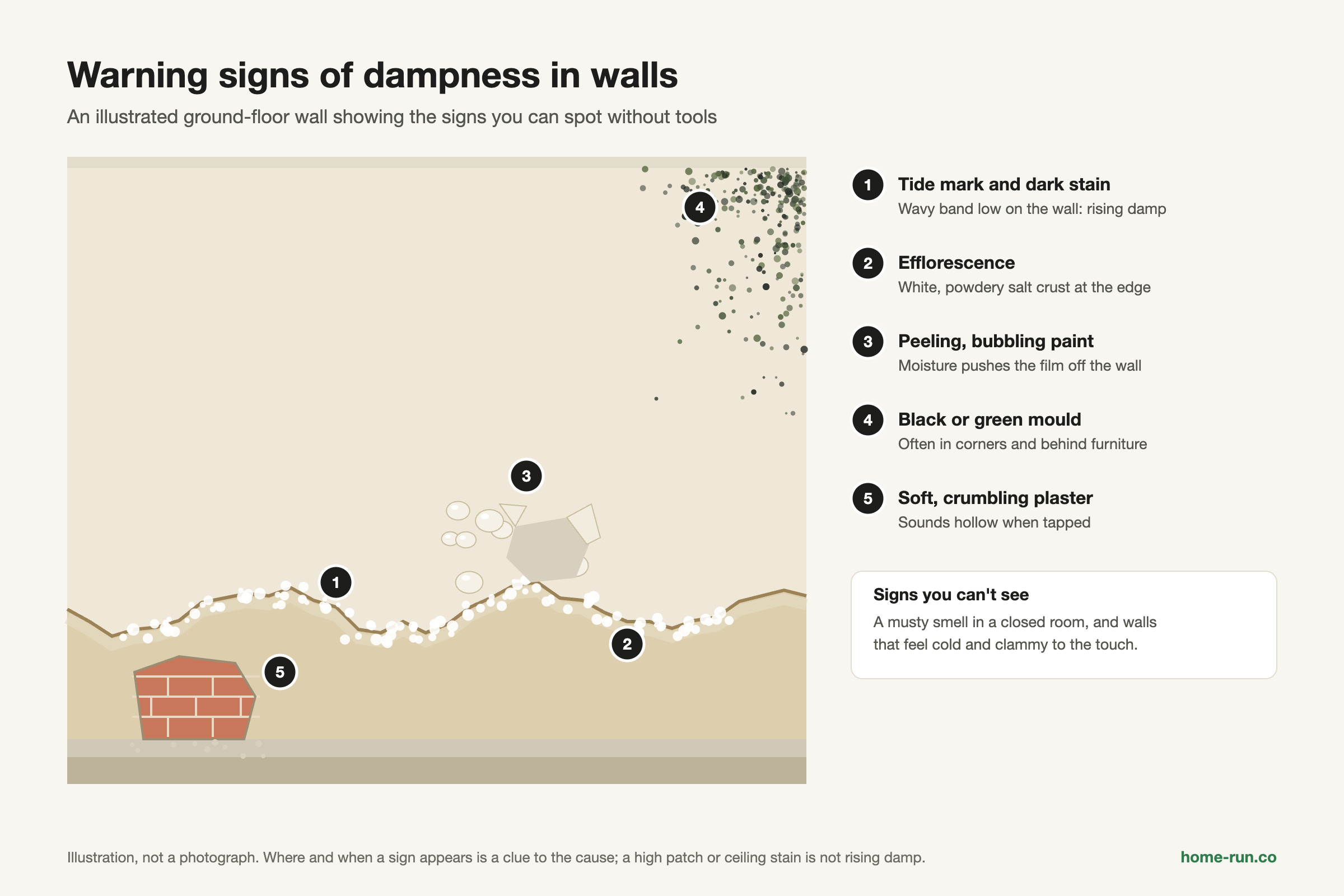
- Peeling, bubbling or flaking paint as moisture pushes the film off the wall
- Efflorescence: a white, powdery salt crust left when salty water evaporates
- Dark stains or black and green mould, often in corners
- A musty, stale smell in a closed room
- Soft or crumbling plaster that sounds hollow when tapped
- Walls that feel cold and clammy to the touch
Where and when a sign appears is itself a clue to the cause.
Left alone, a damp patch usually gets worse in stages:
Faint stain
A light patch or tide mark appears on the paint.
Salt deposits
White efflorescence forms as water evaporates at the surface.
Blistering paint
Paint and putty bubble, flake and lose grip.
Mould and odour
Black or green growth and a musty smell set in.
Plaster failure
Plaster softens, cracks and falls away from the masonry.
How Does Rising Damp From the Ground Affect Walls?
Rising damp is ground water drawn up into the bottom of a wall through tiny pores in brick, stone and mortar. This wicking effect is called capillary action.
- It shows as a stained band low on ground-floor and compound walls, often with salts along its upper edge.
- The usual root cause is a missing or failed damp-proof course (DPC), a waterproof layer laid in the wall at plinth level.
- A DPC is typically placed about 150 mm above ground level.
- Older buildings, and walls where outside paving now sits above the DPC, are most at risk.
Ground water cannot climb to an upper floor or a ceiling. A damp patch high on a wall, or in a first-floor flat, has another cause.
Why Do Roofs, Terraces and External Walls Let Rain In?
Rain gets into walls through failed terrace waterproofing, ponding water, cracked parapets and porous external plaster. This penetrating damp is a leading cause of damp walls in Indian homes during the monsoon.
Penetrating damp can appear at any height and on any floor. Top-floor flats and walls facing the prevailing rain are hit hardest.
From the roof or terrace
Top floorShows on ceilings and the top of walls.
- Old or cracked terrace waterproofing
- Flat slab that lets water pond
- Blocked or too few rainwater downpipes
- Cracked parapet tops and coping
Through external walls
Any floorShows on walls facing the rain.
- Wind-driven rain through porous plaster
- Gaps around window frames
- Cracks at chajja and balcony junctions
- Hairline cracks in external paint and plaster
Water travels along slabs, cracks and pipes before it surfaces. A ceiling stain may start at a parapet several metres away, so inspect the whole roof, not just the spot above the patch.
Can Plumbing and Bathroom Leaks Cause Damp Walls?
Yes, plumbing and bathroom leaks are a very common cause of damp walls in flats. The water comes from inside the building, so the patch does not follow the weather.
- Damp that stays the same in dry months
- A patch strongest on a wall shared with a bathroom or kitchen
- A stain on your ceiling under the flat above's bathroom
- Cracked or missing tile grout in the shower area
- Drips at tap, geyser or washing-machine connections
Hidden sources include concealed pipes, weak waterproofing under bathroom tiles and failed grout. Regrouting with epoxy grout helps stop water entering through tile joints.
Turn off every tap and appliance, note the meter reading, and use no water for a few hours. If the reading rises, a supply pipe is likely leaking.
How Do Condensation and Poor Ventilation Make Walls Damp?
Condensation makes walls damp when warm, humid indoor air touches a cooler wall and turns to water. The wall gets wet on the surface only.
- It forms in cold corners, behind wardrobes and on walls with little airflow.
- Cooking, bathing and drying clothes indoors add moisture to the air.
- Kitchens and bathrooms without exhaust fans are the usual hotspots.
- UK ventilation guidance treats indoor humidity above 70% for more than 2 hours at a time as a mould risk.
No water enters through the structure. Better airflow and exhaust fans solve it cheaply.
Which Cracks and Drainage Problems Let Water Into Walls?
Cracks, poor workmanship and bad site drainage let water into walls and often feed the other types of damp.
- Cracks in plaster, masonry joints and concrete
- Under-cured plaster that stays porous
- Honeycombed concrete, with voids left by poor compaction
- Ground sloping towards the house, so rain pools against the wall
- Blocked surface drains and raised outside paving
Fine surface cracks in plaster are usually cosmetic. Wide cracks, cracks that keep growing, or diagonal cracks near doors and beams need a structural engineer's opinion.
How Do You Find Which Cause Is Behind Your Damp Wall?
You find the cause of a damp wall by checking three things: where the patch is, which floor it is on, and when it gets worse.
Match the symptom to the likely cause
Use as a first check, not a final verdict| What you see | Likely cause | Quick check |
|---|---|---|
| Band low on a ground-floor wall, salts at its edge | Rising damp | Is the outside ground or paving above the plinth? |
| Ceiling or upper-wall patch, worse after rain Monsoon | Penetrating damp from roof or terrace | Look for ponding, cracks and blocked downpipes |
| Patch on an outside wall, worse in the monsoon | Rain through wall or window joints | Inspect external plaster and frame gaps |
| Wet all year, next to a bathroom or kitchen | Plumbing or wet-area leak | Water meter test; check grout and fittings |
| Droplets or mould in corners, behind furniture | Condensation | Does it dry when the room is aired? |
| Damp along a visible crack | Crack or construction defect | Measure whether the crack is growing |
- Note the patch's height, floor and the rooms on the other side.
- Track it across wet and dry weeks.
- Run the water meter test if a wet area is nearby.
- Get a moisture meter reading or a professional survey if the cause is still unclear.
How Can You Prevent Dampness in Walls Once You Know the Cause?
You prevent dampness in walls by repairing the water source first, then keeping the building dry with routine checks.
Cause and the right type of fix
Repair the source before repainting| Cause | Right fix | What will not work |
|---|---|---|
| Rising damp | New DPC or chemical DPC injection; lower outside ground | Waterproof paint on the inside face |
| Roof or terrace leak | Terrace waterproofing, slope correction, clear downpipes | Repainting the ceiling below |
| External wall seepage | Crack filling, exterior waterproof coating, sealing frames | Interior anti-damp primer alone |
| Plumbing leak | Pipe or joint repair, regrouting, wet-area waterproofing | Any wall coating |
| Condensation | Exhaust fans, cross-ventilation, less indoor drying | Waterproofing chemicals |
Simple habits keep walls dry year after year:
- Clear terrace outlets and downpipes before the monsoon.
- Reseal cracks in parapets, chajjas and external plaster each year.
- Keep outside paving and soil below the plinth, sloping away from the wall.
- Regrout shower areas when joints crack or darken.
- Run exhaust fans while cooking and bathing.
Our guide to water seepage causes and lasting solutions covers repair options and costs. Once the wall is dry, fix damp patches before painting. Call a professional if damp keeps returning.
Found the cause? Get the right materials
Waterproofing, plumbing and paint supplies delivered across Bengaluru with a GST invoice.