On this page
- What Are the Main Types of Roofs, and How Do You Tell Them Apart?
- Which Types of Roof Shapes Are Common on Indian Houses?
- What Types of Roof Materials Are Used in India?
- Flat Roof vs Sloped Roof: Which Suits Your Climate and Budget?
- How Do You Choose Between the Types of Roofs for Your Home?
- What Should You Do Next?
- The types of roofs are sorted two ways: by shape (flat, shed, gable, hip) and by material (concrete, tiles, sheets).
- Most shapes can take several materials, so you choose the two separately.
- Flat RCC roofs dominate Indian cities because they give a usable terrace and room for another floor.
- Sloped roofs shed water fastest and suit heavy-rain coasts and hill regions.
- Check rainfall, wind zone, structural load and budget before you switch roof type.
The types of roofs on Indian homes come down to two choices: the roof shape and the material that covers it. A flat roof is usually a reinforced concrete slab. A sloped roof can carry clay tiles, metal sheets or fibre-cement sheets.
What Are the Main Types of Roofs, and How Do You Tell Them Apart?
The main types of roofs are flat roofs and pitched (sloping) roofs. Pitched roofs then split into shed, gable, hip and composite shapes.
Roof pitch is how steep the roof is. It is written as rise over run (for example 6:12) or as an angle in degrees. A flat roof has almost no pitch; a pitched roof sheds rain by gravity.
Many roof lists mix shapes (gable, hip) with materials (tiles, metal) in one list. Keep them apart. A gable roof can be tiled or sheeted, and a flat roof can be bare concrete or covered with a waterproof membrane.
Which Types of Roof Shapes Are Common on Indian Houses?
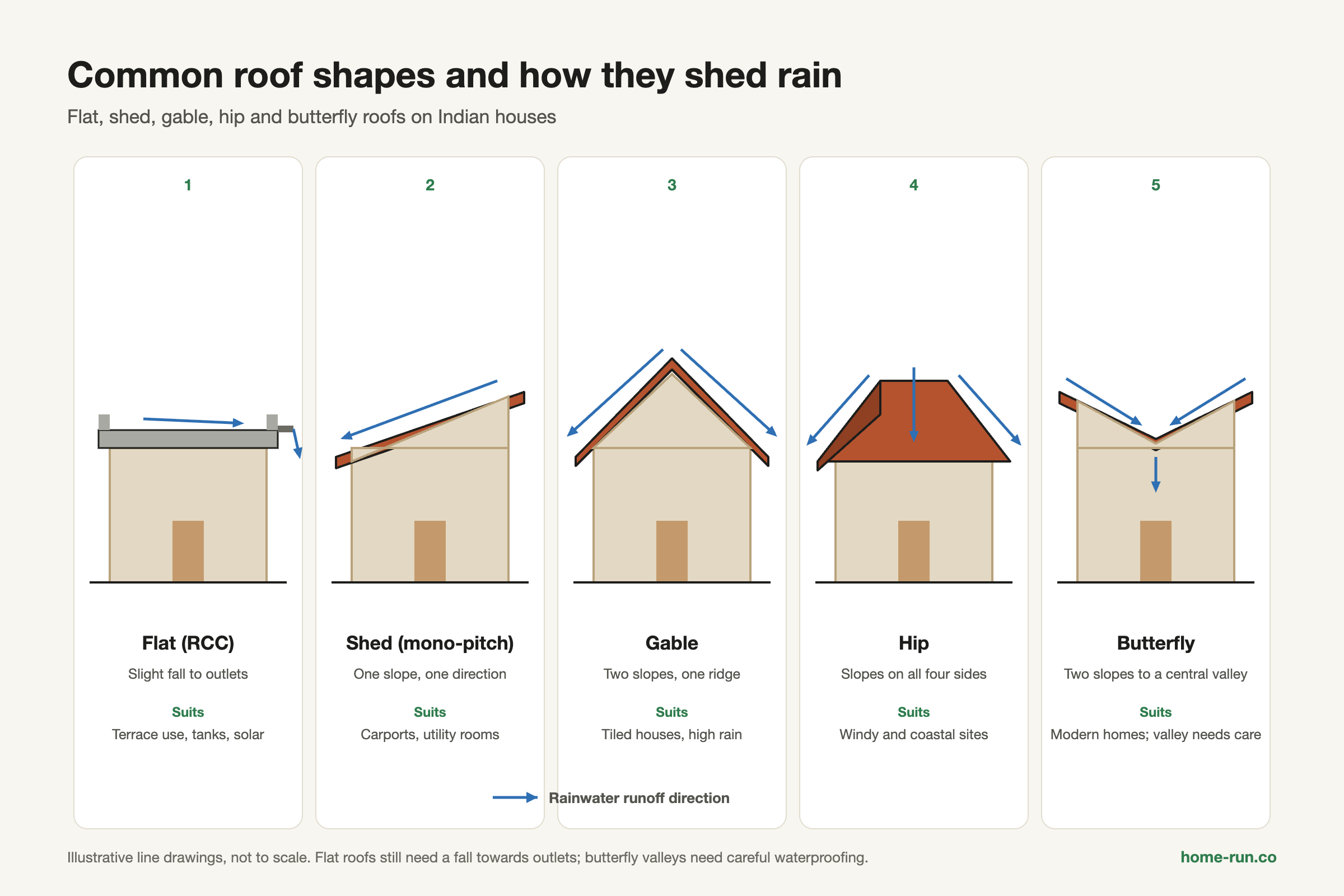
Four roof shapes cover most Indian houses: flat, shed, gable and hip. A handful of composite shapes appear on custom designs.
1. Flat roof (RCC terrace)
A flat roof is a nearly level reinforced cement concrete (RCC) slab, which is concrete with steel bars set inside it. It is the standard roof in Bengaluru and most Indian cities.
"Flat" is not truly level. Indian design guides suggest a fall of about 1 in 100 to 1 in 60 towards the drain outlets, built up with screed or brickbat coba.
- Good for: terrace use, water tanks, solar panels and adding a floor later.
- Watch for: ponding and seepage if the slope or waterproofing fails.
2. Shed roof (lean-to or mono-pitch)
A shed roof is a single sloping surface. Lean-to and mono-pitch are other names for the same form.
You see it on carports, utility rooms, staircase covers and modern homes with high clerestory windows.
3. Gable roof
A gable roof has two slopes meeting at a ridge, with a triangular wall at each end. It drains fast and leaves loft space, which is why it is common on tiled houses in high-rain areas.
Our guide to gable roof shapes and variants covers its parts, pitch maths and the side, front and cross gable styles.
4. Hip roof
A hip roof slopes down on all four sides and has no vertical gable walls. The slopes brace each other, so the shape copes better with strong wind.
US Department of Energy research notes that peak wind pressures on hip roofs can be up to 50% lower than on gable roofs. That makes hip roofs a sound pick for cyclone-prone coasts.
5. Gambrel, mansard, saltbox and butterfly roofs
These composite shapes are rare on Indian houses because they cost more to frame and flash.
- Gambrel: two slopes on each side, shallow above and steep below, like a barn.
- Mansard: a gambrel-style break on all four sides, often hiding an extra room.
- Saltbox: a gable with one slope much longer than the other.
- Butterfly: two slopes falling inward to a central valley. The valley collects rainwater but needs careful waterproofing.
The more rain your site gets, the more slope your roof needs. Bengaluru averages about 978 mm of rain a year; coastal Dakshina Kannada averages about 3,975 mm, where sloped tiled roofs are the local norm.
What Types of Roof Materials Are Used in India?
The roofing materials used in India are RCC slabs, clay and concrete tiles, metal sheets, fibre-cement sheets and polycarbonate sheets, plus green roofs as an add-on.
6. RCC concrete slab
An RCC slab is the default covering for urban homes, usually 100–150 mm thick for houses as sized by the structural engineer. It is designed to IS 456:2000, the Indian code for plain and reinforced concrete.
The slab itself is not waterproof. It needs a waterproofing layer such as brickbat coba, a liquid membrane or a bitumen sheet. Our guide to water seepage causes and prevention covers how leaks start.
7. Clay tiles (Mangalore pattern)
Mangalore tiles are interlocking red clay tiles from coastal Karnataka. The Basel Mission began making them in Mangaluru in the 1860s, using local laterite clay.
Clay tiles keep interiors cooler than sheets but are heavy and need a sloped timber or steel frame. Read more in our guide to clay roof tiles.
8. Concrete tiles
Concrete roof tiles are cement-based tiles that copy the clay tile look. They are heavier than clay tiles, so the roof frame must be sized for the extra load.
9. Metal sheets (GI and colour-coated)
GI (galvanised iron) sheets are steel sheets coated with zinc to resist rust, covered by IS 277. Colour-coated sheets add a paint layer on top.
Metal sheets are light and fast to fix, so they suit sheds, godowns and budget homes. They heat up and get noisy in rain unless you add insulation underneath.
10. Stone-coated steel
Stone-coated steel is a steel sheet pressed into a tile profile and coated with stone granules. It gives a tile look at a fraction of the weight.
11. Fibre-cement and polycarbonate sheets
Fibre-cement sheets are corrugated cement sheets reinforced with non-asbestos fibres, covered by IS 14871:2000. They are a low-cost choice for sheds and outhouses.
Polycarbonate sheets are clear or tinted plastic sheets used for skylights, balcony covers and car porches where you want daylight.
Asbestos cement sheets are still sold in India, and the Government told Parliament in 2022 that no type of asbestos is banned. Asbestos is a known cause of lung disease, so choose asbestos-free fibre-cement or metal sheets for any new roof.
12. Green roofs and cool roofs
A green roof is a planted layer laid over a waterproofed slab. It cools the space below but adds weight and needs a root barrier.
A cool roof uses white or reflective coatings to bounce sunlight away. Telangana's Cool Roof Policy 2023–2028 aims to cover 200 sq km of roofs in Hyderabad by 2030.
Asphalt shingles and rubber slate lead many overseas lists but are uncommon in India. See our roof shingles guide if you are considering them.
Roofing materials in India compared
Relative ratings, not prices| Material | Weight | Heat inside | Upkeep | Best for |
|---|---|---|---|---|
| RCC slab City default | Very heavy | Hot without insulation | Waterproofing checks | Terraces, extra floors |
| Clay (Mangalore) tiles | Heavy | Cool | Replace broken tiles | High-rain sloped roofs |
| Concrete tiles | Heaviest tile | Moderate | Low | Tile look on a strong frame |
| GI / colour-coated sheets Budget | Light | Hot, noisy in rain | Check fixings, rust | Sheds, low-cost homes |
| Stone-coated steel | Light | Moderate | Low | Tile look, light frame |
| Fibre-cement sheets | Medium | Moderate | Brittle under foot | Outhouses, sheds |
| Asbestos cement Avoid | Medium | Hot | Health risk if broken | Replace, do not add |
Building or re-roofing in Bengaluru?
Order roofing and slab materials with a GST invoice and delivery across Bengaluru.
Flat Roof vs Sloped Roof: Which Suits Your Climate and Budget?
A flat RCC roof suits city plots where you want a terrace or a future floor. A sloped roof suits heavy-rain and hilly areas where fast drainage matters most.
Flat RCC roof
City pickSuits Bengaluru plots and most urban homes.
- Usable terrace for tanks, solar and drying
- Can carry a future floor if designed for it
- Needs a drainage fall and waterproofing
- Absorbs heat unless coated or insulated
Sloped roof
High-rain pickSuits coastal Karnataka, the Western Ghats and hill towns.
- Sheds monsoon rain by gravity
- Loft space keeps rooms cooler
- No usable terrace on top
- Adding a floor means removing the roof
IS 875 (Part 3):2015, the Indian code for wind loads on buildings, sets a basic wind speed of 33 m/s for Bengaluru and 50 m/s on the cyclone coast. Exposed sites need stronger roof fixings whatever the shape.
How Do You Choose Between the Types of Roofs for Your Home?
Choose the roof shape for your climate and use first, then the material for heat, weight and budget.
- Check rainfall and wind: heavy rain favours slope; strong wind favours hip roofs and secure fixings.
- Decide on terrace use: if you want a terrace or a later floor, go flat RCC.
- Match the covering to the pitch: never lay tiles or sheets below the minimum pitch on the data sheet, or rain creeps under the laps.
- Check the structural load: tiles and slabs weigh far more than sheets.
- Set budget and upkeep: sheets cost less up front; tiles and slabs need different routine care.
- Get two or three local quotes: ask each contractor to price the same drawing.
What Should You Do Next?
Shortlist one roof shape and one or two materials that suit your rainfall, plot and budget. Then ask for a material estimate and a price list for your roof area before you book labour.