On this page
- What Is Rooftop Rainwater Harvesting and Why Does It Matter?
- What Are the Components of a Rooftop Rainwater Harvesting System?
- Storage or Recharge: Which Method Suits Your Plot?
- How Much Rainwater Can Your Roof Collect?
- How Do First Flush Diverters and Filters Keep Water Clean?
- How Do You Set Up Rooftop Rainwater Harvesting, Step by Step?
- What Are the BWSSB Rainwater Harvesting Rules in Bengaluru?
- How Much Does Rooftop Rainwater Harvesting Cost in India?
- Is Harvested Rainwater Safe, and How Do You Maintain It?
- Rooftop rainwater harvesting sends roof rain to a storage tank or a recharge well.
- A first flush diverter and a filter keep dust and droppings out of the water.
- In Bengaluru, a 100 sq m roof can yield about 86,000 litres a year.
- BWSSB asks for at least 20 litres of capacity per sq m of roof, plus 10 per sq m of paving.
- Harvested water is not drinkable without treatment and lab testing.
Rooftop rainwater harvesting is the practice of catching rain that falls on a roof and using it. The water is filtered, then stored in a tank for later use or sent underground to refill groundwater.
What Is Rooftop Rainwater Harvesting and Why Does It Matter?
Rooftop rainwater harvesting (RTRWH) turns your roof into a water source. Rain is guided from the roof into pipes, cleaned, and then sent to one of two places.
- Storage: a sump or tank holds the water for gardening, flushing, washing or, after treatment, other uses.
- Groundwater recharge: the water soaks into the aquifer, the underground layer that feeds your borewell.
In Indian cities, most monsoon rain runs off roofs and roads into storm drains. Bengaluru relies on piped Cauvery water and borewells, so every litre kept on the plot eases both.
Rooftop systems collect only roof rain, which is fairly clean. Surface runoff harvesting collects water from paved yards, roads or open land, which carries more silt and needs more settling.
What Are the Components of a Rooftop Rainwater Harvesting System?
A rooftop rainwater harvesting system has six main parts, listed here in the order water travels.
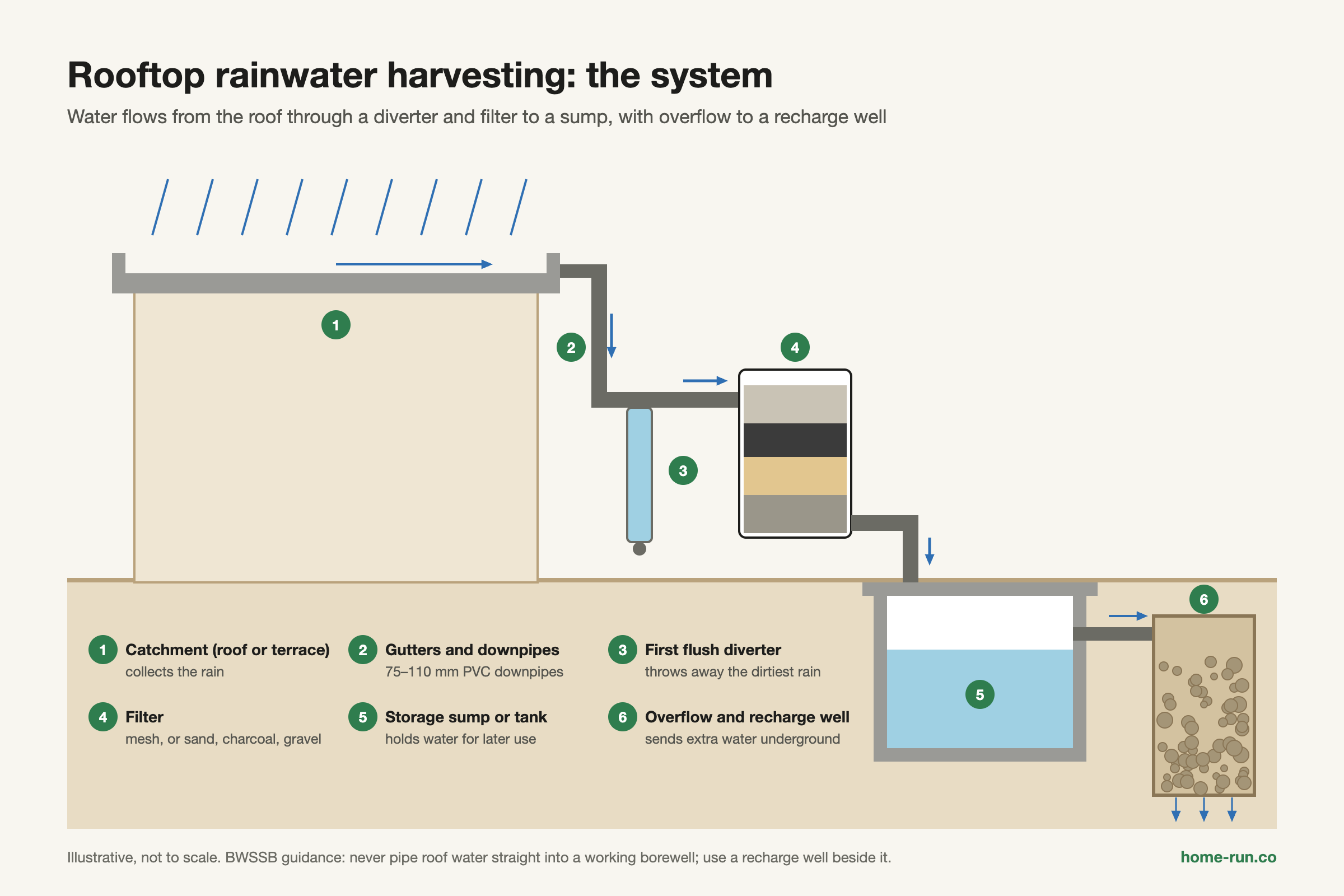
Parts of a rooftop system, roof to ground
In flow order| Component | What it does | If it is missing |
|---|---|---|
| Catchment (roof or terrace) | Collects the rain | Dirty roofs pass dirt straight to the tank |
| Gutters and downpipes | Carry water to the ground (downpipes are usually 75–110 mm PVC) | Undersized pipes overflow in heavy rain |
| First flush diverter | Throws away the first, dirtiest rain | Droppings and dust reach the filter and tank |
| Filter Essential | Removes leaves and silt (mesh, or sand, charcoal and gravel layers) | Tanks silt up and recharge wells clog |
| Storage sump or tank | Holds water for later use | No stored supply for dry months |
| Overflow and recharge well | Sends extra water underground | Overflow floods the plot or the drain |
Storage or Recharge: Which Method Suits Your Plot?
The two main methods of rooftop rainwater harvesting are storing water for direct use and recharging groundwater. Many Bengaluru homes combine them: the sump fills first, and the overflow goes to a recharge well.
Storage for use
Direct supplyWater goes to a sump or overhead tank.
- Cuts tanker and piped water use
- Needs a covered, cleanable tank
- Tank size limits how much you keep
- Best for gardening, flushing and washing
Groundwater recharge
Recommended overflowWater soaks in through a recharge well or pit.
- Handles heavy rain with no size limit
- Can improve nearby borewell yield
- Needs good soil and silt control
- Low upkeep once built
Recharge structures come in three common forms:
- Recharge well: a ring-lined shaft, the usual choice in Bengaluru.
- Recharge pit or trench: a shallow pit filled with boulders, gravel and sand, for small plots with permeable soil. It works much like a soak pit, but for clean rainwater.
- Open well recharge: filtered water fed into an existing open well.
BWSSB guidance says filtered roof water must not go directly into a working borewell. Send it to a recharge well or open well beside the borewell instead.
For a wider view of methods, including traditional systems such as Rajasthan's underground tankas, see our guide to rainwater harvesting methods in India.
How Much Rainwater Can Your Roof Collect?
Your roof's yearly yield equals roof area times annual rainfall times a runoff coefficient. The runoff coefficient is the share of rain that actually reaches the pipes after splashing, evaporation and absorption.
Runoff coefficient by roof type
Indicative values| Roof or catchment | Runoff coefficient | Note |
|---|---|---|
| GI or metal sheet, sloped | 0.85–0.95 | Smooth, sheds water fast |
| RCC flat terrace Most Bengaluru homes | 0.80–0.90 | Tiled or waterproofed surface |
| Clay or Mangalore tile | 0.65–0.80 | Tiles absorb some water |
| Paved courtyard | 0.50–0.70 | Dirtier water; filter well |
Size storage by the dry spell you want to cover, not by total rainfall. Bengaluru's rain arrives in bursts from April to November, so most homes keep a modest sump and send the rest to recharge.
How Do First Flush Diverters and Filters Keep Water Clean?
A first flush diverter discards the first rain of each shower, which washes dust, leaves and bird droppings off the roof. It is a separate step from filtering.
- How much to discard: guides vary from the first 1 mm of rain to 2–5 mm. On a 100 sq m roof, 1 mm is 100 litres.
- How it works: a vertical pipe chamber fills first, then clean water flows on. A slow-drain valve or end cap empties it.
- Filter types: mesh filters suit storage-light systems; sand, charcoal and gravel bed filters give cleaner water for tanks.
- Bypass valve: lets you skip harvesting when the roof is dirty. A simple ball valve does the job.
How Do You Set Up Rooftop Rainwater Harvesting, Step by Step?
You can set up rooftop rainwater harvesting in six steps, with a plumber or civil contractor doing the build.
- Check the roof. Clean the terrace and fix cracks first; terrace water seepage wastes water and damages slabs.
- Measure the catchment. Note the roof area and calculate yield and BWSSB minimum capacity.
- Fit gutters and downpipes. Slope gutters toward the downpipes and add mesh at each outlet.
- Add the first flush diverter and filter. Place them where you can reach them for cleaning.
- Connect to the sump and recharge well. Route overflow from the sump to the recharge well.
- Test in the first shower. Check for leaks, overflowing gutters and muddy water at the outlet.
Pigeon roosts, stored chemicals, fresh tar or bitumen coatings and terrace car washing all contaminate harvested water. Keep the catchment clean, or divert that section away from storage.
What Are the BWSSB Rainwater Harvesting Rules in Bengaluru?
In Bengaluru, rainwater harvesting is mandatory under Section 72A of the Bangalore Water Supply and Sewerage Act, added by a 2009 amendment. The Bangalore Water Supply and Sewerage Board (BWSSB) enforces it.
BWSSB rainwater harvesting requirements
As reported; confirm with BWSSB| Rule | Requirement |
|---|---|
| Existing buildings | Sites of 2,400 sq ft (60 × 40 ft) and above |
| New construction | Sites of 1,200 sq ft (30 × 40 ft) and above |
| Minimum capacity | 20 L per sq m of roof plus 10 L per sq m of paved area, as storage, recharge or both |
| Recharge well | At least 3 m deep and 0.9 m wide, left open (no jelly or sand fill) |
| Non-compliance Penalty | Extra charge on the monthly water bill, reported at 50% for homes and 100% for commercial users |
Penalties are common. Deccan Herald reported that about 43,000 households were paying close to ₹1.5 crore a month in fines for skipping harvesting.
There is no single national rule. Tamil Nadu made rainwater harvesting compulsory for buildings in 2003, one of the first states to do so. Check your city's building bye-laws before you build.
How Much Does Rooftop Rainwater Harvesting Cost in India?
A basic rooftop rainwater harvesting setup costs about ₹5,000–12,000 for most homes. A full system with a new storage tank costs about ₹15,000–30,000.
Indicative component costs
₹, one Indian filter maker's figures, Jan 2026| Item | Cost (₹) |
|---|---|
| Rooftop rainwater filter | 2,950–6,500 |
| First flush diverter | ~1,300 |
| PVC pipes and fittings | 1,500–3,000 |
| Plumber labour | 1,000–2,500 |
| Basic setup (filter, pipes, labour) Most homes | 5,000–12,000 |
| Complete system with storage tank | 15,000–30,000 |
Building the system in during construction costs less than a retrofit, because pipes can run inside walls and the sump is already being dug.
Setting up rainwater harvesting?
Get pipes, tanks and fittings delivered across Bengaluru with a GST invoice.
Is Harvested Rainwater Safe, and How Do You Maintain It?
Harvested roof water is safe for gardening, toilet flushing and washing after basic filtering. It is not safe to drink until it is treated, disinfected and tested by a lab.
Before the first showers
Sweep the terrace and clear gutters, outlets and mesh.
Discard the first flush
Keep the bypass open for the first heavy shower.
During the rains
Empty the first flush chamber and check the filter after big storms.
After the season
Rinse filter media, inspect the sump and desilt the recharge well when needed.
- Muddy or smelly water in the sump
- Gutters overflowing during normal rain
- Water standing in the recharge well for days
- Mosquito larvae in the tank or first flush chamber
Cover every tank and fit mesh on overflow and vent pipes to stop mosquito breeding.