On this page
- What Does a Permanent Solution for Roof Leakage Really Mean?
- Why Do Roofs Leak in Indian Homes?
- How Do You Find Where a Roof Leak Starts?
- What Makes a Roof Leak Fix Last?
- Which Waterproofing System Is the Best Permanent Solution for Roof Leakage?
- What Is the Lasting Fix for Metal Sheet and Tiled Roofs?
- Can a Sealant Give a Permanent Fix for a Leaking Roof?
- How Much Waterproofing Material Does Your Roof Need?
- Should You Waterproof Yourself or Hire a Professional?
- How Long Does Roof Waterproofing Last, and Is It Worth the Cost?
- How Do You Keep a Roof Leak Fix Working Every Monsoon?
- A permanent solution for roof leakage fixes the cause first, then adds a full waterproofing layer.
- Most terrace leaks start at cracks, parapet corners, outlets and ponding spots, not the open slab.
- Flexible systems such as liquid membranes and APP sheets outlast rigid coats on slabs that move.
- Metal sheet leaks need new fasteners and sealed overlaps, not terrace chemicals.
- Insist on a 24-hour flood test and a written warranty before you pay in full.
A permanent solution for roof leakage is a fix that removes the cause of the leak and then protects the whole roof with a complete waterproofing system. No coating lasts forever. A well-applied system with yearly upkeep can keep a roof dry for many monsoons.
This explainer covers which solutions last and why. For a hands-on repair sequence, ask your applicator for the product's data sheet and follow it.
What Does a Permanent Solution for Roof Leakage Really Mean?
A permanent solution for roof leakage means a system designed to last many years, not a coat that lasts forever. "Permanent" in ads usually means "long-lasting if applied and maintained well".
Three different jobs get called "leak repair":
- Repair: sealing one crack, joint or screw hole. Right for a single, clearly found leak.
- Waterproofing: a continuous barrier over the whole roof. Right when leaks are many or the old layer has aged out.
- Replacement: new sheets, tiles or a new slope layer. Right when the roof itself has failed.
Patching only the visible drip usually fails. Water enters at one point and travels along the slab, so the patch often sits in the wrong place.
Quick answer by roof type
Details in the sections below| Roof type | Usual failure point | Approach that lasts |
|---|---|---|
| RCC flat terrace Most Indian homes | Cracks, parapet corners, outlets, ponding | Repair cracks, fix slope, then a flexible membrane |
| Metal or GI sheet | Screws, washers, overlaps, rust holes | Replace fasteners, seal laps, treat or replace rusted sheets |
| Clay or concrete tile, pitched | Broken or slipped tiles, ridge mortar | Replace tiles, re-bed ridges, add an underlayer |
A water-resistant roof paint sheds light moisture. A waterproofing system is a continuous barrier that also bridges hairline cracks. Plain paint will not stop a leaking slab.
Why Do Roofs Leak in Indian Homes?
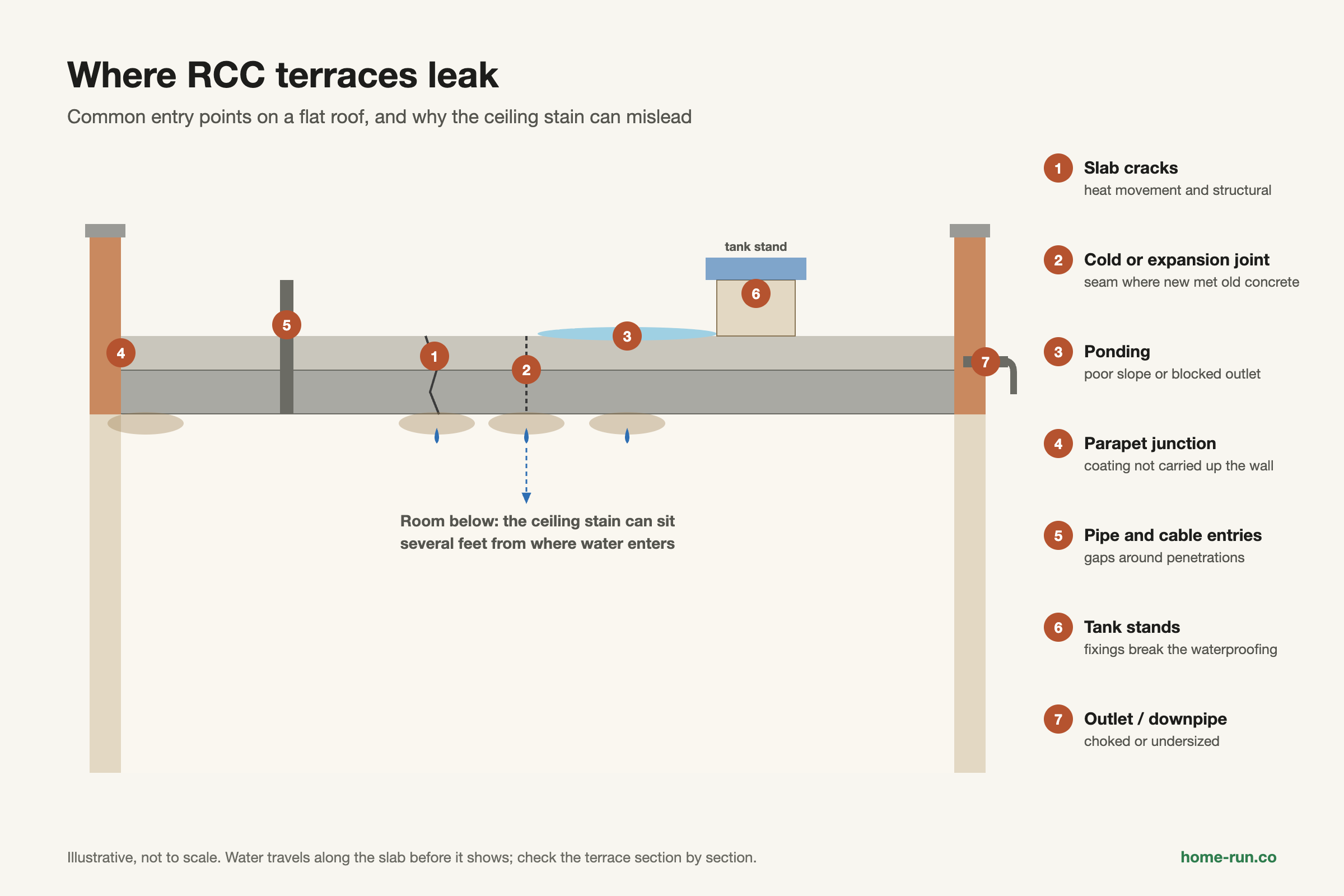
Roofs in Indian homes leak mainly through cracks and joints in the RCC slab, weak parapet junctions, and water that cannot drain away. RCC (reinforced cement concrete) is the common flat concrete slab with steel bars inside.
- Hairline cracks from heat movement, and structural cracks in the slab
- Expansion joints and cold joints (seams where new concrete met old)
- Ponding: water standing on a flat roof due to poor slope or blocked outlets
- Parapet and wall-slab junctions where the coating was not carried up the wall
- Gaps around pipes, water tank stands and cable entries
- Old brickbat coba or waterproofing that has simply aged out
- Metal sheets: loose or rusted screws, worn washers, open overlaps
- Tiled roofs: displaced tiles and cracked ridge mortar
Not every damp ceiling is a roof leak. Bathroom pipes and wall seepage cause similar stains, so read our guide to causes of wall dampness if the patch sits low on a wall.
How Do You Find Where a Roof Leak Starts?
You find a roof leak by checking the terrace section by section, not by looking only at the ceiling stain. Water travels along the slab, so the entry point can be several feet away.
- Mark stains, peeling paint, mould and white salt deposits (efflorescence) on the ceiling below.
- Walk the terrace an hour after rain and note every puddle.
- Check parapet corners, outlets, pipe entries and tank bases for cracks.
- Block the outlets and flood one marked section at a time, then watch the ceiling below.
- Note whether the leak appears only in heavy rain, which points to ponding or overflowing outlets.
Early action costs less. A small leak left for one monsoon can mean re-plastering and repainting the room below, and long-term damp can corrode the slab's steel bars.
What Makes a Roof Leak Fix Last?
A roof leak fix lasts when the slope drains, the junctions are detailed, the surface is properly prepared, and the product is applied exactly as its data sheet says. The product brand matters less than these four things.
- Slope and drainage: a flat roof needs a fall of at least 1 in 100 (10 mm per metre) toward outlets, and 1 in 60 is safer. Standing water speeds up wear on any coating.
- Outlets: IS 3067:1988, the Indian code for design details and preparatory work for damp-proofing and waterproofing of buildings, asks for outlets placed so water does not collect, with masonry drain mouths widened to 2.5 times the pipe diameter.
- Parapet junction: IS 3067 asks for a 75 mm radius fillet where the roof meets the parapet. The waterproofing should turn up the wall, commonly 150–300 mm, and tuck into a groove.
- Surface preparation: loose plaster, dust and old flaking coats must come off, and cracks must be opened and filled. Skipping this step is the most common reason a new layer peels.
Data sheets also set waiting times that rushed jobs ignore. This sequence follows one manufacturer's sheet for an acrylic-PU roof coating (Dr. Fixit Roofseal Classic):
Clean and fill cracks
Cracks wider than 0.5 mm are cut to a V-groove and filled with sealant.
Let the sealant cure
The sealant needs at least 72 hours before coating.
Primer, then coats
Primer dries 2–3 hours. Two coats go on crosswise, 4–6 hours apart, with mesh and extra coats at joints.
Air cure
The coating air cures for 7 days with no foot traffic.
Flood test
50 mm of water stands for 24 hours while the ceiling below is checked.
A proper terrace job needs about 12 dry days from crack filling to flood test. Book it in the dry months, well before the first summer showers.
Coatings will not bond to a wet slab. During the rains, use a tarpaulin, clear the outlets and seal obvious cracks as a stopgap. Plan the full system for the dry season.
Which Waterproofing System Is the Best Permanent Solution for Roof Leakage?
For most RCC terraces, a flexible system such as a polymer or PU-based liquid membrane or an APP bitumen membrane is the best permanent solution for roof leakage. Flexible layers stretch over the small movements that crack rigid coats.
Roof waterproofing systems compared
Qualitative; check each data sheet| System | Best for | Handles cracks and movement | Watch out |
|---|---|---|---|
| Cementitious coating | Sound slabs, under tiles or screed | Low; rigid types crack with the slab | Avoid as the only layer on a cracking slab |
| Acrylic or acrylic-PU liquid membrane Default pick | Exposed home terraces | Good; one product bridges cracks up to 2–3 mm | Needs mesh at joints and the full coat count |
| Polyurethane (PU) coating | Terraces with heat movement or detailing | Very good; highly elastic | Surface must be dry; some types need a UV topcoat |
| APP bitumen sheet membrane | Large flat roofs, under screed | Good | Laps of at least 100 mm; needs aluminium paint or screed on top |
| Crystalline treatment | Sealing pores inside concrete | Low; does not bridge moving cracks | A support layer, not a full roof barrier |
| Brickbat coba | Slope and heat insulation | Low once old and cracked | Old coba holding water is often replaced, not patched Avoid patching |
Can you waterproof over the old layer? Only if the old layer is firmly bonded, clean and compatible. Flaking coats, hollow-sounding screed and coba that traps water must be removed first.
Patch repair now
Small, single leakSeal one crack, joint or outlet.
- Rest of the roof layer still sound and bonded
- One clearly found entry point
- No past repairs in that area
- Fast and low cost, but local only
Full re-waterproofing
Lasting fixStrip, repair and coat the whole roof.
- Old layer aged, flaking or holding water
- Leaks in several rooms or spots
- Two or more patches have already failed
- Backed by a flood test and a warranty
Planning terrace waterproofing?
Get waterproofing chemicals, sealants and cement delivered across Bengaluru with a GST invoice.
What Is the Lasting Fix for Metal Sheet and Tiled Roofs?
A metal sheet roof leak is fixed for good by replacing failed fasteners and sealing the overlaps, because most sheet leaks start at screws. Terrace chemicals do not solve this problem.
- Washers wear out: the rubber washer under each screw head is the seal, and sun and sheet movement break it down.
- Tightening matters: an over-driven screw crushes its washer; an under-driven one never seals.
- Do not reuse screws: fit a screw one size wider so it cuts fresh thread in the old hole.
- Treat rust: wire-brush and prime rusted laps, and replace sheets with holes rusted through.
Tiled and pitched roofs leak through broken or slipped tiles and cracked ridge mortar. Replace the damaged tiles, re-bed the ridge, and add an underlayer below the tiles when re-roofing. Our guide to clay roof tiles covers tile types and laying.
Can a Sealant Give a Permanent Fix for a Leaking Roof?
A sealant gives a lasting fix only for joints, overlaps, screw heads and small cracks. It cannot replace a waterproofing system on a terrace that leaks in many places.
- Polyurethane sealants: flexible and paintable, used for slab cracks and expansion joints.
- Silicone sealants: good sun resistance, used on sheet laps and flashings; most cannot be painted.
- Butyl tape: sticky rubber tape for sheet overlaps and ridge joints.
On the label, check three things: the surface it bonds to (metal, concrete), UV resistance, and how far it stretches. A coating is a thin protective film. A membrane is a full barrier with a set thickness.
How Much Waterproofing Material Does Your Roof Need?
Waterproofing quantity equals roof area times the number of coats, divided by the coverage per coat, plus wastage. Always include the parapet upturn, which most estimates forget.
Coverage rates come from the Dr. Fixit Roofseal Classic data sheet (2.0–2.2 sq m per litre per coat on the roof, 1.65–1.85 on walls). Use the lower figure to be safe, and use your own product's sheet.
Should You Waterproof Yourself or Hire a Professional?
DIY suits small cracks, single joints and screw replacement. Full terrace waterproofing needs surface prep skill, correct layering and curing, so a trained applicator usually gives a better, warranty-backed result.
Before you sign, confirm these with the contractor:
- The exact system and brand, with its technical data sheet
- How old layers, loose plaster and cracks will be treated
- Coat count, mesh at joints and upturn height on the parapet
- A flood test before handover, with you present
- Warranty period, what it covers and who does rework, in writing
A weak quote names no product, quotes one rate for "chemical", or skips the flood test. Cost depends on area, roof condition, system and city, so compare written quotes for the same scope.
How Long Does Roof Waterproofing Last, and Is It Worth the Cost?
Roof waterproofing lasts as long as its application and upkeep allow; manufacturer life claims assume both. For example, Pidilite states weathering resistance of up to 15 years for Dr. Fixit Roofseal Ultra when reinforced with glass fibre mesh.
The same data sheets also say the maker gives no guarantee on results, because site work decides the outcome. Your real protection is the applicator's written warranty.
Cost depends on four things:
- Roof area, including upturns
- Condition, and whether old layers must be removed
- The system chosen and its coat count
- City labour rates and access to the roof
One proper system usually costs less over time than patching every monsoon. Each failed patch adds labour, ceiling repair and repainting.
How Do You Keep a Roof Leak Fix Working Every Monsoon?
You keep a roof leak fix working by keeping water moving off the roof and repairing small damage early. Bengaluru gets about 1,077 mm of rain a year, and its wettest season runs from September to November, so a pre-monsoon and a post-monsoon check both matter.
- Clear outlets, spouts and downpipes before the rains and after storms
- Look for puddles an hour after rain; none should be deeper than a coin
- Reseal cracked sealant and check screws on sheet roofs
- Keep heavy pots, tank stands and dragged furniture off the membrane
- Repaint the protective topcoat when the maker's sheet says so
If damp spreads on walls rather than ceilings, see our guide to water seepage causes and solutions. Parapet cracks are a common link between the two; see parapet wall design.