On this page
- What Are Roofing Sheets and How Many Types Are There?
- Which Metal Roofing Sheets Are Used in India?
- Which Plastic and Translucent Roofing Sheets Can You Choose?
- What Are Cement-Based and Bitumen Roofing Sheets?
- What Are Insulated and Metal Tile Roofing Sheets?
- How Do Roofing Sheet Profiles Differ?
- How Do the Types of Roofing Sheets Compare on Durability, Weight and Heat?
- Which Types of Roofing Sheets Suit Your Building and Climate?
- How Many Roofing Sheets Do You Need?
- What Should You Check Before Buying Roofing Sheets?
- How Do You Shortlist Sheets and Get a Quote?
- The types of roofing sheets fall into five families: metal, plastic, cement-based, bitumen and insulated panels.
- Material, coating and profile are separate choices; "corrugated" is a shape, not a material.
- For steel sheets, ask for the BIS code: IS 277 (GI), IS 14246 (colour-coated GI), IS 15961 (Galvalume).
- A heavier zinc coating (higher GSM) and an aluminium-zinc coating resist rust longer.
- Asbestos cement is still legal in India, but most countries have banned it; choose non-asbestos fibre cement instead.
The types of roofing sheets used in India are coated steel (GI, colour-coated and Galvalume), aluminium, polycarbonate, FRP, UPVC, fibre cement, asbestos cement, bitumen, insulated PUF panels and metal tile sheets.
Each one trades off cost, weight, heat, noise and lifespan differently. This guide lists them one by one, then compares them.
What Are Roofing Sheets and How Many Types Are There?
Roofing sheets are factory-made panels of metal, plastic, cement or bitumen that are fixed over purlins (the horizontal roof members) to form a roof. They are lighter and faster to fit than an RCC slab or clay tiles.
There is no official count of types. Ranking lists say 6, 8 or 14, depending on how they split them.
This guide groups 12 materials into five families. Then it covers profiles separately, because any material can come in more than one shape. For roof shapes rather than sheets, see our guide to types of roofs.
Many lists show "corrugated", "galvanised" and "colour-coated" as parallel types. They are not. Base metal, coating and profile are three separate choices. A colour-coated Galvalume sheet can be corrugated or trapezoidal.
Which Metal Roofing Sheets Are Used in India?
Coated steel sheets are the most widely used roofing sheets in India, followed by aluminium. Steel sheets differ mainly in their coating.
1. Galvanised iron (GI) sheets
A GI sheet is a steel sheet coated with zinc to slow rusting. Despite the name, the base is steel, not iron.
The BIS standard is IS 277:2018, Galvanized Steel Strips and Sheets (Plain and Corrugated). Traders call the flat sheet "GP" and the corrugated sheet "GC".
- Suits: sheds, site offices, cattle sheds and budget roofs inland.
- Weak point: rusts at scratches, cut edges and in salty coastal air.
2. Colour-coated sheets (PPGI and PPGL)
A colour-coated sheet is a coated steel sheet painted in the factory before it is rolled into a profile. PPGI (pre-painted galvanised iron) has a zinc base; PPGL has a Galvalume base.
Pre-painted galvanised sheets are covered by IS 14246, and pre-painted Galvalume by IS 15965.
- Suits: homes, terrace covers, car porches and factories.
- Weak point: paint can chalk and fade; colour says nothing about coating thickness.
3. Galvalume (Aluzinc) sheets
A Galvalume sheet is steel coated with an aluminium-zinc alloy of 55% aluminium, 43.5% zinc and 1.5% silicon. It is also sold as Aluzinc or Zincalume.
The BIS standard for aluminium-zinc coated steel is IS 15961. The coating usually outlasts plain zinc and reflects more heat.
- Suits: long-life homes, warehouses and coastal sites.
- Weak point: costs more than GI; ask for the coating class, such as AZ150.
4. Aluminium roofing sheets
Aluminium sheets are light, do not rust, and handle salty air well. They are softer than steel, so they dent more easily and cost more.
- Suits: coastal homes and light structures.
- Weak point: dents under foot traffic and hail.
Gauge is an old thickness number: a higher gauge means a thinner sheet. BMT (base metal thickness) is the steel alone; TCT (total coated thickness) adds coating and paint. GSM is grams of zinc or alloy per square metre, both sides together. Compare BMT with BMT and GSM with GSM.
Indian GI roofing is commonly sold at 120 GSM. An industry review notes that many other countries use 275 GSM or more. Near the sea, low-GSM bare GI rusts early; pay for heavier zinc or Galvalume.
Which Plastic and Translucent Roofing Sheets Can You Choose?
Plastic roofing sheets do not rust, and most let some daylight through. The three common types are polycarbonate, FRP and UPVC.
5. Polycarbonate sheets
Polycarbonate is a tough, clear or tinted plastic used for skylights, patios, car parks and greenhouses. It is far more impact-resistant than acrylic or cheap PVC sheets.
Solid sheets look like glass. Multiwall sheets have hollow cells that add stiffness and some insulation.
- Suits: daylighting, walkway and balcony covers.
- Weak point: without a UV-protected outer face, it yellows and turns brittle.
6. FRP sheets
FRP (fibre-reinforced plastic) sheets are fibreglass-reinforced resin sheets. Factories often fit them as translucent strips between metal sheets for daylight.
- Suits: industrial sheds and warehouses.
- Weak point: surface weathers and loses clarity over time.
7. UPVC and PVC sheets
UPVC (unplasticised PVC) is the rigid plastic used for roofing; plain PVC is softer. UPVC resists chemicals and salty air, and is quieter than metal in rain.
- Suits: poultry farms, chemical plants, coastal sheds.
- Weak point: lower stiffness, so purlins sit closer.
- No brand or batch printed on the sheet
- No mention of a UV-protected side
- Sheet bends or creases easily by hand
- Warranty given only verbally
What Are Cement-Based and Bitumen Roofing Sheets?
Cement-based sheets are heavy, fire-resistant and quiet in rain. Bitumen sheets are light and rust-free.
8. Fibre cement sheets
Fibre cement sheets are cement roofing sheets reinforced with non-asbestos fibres such as cellulose. Long corrugated fibre cement sheets are covered by IS 14871.
- Suits: sheds, farm buildings and low-cost roofs.
- Weak point: heavy and brittle; never walk directly on the sheet.
9. Asbestos cement (AC) sheets
AC sheets are corrugated cement sheets made with chrysotile asbestos fibre, covered by IS 459:1992. Indian manufacturers state a chrysotile content of 7–9%.
Asbestos is a known human carcinogen, and 72 countries have banned it. India has not banned its use, and the matter is under review at the National Green Tribunal.
Dust from cutting, drilling or breaking AC sheets is the main health risk. Before removing an old roof, use a specialist and wet methods. If a "cement sheet" is not marked asbestos-free, ask before you buy.
10. Corrugated bitumen sheets
Bitumen sheets are organic fibre sheets soaked in bitumen. They are light, do not rust, and are quiet in rain. Fixers overlap them by about 100 mm for a watertight seam.
- Suits: garden sheds, pergolas, re-roofing over old sheets.
- Weak point: can soften and sag in sustained heat.
What Are Insulated and Metal Tile Roofing Sheets?
Insulated panels and metal tile sheets are the premium end of the market. One cuts heat; the other gives a tiled look.
11. PUF sandwich panels
A PUF panel is two metal skins bonded to a polyurethane foam core. It is the standard choice for cold storage, clean rooms and prefab buildings. See our PUF panel price guide for sizes and rates.
12. Metal tile and stone-coated sheets
Metal tile sheets are steel sheets pressed to look like clay tiles, sometimes coated with stone chips. They weigh far less than real clay roof tiles.
Slate, EPDM rubber membranes and bamboo composite sheets also exist, but they are niche choices in Indian homes.
How Do Roofing Sheet Profiles Differ?
A profile is the cross-section shape of a sheet, and it is independent of the material. The shape decides stiffness, drainage and how screws are fixed.
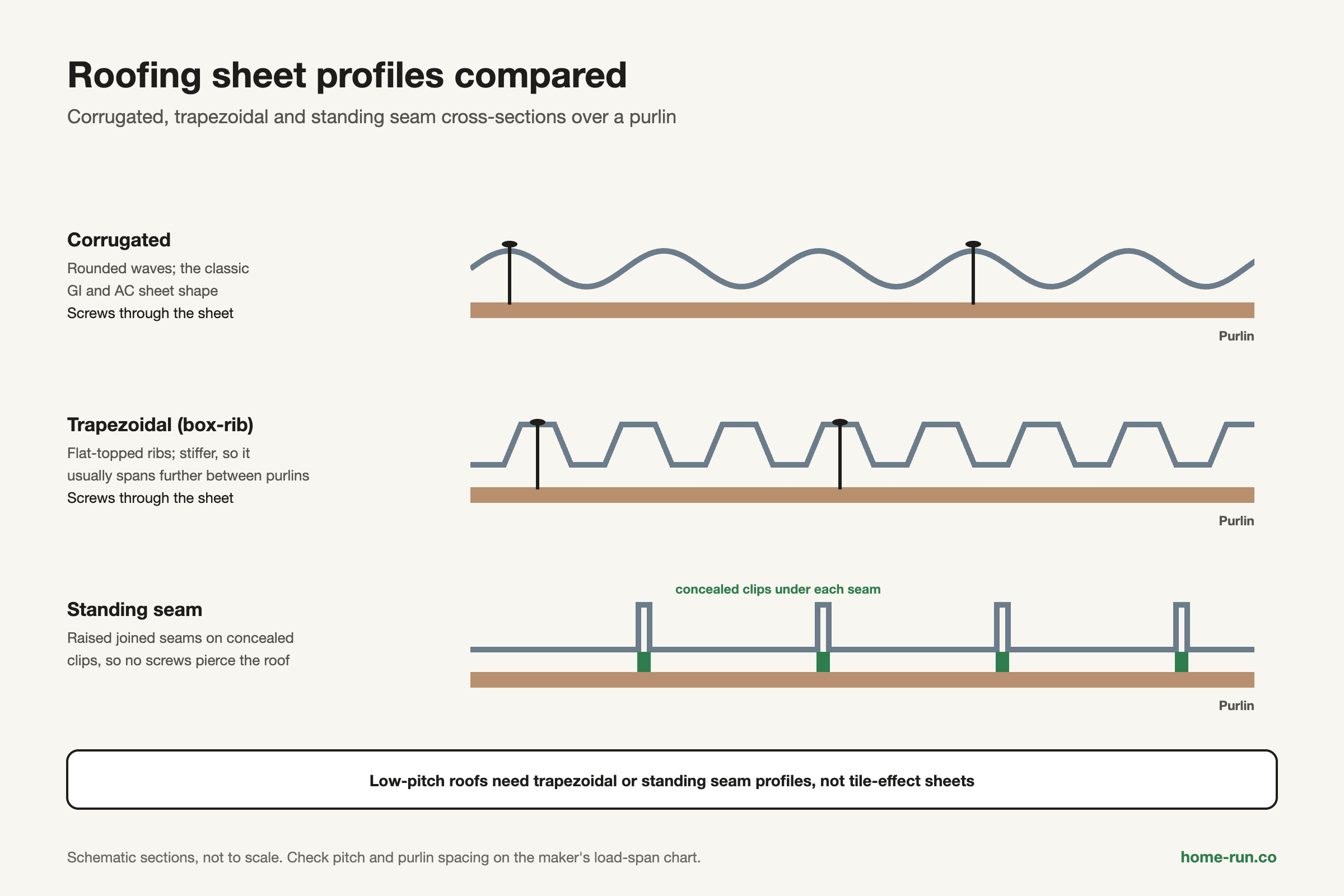
- Corrugated: rounded waves; the classic GI and AC sheet shape.
- Trapezoidal (box-rib): flat-topped ribs; stiffer for the same thickness, so it usually spans further between purlins.
- Standing seam: raised joined seams with concealed clips, so no screws pierce the roof.
- Tile-effect: pressed to look like tiles; needs a steeper pitch.
Check the minimum roof pitch and maximum purlin spacing on the maker's load-span chart for your exact sheet and thickness. Low-pitch roofs need trapezoidal or standing seam profiles, not tile-effect sheets.
How Do the Types of Roofing Sheets Compare on Durability, Weight and Heat?
Galvalume, aluminium, PUF panels and metal tile sheets rate highest for durability; bare GI and bitumen sheets rate lowest. The table rates each type relative to the others.
Roofing sheet types compared
Relative ratings, not test values| Sheet type | Durability | Weight | Heat under roof | Rain noise | Relative cost | Typical use |
|---|---|---|---|---|---|---|
| GI Budget | Low to medium | Light | High | High | Low | Sheds, temporary roofs |
| PPGI / PPGL Default pick | Medium to high | Light | Medium | High | Medium | Homes, porches, factories |
| Galvalume | High | Light | Medium | High | Medium | Warehouses, coastal sites |
| Aluminium | High | Very light | Medium | High | High | Coastal homes |
| Polycarbonate | Medium (UV grade) | Very light | High (lets sun in) | Medium | Medium | Skylights, patios |
| FRP | Medium | Very light | High (lets sun in) | Medium | Low to medium | Daylight strips in sheds |
| UPVC | Medium to high | Light | Low to medium | Low | Medium | Poultry, chemical areas |
| Fibre cement | Medium | Heavy | Low | Low | Low | Farm and utility sheds |
| Asbestos cement Avoid | Medium | Heavy | Low | Low | Low | Legacy roofs only |
| Bitumen | Low to medium | Very light | Medium | Low | Medium | Garden sheds, pergolas |
| PUF panel | High | Medium | Very low | Low | High | Cold storage, prefab |
| Metal tile | High | Light | Medium | Medium | High | Sloped home roofs |
Price per sheet misleads. A cheaper sheet with thinner steel or lighter coating can need closer purlins and earlier replacement.
Coated steel (PPGI / Galvalume)
For the main roofStrength and value.
- Stiff; spans wider purlin gaps
- Long life with the right coating
- Many colours and profiles
- Gets hot and loud without insulation
Polycarbonate
For lightDaylight and impact strength.
- Lets daylight through
- Very hard to crack
- Needs a UV-protected grade
- Traps heat under a full roof
Which Types of Roofing Sheets Suit Your Building and Climate?
For most Indian homes, colour-coated Galvalume or PPGI is the safe default; the right sheet still depends on use and climate.
Sheet choice by use and climate
Guidance, not a guarantee| Situation | Good choice | Why |
|---|---|---|
| Home roof or terrace cover | PPGL or PPGI, or metal tile | Durable, many colours |
| Factory shed or warehouse | Galvalume trapezoidal + FRP strips | Wide spans, daylight |
| Coastal or salty air | Galvalume, aluminium or UPVC | Resist salt corrosion |
| Heavy rainfall (Kerala, Konkan) | Coated steel or UPVC, insulated | Sheds water, cuts rain noise |
| Cold storage | PUF sandwich panels | Holds temperature |
| Poultry and farm sheds | UPVC or fibre cement | Cooler, resists ammonia |
| Patio, skylight, car park | Polycarbonate | Light plus impact strength |
Bengaluru is inland, so salt corrosion is not the main threat. Summer heat under metal and sudden heavy rain are. A light-coloured coated sheet with an insulation layer handles both.
How Many Roofing Sheets Do You Need?
To count roofing sheets, divide the roof length by the sheet's effective cover width, then multiply by the sheets needed along the slope after end laps.
Dividing area alone would mislead. Roof area is 6.096 × 3.787 = 23.1 m². Divided by a 1 m × 2.44 m sheet, that gives only 10 sheets, 5 short.
Use your supplier's actual cover width. Long-run sheets cut to 3.8 m would remove the end lap altogether.
What Should You Check Before Buying Roofing Sheets?
Check thickness, coating, standard and fixings before price. Confirm these with your supplier in writing.
- BMT or TCT thickness, stated in mm
- Coating mass (GSM or AZ class) and BIS standard number
- Profile, effective cover width and maximum purlin spacing
- Screws, sealing washers, ridge caps and flashings that match the sheet
- Asbestos-free marking on any cement sheet
- Written warranty and test certificate
Weight matters too. Heavy cement sheets need a stronger frame than light metal or plastic sheets.
Fixing or sealing a sheet roof?
Get hardware, waterproofing and paints delivered across Bengaluru with a GST invoice.
How Do You Shortlist Sheets and Get a Quote?
Shortlist two sheet types for your use and climate, then compare like-for-like quotes.
- Measure roof length, horizontal run and pitch.
- Choose material, coating and profile.
- Fix thickness and coating class with the supplier.
- Count sheets, ridge caps and fixings.
- Ask at least three suppliers for quotes including delivery.