On this page
- What Are Clay Roof Tiles?
- What Types of Clay Roof Tiles Are Available in India?
- What Are the Advantages and Disadvantages of Clay Roof Tiles?
- How Does Clay Compare With Concrete, Metal Sheet and RCC Roofs?
- How Do You Check Tile Quality Before Buying?
- How Many Tiles Does Your Roof Need?
- How Much Does a Clay Tile Roof Cost in India?
- Clay roof tiles are fired clay units laid in overlapping rows on a pitched roof.
- Mangalore pattern tiles follow IS 654:2023; country tiles follow IS 13317.
- Main advantages: heat comfort, fire resistance and a long life with care.
- Main drawbacks: weight, brittleness, moss and skilled laying.
- Clay tiles need a sloped structure; they are not a flat-roof finish.
Clay roof tiles are roofing units pressed or moulded from natural clay and fired in a kiln. In India, clay roof tiles cover sloped roofs on homes, farmhouses and resorts, especially in Karnataka, Kerala, Goa and the Konkan coast.
What Are Clay Roof Tiles?
Clay roof tiles are fired-clay tiles that shed rainwater from a pitched roof. The red colour comes from iron compounds in the clay.
Three terms get mixed up:
- Terracotta: natural, unglazed fired clay, usually matt orange-red.
- Ceramic roof tiles: fired clay with a glaze or coating, often glossy or coloured.
- Concrete roof tiles: cement and sand, cured, not fired. They are a separate material.
The Basel Mission factory in Mangaluru began making interlocking tiles on 4 December 1865. The name now means that machine-pressed, grooved style, wherever it is made.
What Types of Clay Roof Tiles Are Available in India?
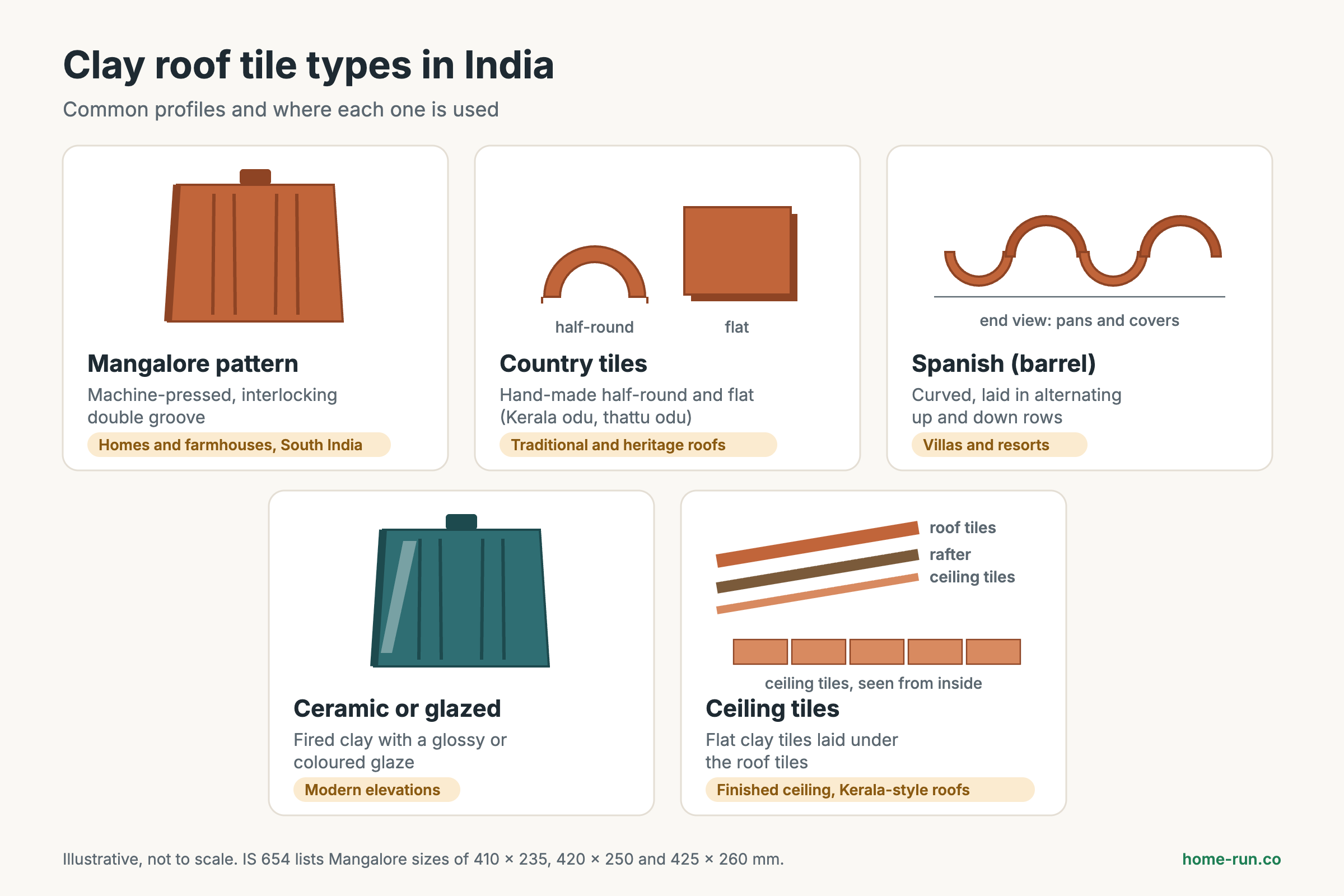
The main types of clay roof tiles in India are Mangalore pattern, country (half-round and flat), Spanish curved and designer interlocking tiles.
Common clay roof tile types
Confirm sizes on the maker's spec sheet| Type | Look and profile | Typical use | Standard |
|---|---|---|---|
| Mangalore pattern Most common | Machine-pressed, interlocking, double groove | Homes and farmhouses across South India | IS 654:2023 |
| Country tiles (half-round, flat) | Hand-made or simple pressed; Kerala odu and thattu odu styles | Traditional and heritage roofs | IS 13317 |
| Spanish (barrel) tiles | Curved, laid in alternating up and down rows | Villas and resorts | Maker's spec |
| Ceramic or glazed tiles | Glossy or coloured finish | Modern elevations | Maker's spec |
| Ceiling tiles | Flat clay tiles laid under the roof tiles | Finished ceiling inside Kerala-style roofs | IS 1464 |
What Are the Advantages and Disadvantages of Clay Roof Tiles?
Clay roof tiles give a cool, fire-resistant, long-lasting roof, but they are heavy, brittle and need upkeep.
Advantages
StrengthsWhy clay suits hot, rainy regions.
- Cooler rooms than a bare metal sheet roof
- Fire-resistant, since the clay is kiln-fired
- Can last 50 years or more with maintenance
- Single broken tiles are easy to replace
- Natural material with a traditional look
Disadvantages
Watch outWhat to plan and budget for.
- Heavy, so rafters and battens must be sized for it
- Brittle; tiles crack if walked on or dropped
- Moss and algae grow in damp, shaded spots
- Needs a pitched roof and a skilled tiler
- Fewer colours than metal or concrete tiles
How Does Clay Compare With Concrete, Metal Sheet and RCC Roofs?
Clay roof tiles beat metal sheets on heat and rain noise, but cost and weigh more.
Roofing options for Indian homes
Qualitative ratings| Roof | Heat comfort | Weight on structure | Rain noise | Upkeep |
|---|---|---|---|---|
| Clay tiles Heat pick | Good | Heavy | Quiet | Moss checks, tile swaps |
| Concrete tiles | Poorer than clay | Heavier than clay | Quiet | Moss checks, tile swaps |
| Metal sheets Budget | Poor without insulation | Lightest | Noisy | Rust and fixings |
| RCC slab | Needs insulation or shading | Structural slab | Quiet | Waterproofing |
How Do You Check Tile Quality Before Buying?
A good clay roof tile rings when tapped, has even colour and meets IS 654 limits.
- Water absorption: at most 18% (Class A) or 20% (Class B).
- Breaking load: at least 1.00 kN average for a Class A 420 × 250 mm tile.
- Test report: ask for one against IS 654 or IS 13317.
- Dull thud when tapped, a sign of under-firing
- Hairline cracks, warping or chipped lugs
- White salt patches (efflorescence)
- Uneven colour across one batch
How Many Tiles Does Your Roof Need?
You need about 16 to 17 Mangalore tiles per m² of sloped roof for the 420 × 250 mm size.
Two to three tonnes on one roof is normal for clay. Ask a structural engineer to confirm rafter and batten sizes, and seal valleys well to avoid water seepage.
How Much Does a Clay Tile Roof Cost in India?
Clay roof tiles cost roughly ₹30 to ₹100 per sq ft for the tiles alone, by published guides.
One guide quotes ₹30 per piece up to ₹45 per sq ft, and installation at ₹170 to ₹300 per sq ft. Another (June 2025) quotes ₹50 to ₹100 per sq ft. Glazed and imported tiles cost more. Confirm whether quotes include GST, transport and ridge tiles.
If you want a glossy finish instead, see how glazing changes clay in our guide to ceramic tiles.
Building a sloped roof in Bengaluru?
Order structure and waterproofing materials with a GST invoice.