On this page
- What Is White Cement, and Why Use It Instead of Grey Cement?
- What Are the Main Uses of White Cement?
- Which White Cement Uses Suit Walls: Wash, Putty or Paste?
- How Do You Use White Cement to Fill Gaps Between Tiles?
- What Are the Decorative Uses: Floors, Precast and Art?
- White Cement vs Grey Cement: Which Should You Use?
- Is White Cement Waterproof, and How Does It Cure?
- How Do You Apply White Cement Step by Step?
- What Problems Can It Cause, and How Do You Avoid Them?
- How Do You Buy the Right Bag in India?
- White cement is used for finishes: tile and marble joints, cement wash, wall putty, terrazzo, precast and decorative work.
- Grey cement (OPC or PPC) stays the default for foundations, columns, slabs and structural plaster.
- Under emulsion paint, a ready-made white cement-based putty usually beats plain white cement paste.
- White cement is not a waterproofing product: it can cover small gaps but will not stop an active leak.
- Mix small batches, buy one batch for the whole job, and keep the finish damp while it cures.
White cement uses share one idea: the cement itself is the visible finish. White cement is a white Portland cement, so it sets like grey cement but stays bright white and takes pigments cleanly.
That makes white cement the right material for tile joints, cement wash, wall putty, terrazzo floors and decorative castings. This page covers where to use it and how to apply it. For raw materials, chemistry and test values, read our guide to white cement composition and properties.
What Is White Cement, and Why Use It Instead of Grey Cement?
White cement is Portland cement made from raw materials very low in iron and manganese. Those oxides colour grey cement, so leaving them out gives a cement that sets white.
The main raw materials are pure limestone, kaolin (china clay), silica sand and gypsum. In India, white Portland cement is specified by IS 8042, the Bureau of Indian Standards (BIS) specification for white Portland cement.
White cement costs more than grey cement because pure raw materials are scarce and the kiln runs hotter. If paint, plaster or tiles will hide the cement, the premium buys you nothing.
On site, white cement handles like grey cement. IS 8042 sets an initial set of at least 30 minutes and a final set of at most 600 minutes.
What Are the Main Uses of White Cement?
The main uses of white cement are tile and marble joints, wall finishing, decorative floors, precast castings and coloured cement work. The table maps each use to what white cement does there.
White cement uses at a glance
Finishing and decorative work only| Use | Where | What white cement does |
|---|---|---|
| Tile and marble joints Most common | Interior floors and walls | Fills joints without grey showing through light tiles |
| Cement wash | Interior and exterior walls | Gives plastered or masonry walls a bright, low-cost white coat |
| Wall putty base | Interior walls | Main binder in ready-made white cement-based putty |
| Gaps at sanitary fittings | Bathrooms and kitchens | Covers small gaps around fittings and tile edges |
| Terrazzo and mosaic floors | Interior floors, stairs | Clean base for marble chips and pigments |
| Precast, art and restoration Specialist | Facades, gardens, old buildings | Clean cast faces, fine detail, matching old finishes |
| Cool roof coating | Terraces | Light, reflective top coat listed by Birla White |
Which White Cement Uses Suit Walls: Wash, Putty or Paste?
White cement is used on walls in three ways: as a cement wash, as the binder in wall putty, and as a filler for fine cracks. Most homeowners buy it inside a ready-made putty rather than mixing their own.
When does a cement wash make sense?
A cement wash is a thin coat of white cement and water, brushed or sprayed onto a clean wall. Birla White advises about 1 part water to 1 part cement, mixed until no lumps remain.
A cement wash suits compound walls, parapets and utility areas. It does not replace emulsion or exterior paint on main walls.
White cement vs wall putty: what does your wall need?
White cement-based wall putty
Under emulsion paintFactory blend of white cement, polymers and fillers.
- Polymers improve bonding to plaster
- Spreads smoothly in thin coats
- Lower risk of hairline cracks
- Mixed exactly as the bag says
Plain white cement paste
Small repairsWhite cement mixed with water on site.
- No added polymers
- Harder to spread thin and level
- More prone to shrinkage cracks
- Fine for small patches and gaps
Under emulsion paint, use a ready-made wall putty. Keep plain white cement for cement wash, tile joints and small patch repairs.
For smooth and textured putty finishes, see our wall putty design ideas.
How Do You Use White Cement to Fill Gaps Between Tiles?
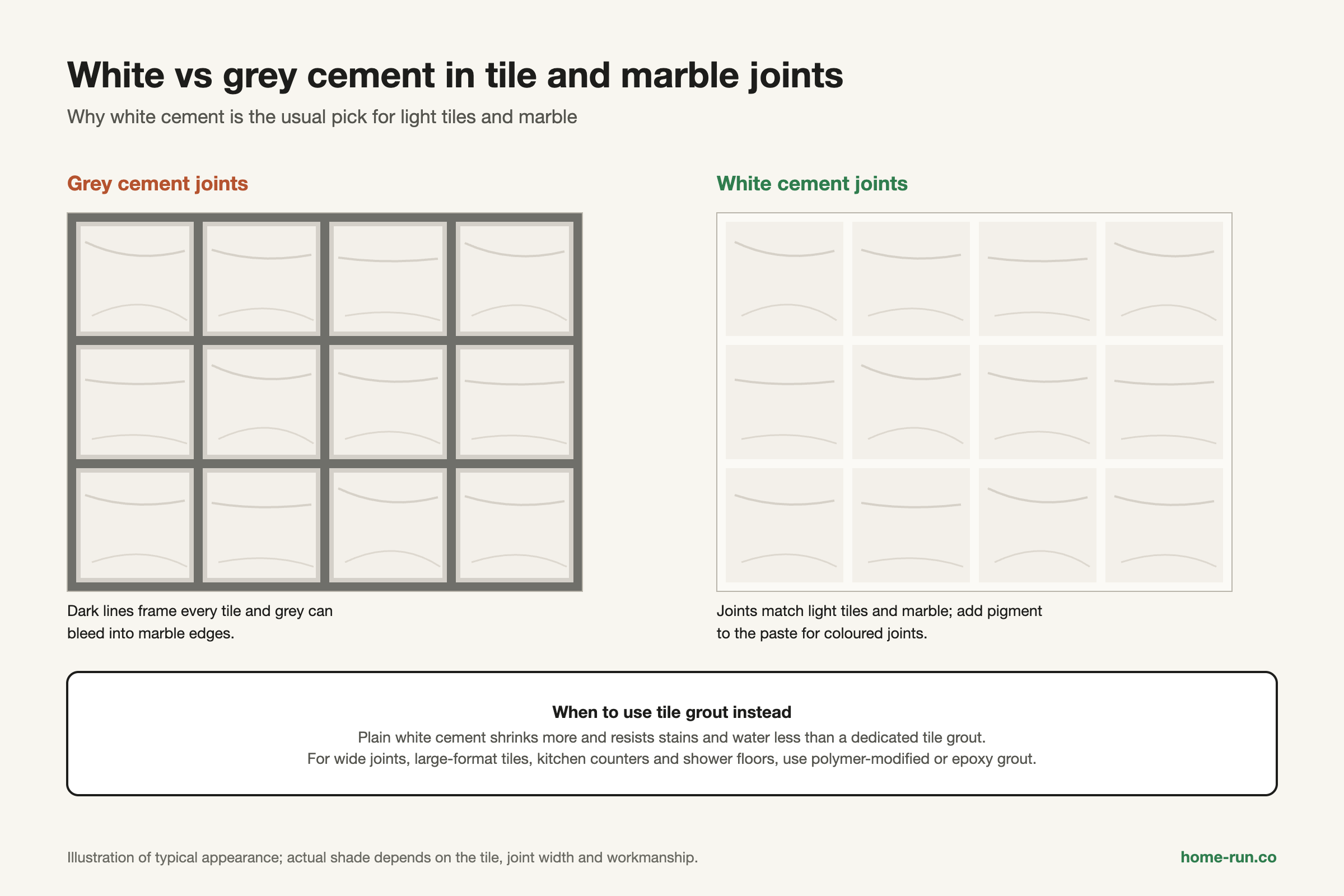
To fill gaps between tiles with white cement, clean the joints, press in a thick white cement paste, and wipe the tile faces before the paste hardens. White cement suits light tiles and marble, where grey cement would show through or darken the edges.
- Let the tile bed set. Wait until the tile adhesive or mortar has set, as its bag says.
- Clean the joints. Rake out dust and loose mortar; dampen lightly.
- Mix a thick paste. Add water little by little until the paste holds its shape. Add pigment now for coloured joints.
- Press it in. Work the paste in with a rubber float, diagonally across the tiles.
- Wipe the faces. Clean off excess with a damp sponge before it hardens.
- Keep it damp. Mist or cover the joints for the first few days and keep foot traffic off.
Plain white cement shrinks more and resists stains and water less than a dedicated tile grout. For wide joints, large-format tiles, kitchen counters and shower floors, use a polymer-modified or epoxy grout. Our guide to epoxy grout explains when the upgrade pays off.
What Are the Decorative Uses: Floors, Precast and Art?
The decorative uses of white cement all need a clean white or true-colour base.
- Terrazzo and mosaic floors: marble chips set in a white or pigmented cement topping, then ground and polished.
- Precast panels, jaali and countertops: cast in moulds for a uniform face. GRC (glass fibre reinforced cement) adds glass fibres for thin facade panels.
- Sculpture and garden work: planters, benches and statues with fine detail.
- Heritage restoration: matching light old finishes.
- Coloured cement work: pigments look truer in a white base than in grey. See coloured cement for pigment dosage and mixing.
Terrazzo shows why white finishes need time. A typical in-situ terrazzo schedule from published laying guidance runs like this:
Lay the topping
Lay the white cement and marble chip topping while the underlayer is still plastic.
First grinding
Grind with coarse grit, wash off the slurry and fill pinholes with matching cement grout.
First curing
Keep the floor moist.
Second grinding
Rub with fine grit blocks.
Second curing
Keep the floor moist again.
Final grinding and polish
Fine grinding for a smooth surface without pinholes.
Follow your flooring contractor's specification for mix, thickness and timings.
White Cement vs Grey Cement: Which Should You Use?
Use white cement where the cement is the visible finish, and grey cement for everything structural. The table adds wall putty and POP (plaster of Paris), which buyers often weigh too.
Where each material fits
General guidance| Material | Best use | Finish | Damp areas |
|---|---|---|---|
| White cement | Joints, cement wash, decorative work | Bright white, takes pigment | Fair once cured, not waterproof |
| Grey cement (OPC/PPC) Structural default | Foundations, slabs, columns, plaster | Grey | Fair once cured, not waterproof |
| White cement-based putty | Smoothing walls before paint | Smooth white base | Better than POP |
| POP (plaster of Paris) Dry areas only | False ceilings, smoothing dry walls | Very smooth white | Poor; gypsum weakens when wet |
Is White Cement Waterproof, and How Does It Cure?
No, white cement is not a waterproofing material on its own. A dense, well-cured coat resists water better than a loose one, but it still cracks and lets water through.
You mix white cement with water like any cement. IS 8042 only guarantees 30 minutes before the initial set, so mix only what you can use quickly.
Packing white cement into a crack around a leaking pipe or shower tray hides the problem for a while. Find the source first, then use a waterproofing compound or sealant made for the job.
Curing decides how a white finish looks. Keep fresh work damp by misting or covering it for the first days. A white finish that dries too fast can crack, powder or turn patchy.
How Do You Apply White Cement Step by Step?
You apply white cement in six steps: prepare, dampen, mix, apply, finish and cure. Take exact water and sand quantities from the bag or datasheet, because they differ by use.
- Prepare the surface. Remove dust, grease, loose paint and algae; let damp walls dry.
- Dampen porous surfaces. Wet plaster or brick lightly so it does not pull water out of the mix.
- Mix to the right consistency. Use a thin, lump-free slurry for cement wash and a thick paste for joints and patches.
- Apply. Brush or spray wash coats. Press pastes in with a float or trowel.
- Finish. Smooth or wipe the surface before it hardens.
- Cure. Mist or cover the work and keep it damp.
What Problems Can It Cause, and How Do You Avoid Them?
The common white cement problems are colour patches, cracks, powdering and salt patches. Most come from mixed batches, too much water or skipped curing.
White cement problems, causes and fixes
Check the cause before you redo the work| Problem | Likely cause | Fix |
|---|---|---|
| Colour difference | Different batches, uneven water or pigment | Buy one batch; weigh every mix |
| Hairline cracks Common | Thick layer, fast drying, no curing | Thin coats; keep damp while curing |
| Powdering | Too much water, fast drying, weak base | Thicker mix, sound base, proper curing |
| White salt patches | Efflorescence: moisture carrying salts out of the wall | Stop the damp, brush off when dry, recoat |
Handle white cement safely. Wet cement is strongly alkaline, with a pH above 11.5 in cement safety data sheets. It can burn skin, and the pain may start hours later.
Wear alkali-resistant gloves, goggles, long sleeves and a dust mask. Store bags sealed, dry and off the floor.
How Do You Buy the Right Bag in India?
In India, white cement is sold mainly as Birla White and JK White Cement, in packs from 1 kg to 50 kg. Birla White, for example, lists 1 kg, 5 kg, 25 kg and 50 kg packs.
Buy small packs for joints and patch work. Buy 50 kg bags for terrazzo, large cement wash jobs or precast work, and compare the price per kg across pack sizes.
Signs a bag may be off-grade or old:
- Greyish or yellowish tint next to a fresh sample
- Hard lumps that do not crumble
- Torn, re-stitched or unbranded bag
- No ISI mark or IS 8042 reference printed on the bag
- Missing or old manufacturing date
Before you order:
- Work out the quantity with the formula above
- Check the ISI mark and manufacturing date
- Order enough from one batch
Finishing walls or tiles?
Get white cement, wall putty, tile adhesive and paints delivered across Bengaluru with a GST invoice.