On this page
- What Is OPC Cement and What Does the Name Mean?
- What Is OPC Made Of, and How Is It Produced?
- OPC 33, 43 or 53: What Do the Grades Mean?
- Where Is OPC Used, and Where Is It a Poor Fit?
- OPC vs PPC Cement: Which Is Better?
- How Much Does OPC Cement Cost in India?
- Is OPC Waterproof, and Can You Mix It With PPC?
- How Should You Store and Check OPC on Site?
- Which Cement Should You Buy for Your Project?
- OPC means Ordinary Portland Cement: cement clinker ground with a little gypsum.
- The grade (33, 43 or 53) is the minimum 28-day strength in MPa of a standard mortar test, not a quality rating.
- For most house work, OPC 43 or PPC is enough. Follow your structural engineer's drawing first.
- Check the ISI mark, grade and packing date on every bag; use cement within 3 months of packing.
OPC cement is Ordinary Portland Cement, the basic grey cement made by grinding cement clinker with a small amount of gypsum. It sets and hardens when mixed with water, so it binds sand and aggregate into mortar and concrete.
In India, OPC is sold in three grades, 33, 43 and 53. All three are covered by IS 269:2015, the Bureau of Indian Standards (BIS) specification for ordinary Portland cement.
What Is OPC Cement and What Does the Name Mean?
OPC cement is a hydraulic binder: it reacts with water and hardens, even under water. "Portland" refers to Portland stone in England, which it resembled.
OPC is one of three common cement types in India:
- OPC (Ordinary Portland Cement): clinker and gypsum, under IS 269.
- PPC (Portland Pozzolana Cement): clinker blended with fly ash, under IS 1489 (Part 1).
- PSC (Portland Slag Cement): clinker blended with ground blast furnace slag, under IS 455.
Most large brands sell both OPC and PPC. Read the cement type and grade printed on the bag, not the brand name.
What Is OPC Made Of, and How Is It Produced?
OPC is made from limestone, clay or shale, a little iron ore, and gypsum. Limestone supplies lime; clay and shale supply silica and alumina.
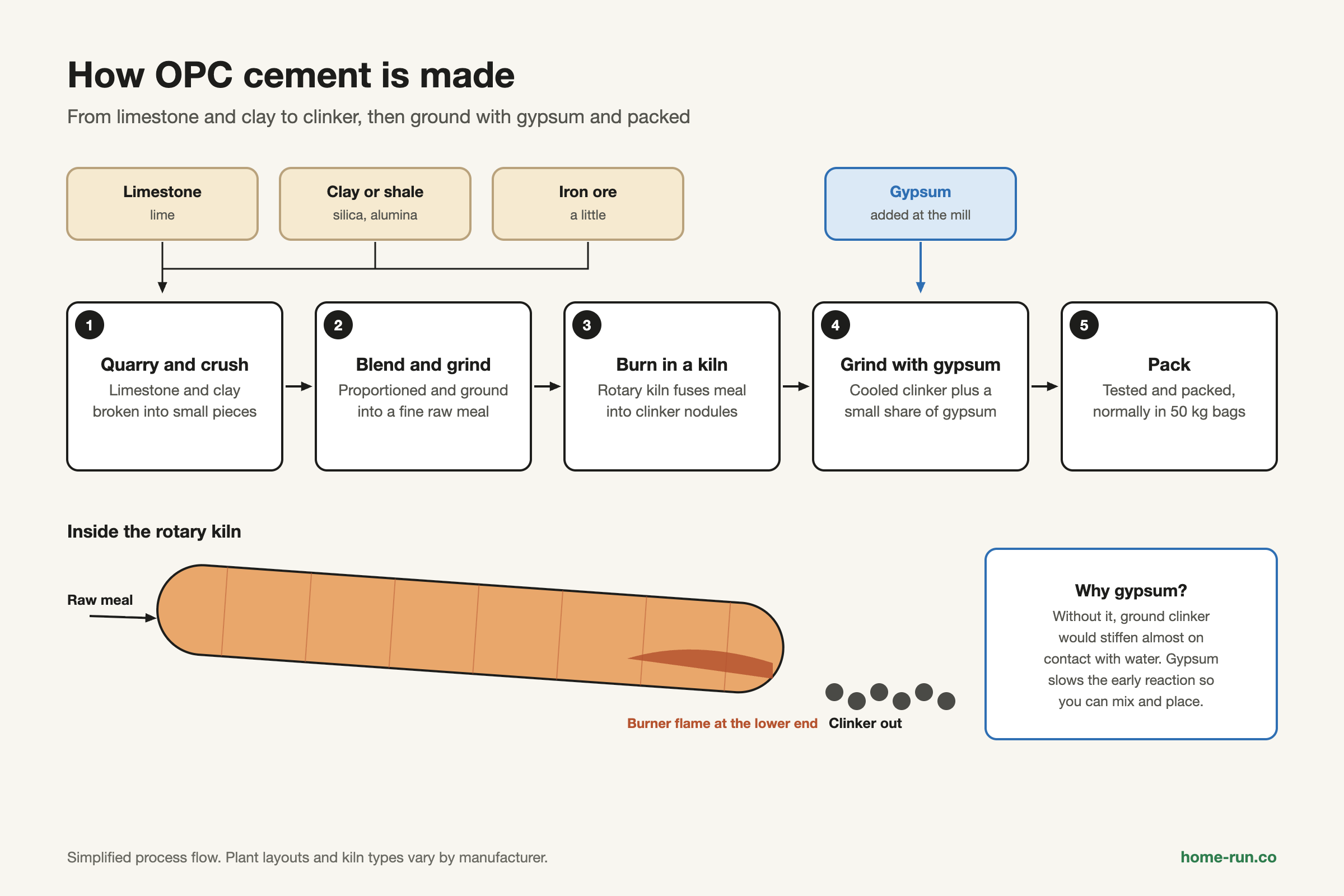
- Quarry and crush. Limestone and clay are crushed into small pieces.
- Blend and grind. The materials are proportioned and ground into a fine raw meal.
- Burn in a kiln. A rotary kiln heats the raw meal until it fuses into hard nodules called clinker.
- Grind with gypsum. Cooled clinker is ground with a small share of gypsum into fine powder.
- Pack. The cement is tested and packed, normally in 50 kg bags.
Why gypsum? Without gypsum, ground clinker would stiffen almost on contact with water. Gypsum slows the early reaction so you can mix and place concrete.
OPC 33, 43 or 53: What Do the Grades Mean?
The grade number is the minimum compressive strength, in megapascals (MPa), that a standard cement mortar cube must reach after 28 days. OPC 53 must reach at least 53 MPa; OPC 43, at least 43 MPa.
IS 269:2015 (sixth revision) brought all three grades into one standard. Older documents may still cite IS 8112 for OPC 43 and IS 12269 for OPC 53; BIS folded both into IS 269.
OPC grade requirements under IS 269:2015
Mortar cube strength in MPa| Grade | 3 days (min) | 7 days (min) | 28 days | Typical use |
|---|---|---|---|---|
| OPC 33 Rare today | 16 | 22 | 33 to 48 | Masonry, plaster, non-structural work |
| OPC 43 House default | 23 | 33 | 43 to 58 | General RCC, plaster, flooring |
| OPC 53 High strength | 27 | 37 | 53 min | High-grade RCC, precast, early de-shuttering |
A higher grade is not automatically better. Concrete strength comes from the mix design, water content and curing. Use the grade your engineer specifies; for ordinary house RCC that is usually OPC 43 or PPC.
For how cement quantity changes with concrete grade, see our concrete mix ratio guide.
Where Is OPC Used, and Where Is It a Poor Fit?
OPC is used where concrete must gain strength quickly, so formwork can come off sooner. OPC is a good fit for:
- RCC columns, beams and slabs, such as the M20 concrete used in many homes
- Precast blocks, paver moulds and other factory-cast items
- Repairs and jobs on a tight schedule
OPC is a weaker choice for mass concrete, such as thick rafts, because its higher heat of hydration (heat released as cement reacts) can cause thermal cracks. In sulphate-rich soil or near the sea, PPC or PSC usually performs better. Our page on raft foundations covers thick pours.
OPC vs PPC Cement: Which Is Better?
Neither OPC nor PPC is better in every case; the right choice depends on the job. OPC gains strength faster, while PPC gains it more slowly but gives denser, more durable concrete over time.
PPC (Portland Pozzolana Cement) is clinker blended with 15% to 35% fly ash under IS 1489 (Part 1):2015.
OPC
SpeedClinker and gypsum only.
- Faster early strength
- Higher heat of hydration
- Minimum 7 days of moist curing
- Suits RCC on tight schedules
PPC
General house workClinker, gypsum and fly ash.
- Slower early strength
- Lower heat, fewer thermal cracks
- Minimum 10 days of moist curing
- Suits plaster, masonry and footings
OPC vs PPC at a glance
General guidance| Factor | OPC | PPC |
|---|---|---|
| Indian standard | IS 269:2015 | IS 1489 (Part 1):2015 |
| Later strength and durability | Good | Keeps improving; denser concrete |
| Minimum curing (IS 456:2000) | 7 days | 10 days |
| Aggressive soil or damp sites | Less suited | Better suited |
How Much Does OPC Cement Cost in India?
OPC cement prices vary by brand, grade, city, dealer, taxes and delivery, so no single per-bag price applies everywhere. OPC 53 usually costs a little more than OPC 43.
Compare the rate per 50 kg bag for the same grade from two or three local suppliers, and confirm whether GST and delivery are included.
Pouring a slab or column?
Get OPC and PPC cement, TMT bars and aggregates delivered across Bengaluru with a GST invoice.
Is OPC Waterproof, and Can You Mix It With PPC?
No, OPC is not waterproof on its own. Well-compacted, well-cured OPC concrete resists water, but cracks and pores still let it through. Roofs, sunken bathrooms and basements need a waterproofing admixture or coating.
OPC and PPC set and gain strength at different rates. Mixing them in one pour makes setting, strength and curing time less predictable.
How Should You Store and Check OPC on Site?
Store OPC bags dry, raised off the floor and away from walls, and use the oldest stock first. IS 269:2015 requires every bag to carry a best-before date of 3 months from packing.
Storage rules, based on IS 4082:1996 guidance for storing building materials:
- Stack on pallets or planks at least 150 mm above the floor
- Leave a gap of about 300 mm from outer walls
- Keep stacks no more than 10 bags high
- Cover stacks with a waterproof sheet; first in, first out
At delivery, check each bag for the ISI mark, type, grade, net weight and packing week. Signs of a bad bag:
- Hard lumps that do not crumble between your fingers
- Torn, wet or re-stitched bag
- No ISI mark or IS 269 reference
- Packing date older than 3 months
- Bag that feels noticeably light
Which Cement Should You Buy for Your Project?
Buy the cement type and grade named on your structural drawings; the engineer's specification always comes first. Without one, these defaults are common:
- RCC columns, beams, slabs: OPC 43 or OPC 53, or PPC if early strength is not needed
- Plastering and brickwork: PPC or OPC 43
- Footings in damp or aggressive soil: PPC or PSC
- Precast and fast-track repairs: OPC 53