On this page
- What Is Precast Concrete and How Is It Different From Site-Cast Concrete?
- How Are Precast Elements Made?
- What Materials and Reinforcement Go Into Precast Concrete?
- Which Precast Concrete Products Are Most Common?
- What Are the Advantages of Precast Concrete?
- What Are the Drawbacks and Limits?
- Is Precast Concrete Cheaper Than Cast-in-Place Concrete?
- How Heavy Is a Precast Element to Lift?
- How Do You Choose a Good Precast Supplier in India?
- Which Standards and Quality Checks Matter for Precast Concrete?
- Precast concrete is cast and cured in a factory or yard, then transported and lifted into place.
- Ready-mix concrete (RMC) is fresh concrete delivered by truck; it is not precast.
- Common precast products include compound walls, hollow core slabs, culverts, manholes and pavers.
- Precast saves time when the same element repeats and a crane can reach the site.
- Connections between pieces, not the pieces themselves, are the critical design issue.
Precast concrete is concrete that is cast in a reusable mould, cured in a factory or casting yard, and then transported to site and lifted into its final position. Precast concrete gives you factory-controlled quality and faster site work, at the cost of transport, cranes and careful joint design.
What Is Precast Concrete and How Is It Different From Site-Cast Concrete?
Precast concrete differs from site-cast (cast-in-situ) concrete in where it is poured and cured. Site-cast RCC is poured into shuttering at its final position and cured there. A precast element hardens in a factory and arrives finished.
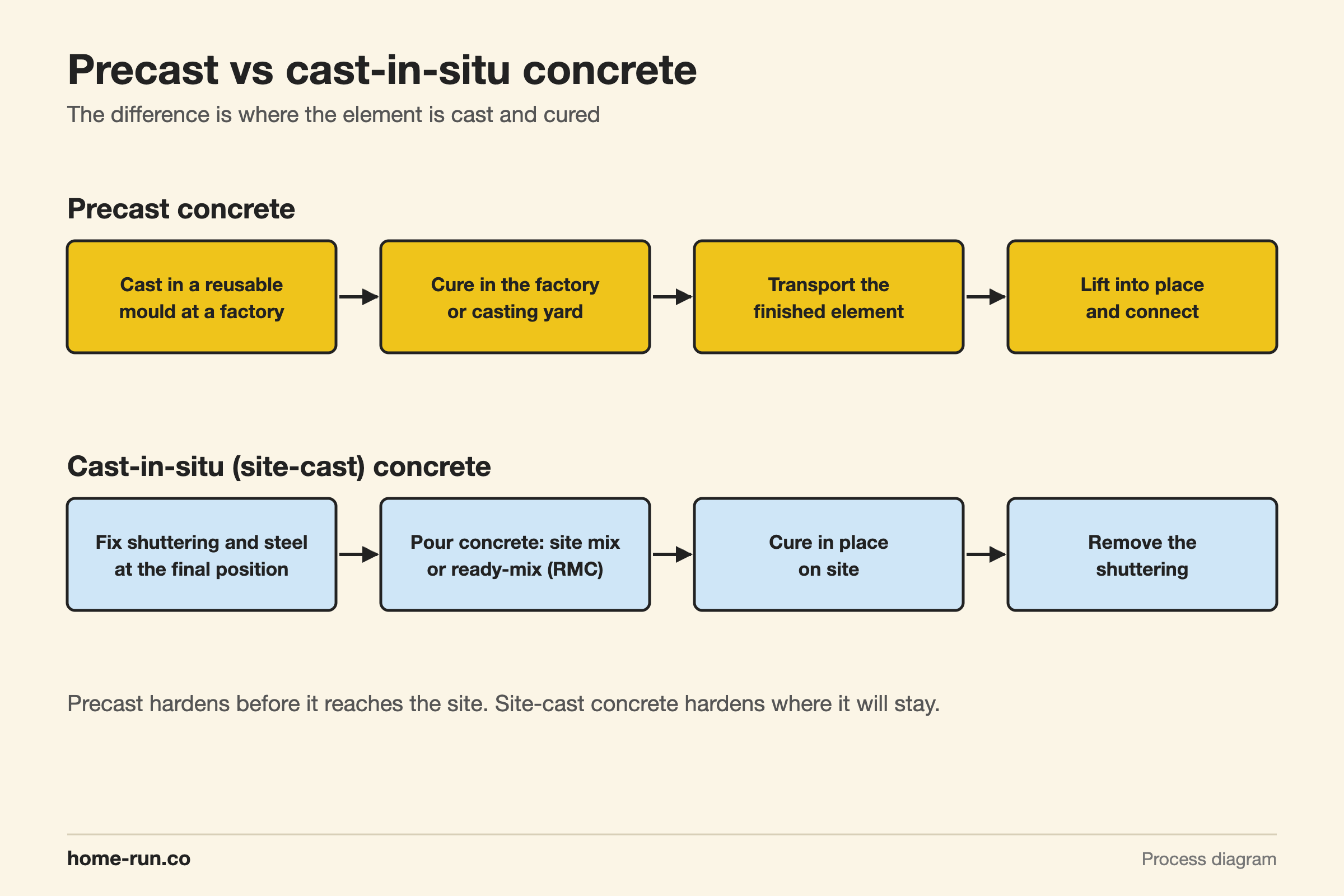
Three terms get mixed up when you ask for quotes:
- Precast: hardened, finished elements such as wall panels, slabs or pipes.
- Ready-mix concrete (RMC): fresh, wet concrete delivered by transit mixer and poured on site.
- Cast-in-situ: concrete poured and cured in place, whether mixed on site or bought as RMC.
Precast describes where an element is cast. Prestressed describes how it is reinforced: steel tendons are tensioned so the concrete is squeezed before it carries load. Reinforced concrete simply has steel bars inside. A precast slab can be prestressed or ordinarily reinforced.
How Are Precast Elements Made?
Precast elements are made in a fixed sequence: prepare the mould, place the steel, pour and vibrate the concrete, cure it, demould, store and transport. IS 15916:2010, the BIS code of practice for building design and erection using prefabricated concrete, sets out each stage.
Mould preparation
Steel moulds are cleaned, oiled and checked for size. Reusing the same mould is where precast saves money.
Reinforcement and inserts
The rebar cage or prestressing strands go in, along with lifting hooks and fixing plates.
Pour and compact
Concrete is poured and vibrated to remove air pockets.
Delay period
IS 15916 asks for the concrete to reach initial set first: a wait of about 2–5 hours before steam heating starts.
Steam curing
Air is heated to 75–80 °C at no more than 30 °C per hour, held for 3–5.5 hours, then cooled at the same slow rate.
Demould and stack
The element is lifted out at the demoulding age shown on its drawings, then stacked in the yard to keep gaining strength.
Transport and erection
Trucks carry the element to site, where a crane sets it on prepared bearings and the joints are made.
Steam curing is the main reason a factory can reuse a mould daily. Site-cast RCC sits in shuttering for days while it gains enough strength to strip.
What Materials and Reinforcement Go Into Precast Concrete?
Precast concrete uses the same basic ingredients as site concrete, mixed to tighter control and usually to a higher grade.
What goes into a precast element
Check the supplier's mix design| Ingredient | Role | What to ask |
|---|---|---|
| Cement | Binder; OPC 43 or 53 grade is common | Brand and grade used |
| Aggregates | Sand and graded crushed stone for bulk and strength | Maximum aggregate size |
| Admixtures | Plasticisers for workability at low water content | Type used; calcium chloride is not allowed in reinforced elements under IS 15916 |
| Steel reinforcement | TMT bars and mesh carry tension | Bar grade and cover |
| Prestressing strand Long spans | High-tensile wire pre-tensioned before the pour | Concrete grade at transfer |
Prestressing lets a slab or beam span further with a slimmer section. IS 1343:2012, the Indian code for prestressed concrete, is commonly cited as setting a minimum of M40 for pre-tensioned work and M30 for post-tensioned work. For ordinary mixes, see our concrete mix ratio guide.
Which Precast Concrete Products Are Most Common?
The most common precast concrete products in India are compound walls, floor and roof slabs, drainage structures and paving units. The table maps each one to its typical job.
Common precast products and their jobs
Catalogue = standard sizes in stock| Product | Typical use | Structural role | Supply |
|---|---|---|---|
| Compound wall (posts + panels) Most searched | Plot boundaries, farm and factory fencing | Non-load-bearing; not a retaining wall | Catalogue |
| Hollow core slab | Floors and roofs | Spanning, usually prestressed | Made to span |
| Beams and columns | Building frames | Load-bearing | Made to order |
| Wall panels | Housing blocks, cladding, partitions | Load-bearing or cladding only | Made to order |
| Box culvert and drain channel | Road crossings, storm drains | Carries soil and traffic load | Catalogue sizes |
| Manhole chamber and cover | Sewer and storm lines | Carries wheel load | Catalogue |
| Pipes and water or septic tanks | Drainage, storage | Carries soil load | Catalogue |
| Pavers, kerbs, cable cover tiles | Driveways, roads, cable trenches | Surface and protection | Catalogue |
A precast compound wall uses grooved posts set in small footings, with thin panels slotted between them. Precast systems for whole buildings come in three types: frame (beams and columns), panel (walls and floors) and volumetric (room-sized boxes). For paving units, see our explainer on paving blocks.
What Are the Advantages of Precast Concrete?
The main advantages of precast concrete are speed, consistent quality and less work on site.
- Parallel work: the factory casts elements while your site team digs foundations.
- Controlled quality: fixed moulds, batching and curing give uniform strength and finish.
- Tight tolerances: IS 15916 limits thickness deviation to about ±2–4 mm for many products.
- Less shuttering and curing on site: no props, no ponding, less water use.
- Less waste and labour: a small crew erects elements instead of a large casting gang.
India's Light House Projects under PMAY-Urban show the scale: Chennai's 1,152 homes used precast beams, columns, slabs and stairs, and Ranchi used 3D volumetric precast modules.
The speed advantage is real once the foundations are ready and the same element repeats dozens of times. On a one-off house with a dozen different slab sizes, most of it disappears.
HomeRun Team
What Are the Drawbacks and Limits?
Precast is a poor fit when the site is hard to reach, the design keeps changing, or each element is different.
- Transport and lifting: large elements need trailer access and a crane, which narrow Bengaluru lanes may not allow.
- Joints and connections: bolted plates, grouted sleeves or in-situ stitches decide strength, earthquake behaviour and leaks.
- Design lock-in: openings, sleeves and inserts must be fixed before casting.
- Volume economics: moulds pay back only over many repeats.
- Monsoon handling: wet sites slow crane work and make grouting harder.
A precast element is only as good as its connections. Ask your structural engineer to detail and inspect every joint, and plan waterproofing at roof and wall joints before erection.
Is Precast Concrete Cheaper Than Cast-in-Place Concrete?
Precast concrete is usually cheaper only when an element repeats many times and the site is easy to reach. On small, varied jobs, site-cast RCC often costs less.
Precast
Repetitive, fast jobsCompound walls, drains, housing blocks.
- Higher price per element
- Little shuttering or curing on site
- Pays for transport and crane hire
- Shorter project time and carrying cost
Cast-in-situ
One-off, varied jobsIndividual houses, irregular slabs.
- Lower material price per cubic metre
- Pays for shuttering, props and curing
- No crane needed for most homes
- Longer time on site
How to compare quotes like for like
Ask for itemised prices| Cost line | Precast quote should include | Site-cast quote should include |
|---|---|---|
| Material | Element price, grade, steel | Cement, aggregates, steel or RMC |
| Formwork | Mould cost, if custom | Shuttering and props hire |
| Transport and lifting | Trailer and crane hire | Usually none |
| Labour | Erection and joint grouting | Casting, curing, stripping |
| Time | Factory lead time plus erection days | Casting and curing days per floor |
Compare delivered-and-installed cost, never the ex-factory element price against site concrete per cubic metre. Rates change with project size and season, so get dated written quotes.
How Heavy Is a Precast Element to Lift?
A precast element's lifting weight equals its concrete volume times the concrete's unit weight. IS 875 (Part 1), the Indian code for dead loads, gives 25 kN/m³ for reinforced concrete.
The voids make this slab about 32% lighter than a solid one. Crane capacity drops as the boom reaches further, so give the operator the lifting radius, not just the weight.
How Do You Choose a Good Precast Supplier in India?
Choose a precast supplier by visiting the yard, checking test records and confirming who handles transport and erection.
- Factory or yard visit: clean moulds, a covered curing area, organised stacking
- Mix design, concrete grade and reinforcement details in writing
- Cube test records for recent batches
- ISI mark for products with a BIS standard, such as pipes and paver blocks
- Own trailers, cranes and an erection crew, or named partners
- Reference projects you can see in Bengaluru
Walk away if you see
- No test records or vague answers about concrete grade
- Honeycombing or exposed steel on stacked elements
- Delivery and erection terms left out of the quote
Which Standards and Quality Checks Matter for Precast Concrete?
IS 15916:2010 is the main Indian code for precast buildings, and it works alongside IS 456:2000, the code for plain and reinforced concrete. Product standards also apply, such as IS 458 for concrete pipes and IS 15658 for paving blocks.
Bearings of at least 75 mm on concrete or steel and 100 mm on masonry, and joints with fire resistance equal to the members they connect. Steel frames are a separate system; see our explainer on the pre-engineered building for that route.
Casting footings, joints or toppings on site?
Get cement, steel and aggregates delivered across Bengaluru with a GST invoice.