On this page
- What Is Coloured Cement and How Is It Made?
- Paint, Tiles or DIY Oxide Mixing: Which Should You Choose?
- Where Is Coloured Cement Used in Indian Homes?
- How Much Pigment Should You Add?
- How Do You Mix and Apply It Without Patches?
- Does the Colour Fade or Weaken the Mix?
- What Does It Cost, and What Should You Check When Buying?
- Is It Safe to Handle?
- Coloured cement carries pigment through the whole material, so it does not peel like paint.
- White cement gives bright and pastel shades; grey cement gives darker, earthy tones.
- In concrete, keep pigment at or below 10% of the cement weight.
- Judge the final shade after about 28 days, once the surface has dried and lightened.
Coloured cement is cement mixed with a fine mineral pigment, so the colour runs through the material instead of sitting on top. Indian homes use it for red and green oxide floors, tile grout, paver blocks, wall finishes and craft work.
What Is Coloured Cement and How Is It Made?
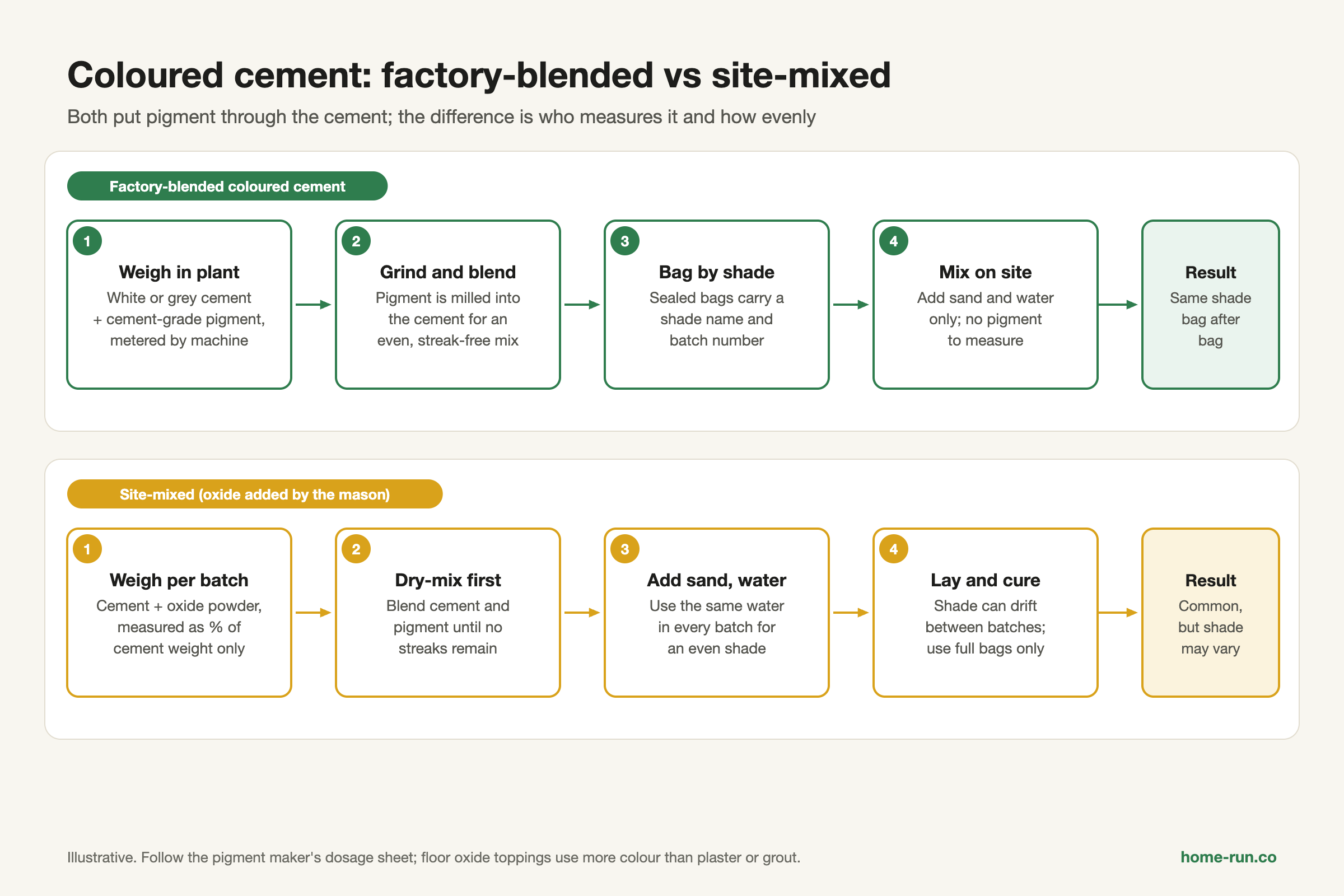
Coloured cement is Portland cement blended with pigment, either in a factory or on site. On site, a mason dry-mixes oxide powder into grey or white cement.
The base cement sets the colour range. White cement has almost no iron, so pigments show their true colour. Grey OPC (Ordinary Portland Cement) mutes every shade towards brown and grey.
Pigments used in coloured cement
Metal oxides suit alkaline cement| Pigment | Colour it gives |
|---|---|
| Iron oxide Most used | Red, yellow, brown, black |
| Chromium oxide | Green |
| Cobalt oxide | Blue |
| Carbon black | Black (can leach unless sealed) |
| Titanium dioxide | Whitener, not a colour |
Cement paint is a coating brushed on after the wall is built, covered by IS 5410, the Indian standard for cement paint. Coloured cement is the building material itself.
Paint, Tiles or DIY Oxide Mixing: Which Should You Choose?
Choose coloured cement when you want colour that will not peel. Paint needs repainting, and tiles add joints. Site-mixed oxide is common in India but varies in shade between batches.
Integral (mass) colour
RecommendedPigment mixed through the whole mix.
- Colour runs all the way through
- Chips do not show grey beneath
- Uses more pigment, costs more
- Best for floors, pavers, precast
Surface colour
BudgetDry shake, stain or paint on top.
- Colour only in the top layer
- Wear can expose grey cement
- Uses less pigment
- Best for low-traffic surfaces
Where Is Coloured Cement Used in Indian Homes?
Coloured cement suits any cement surface that needs lasting colour.
- Oxide floors: classic red, green and black polished floors.
- Tile grout and pointing: joints that match tiles or stone.
- Paver blocks and precast: factory-coloured paving blocks, tiles and panels.
- Terrazzo and mosaic: stone chips set in a coloured cement matrix.
- Walls: coloured plaster and render.
- Crafts: planters, coasters and small cast decor.
How Much Pigment Should You Add?
Pigment is measured as a percentage of the cement weight only, leaving out sand, aggregate and water.
Thin oxide floor toppings use more. Tata Pigments' floor oxide data sheet suggests about 1 part colour to 4 or 5 parts cement. Follow your pigment maker's sheet.
How Do You Mix and Apply It Without Patches?
Dry-mix the pigment with the cement first, then add sand and water. That single step prevents most streaks.
- Clean and dampen the base evenly.
- Weigh cement and pigment for each batch. Use full bags only.
- Dry-mix cement and pigment until no streaks remain.
- Add sand, then water. Keep the water quantity the same in every batch.
- Apply and finish without sprinkling water on the surface.
- Cure, then polish or seal floors once dry. Tata's sheet suggests buffing after about a week.
Cement brands vary in shade. Buy everything for one surface from one batch.
Does the Colour Fade or Weaken the Mix?
Coloured cement holds its colour well with cement-grade mineral oxides at the right dose. Poor curing and exposure cause most problems.
- White bloom (efflorescence): salts left by moisture, not pigment failure.
- Mottled patches: uneven water or plastic sheets during curing.
- Weak, dusty surface: overdosed pigment or too much water.
- Fading outdoors: some floor oxides suit only indoor or covered areas.
Bengaluru gets both the south-west and north-east monsoons, so seal exposed surfaces. For white patches on walls, check for causes of wall dampness first.
What Does It Cost, and What Should You Check When Buying?
Coloured cement costs more than grey cement because white cement and pigment add cost. Bright shades on a white base cost the most.
- Cement-grade pigment, stated as alkali and light resistant
- Shade card or a sample from the same batch
- White cement to IS 8042, the Indian standard for white Portland cement
Planning a coloured floor or finish?
Cement and finishing materials delivered across Bengaluru.
Is It Safe to Handle?
Coloured cement is safe with basic care. Wet cement is alkaline and irritates skin and eyes, and fine pigment dust should not be breathed in. Wear gloves, a dust mask and goggles while dry-mixing.