


On this page
- What Is White Cement and How Does It Differ From Grey Cement?
- What Are the Raw Materials in White Cement?
- What Is the Chemical Composition of White Portland Cement?
- How Is White Cement Manufactured?
- What Affects the Whiteness of White Cement?
- What Are the Key Properties of White Cement?
- Is White Cement Better Than Ordinary Portland Cement?
- Where Is White Cement Used?
- What Are the Pros and Cons of White Cement?
- White cement is white Portland cement: the same binder as OPC, made white by keeping iron and manganese out.
- It is made from pure limestone, kaolin, silica sand and gypsum.
- The kiln runs hotter (about 1,600–1,700°C) and the clinker is quenched fast, so white cement costs more.
- IS 8042 requires reflectance of at least 70% and strength close to 33-grade OPC.
- Use it for finishes and decorative work, not structural concrete. It is not waterproof on its own.
White cement is a Portland cement made from raw materials that are very low in iron and manganese, which gives it a bright white colour instead of grey. It is also called white Portland cement. It sets and hardens like ordinary grey cement, but it is used for finishes, decorative concrete, tile grout and wall putty rather than for structural work.
This guide explains what white cement is made of, how it is manufactured, its key properties, how it compares with grey OPC, and where to use it.
What Is White Cement and How Does It Differ From Grey Cement?
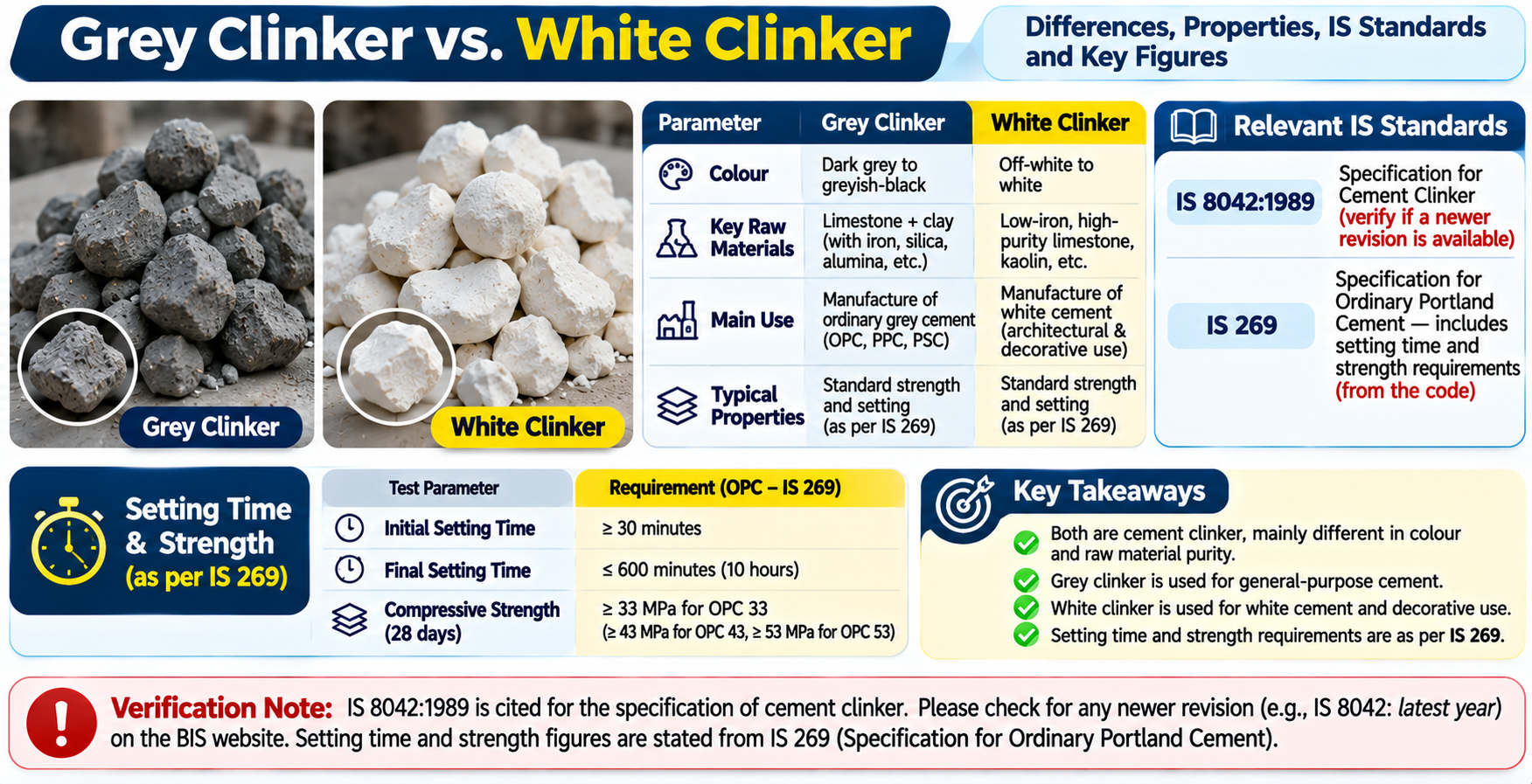
White cement is white Portland cement: the same hydraulic binder as ordinary Portland cement (OPC), made white by keeping out the oxides that colour grey cement.
Grey cement gets its colour mainly from iron oxide, with some help from manganese and chromium oxides. White cement manufacturers choose raw materials low in these oxides and control the kiln and grinding so none creep back in.
In India, white Portland cement is covered by IS 8042, the Bureau of Indian Standards (BIS) specification for white Portland cement.
What Are the Raw Materials in White Cement?
The main raw materials in white cement are limestone, kaolin (china clay), silica sand and gypsum. Every one of them must be low in iron.
- Limestone: supplies calcium oxide (lime), the largest ingredient. White cement needs very pure limestone.
- Kaolin (china clay): supplies alumina and silica. It replaces ordinary clay, which carries too much iron.
- Silica sand: tops up silica, because kaolin is relatively low in it.
- Gypsum: added during grinding to control the setting time.
Low-iron limestone and kaolin deposits are scarce, which is one reason white cement costs more than grey cement.
What Is the Chemical Composition of White Portland Cement?
White Portland cement contains the same main oxides as grey cement, but with very little iron oxide. That changes the balance of the clinker minerals.
Key oxides in white cement clinker
Role and typical limit| Oxide | Role | In white cement |
|---|---|---|
| Lime (CaO) | Main strength-forming oxide | Major component |
| Silica (SiO₂) | Forms calcium silicates | Major component |
| Alumina (Al₂O₃) | Forms aluminates; speeds setting | Minor component |
| Iron oxide (Fe₂O₃) Kept low | Causes grey colour | Below 0.35% |
| Manganese oxide (Mn₂O₃) Kept low | Darkens colour | Below 0.03% |
| Chromium oxide (Cr₂O₃) Kept low | Gives a green tint | Below 0.003% |
Portland clinker has four main phases: tricalcium silicate (C₃S), dicalcium silicate (C₂S), tricalcium aluminate (C₃A) and tetracalcium aluminoferrite (C₄AF). Because white cement has almost no iron, it has very little C₄AF. The silicates still give most of the strength.
How Is White Cement Manufactured?
White cement is made in the same basic steps as grey cement, with extra care at every stage to keep iron out:
- Select and prepare raw materials: pure limestone, kaolin and silica sand are crushed and ground.
- Blend: the raw meal is proportioned to the target chemistry.
- Burn in the kiln: at about 1,600–1,700°C, higher than grey cement, because there is little iron to help the minerals form.
- Bleach and quench: the hot clinker is cooled very fast, often with water, to lock in whiteness.
- Grind with gypsum: in mills that avoid iron pick-up from grinding media.
- Test and pack: whiteness, fineness and strength are checked before bagging.
The hotter kiln typically uses 20–50% more fuel and produces 20–50% less clinker than a grey cement kiln. That, plus scarce raw materials, explains the price premium.
What Affects the Whiteness of White Cement?
Whiteness depends on the iron and manganese content, the kiln atmosphere, how fast the clinker is cooled, and contamination during grinding. Low iron alone does not guarantee a bright white.
Whiteness is measured as reflectance. IS 8042 requires a reflectance of at least 70% on a test sample. Manufacturers often report a different scale: Birla White, for example, quotes 89%+ on the Hunter Whiteness Scale. The two scales are not directly comparable.
What Are the Key Properties of White Cement?
White cement has setting times and strength close to 33-grade OPC, a finer grind, and much higher whiteness. IS 8042 applies the physical requirements of IS 269 for 33-grade OPC, with mortar strength of at least 90% of those values.
White cement properties
Indian standard minimums and one brand's figures| Property | IS 8042 basis | Example brand claim |
|---|---|---|
| Initial setting time | At least 30 minutes (per IS 269) | Not stated |
| Final setting time | At most 600 minutes (per IS 269) | Not stated |
| 28-day mortar strength | At least 90% of 33-grade OPC (about 29.7 MPa) | 60 MPa (Birla White) |
| Fineness | As IS 269 | 370–400 m²/kg Blaine (Birla White) |
| Whiteness | Reflectance ≥ 70% | 89%+ Hunter scale (Birla White) |
No. White cement is not waterproof on its own. It is a base for cementitious waterproof coatings and white cement paints, which add polymers or water repellents. For a damp wall, fix the moisture source first.
Is White Cement Better Than Ordinary Portland Cement?
White cement is not better than ordinary Portland cement; it does a different job. White cement is for appearance and finish, while grey OPC is the structural, cost-effective choice.
White cement
For finishesChosen for colour and surface quality.
- Bright white, true base for pigments
- Used in putty, grout, terrazzo and facades
- Costs much more per kg than grey cement
- Sold in small packs from 1 kg
Grey OPC
For structureChosen for strength and economy.
- Grey colour from iron oxide
- Used in RCC, plaster, masonry and footings
- Much cheaper per bag
- Sold mainly in 50 kg bags
Where Is White Cement Used?
White cement is used wherever colour or a clean finish matters. The low iron content lets pigments show their true colour, so it is also the base for coloured cement.
- Architectural: facade panels, precast elements, terrazzo and mosaic floors.
- Decorative: coloured concrete and mortar with pigments, sculptures, garden features.
- Finishing: wall putty, filling hairline cracks, tile grout and joint filling.
- Coatings: the base for cement paints and some waterproof coatings.
White cement-based wall putty is the usual first layer before painting. See our home painting tips for where putty fits in the painting sequence, and our guide on fixing damp patches on walls before painting before you apply any finish over a damp wall.
The aggregate here is marble or stone chips plus pigment. Confirm the mix, thickness and dry-volume factor with your flooring contractor.
What Are the Pros and Cons of White Cement?
White cement's main advantage is its colour; its main drawback is cost. Weigh both against the job:
- Pro: clean white finish and a true base for coloured mixes
- Pro: fine grind gives smooth putty, grout and plaster finishes
- Pro: similar setting and strength behaviour to OPC
- Con: much higher price than grey cement
- Con: stains easily from dirty tools, water or curing materials
- Con: not needed for structural concrete
Grey cement mixed with white pigment is not white cement. It looks dull and greyish, and pigments do not show true colour in it. Check the bag for "White Portland Cement" and the IS 8042 mark.
Use white cement where people will see it, and grey cement everywhere else.
HomeRun Editorial Desk
White cement and finishing materials
White cement, wall putty, primers and paints from trusted brands, delivered across Bengaluru. Genuine stock, GST invoice.