On this page
- What Is Epoxy Grout Made Of?
- How Is Epoxy Grout Different From Cement Grout?
- What Does a Resin Grout Do Better Than Cement Grout?
- Where Is Epoxy Grout Used in Homes and Buildings?
- How Much Does Epoxy Grout Cost in India?
- How Much Grout Should You Buy for Your Floor?
- Which Brands Sell Tile Epoxy in India?
- Which Grout Colour Hides Dirt Best?
- How Do You Mix, Apply and Clean a Resin Grout?
- What Mistakes Ruin a Resin Grout Job?
- Should You DIY or Hire a Trained Applicator?
- How Do You Clean and Store Resin Grout?
- Epoxy grout is a two- or three-part resin grout that sets by chemical reaction, not by drying.
- Cured epoxy grout is near non-porous, so it resists stains and mould and needs no sealer.
- Use it in wet, oily or hygiene-critical areas; cement grout is enough for dry bedroom floors.
- Mix small batches: you get about 45 minutes of working time.
- Wipe residue before it hardens; cured epoxy haze needs a special stripper.
Epoxy grout is a tile-joint filler made from epoxy resin, a hardener and a coloured filler powder. The parts react and cure into a hard, near-waterproof joint. Cement grout, by contrast, hardens when cement reacts with water and stays porous.
What Is Epoxy Grout Made Of?
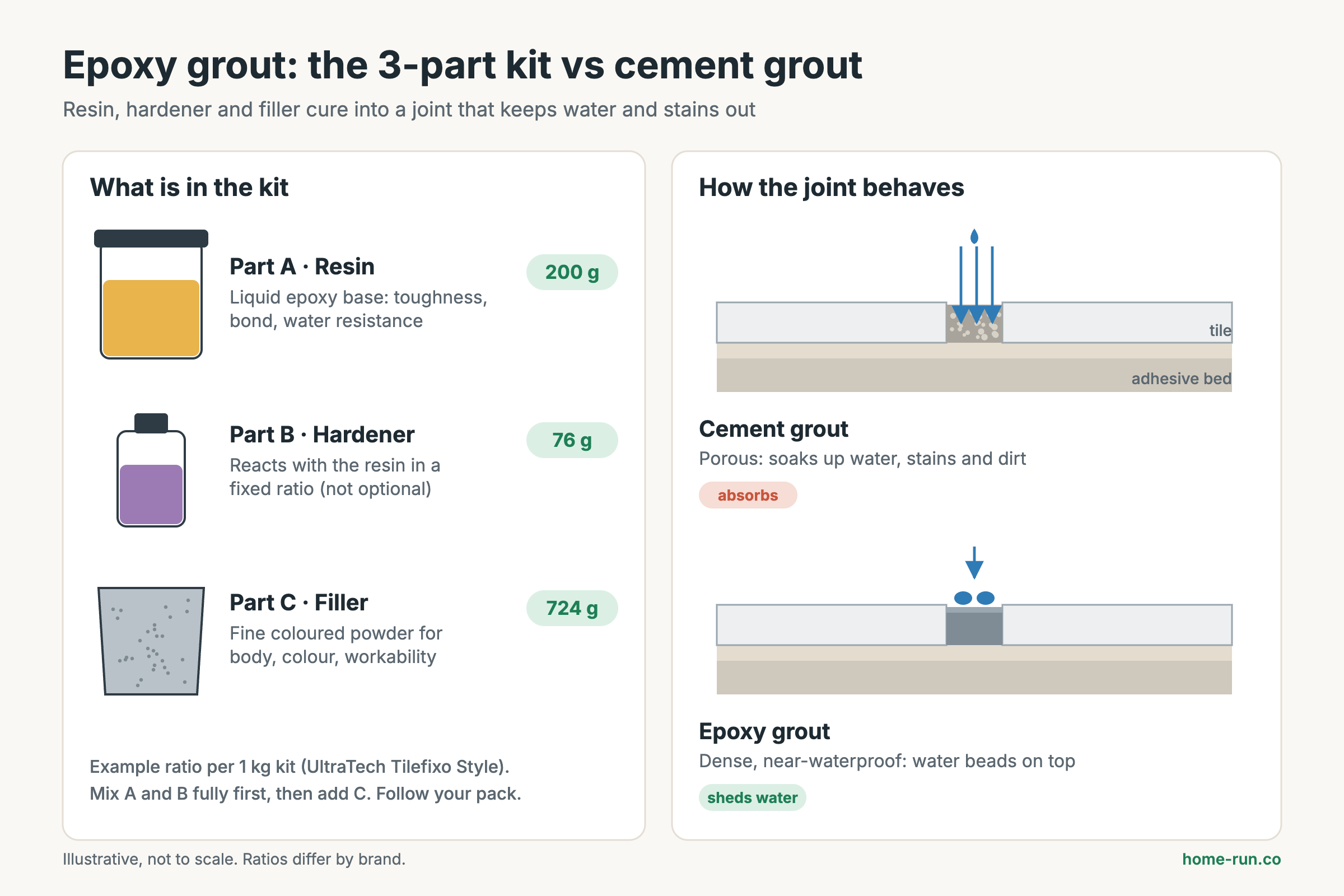
Epoxy grout is made of three components that you mix on site just before use.
- Part A, resin: the liquid epoxy base. It gives toughness, bond and water resistance.
- Part B, hardener: reacts with the resin in a fixed ratio. It is not an optional additive.
- Part C, filler: fine coloured powder that gives body, colour and workability.
UltraTech's Tilefixo Style data sheet gives one real ratio: 200 g resin, 76 g hardener and 724 g filler per 1 kg kit. Every brand differs, so always follow the ratio on your pack.
True epoxy grout comes as separate resin, hardener and filler. An "epoxy-fortified" or polymer-modified grout is still cement grout with additives. Furan grout is a different resin grout, made from furfuryl alcohol, used on industrial floors exposed to strong acids.
In Europe, EN 13888 (the standard for tile grouts) classes reaction resin grouts as RG. Cement grouts are classed CG1 or CG2. Ask your dealer which class a product meets.
How Is Epoxy Grout Different From Cement Grout?
Epoxy grout differs from cement grout mainly in porosity, working time and price. Epoxy shuts out water and stains; cement grout is cheaper and far easier to apply.
Epoxy grout vs cement grout vs furan grout
Check the product data sheet for exact figures| Property | Epoxy grout | Cement grout | Furan grout |
|---|---|---|---|
| How it sets | Resin-hardener reaction | Hydration with water | Resin reaction, no water |
| Water absorption | Near zero | Porous | Very low |
| Stain and mould resistance | High | Low unless sealed | High |
| Sealer needed | No | Yes, for wet areas | No |
| Working time | About 45 min per batch | Longer, more forgiving | Specialist only |
| Ease of application | Hard; residue must be wiped fast | Easy | Industrial applicators |
| Material cost | High | Low | High |
| Typical use | Showers, kitchens, pools, hospitals | Dry living areas, walls | Acid-exposed industrial floors |
Pay for epoxy where water, oil, food or harsh cleaners reach the joint. Use good cement grout on dry bedroom and living-room floors.
What Does a Resin Grout Do Better Than Cement Grout?
The main benefit of epoxy grout is a joint that does not soak up water, stains or dirt.
- Stain resistance: turmeric, oil and tea do not sink into the joint.
- Mould resistance: no pores for moisture, so bathroom joints stay lighter for longer.
- Chemical resistance: handles many cleaners and dilute acids better than cement grout.
- No sealing: cured epoxy grout needs no sealer.
- Even colour: no patchy drying, because colour comes from the filler, not from curing water.
MYK Laticrete's SP-100 data sheet lists water absorption of 0.015–0.040 g in its test, against a limit of 0.1 g. Its chemical table still rates some acids only "good" or "poor", so check the table before using epoxy in labs or factories.
Epoxy grout makes the joints waterproof, not the floor. Water still finds cracked tiles, gaps at drains and wall junctions. You still need a waterproofing layer under the tiles; see our guide to water seepage causes and prevention.
Where Is Epoxy Grout Used in Homes and Buildings?
Epoxy grout is used wherever tile joints face water, food, chemicals or strict hygiene.
Where epoxy grout earns its price
General guidance; check the tile and grout maker's advice| Area | Epoxy grout? | Why |
|---|---|---|
| Shower floor and walls Default pick | Yes | Constant wetting, soap and mould |
| Kitchen platform and backsplash Default pick | Yes | Oil, turmeric and acidic food spills |
| Swimming pools and water bodies | Yes | Permanent immersion and pool chemicals |
| Hospitals, food processing, labs | Yes | Hygiene and chemical cleaning |
| Covered balcony | Yes, if not in direct sun | Monsoon wetting; UV can discolour light shades |
| Open terrace in full sun Check | Only if rated for exteriors | Heat and UV exposure |
| Bedroom and living-room floors Optional | Not needed | Dry areas; cement grout is enough |
Epoxy grout suits ceramic, vitrified, glass mosaic, marble and granite tiles. Brand data sheets list these surfaces. It works well with large vitrified tiles and narrow joints, and with ceramic tiles on bathroom walls.
Light marble and porous stone can absorb pigment from dark grout. Grout a spare piece and check it before doing the floor.
Epoxy grout is not the same as an epoxy floor coating. A coating covers the whole slab; grout only fills tile joints.
How Much Does Epoxy Grout Cost in India?
Branded tile epoxy grout in India mostly sells for about ₹400–1,400 per kg (Nov 2026 listings). Prices depend on brand, pack size and finish.
Sample epoxy grout listings in India
Checked Nov 2026; indicative, confirm with your dealer| Product | Pack | Listed price | Source |
|---|---|---|---|
| Hindware epoxy grout | 1 kg box | ₹1,365 MRP | Brand website |
| Kerakoll epoxy tile grout | 1 kg | ₹1,250/kg | IndiaMART seller |
| MYK Laticrete SP-100 | 5 kg | ₹415/kg | IndiaMART seller |
| Roff Starlike | 1 kg | On request | Moglix |
Three things push the real cost up:
- Labour: applicators charge more than for cement grout, because the work is slower and cleanup is critical.
- Pack size: 5 kg units cost less per kg, but only if you can use them before the pot life ends.
- Wastage: mixed epoxy that hardens in the bucket is lost, so cheap packs mixed badly cost more.
How Much Grout Should You Buy for Your Floor?
The epoxy grout you need depends on tile size, joint width, joint depth and grout density.
Smaller tiles mean more joints. The same floor in 300×300 mm tiles needs about twice as much grout, roughly 0.32 kg/m².
Which Brands Sell Tile Epoxy in India?
Common epoxy grout brands in India include MYK Laticrete, UltraTech, Roff, Pidilite, Kerakoll, Mapei, Weber and Hindware. Compare them on facts from each data sheet.
What the data sheets say
From each maker's technical data sheet or product page| Product | Parts | Joint width | Pot life | Packs |
|---|---|---|---|---|
| MYK Laticrete SP-100 | 3 | Not stated | 45 min at 21 °C | 1, 5, 10 kg |
| UltraTech Tilefixo Style | 3 | 2–14 mm | 45 min at 27 °C | 1, 5 kg |
| Roff Starlike | Kit | 1–15 mm | See pack | 1 kg |
| Hindware epoxy grout | Kit | See pack | See pack | 1 kg, 40 colours |
Shortlist on colour range, pot life, pack size and dealer support. Buy from authorised dealers and check the manufacturing date on the bucket.
Which Grout Colour Hides Dirt Best?
Choose an epoxy grout colour that hides the dirt your floor will see. Grey and off-white suit most homes.
Light grout (white, ivory)
WallsClean look that blends with pale tiles.
- Shows dirt on busy floors
- Can discolour in strong sun
- Suits bathroom walls
Mid or dark grout (grey, charcoal)
FloorsPractical choice for kitchens and showers.
- Hides grime and hard-water marks
- Can stain pale marble edges
- Suits floors and counters
Cured colour often looks different from the wet mix. Grout a spare tile and let it cure before you commit. Gold and metallic finishes are decorative and show scratches.
How Do You Mix, Apply and Clean a Resin Grout?
You apply epoxy grout by mixing a small batch, packing it into clean, dry joints and wiping the surface before it sets.
Before you open the kit, confirm:
- Tile adhesive has fully cured as per its data sheet
- Joints are clean, dry and free of dust and adhesive
- Rubber float, mixing bucket, sponge, microfibre cloth and clean water are ready
- Nitrile gloves are on and the room is ventilated
- Mix the full resin and hardener first, then add the filler. Follow the pack ratio exactly.
- Work in small areas at a time. Pot life is about 45 minutes, and heat shortens it.
- Press the grout into the joints with the rubber float held at an angle.
- Pull the float diagonally across the tiles to remove excess.
- Clean with water and a sponge within the window on the pack, usually 20–45 minutes.
- Do a final clean with mild soap solution within 24 hours.
- Keep off the floor for 24 hours, and from heavy loads for 72 hours.
On hot Bengaluru afternoons between March and May, mix smaller batches. LATICRETE advises a surface temperature between 16 °C and 32 °C.
Apply and first clean
Pack joints, remove excess, sponge clean.
Final clean
Wipe with mild soap solution to lift any film.
Light foot traffic
Walk carefully; no water jets or heavy loads.
Heavy traffic and full service
Check the data sheet for full cure and chemical exposure.
What Mistakes Ruin a Resin Grout Job?
Most epoxy grout failures come from wrong mixing, late cleaning or a damp surface.
- Soft or tacky joints: wrong ratio or too little mixing. The batch will not cure; remove and redo.
- Haze that won't wipe off: cleaning started too late. Use the maker's epoxy haze remover.
- Pinholes and voids: joints not packed fully, or grout spread too thin.
- Patchy colour: batches mixed with different amounts of filler.
- Poor bond: grout laid over damp joints or uncured adhesive.
For cured haze, LATICRETE recommends its STONETECH Epoxy Grout Haze & Coating Stripper. Avoid strong acid home remedies; they can etch marble.
Should You DIY or Hire a Trained Applicator?
Hire an applicator for epoxy grout unless the area is small and simple. A single backsplash suits a careful DIYer. A full bathroom, kitchen floor or pool needs trained hands.
Ask tile dealers for brand-trained applicators. Before hiring, ask:
- Which brand have they used, and can you see a past job?
- Will they mix full kits or measured part-batches?
- Who removes haze if it appears?
How Do You Clean and Store Resin Grout?
Maintain epoxy grout with plain water and a mild pH-neutral cleaner. It needs no sealer.
- Wipe spills quickly, especially on light shades
- Avoid harsh acids and abrasive scrubbers
- Store unopened packs in shade, roughly 10–35 °C, and use before the shelf-life date
Epoxy grout's limits are real: higher cost, a short working time, tricky cleanup and possible discolouring under strong sun. For pale joints in dry rooms, white cement based grout is a cheaper choice.
Ready to grout? Get everything in one order
Pick your shade, add tiles and adhesive, and get a GST invoice with delivery across Bengaluru.