On this page
- What Is Mosaic Flooring, and How Is It Different from Regular Tiles?
- What Are the Main Types of Mosaic Flooring?
- Which Mosaic Shapes and Patterns Suit Your Space?
- What Are the Benefits of Mosaic Flooring?
- What Are the Disadvantages of Mosaic Flooring?
- Where Should You Use Mosaic Flooring in an Indian Home?
- How Much Does Mosaic Flooring Cost in India?
- How Is a Mosaic Floor Installed?
- How Do You Maintain Mosaic Flooring?
- Mosaic Flooring vs Regular Tiles: Which Should You Choose?
- In India, mosaic flooring usually means a site-cast floor of marble chips in cement, ground and polished.
- Elsewhere, it means small ceramic, glass or stone tiles on mesh sheets.
- Site-cast mosaic needs divider strips, slow curing and skilled grinding to avoid cracks.
- Ceramic, porcelain and stone mosaics suit floors; glass and metal suit walls and accents.
- Clean with pH-neutral cleaners; acids etch marble chips and dull the polish.
Mosaic flooring is a floor made of many small pieces, chips or tiles set in a pattern and finished to a smooth surface. In most Indian homes, the term means the classic marble-chip-in-cement floor, cast on site and polished by machine.
This guide covers both meanings: the Indian site-cast floor and modern mosaic tile sheets. It explains the types and benefits of mosaic flooring, installation and upkeep.
What Is Mosaic Flooring, and How Is It Different from Regular Tiles?
Mosaic flooring differs from regular tiles in piece size and finish. Regular tiles are large single units. A mosaic floor is built from many small pieces or chips.
The word covers three products in India:
- Site-cast (in-situ) mosaic: marble chips mixed with cement, laid wet on site, then ground and polished. Most older Bengaluru homes have this floor.
- Cement mosaic tiles: factory-pressed tiles of cement and marble chips, laid like normal tiles and polished after fixing.
- Mosaic tile sheets: small pieces of ceramic, porcelain, glass, stone or metal, called tesserae, glued to a mesh backing.
Terrazzo is chips set in cement or resin and polished. Indian site-cast mosaic is a type of cement terrazzo with fine marble chips. Mosaic tile sheets are a tile format, not a terrazzo.
What Are the Main Types of Mosaic Flooring?
The main types of mosaic flooring are site-cast marble chip, cement mosaic tiles, and ceramic, porcelain, glass, stone and metal tile mosaics. Only some are fit for heavy foot traffic.
Site-cast marble chip mosaic
Site-cast mosaic is a cement and marble chip topping laid over a concrete base. Grey or white cement with pigment sets the background colour. The chip size and colour set the pattern.
Cement mosaic tiles
Cement mosaic tiles are pressed terrazzo tiles covered by IS 1237:2015, the Indian standard for cement concrete flooring tiles. The standard sets a minimum wearing layer of 5 mm for general-purpose tiles and 6 mm for heavy-duty tiles.
Ceramic and porcelain mosaic
Ceramic and porcelain mosaics are small fired clay tiles on mesh sheets. Porcelain absorbs less water than ceramic, so porcelain mosaic suits wet floors well. Read more in our guides to ceramic tiles and porcelain tiles.
Glass, stone and metal mosaic
Glass mosaic is bright and water-resistant but slippery when wet. Stone mosaic (marble, granite, slate, pebble) gives a natural, textured look. Metal mosaic scratches and dents, so keep it to walls and borders.
Mosaic flooring types compared
Check each product's floor rating| Type | Look | Floor use | Best for |
|---|---|---|---|
| Site-cast marble chip Classic pick | Joint-free speckled floor with strip patterns | Full floors, heavy traffic | Living, dining, bedrooms |
| Cement mosaic tiles | Speckled tiles, polished after laying | Full floors | Homes, corridors, stairs |
| Porcelain mosaic Wet areas | Plain, matte or patterned small tiles | Full floors | Bathrooms, shower areas |
| Ceramic mosaic Budget | Glazed colours and patterns | Light to medium traffic | Bathrooms, kitchens |
| Natural stone mosaic | Natural veins and texture | Floors, if sealed | Feature panels, balconies |
| Glass mosaic Avoid on floors | Shiny, translucent colours | Walls, pools, accents | Shower walls, backsplashes |
| Metal mosaic Avoid on floors | Metallic shine | Walls and borders only | Accent strips |
Which Mosaic Shapes and Patterns Suit Your Space?
Shape and chip size set both the look and the grip of a mosaic floor. Smaller pieces mean more grout lines, which give better grip but more cleaning.
- Square and hexagon: simple, timeless, easy to lay.
- Penny round: small circles with many grout lines; good grip in showers.
- Chevron and herringbone: directional patterns that make a room look longer.
- Geometric, floral and abstract: the classic site-cast styles, made with coloured panels and brass strips.
A mosaic border, rug panel or shower-floor insert inside plain field tiles gives the look at a lower cost and less grout to clean.
What Are the Benefits of Mosaic Flooring?
The main benefits of mosaic flooring are durability, design freedom, moisture resistance and easy repair. Each benefit depends on the right type and good workmanship.
- Long life: a well-laid site-cast floor can last 50 years or more and can be re-polished instead of replaced.
- Design freedom: any colour, pattern or inlay, from plain grey to floral borders.
- Moisture resistance: porcelain and glass mosaics barely absorb water, which helps in Bengaluru's monsoon months.
- Grip: many grout lines on small tiles give feet more traction in wet bathrooms.
- Cool underfoot: cement and stone stay cool, which suits warm Indian summers.
- Easy repair: a few damaged tiles or a cracked panel can be fixed without relaying the whole floor.
What Are the Disadvantages of Mosaic Flooring?
The main disadvantages of mosaic flooring are grout upkeep, slow installation and dependence on skilled labour.
- Grout upkeep: many grout lines trap dirt and can stain or grow mould in damp bathrooms.
- Skilled work: site-cast floors need experienced grinders; bad work shows as uneven chips or pinholes.
- Hairline cracks: poor curing or missing divider strips cause shrinkage cracks.
- Slow and messy: wet grinding takes days and creates slurry, so the room is out of use.
- Slippery when polished: a high-gloss finish can be slippery when wet.
- Uneven quality: cheap mesh sheets may have loose pieces or mismatched shades.
Hard water leaves white scale on grout and glass. In bathrooms, an epoxy grout resists stains and mould better than plain cement grout.
Where Should You Use Mosaic Flooring in an Indian Home?
Use mosaic flooring where grip, moisture resistance or decoration matter most. Match the type to the room.
Which mosaic type for which room
Full floor or feature panel| Room | Recommended type | Full floor or accent |
|---|---|---|
| Bathroom and shower floor | Matte porcelain mosaic | Full floor or shower tray |
| Kitchen | Porcelain or ceramic mosaic, cement mosaic | Floor accent; glass on backsplash |
| Living and dining | Site-cast marble chip or cement mosaic | Full floor or rug panel |
| Balcony and terrace | Anti-skid porcelain or honed stone | Full floor, sloped for drainage |
| Shops, cafes, lobbies | Site-cast mosaic or terrazzo | Full floor with logo inlay |
How Much Does Mosaic Flooring Cost in India?
Mosaic flooring cost in India depends on the material, pattern, chip size, brand and labour. Ask for itemised quotes so you can compare them line by line.
- Material: ceramic is cheapest; glass, natural stone and metal cost more.
- Pattern: inlays, borders and many colours add labour.
- Consumables: tile adhesive, grout and sealer; epoxy grout costs more than cement grout.
- Labour: site-cast mosaic includes several rounds of grinding and polishing.
- Wastage: cuts at walls and corners; patterns waste more.
Multiply the sheets by the dealer's rate, then add adhesive, grout and labour for a full quote.
How Is a Mosaic Floor Installed?
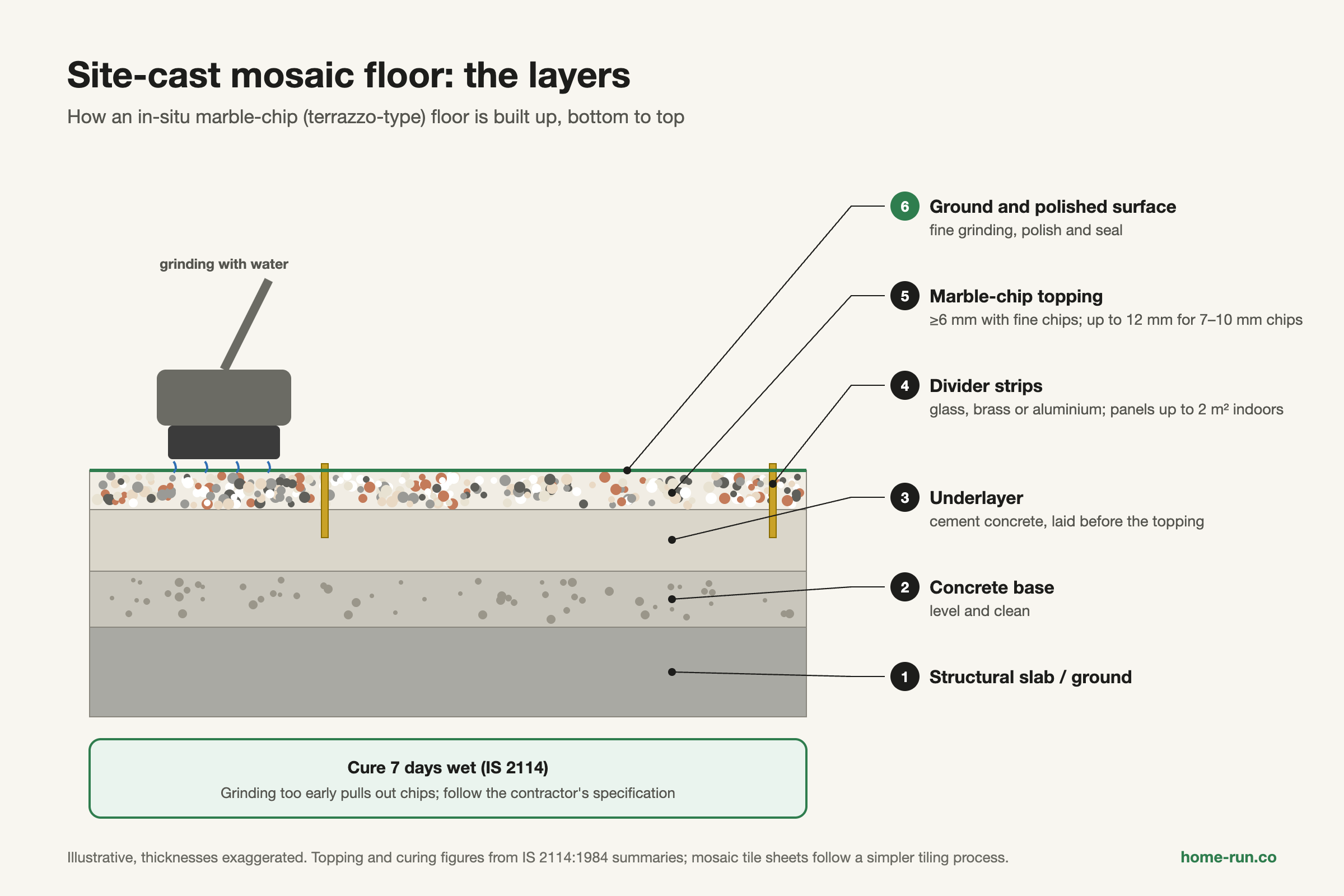
A site-cast mosaic floor is laid in layers: a concrete base, an underlayer, divider strips, a chip topping, then grinding and polishing. Tile sheets follow a simpler tiling process.
Prepare the base
Lay a level, clean concrete base and fix the finished floor level.
Set divider strips
Fix glass, brass or aluminium strips to form panels of up to 2 m² indoors.
Lay the underlayer and topping
Spread the cement concrete underlayer, then the chip topping while the underlayer is still plastic.
First grinding
Grind with coarse stones and water until the chips show evenly.
Fill pinholes and cure
Apply matching cement slurry and keep the floor wet for several days.
Fine grinding and polish
Grind with finer stones, then polish and seal before handover.
IS 2114:1984, the Indian code for laying in-situ terrazzo floors, sets 7 days of wet curing. It also calls for a topping of at least 6 mm with fine chips. Larger chips need a thicker topping, up to 12 mm for 7 to 10 mm chips.
Sources differ. Some guides start the first grind about 36 hours after laying; summaries of IS 2114 say wait 5 to 7 days. Grinding too early pulls out chips, so follow your contractor's specification.
For mosaic tile sheets, the fitter levels the screed, spreads adhesive with a notched trowel, presses in the sheets and grouts after the adhesive sets. Use the adhesive and grout the tile maker recommends, especially for glass and stone.
Signs of a poorly laid mosaic floor
- Hollow sound when tapped
- Uneven edges between tiles or panels (lippage)
- Visible gaps along sheet seams
- Pinholes or patchy shine on site-cast floors
How Do You Maintain Mosaic Flooring?
Maintain mosaic flooring by sweeping daily, mopping with a pH-neutral cleaner and resealing grout and stone when water stops beading.
- Sweep or vacuum grit daily; sand scratches the polish.
- Mop with lukewarm water and a mild, pH-neutral floor cleaner.
- Avoid acid cleaners, vinegar and lemon on marble chips; acids etch the surface.
- Scrub grout lines with a soft brush every few weeks in bathrooms.
- Reseal cement grout and natural stone as the maker advises.
- Re-grind and re-polish a dull site-cast floor rather than replacing it.
Mosaic Flooring vs Regular Tiles: Which Should You Choose?
Choose mosaic flooring for wet areas, small rooms and decorative panels. Choose large vitrified tiles for big rooms where fast laying and less grout matter more.
Mosaic flooring
Wet areas and accentsSmall pieces or site-cast chips.
- Better grip from many grout lines
- Follows slopes to bathroom drains
- Custom patterns and inlays
- Can be re-polished for decades
- More grout to clean
Large regular tiles
Large roomsVitrified or ceramic tiles of 60 cm and above.
- Fewer grout lines, easier mopping
- Faster to lay
- Uniform factory finish
- Broken tiles are replaced, not polished
- Can be slippery in wet areas
Before you buy, confirm these points with the dealer:
- Floor rating and slip resistance on the datasheet
- Sheet size and mesh backing type
- Same shade and batch number for every box
- Recommended adhesive and grout
- Returns policy for unopened boxes
Planning a new floor in Bengaluru?
Order tiles, adhesive and grout with a GST invoice and delivery across Bengaluru.