On this page
- How Do Interlocking Bricks Work?
- What Types and Sizes Are Available?
- How Are the Blocks Made?
- Are Interlocking Bricks Strong Enough for a House?
- What Does a Wall Cost Compared with Red Bricks?
- What Are the Pros and Cons of Each Type?
- How Do Masons Lay the Blocks?
- How Do You Buy Good Blocks and Spot Poor Quality?
- Interlocking bricks lock together with keys and grooves, so walls need little or no mortar between courses.
- Two families exist: concrete blocks and stabilised mud (soil-cement) blocks. Their strength and damp resistance differ.
- Interlocking paver blocks are a flooring product, not a wall brick.
- Load-bearing interlocking walls need steel bars and grout in the holes and an engineer's design.
- Per piece they cost more than red bricks; the saving comes from mortar, plaster and labour.
Interlocking bricks are bricks or blocks shaped with projections (shear keys) and matching grooves, so each course locks into the one below. Masons stack them dry or with a very thin binder layer instead of a full mortar bed. You will see them in house walls, compound walls and low-cost housing across South India.
How Do Interlocking Bricks Work?
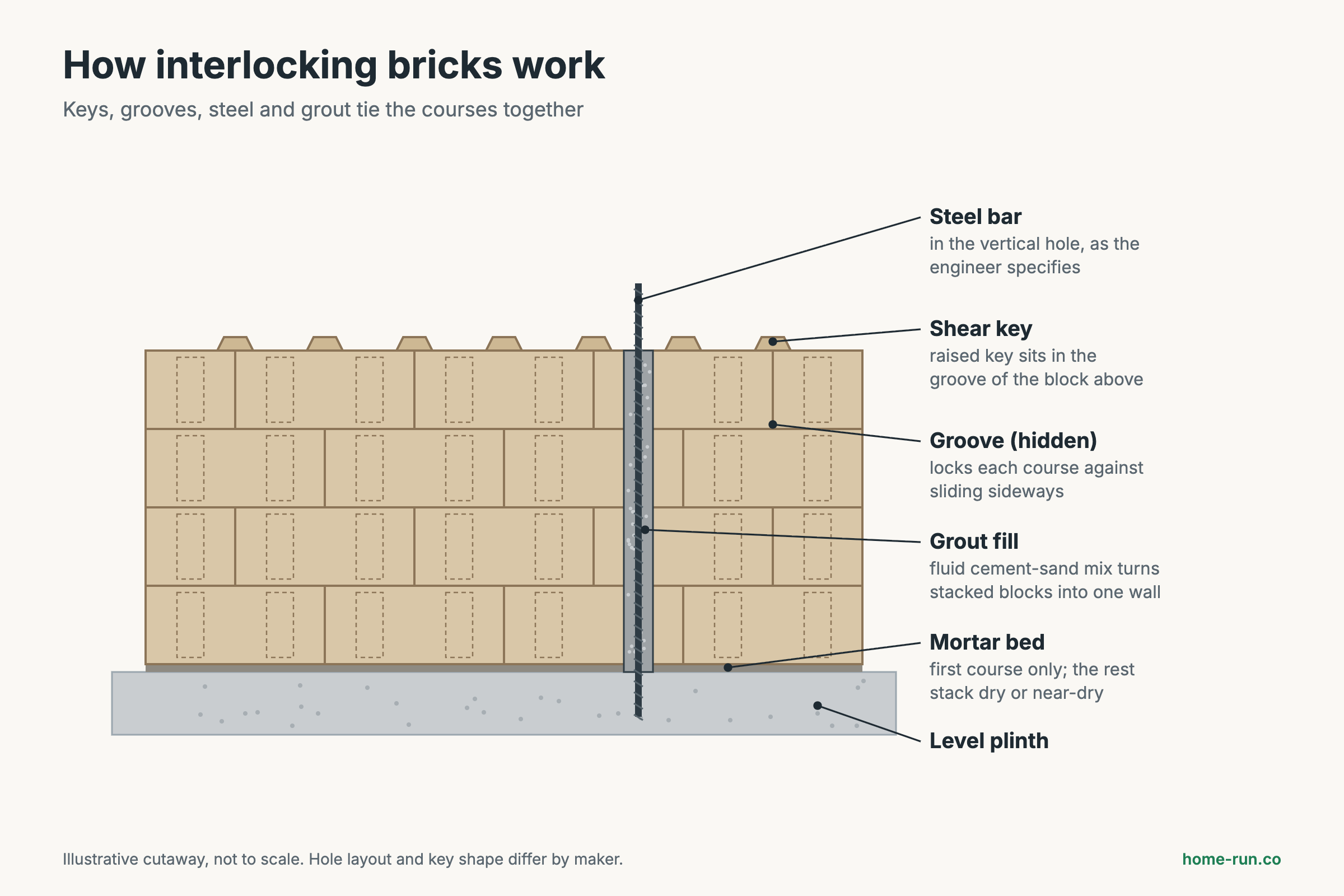
Interlocking bricks work by shape. A raised key on top of each block sits in a groove under the block above, which stops the course from sliding sideways.
Many systems also have vertical holes for steel bars and grout (a fluid cement-sand mix), which turn stacked blocks into a reinforced wall.
Interlocking paver blocks (zig-zag, hexagon) are laid on sand for driveways and courtyards, as in our guide to paving blocks. Interlocking retaining-wall blocks hold back soil. Neither is a wall brick for a house.
What Types and Sizes Are Available?
Interlocking bricks come in two main wall types: concrete (cement, sand and stone dust) and stabilised mud (soil pressed with a little cement or lime). Sizes vary by maker and machine mould.
Common interlocking brick types and sizes
Sizes are examples; confirm with your supplier| Type | Example size | Typical use | Standard to ask about |
|---|---|---|---|
| Concrete interlocking block Most sold | 12 × 6 × 4 in (Bengaluru listing) | House walls, compound walls | IS 2185 (Part 1):2005 |
| Mud (soil-cement) interlocking brick | 9 × 4 × 3 in (Bengaluru listing) | Low-rise homes, farmhouses | IS 1725, stabilised soil blocks |
| Hollow interlocking earth block | 245 × 245 × 95 mm (Auroville) | Reinforced walls up to 2 storeys | IS 1725 plus engineer's design |
| Interlocking paver block Floors only | 60 mm or 80 mm thick | Driveways, courtyards | IS 15658:2006 |
How Are the Blocks Made?
Interlocking bricks are pressed and cured, not fired in a kiln.
- Grade the raw material: soil or laterite is sieved; concrete mixes use cement, sand and stone dust.
- Mix: the stabiliser and water are blended in to an even, damp mix.
- Press: a manual or hydraulic press packs the mix into a mould that forms the keys and grooves.
- Cure: blocks are kept damp so the cement hardens. Guidance on IS 1725 soil blocks suggests at least 28 days.
Press pressure and curing decide strength, which is why quality varies between suppliers. Stabilised mud block technology was developed at the Indian Institute of Science (IISc) in Bengaluru by Prof. K. S. Jagadish's ASTRA team.
Are Interlocking Bricks Strong Enough for a House?
Interlocking bricks are strong enough for low-rise homes when the blocks meet the code and the wall is reinforced as designed. They are not a shortcut past a structural engineer.
- Concrete blocks: IS 2185 (Part 1):2005, the code for concrete masonry units, caps water absorption at 10% and sets minimum strength by grade.
- Stabilised soil blocks: IS 1725, the code for soil-based blocks, sets wet compressive strength classes from about 2 N/mm² and caps water absorption at 15%.
- Height: the Auroville Earth Institute rates its reinforced hollow interlocking systems at up to two storeys; some variants are single-storey only.
- Earthquakes: Gujarat approved the Auroville system up to two floors for rebuilding after the 2001 Kutch earthquake.
Interlocking walls still need a level plinth beam, lintels over openings and steel at corners. Earth blocks have poor bending and shear strength without that reinforcement.
What Does a Wall Cost Compared with Red Bricks?
Interlocking bricks cost about the same as red bricks per square foot of wall in Bengaluru. The saving, if any, comes from less mortar, thinner plaster and faster laying.
Red brick figures use a 230 × 75 mm face with a 10 mm joint, a thinner 110 mm wall than the 150 mm block, and InfraLens Bengaluru prices from May 2026. Sellers often claim 25–30% overall savings; treat that as a claim until you price both walls.
If you plaster the wall anyway, or your mason has never laid interlocking blocks, expect little or no saving.
Materials for your walls
Order masonry materials with a GST invoice and delivery across Bengaluru.
What Are the Pros and Cons of Each Type?
The main advantages of interlocking bricks are faster laying and less mortar; the main drawbacks are the need for precision and uneven supplier quality.
Concrete interlocking
Wetter sitesDenser and better against rain.
- Higher strength from cement and stone dust
- Lower water absorption
- Can stay exposed with a sealer
- More cement per block
Mud interlocking
Low-rise, dryUses local soil and less cement.
- Lower embodied energy
- Earthy finish without paint
- Needs protection from rain and damp
- Strength varies with the soil
- First-course errors: a small slip at the base shows up all the way up the wall.
- Unskilled masons: crews used to red bricks may over-mortar or miss grout holes.
- Poor curing: under-cured blocks crack and chip at the keys.
- Services: conduits and pipes need planning before stacking, not chasing later.
How Do Masons Lay the Blocks?
You lay interlocking bricks on a level plinth, bed only the first course in mortar, then stack, reinforce and grout.
Level plinth
Check the plinth beam with a level; fix any high spots first.
First course in mortar
Bed and level every block; this course sets the whole wall.
Stack and plan services
Dry-stack or use the thin binder; run conduits through holes as you go.
Lintels and steel
Place lintels over openings and steel bars where the drawings show.
Grout and protect
Fill reinforced holes with grout, then seal, point or plaster exposed faces.
Before the monsoon, give mud blocks a damp-proof course at plinth level, wide roof overhangs and a water-repellent coat or plaster outside.
How Do You Buy Good Blocks and Spot Poor Quality?
You buy interlocking bricks safely by asking for test reports, checking a sample and getting two or three quotes for the same size and strength.
- Test report: compressive strength and water absorption against IS 2185 or IS 1725.
- Curing age: ask when the batch was made; avoid fresh blocks.
- Size check: stack five blocks; keys should seat without gaps or rocking.
- Edges: reject blocks with broken keys or crumbling corners.
- Soak test: weigh a dry block, soak 24 hours and reweigh to compare with the code limit.
- Terms: confirm minimum order, unloading and GST on the invoice.
An ISO 9001:2015 certificate covers a maker's process, not block strength. For other wall options, compare fly ash bricks, and see what masonry means for the basics.