


On this page
- What Are Paving Blocks and Why Are They So Common in India?
- Which Paver Materials Can You Buy?
- Which Shape, Pattern and Finish Should You Pick?
- What Size and Thickness of Paving Block Do You Need?
- How Much Do Paving Blocks Cost?
- How Is a Paver Driveway Laid?
- How Do You Check Quality and Pick a Reliable Supplier?
- How Do You Maintain a Paved Surface?
- What Should You Do Before You Order?
- Paving blocks are precast units laid on sand over a compacted base, locked together by joint sand.
- Concrete blocks to IS 15658 are the default pick for Indian homes and roads.
- Choose 60 mm for paths, 60–80 mm for home driveways and 100 mm or more for heavy vehicles.
- Bengaluru supply prices were about ₹31–43 per sq ft for 60–80 mm blocks in May 2026, before laying.
- The base, edge restraint and compaction decide how long the surface lasts.
Paving blocks are small precast units, usually concrete, laid on a thin sand bed over a compacted stone base, with fine sand swept into the joints so they lock together. You see them on driveways, society roads, parking lots and footpaths because they carry load, drain easily and can be lifted and relaid.
What Are Paving Blocks and Why Are They So Common in India?
Paving blocks are load-bearing units that form a flexible surface: each block is separate, but the sand-filled joints make them work together and spread a wheel load to their neighbours.
That suits Indian sites well. When a water line or cable has to be dug up, you lift the blocks and relay them instead of breaking a slab. The joints let some rain soak away, and textured faces give grip during the monsoon.
A paver block is thick and load-rated. A decorative paver tile is thinner and meant for foot traffic. A cast-in-place concrete slab is one poured piece that cracks and must be broken out for repairs. Ask which one you are being quoted.
Which Paver Materials Can You Buy?
You can buy paving blocks in concrete, clay, natural stone, rubber, recycled plastic and open-grid grass designs, and concrete is the default pick for most Indian homes and roads.
Paving block materials compared
Relative cost, not rupee figures| Material | Typical use | Cost tier | Upkeep |
|---|---|---|---|
| Concrete Default pick | Driveways, roads, parking, footpaths | Low to medium | Low; re-sand joints |
| Clay | Heritage-look paths and patios | Medium | Low; can chip at edges |
| Natural stone | Premium patios and entrances | High | Medium; sealing on some stones |
| Rubber | Play areas, gyms, terraces | Medium | Low; not for cars |
| Recycled plastic Check rating | Light-duty paths | Low to medium | Low; ask for load data |
| Grass / permeable Eco | Parking where drainage or greenery matters | Medium | Grass needs watering and trimming |
If a car or truck will drive on it, buy concrete blocks made to IS 15658 and ask for the test report. Use other materials where only people walk.
Which Shape, Pattern and Finish Should You Pick?
Pick zigzag, I-shape or S-shape blocks for areas where vehicles drive and turn, and rectangular or square blocks for paths and gardens where looks matter more.
- Zigzag, I-shape (dumbbell), S-shape: shaped on all sides, so they grip neighbours in several directions. IRC:SP:63 notes that blocks dentated on all four faces can generally be laid in herringbone bond.
- Rectangular (brick-style): versatile; lay in herringbone for driveways or stretcher bond and basket weave for paths.
- Square, hexagonal, cobble: mostly decorative, best for walkways, patios and gardens.
Laying pattern is separate from shape. Herringbone, with blocks at 45 or 90 degrees, resists creeping where wheels brake and turn.
For finish, rough, matt or shot-blasted faces give better grip on wet ground than glossy ones. IS 15658 sets a minimum skid resistance value of 55. Mid-grey, red or mixed colours hide tyre marks and dust better than white or pale yellow.
What Size and Thickness of Paving Block Do You Need?
The thickness of paving blocks should match the heaviest traffic on the surface: 60 mm for footpaths, 60–80 mm for home driveways and residential streets, and 100–120 mm for heavy vehicles.
Paver thickness and grade by use
From IRC:SP:63 Table 1 and IS 15658 Annex A| Use | Thickness | Grade (IRC:SP:63) |
|---|---|---|
| Footpath, garden path, cycle track | 60 mm | M-30 |
| Car porch, home driveway, residential street Default pick | 60–80 mm | M-40 |
| Bus and truck parking, industrial street | 80–100 mm | M-40 |
| Arterial road, container yard, warehouse | 100–120 mm | M-50 |
| Thin decorative tile on a driveway Avoid | — | Not load-rated |
An M-30 or M-40 label is the characteristic compressive strength in MPa, not the M-grade of slab concrete like M20. Ask the supplier for the grade and a recent test report. A thicker block is not automatically stronger, and a strong block still fails on a poor base.
How Much Do Paving Blocks Cost?
Paving blocks in Bengaluru cost about ₹31 per sq ft for 60 mm and ₹43 per sq ft for 80 mm as typical prices, according to InfraLens in May 2026, with dealer-to-retail ranges of ₹19–43 and ₹26–60. These are supply-only figures.
- Thickness and grade: more concrete and cement per block raises the price.
- Shape, colour and finish: glossy, coloured and shot-blasted blocks cost more than plain grey.
- Volume and distance: large orders and nearby plants bring the rate down.
- Laying: excavation, sub-base, sand, edge restraint and labour come on top.
Studio Matrx (June 2026) gives a national guide of ₹30–45 per sq ft for 50–60 mm M30 blocks and ₹40–65 for 65–80 mm blocks, with laying at ₹25–60 per sq ft extra. Paver blocks attract 18% GST under HSN 6810. Always check whether a quote is per piece, per sq ft or per sq m, and whether GST is included.
Paving blocks and base materials
Blocks, cement and sand for driveways and paths, delivered across Bengaluru with a GST invoice.
How Is a Paver Driveway Laid?
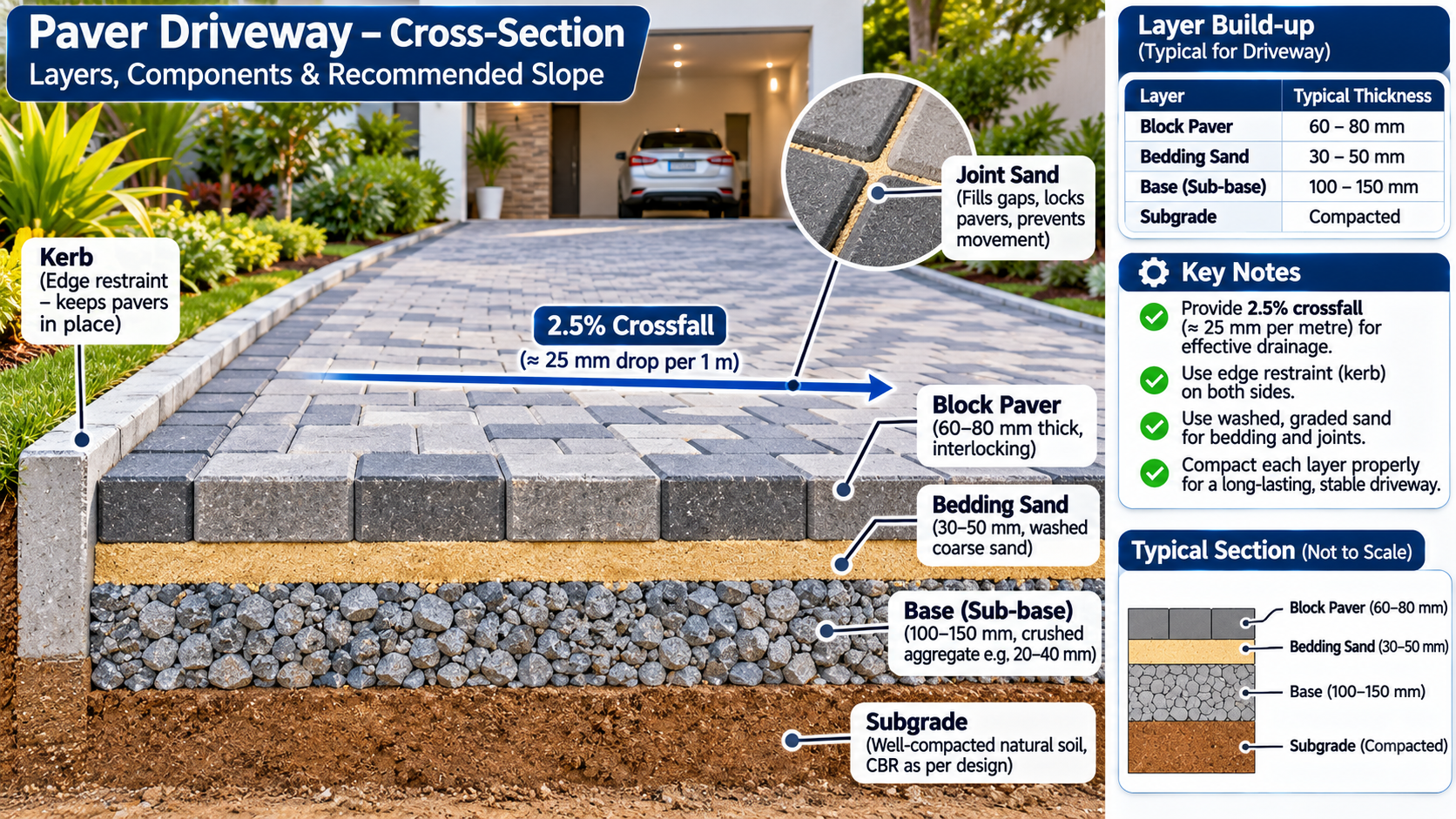
Paving blocks are installed on a compacted stone base and a 30 mm sand bed, laid in pattern, closed with an edge restraint, then vibrated with joint sand.
Mark and excavate
Dig to the depth of base, sand and block, and set levels so water runs off.
Build and compact the base
IRC:SP:63 suggests about 200 mm of base for footpaths and car parks; residential streets need more.
Fix the edge restraint
Kerb stones or a concrete edge strip stop blocks spreading outwards.
Spread bedding sand
Screed 30 to 50 mm loose so it compacts to about 30 ± 5 mm.
Lay and cut blocks
Keep joints around 2–3 mm and cut blocks to fit at the edges.
Sand and vibrate
Sweep fine sand into joints and make at least two passes with a plate compactor.
Give the surface a crossfall of about 2.5% and keep it at least 5 mm above drains and manhole covers. If you want rain to soak into the ground instead, pair permeable pavers with rainwater harvesting.
DIY
Small patios and pathsWorks for a foot-traffic area you can level by hand.
- Lower cost on a small area
- Plate compactor and cutter must be hired
- Uneven settling is a real risk
- Not suited to driveways
Hire an installer
Recommended for drivewaysBest wherever cars or heavier vehicles will drive.
- Correct base depth and compaction
- Own tools and trained crew
- Faster on large areas
- Ask for a written base specification
How Do You Check Quality and Pick a Reliable Supplier?
Check paving blocks for size, edges, colour and cracks on delivery, and buy from a supplier who can show an IS 15658 test report for the grade you ordered.
- Blocks in a batch match in size and thickness
- Edges and corners are sharp and whole
- Colour is even across the whole batch
- No visible cracks (IS 15658 allows none wider than 0.5 mm)
- Test report shows compressive strength and water absorption
- You have seen a finished site the supplier supplied
- Supplier cannot state the strength grade
- Surface crumbles or feels sandy when rubbed
- Only a vague "BIS-compliant" claim with no report
- Many chipped corners in the first stack
How Do You Maintain a Paved Surface?
Maintain paving blocks by sweeping, washing, topping up joint sand and replacing any damaged block on its own.
- Sweep often and wash with water; scrub oil stains early.
- Top up joint sand when the gaps look empty, especially after heavy rain.
- Remove moss and weeds in the monsoon before roots widen the joints.
- Lift a cracked or sunken block, correct the sand under it and relay.
Sealing depends on the finish and how exposed the area is. For a garage or workshop floor that needs a jointless, oil-resistant surface instead, see our epoxy flooring guide.
Interlocking pavers
Residential lanesBest where utilities, parking and slow traffic share the street.
- Lift and relay after digging
- No hot-mix plant needed
- Resists fuel and oil softening
- Usable soon after laying
Bitumen road
Fast through-roadsSuits long, continuous stretches with steady traffic.
- Smooth, quiet ride
- Quick to lay over long lengths
- Patches show after repairs
- Needs hot mix and a paver machine
What Should You Do Before You Order?
Order paving blocks once you have measured the area, fixed the thickness for your heaviest vehicle and chosen the shape and finish.
- Measure the area and add the wastage your installer recommends.
- Pick thickness and grade from the table above.
- Choose shape, colour and finish.
- Get quotes on the same basis: per sq ft, with or without GST and laying.