On this page
- What Is a Spirit Level and Why Is It Called That?
- How Does a Spirit Level Work?
- What Are the Types of Spirit Level Tools?
- How Do You Read a Spirit Level Correctly?
- How Do You Use a Spirit Level on Floors, Walls and Frames?
- How Accurate Is a Spirit Level, and How Do You Check It?
- Can You Use Your Phone as a Spirit Level?
- How Do You Choose a Spirit Level in India?
- What Are the Alternatives to a Spirit Level?
- A spirit level (bubble level) is a hand tool that shows level and plumb with an air bubble in a sealed vial.
- The vial holds alcohol or a mineral spirit, not water, so the bubble moves fast and the liquid does not freeze.
- Good aluminium levels sold in India are rated about 0.5 mm/m; budget ones around 1 mm/m.
- Check any level with the 180° flip test before you trust it on tiles or frames.
- Choose length to suit the job: 300 mm for small fittings, 600 mm for tiling and shelves, longer for walls and frames.
A spirit level is a tool that tells you whether a surface is truly horizontal (level), truly vertical (plumb) or, on some models, at 45°. It does this with a small air bubble trapped in a liquid-filled vial. The same tool is also called a bubble level.
What Is a Spirit Level and Why Is It Called That?
A spirit level is named after the liquid in its vial, which is usually an alcohol, or "spirit". Some makers, such as Johnson Level, describe it as a mineral spirit solution.
A spirit level and a bubble level are the same tool. Each vial checks one thing:
- Horizontal vial: level, such as a slab, shelf or tile bed.
- Plumb vial: vertical, such as a wall, column or door chaukhat.
- 45° vial: angled work such as braces, found on many torpedo levels.
On Indian sites you will see the spirit level in tiling, brickwork, shuttering and fixing door and window frames. Masons use it alongside a plumb bob, as covered in our guide to what masonry means.
Level means flat like a tabletop. Plumb means straight up like a wall edge. Always read the vial that matches the direction you are checking.
How Does a Spirit Level Work?
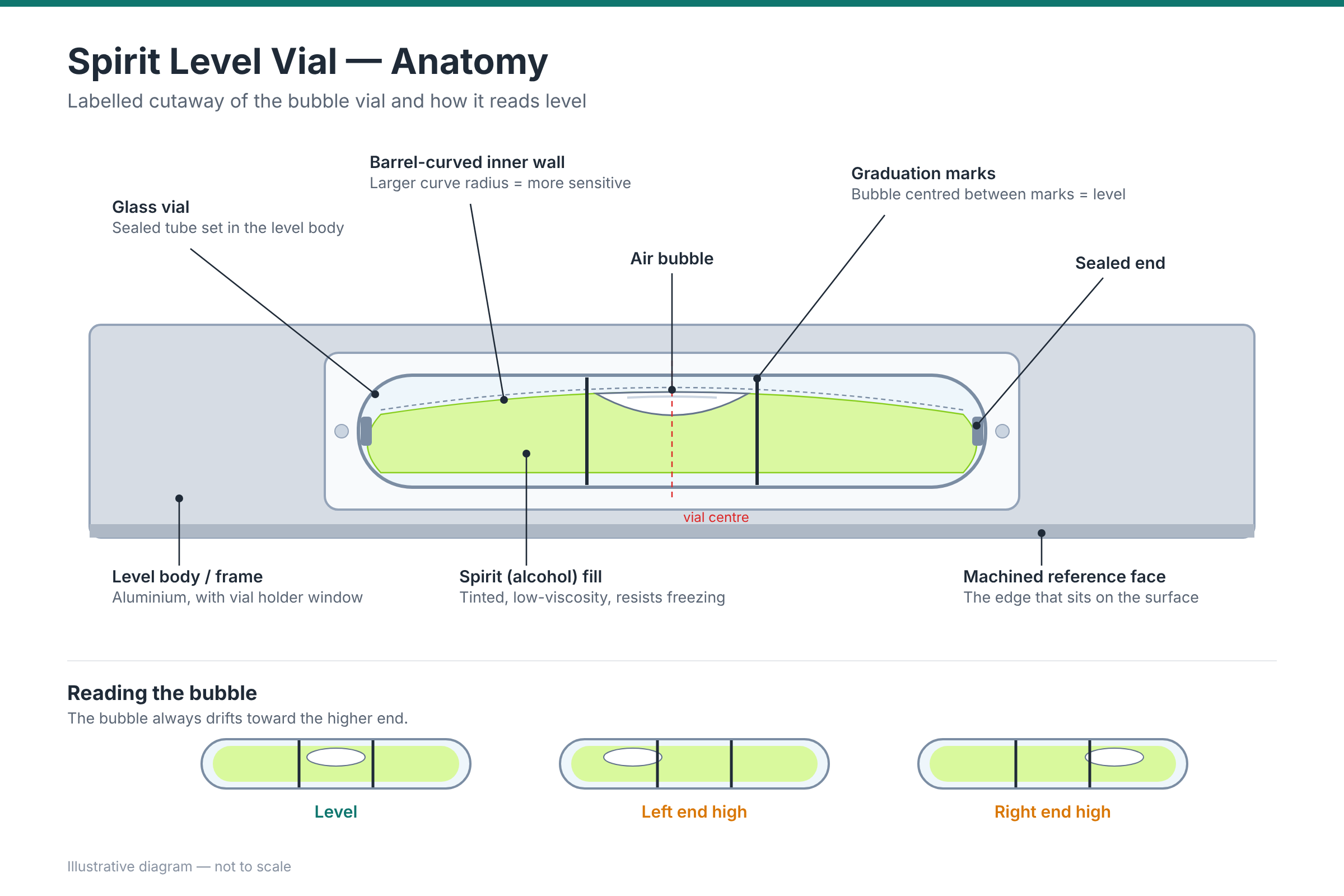
A spirit level works because the air bubble always rises to the highest point of a slightly curved vial. When the bubble sits centred between the two marked lines, the base is level.
A spirit level has four parts:
- Body: the frame, usually extruded aluminium in a box or I-beam shape, with a flat measuring edge.
- Vial: a sealed glass or acrylic tube with a very slight curve, so the bubble settles at the centre.
- Liquid: alcohol-based spirit, often tinted yellow-green so the bubble is easy to see.
- Bubble: the air gap that moves toward the higher end when you tilt the tool.
Alcohol is used instead of water because it has low viscosity and low surface tension. The bubble moves quickly and settles accurately, and the liquid will not freeze and crack the vial. Johnson Level rates its vials for -20 °F to 130 °F (about -29 °C to 54 °C).
What Are the Types of Spirit Level Tools?
The main types of spirit level tools are box-section, I-beam, torpedo, magnetic, line, digital and post levels. Laser levels and phone apps do a similar job but are not spirit levels.
Which spirit level for which job
Typical lengths from Indian and global listings| Type | Typical size | Best for | Watch out |
|---|---|---|---|
| Box-section aluminium Default pick | 300–1200 mm | Tiling, shelves, frames, brickwork | A bent body ruins accuracy |
| I-beam | 600–1200 mm | General site work, lighter to carry | Less rigid than box-section |
| Torpedo Tight spaces | 9–12 in (about 230–300 mm) | Plumbing, electrical boxes, small fittings | Short base misreads long surfaces |
| Magnetic | 300–600 mm | Steel pipes, beams, metal frames | Magnet picks up steel dust |
| Line level Budget | Pocket size | String lines on long outdoor runs | Rough check only |
| Digital level | 300–600 mm | Reading slope as a number, often to 0.1° | Needs batteries and calibration |
| Post level | Small, wraps a post | Fence and pergola posts, plumb two ways | Single-purpose tool |
Engineer's precision levels and surveyor's levels are specialist instruments. In India, IS 5706:1993 covers spirit levels for precision engineering, not everyday builder's levels.
If you buy one spirit level, buy a 600 mm aluminium box-section level with horizontal and plumb vials. A torpedo level is a useful second tool.
How Do You Read a Spirit Level Correctly?
You read a spirit level by looking straight at the vial and checking that the bubble sits exactly between the two lines.
- Set the measuring edge on a clean surface, free of dust, mortar or tile spacers.
- Pick the right vial: horizontal for floors and shelves, plumb for walls and frames.
- Bring your eye level with the vial. Viewing from an angle (parallax) makes the bubble look off-centre.
- If the bubble drifts toward one end, that end is higher.
A bubble touching one line looks close enough, but over a long tile run or door frame that small tilt adds up to a visible gap.
How Do You Use a Spirit Level on Floors, Walls and Frames?
You use a spirit level by placing it along the surface, reading the correct vial, then turning it end for end to confirm the reading.
- Floor, slab or tile bed: check in two directions at 90° to each other, then diagonally. Tap tiles down at the high end. The same checks apply to outdoor paving blocks laid on a sand bed.
- Wall, column or door frame: hold the level upright and read the plumb vial. Check both jambs of a chaukhat and the top member before the frame is grouted in.
- Shelf or picture frame: mark one bracket hole, set the level on a pencil line and mark the second hole only when the bubble is centred.
Some surfaces should not be dead level. Bathroom floors and balconies need a deliberate fall toward the drain, and you can set that with the same tool.
Use the fall your plumber or drawings specify; 1 in 100 is used here only to show the arithmetic.
How Accurate Is a Spirit Level, and How Do You Check It?
A good spirit level is accurate to about 0.5 mm per metre, which Johnson Level gives as its best grade (about 0.029°). Its next grade is 0.75 mm/m. In India, Freemans lists 0.5 mm/m and 1 mm/m models at 600 mm.
Accuracy is how close the reading is to true. Sensitivity is how far the bubble moves for a small tilt. A sensitive vial is not automatically an accurate one.
Use the flip test before any tiling or frame work:
- Place the level on a flat, firm surface and draw pencil marks at both ends.
- Note exactly where the bubble sits against the lines.
- Turn the level 180° end for end and line it up with the same marks.
- If the bubble sits in the same place, the vial is true. If it shifts, the level is out.
Repeat the test against a wall for the plumb vial, flipping the level face to face.
- Readings change after the flip test
- Body is bent, dented or has a chipped measuring edge
- Vial is loose, cloudy or leaking
- The level has been dropped from height
Most budget levels have fixed vials and should be replaced when they fail. Adjustable-vial models can be reset: move the vial to remove half the difference, then repeat the flip test.
Can You Use Your Phone as a Spirit Level?
Yes, you can use your phone as a spirit level for quick home jobs, but not for site work. The phone's motion sensor imitates a bubble on screen.
Phone spirit level app
Quick checksiPhone: Level inside the Measure app. Android: search "bubble level" in the Google app.
- Free and always with you
- Good for photo frames and appliances
- Short base, affected by a phone case
- Accuracy depends on sensor calibration
Physical spirit level
Site workThe right tool for tiles, frames and masonry.
- Long, straight measuring edge
- Rated accuracy you can flip-test
- Survives dust, water and knocks
- Plumb and level in one tool
How Do You Choose a Spirit Level in India?
Choose a spirit level by matching its length to the job, then checking the body, the vials and the rated accuracy.
- Length: 300 mm for small fittings, 600 mm for tiling and shelves, 1000–1200 mm for walls, door frames and brickwork.
- Body: aluminium box-section stays straight longer than plastic or wood.
- Accuracy: look for 0.5 mm/m on the label or listing.
- Vials: clear, firmly fixed, with sharp graduation lines.
- Extras: rubber end caps for drops, a magnetic base for steel work.
Common brands in Indian hardware stores include Freemans, Taparia, Stanley, Bosch and Stabila. A mid-range level from a known brand usually holds its accuracy longer than the cheapest option. If you also fit pipes, see our guide to the pipe wrench.
Tools and materials for level work
Order hardware, tiles and adhesive with a GST invoice and delivery across Bengaluru.
What Are the Alternatives to a Spirit Level?
The main alternatives to a spirit level are the plumb bob, the water level, the laser level and the digital level.
- Plumb bob: a pointed weight on a string. Use it for tall walls and columns.
- Water level (tube level): a clear water-filled pipe. The water stands at the same height at both ends, so masons use it to carry plinth and lintel levels across a site.
- Laser level: projects a level line across a room. Use it for false ceilings and long tile runs.
- Digital level: shows the angle as a number. Use it when you need an exact slope.
Fill the tube with no air bubbles, and work in the cooler part of the day. Heat can stretch the tube and throw off your marks.