


On this page
- What Is the Masonry Meaning in Simple Words?
- What Is the Masonry Meaning in Hindi?
- Where Does the Word Masonry Come From?
- What Are the Main Types of Masonry?
- What Is the Masonry Meaning in Civil Engineering: Load-Bearing or Infill?
- What Materials and Tools Does Masonry Use?
- How Does a Masonry Wall Go Up?
- What Is Masonry Used For?
- What Are the Advantages and Limitations of Masonry?
- How Is Masonry Different From Freemasonry?
- Planning a Masonry Job? What Should You Do Next?
- Masonry means building with units such as bricks, stones or blocks, bound together with mortar.
- In Hindi the work is called चिनाई (chinai) or राजगीरी (rajgiri), and the mason is a rajmistri.
- The main types are brick, stone, concrete block and glass block or veneer masonry.
- Most new Indian buildings use masonry as infill inside an RCC frame, not to carry the floors.
- Freemasonry shares the name but is a fraternal order, not construction.
The masonry meaning in construction is simple: masonry is building work made by laying individual units, such as bricks, stones or concrete blocks, and binding them together with mortar to form walls, foundations, arches and similar structures. The same word also names the finished wall and the mason's trade.
What Is the Masonry Meaning in Simple Words?
Masonry means construction with separate units laid in layers and joined with mortar. Merriam-Webster defines it as something built from materials used by masons, and also as the art, trade or work of a mason.
In civil engineering, masonry is a structural system. Units and mortar together are strong when squeezed (compression) but weak when pulled or bent (tension), so engineers design masonry to carry loads mostly by pressing down.
The person who does masonry is a mason. On Indian sites you will hear mistri or rajmistri. The word is pronounced MAY-sun-ree.
If a wall is built piece by piece from bricks, blocks or stones with mortar in the joints, it is masonry. If it is poured into formwork as one piece, it is concrete work, not masonry.
What Is the Masonry Meaning in Hindi?
In Hindi, masonry is चिनाई (chinai) or राजगीरी (rajgiri), and the mason is a राजमिस्त्री (rajmistri).
Masonry terms in Hindi and on site
From HinKhoj and Multibhashi dictionaries| English | Hindi (Devanagari) | Transliteration | Site usage |
|---|---|---|---|
| Masonry (the work) | चिनाई | chinai | Brick or stone laying |
| Masonry (the trade) | राजगीरी | rajgiri | The mason's craft |
| Mason | राजमिस्त्री | rajmistri | Often shortened to mistri |
Where Does the Word Masonry Come From?
The word masonry comes from "mason", the stoneworker, and Merriam-Webster dates its first known use in English to the 13th century.
Here is how it is used in a sentence:
- The old fort's stone masonry has stood for centuries.
- The contractor quoted separately for masonry and plastering on the second floor.
- After the storm, falling masonry blocked the lane.
Related words include mason, masonic and stonework. Close synonyms are brickwork, blockwork and stonework.
What Are the Main Types of Masonry?
The main types of masonry are brick masonry, stone masonry, concrete block masonry and glass block or veneer masonry, named after the unit used.
Types of masonry compared
Qualitative comparison| Type | Unit | Where you see it |
|---|---|---|
| Brick masonry Most common | Burnt clay or fly ash bricks (IS 1077) | House walls, compound walls, parapets |
| Rubble stone masonry | Rough or uncut stones | Foundations, retaining and boundary walls |
| Ashlar stone masonry Premium | Accurately cut, dressed stones with thin joints | Temples, heritage and facade work |
| Concrete block masonry | Solid, hollow or AAC blocks (IS 2185) | Infill walls in RCC frames, fast-build projects |
| Glass block and veneer Decorative | Glass blocks, thin brick or stone facing | Light walls, cladding over a backing wall |
Brick masonry and block masonry are not the same. Blocks are larger, so a wall goes up with fewer joints, and many are hollow or aerated to cut weight.
Use brick for house walls and facing, concrete or AAC blocks for fast infill walls in framed buildings, and stone for foundations, landscaping and heritage-style work.
What Is the Masonry Meaning in Civil Engineering: Load-Bearing or Infill?
A load-bearing masonry wall carries the floors and roof down to the foundation, while a non-load-bearing wall carries only its own weight and divides space.
Load-bearing masonry
Older and low-rise homesThe walls are the structure.
- Carries slab and roof loads
- Thicker walls on lower floors
- Openings must be planned early
- Cannot be removed without engineering advice
Infill or partition masonry
Most new Indian buildingsAn RCC frame carries the loads; walls fill the gaps.
- Carries only its own weight
- Thinner walls or lighter blocks possible
- Layout changes are easier
- Still needs ties and good bond
Unreinforced masonry has no steel. Reinforced masonry has steel bars or bands added so walls resist bending and shaking. In India, IS 1905 covers the structural use of unreinforced masonry.
Plain masonry cracks easily when an earthquake shakes it sideways. In earthquake-prone regions, an engineer should decide on reinforcement or concrete bands before you build.
What Materials and Tools Does Masonry Use?
Masonry uses units (bricks, blocks or stones), a binder (mortar made of cement or lime, sand and water) and a few hand tools.
- Units: burnt clay bricks, fly ash bricks, solid or hollow concrete blocks, AAC blocks and natural stone.
- Mortar: the paste spread between units. It bonds them, fills gaps and spreads load evenly. Mortar has no coarse aggregate, which is what separates it from concrete.
- Lime mortar vs cement mortar: lime is softer and more flexible and suits heritage work; cement is harder and sets faster.
Bricks are laid in a bond, a pattern where vertical joints in one course do not line up with the course below. A stretcher shows its long face; a header shows its short end. English bond alternates header and stretcher courses.
- Trowel for spreading mortar
- Plumb bob for checking vertical
- Spirit level for checking horizontal
- Line and pins to keep each course straight
Mortar mix ratios depend on the wall, the unit and the project specification. Follow your engineer's drawings rather than a single "standard" ratio.
How Does a Masonry Wall Go Up?
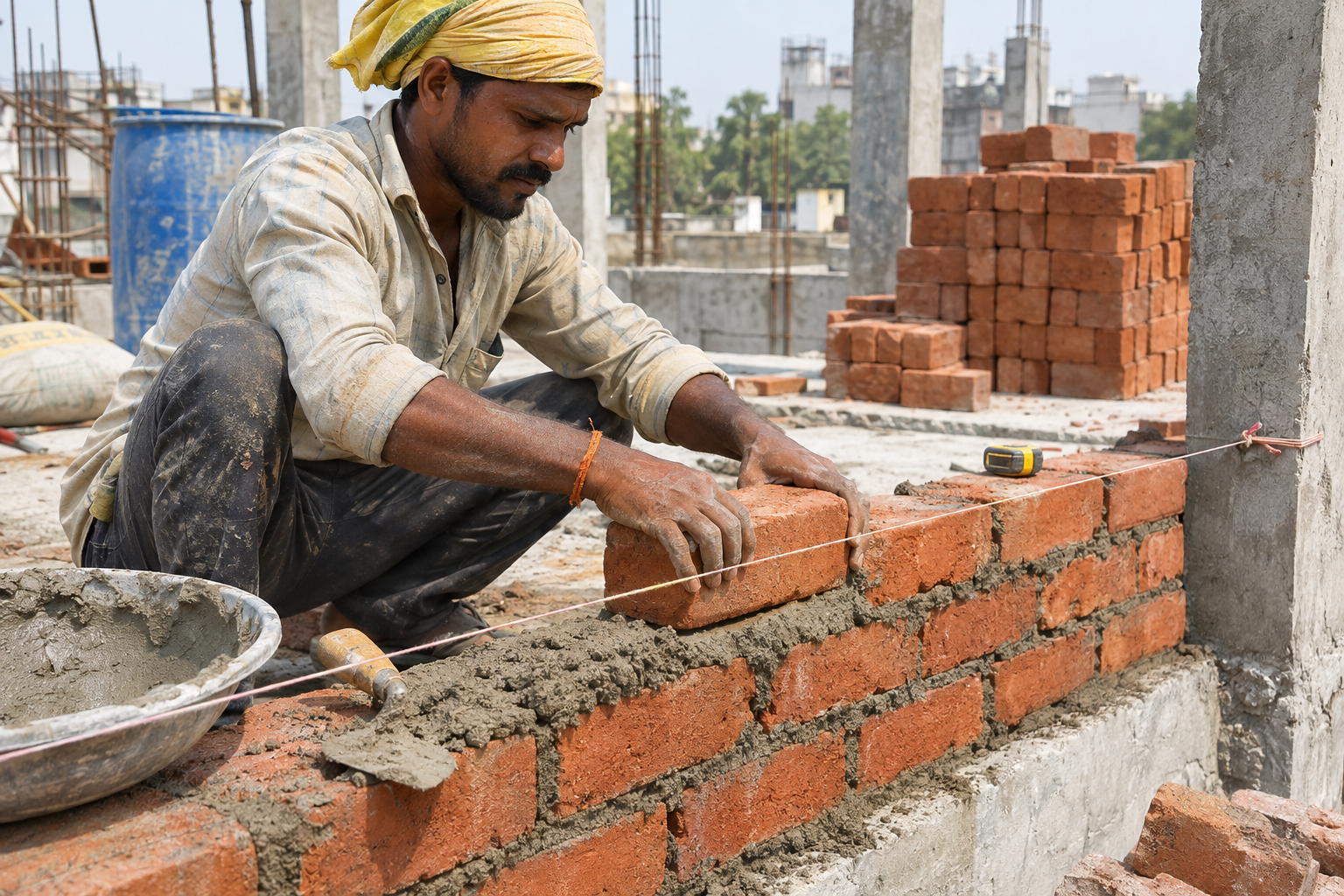
A masonry wall goes up course by course: the mason sets out the line, lays the first course level, then builds upward while checking plumb, level and bond.
Set out
Mark the wall line and corners on the foundation or slab.
Lay the first course
Bed units in mortar to a string line and check that the course is level.
Butter and bed
Spread mortar on each unit's end and bed it firmly so joints are full.
Check plumb and level
Use the plumb bob and spirit level every few courses.
Tool the joints
Finish joints neatly, or rake them back if the wall will be plastered.
Cure
Keep the wall damp for the period your engineer specifies so the mortar gains strength.
What Is Masonry Used For?
Masonry is used for house walls, compound walls, foundations and plinths, arches, retaining walls, parapets and large works such as dams.
- Homes: external walls, internal partitions and parapet walls on terraces.
- Boundaries and foundations: compound walls and stone or brick plinths.
- Masonry dams: dams built from stone or concrete masonry. Nagarjuna Sagar Dam on the Krishna river, built between 1955 and 1967, was the tallest masonry dam in the world when completed.
- Heritage repair: restoring old brick and stone walls, usually with lime mortar to match the original.
What Are the Advantages and Limitations of Masonry?
Masonry is durable, fire resistant and easy to build with local skills, but it is weak in tension, vulnerable in earthquakes when unreinforced and prone to damp.
- Long life with basic maintenance
- Does not burn, so it resists fire well
- Heavy walls can help keep indoor temperatures steadier
- Materials and skilled masons are available across India
- Cracks under bending or sideways loads
- Unreinforced walls perform poorly in earthquakes
- Absorbs moisture, leading to damp and white salt deposits (efflorescence)
- Slower to build than some prefabricated systems
Old mortar joints may need re-pointing over time. If damp is already showing inside, see our guide on fixing damp patches before painting.
Bulging walls, loose parapet bricks or crumbling mortar can lead to falling masonry. Keep people clear and ask a structural engineer to inspect before repairs.
How Is Masonry Different From Freemasonry?
Masonry is the building trade; Freemasonry is a fraternal order of Free and Accepted Masons with no role in present-day construction.
Britannica traces Freemasonry to the guilds of medieval stonemasons and cathedral builders. Its first Grand Lodge was founded in England in 1717, and it kept tools such as the square and compasses as symbols. When "Masonry" is capitalised, it usually means Freemasonry.
A masonry drill bit has a hard tip, usually tungsten carbide, for drilling into brick, concrete and stone. Use it with a hammer-action drill.
Planning a Masonry Job? What Should You Do Next?
Start by choosing the type of masonry for your wall, then check material quality and get a written estimate before you buy.
- Decide whether the wall is load-bearing or infill, and pick brick, block or stone to suit.
- Check that bricks or blocks are uniform in size, with sharp edges and no cracks, and ask for test reports.
- Get a written estimate that separates materials, labour and plastering.
Bricks, blocks and cement for your walls
Order masonry materials with a GST invoice and delivery across Bengaluru.