On this page
- What Are Red Bricks Made Of?
- How Is Clay Turned into a Fired Brick?
- What Are the Key Characteristics of Red Bricks?
- What Are the Advantages and Disadvantages of Red Bricks?
- Where Are Burnt Clay Bricks Used?
- How Do They Compare with Fly Ash Bricks and Concrete Blocks?
- How Do You Check Brick Quality Before Buying?
- How Many Bricks Does a 3 m Wall Need?
- Red bricks are clay bricks fired in a kiln; iron oxide gives the colour.
- IS 1077:1992 grades them by strength class, from 3.5 to 35 N/mm².
- Good bricks absorb no more than 20% water up to class 12.5.
- Load-bearing use needs a class and wall thickness your engineer approves.
Red bricks are burnt clay bricks: clay moulded, dried and fired in a kiln, where its iron turns red. In India they are covered by IS 1077:1992, the Bureau of Indian Standards (BIS) code for common burnt clay building bricks.
What Are Red Bricks Made Of?
Red bricks are made of brick earth, a clay rich in silica and alumina.
Composition of good brick earth
Share of the clay by weight| Ingredient | Share | What it does |
|---|---|---|
| Silica | 50–60% | Holds shape, limits warping |
| Alumina | 20–30% | Makes clay mouldable |
| Lime | 5% or less | Helps grains fuse |
| Iron oxide | 5–6% | Red colour, hardness |
| Magnesia | Small amount | Less shrinkage |
Too much iron oxide makes bricks dark blue or blackish.
How Is Clay Turned into a Fired Brick?
Clay becomes a red brick in four stages: mixing, moulding, drying and firing.
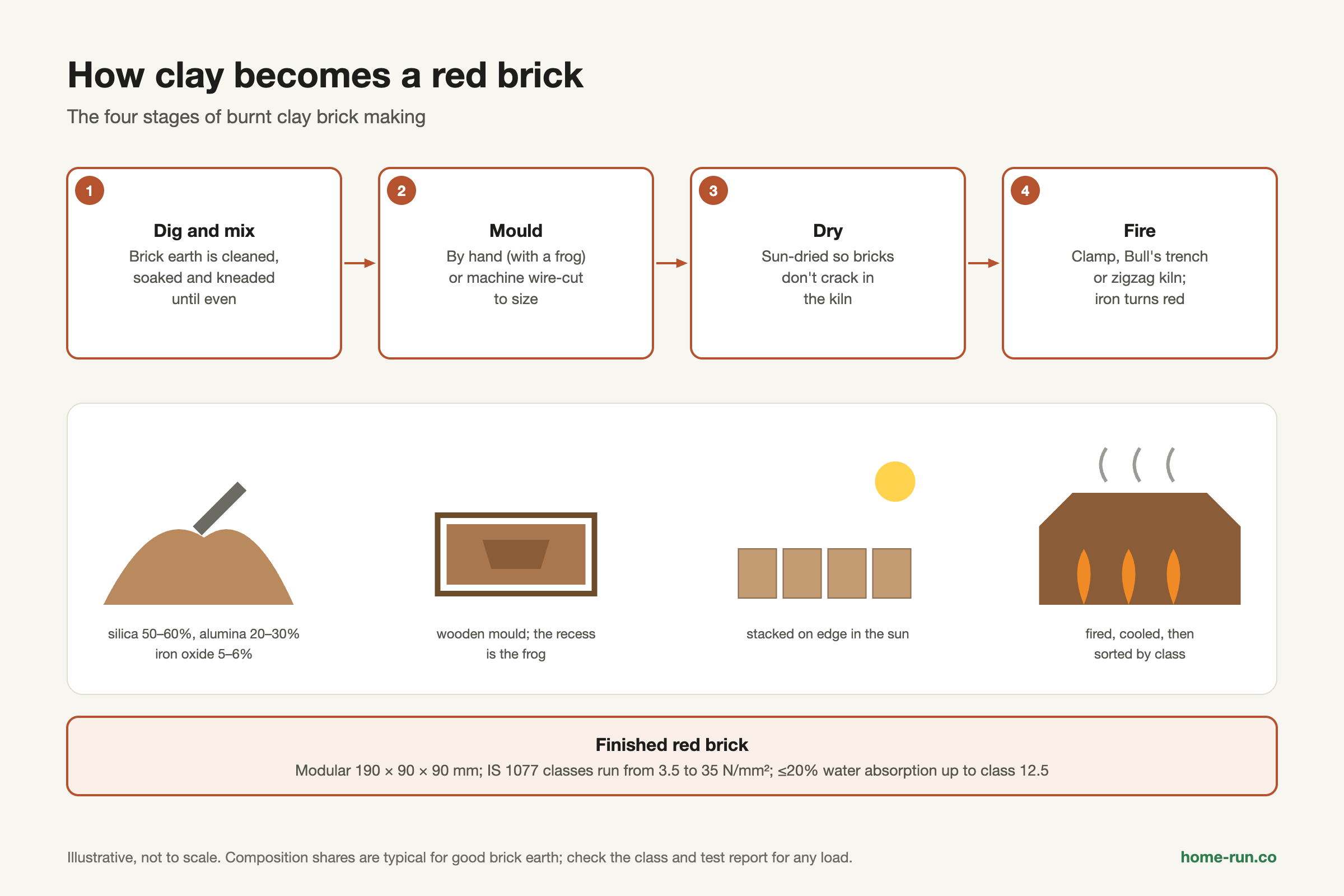
- Dig and mix: clay is cleaned, soaked and kneaded until even.
- Mould: by hand or by machine (wire-cut). Hand-moulded bricks carry a frog, a 10–20 mm recess that grips mortar.
- Dry: bricks dry in the sun so they do not crack when fired.
- Fire: in a clamp, Bull's trench or zigzag kiln, then cooled and sorted.
What Are the Key Characteristics of Red Bricks?
The key red bricks characteristics are strength, water absorption, efflorescence, size, fire resistance and thermal mass.
- Compressive strength: crushing load per area. IS 1077 has 11 classes, from 3.5 to 35 N/mm²; each is a minimum average.
- Water absorption: after 24 hours soaking, at most 20% by weight up to class 12.5 and 15% above.
- Efflorescence: white salt deposits; "moderate" allowed up to class 12.5, "slight" above.
- Size: modular 190 × 90 × 90 mm; non-modular 230 × 110 × 70 mm.
- Fire resistance: the clay is already fired, so the brick does not burn.
- Thermal mass: walls store heat by day and release it slowly, though brick is not a true insulator.
Trade grades of first, second and third class are judged by look and sound. They do not match IS strength classes, so ask for the class number and a test report.
What Are the Advantages and Disadvantages of Red Bricks?
Red bricks are easy to source and lay, but heavy and uneven in quality.
Advantages
Why builders use themPoints
- Sold almost everywhere in India
- Every mason can lay them
- Do not burn in a fire
- Thermal mass keeps rooms steadier
Disadvantages
Watch forPoints
- Heavy, so walls add dead load
- Size and strength vary between kilns
- Poor bricks absorb water
- Topsoil loss and kiln smoke
Where Are Burnt Clay Bricks Used?
Red bricks are used for most wall types in Indian homes:
- Load-bearing walls in low-rise homes
- Infill and partition walls in RCC frames
- Compound walls and parapets (see our parapet wall design guide)
- Plinth masonry, using well-burnt bricks
- Exposed and jali walls, often in terracotta jali bricks
A partition brick may not be fit to carry a slab. Confirm load-bearing use with a structural engineer.
How Do They Compare with Fly Ash Bricks and Concrete Blocks?
Red bricks are fired clay; fly ash bricks and concrete blocks are cured, not fired. Grey bricks are usually fly ash or cement products.
Red brick vs fly ash brick vs concrete block
Qualitative unless stated| Factor | Red brick | Fly ash brick | Concrete block |
|---|---|---|---|
| How it is made | Kiln-fired clay | Pressed fly ash and lime | Cement and aggregate, cured |
| Indian standard | IS 1077 | IS 12894 | IS 2185 (Part 1) |
| Max water absorption | 20% (to class 12.5) | Set by class | 10% |
| Best when | Matching old work, exposed brick | A reliable plant is nearby | Fast infill walls |
For weights and prices, see fly ash bricks vs red bricks.
Building a brick wall?
Masonry materials delivered across Bengaluru.
How Do You Check Brick Quality Before Buying?
You check red brick quality with field tests on a sample from each load:
- Look: even colour, sharp edges, flat faces.
- Ring test: strike two bricks; a clear metallic ring is good.
- Scratch test: a fingernail should leave no mark.
- Drop test: dropped flat from about 1 m onto hard ground, it should not break.
- Soak test: weigh dry, soak 24 hours, reweigh; a gain over 20% fails.
Reject bricks that show:
- Pale colour, dull thud, soft surface (under-burnt)
- Blackish or warped faces (over-burnt)
How Many Bricks Does a 3 m Wall Need?
A 3 m × 2.7 m half-brick wall needs about 426 modular red bricks, including 5% wastage.
Deduct openings first, and test a sample before a bulk order.