On this page
- Clay bricks are made by preparing, moulding, drying and firing brick earth.
- Firing at about 900–1,100 °C vitrifies the clay and decides most of the strength.
- By shape and method, the main types are hand-moulded, wire-cut, pressed, perforated and hollow.
- IS 1077 grades common bricks into 11 classes from 3.5 to 35 N/mm².
- Higher classes must absorb less water: 15% by weight instead of 20%.
Clay bricks are building units made by moulding wet clay, drying it and firing it in a kiln until it hardens for good. The fired clay brick is India's standard walling unit, from the red brick of a plastered house wall to the wire-cut brick on an exposed facade.
What Are Clay Bricks Made Of?
Clay bricks are made from brick earth: about 50–60% silica, 20–30% alumina and 5–6% iron oxide, with lime kept under 5%. Alumina makes the clay mouldable, silica limits shrinking and warping, and iron oxide turns red when fired.
For colour, density and the full list of properties, see our guide to red brick characteristics.
How Are Clay Bricks Manufactured, Step by Step?
The clay bricks manufacturing process runs in six steps, from the clay pit to the sorted stack.
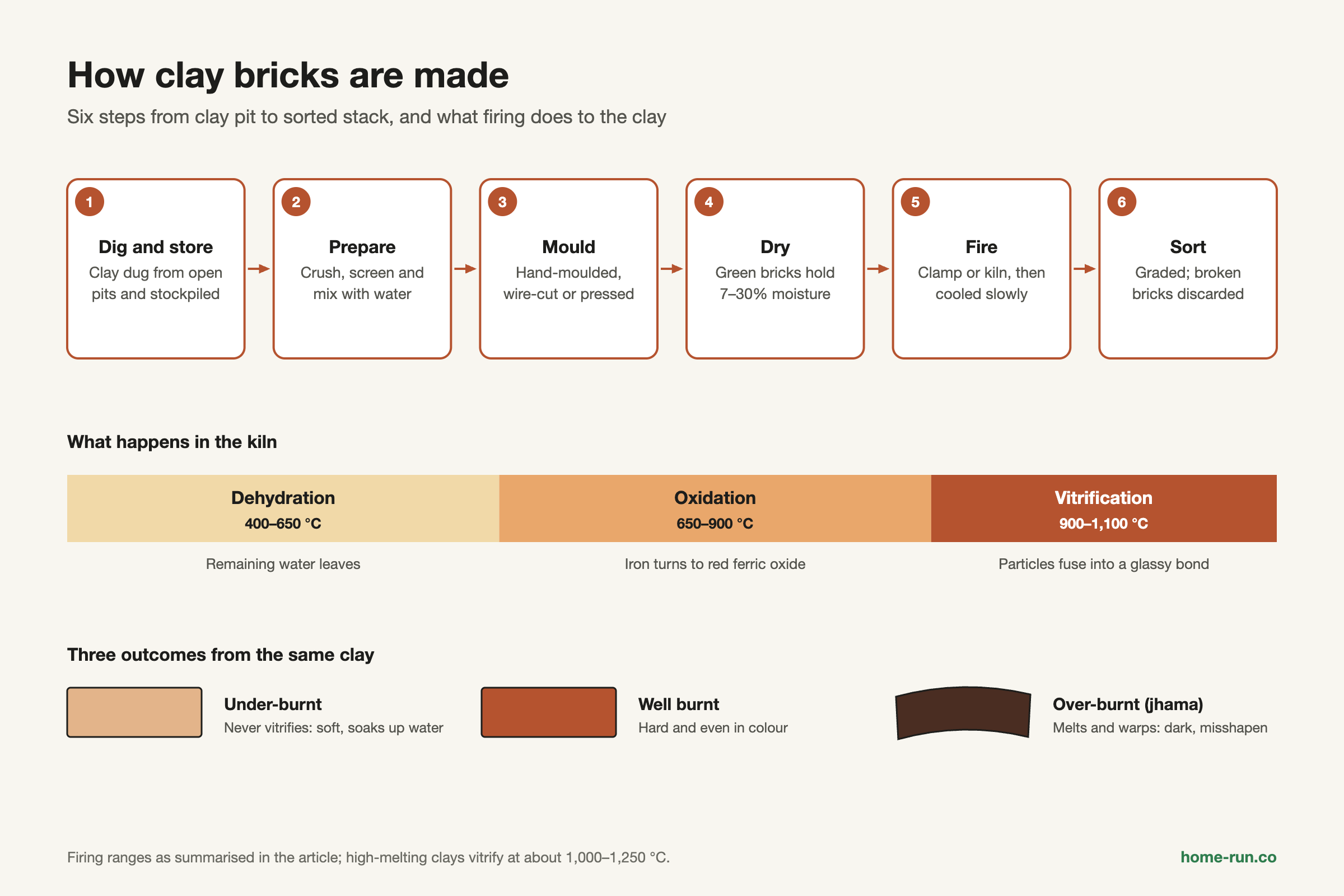
- Dig and store. Clay is dug from open pits and stockpiled.
- Prepare and temper. Clay is crushed, screened and mixed with water. Large plants use a pug mill.
- Mould. Clay is shaped by hand in a wooden mould, extruded and wire-cut, or pressed by machine.
- Dry. Green bricks hold about 7–30% moisture. They dry in the sun or with kiln waste heat.
- Fire. Bricks are burnt in a clamp or kiln, then cooled slowly to avoid cracks.
- Sort. Bricks are graded and broken ones discarded.
What happens to clay inside the kiln
Approximate temperature bands| Firing stage | Temperature | What changes |
|---|---|---|
| Dehydration | 400–650 °C | Remaining water leaves; clay loses plasticity |
| Oxidation | 650–900 °C | Carbon burns off; iron turns to red ferric oxide |
| Vitrification Strength forms here | 900–1,100 °C | Clay particles fuse into a hard, glassy bond |
An under-burnt brick never vitrifies, so it stays soft and soaks up water. An over-burnt brick melts and warps into a dark, misshapen jhama brick. Both come from the same clay as a good brick.
India has an estimated 70,000–80,000 brick kilns, many of them Bull's Trench kilns. A February 2022 Ministry of Environment notification allows only zig-zag, vertical shaft or piped-gas kilns, which burn cleaner.
What Are the Types of Clay Bricks?
Clay bricks are grouped by how they are moulded, by their shape, and by the job they do. Each group has its own Bureau of Indian Standards (BIS) specification.
Types of clay bricks used in India
By method, shape and use| Type | How it is made | Standard | Best for |
|---|---|---|---|
| Hand-moulded (table-moulded) | Clay thrown into a wooden mould, sun-dried, fired | IS 1077, IS 2117 | Plastered walls, budget builds |
| Wire-cut Exposed brickwork | Clay extruded through a die and sliced by wires | IS 1077 | Facades, feature walls |
| Machine-pressed | Stiff clay pressed into steel moulds | IS 1077 | Dense, sharp-edged walling |
| Perforated | Holes cover 30–45% of the face | IS 2222 | Lighter walls and partitions |
| Hollow | Large cores; units up to 290 mm long | IS 3952 | Non-load-bearing partitions |
| Heavy duty | Dense, high-fired; class 40 or 45 N/mm² | IS 2180 | Heavily loaded engineering work |
| Facing | Selected for even colour and finish | IS 2691 | Unplastered faces |
| Paving and jallies | Shaped for floors or pierced screens | IS 3583, IS 7556 | Paths, ventilation screens |
| Fire clay (refractory) | Fireclay fired to resist high heat | BIS refractory standards | Furnaces, chimneys, pizza ovens |
Sellers also use the older field grades: first class (well burnt, even, sharp edges), second class (slightly uneven), third class (under-burnt) and jhama (over-burnt). These field grades are not the same as IS 1077 strength classes. For pierced screen units, see terracotta jali bricks.
What Are the Properties of Clay Bricks Under IS 1077?
IS 1077:1992, the Indian standard for common burnt clay building bricks, sets size, strength, water absorption and efflorescence (white salt deposits) limits.
IS 1077 limits for common burnt clay bricks
Check the current edition| Property | Classes 3.5 to 12.5 | Classes 15 to 35 |
|---|---|---|
| Classes covered | 3.5, 5, 7.5, 10, 12.5 | 15, 17.5, 20, 25, 30, 35 |
| Water absorption, max | 20% by weight | 15% by weight |
| Efflorescence, max | Moderate | Slight |
| Modular size | 190 × 90 × 90 or 190 × 90 × 40 mm | Same |
| Non-modular size | 230 × 110 × 70 or 230 × 110 × 30 mm | Same |
With a 10 mm mortar joint, a 190 × 90 × 90 mm brick fills a 200 × 100 × 100 mm module.
Clay Bricks vs Fly Ash Bricks: Which Should You Use?
Clay bricks are fired in a kiln, while fly ash bricks are pressed from fly ash, lime or cement and sand, then cured. Fly ash bricks follow IS 12894, not IS 1077.
Clay bricks
Traditional defaultFired clay, available in many shapes.
- Wide range of classes, 3.5 to 35 N/mm²
- Exposed wire-cut finish possible
- Size varies more if hand-moulded
- Kiln firing burns fuel
Fly ash bricks
Uniform, curedIndustrial by-product, pressed and cured.
- Strength set by mix and curing
- Usually plastered, not exposed
- Very uniform size and edges
- No kiln firing needed
For a full side-by-side, read fly ash bricks vs red bricks. For light partitions, also compare hollow bricks and blocks.
How Do You Check Clay Brick Quality on Site?
You can check clay brick quality with four quick tests on bricks from the actual delivery lot.
- Even colour, rectangular faces and sharp corners
- A clear ringing sound when two bricks are struck together
- No cracks, chips or white lumps of free lime
- Absorption under 20% after a 24-hour soak
Building brick walls?
Get cement, sand and masonry supplies delivered across Bengaluru with a GST invoice.