On this page
- What Are Fly Ash Bricks Made Of?
- How Are Fly Ash Bricks Made?
- What Is the Size of Fly Ash Bricks, and What Do the Specs Mean?
- Fly Ash Bricks vs Red Bricks: Which Is Better?
- How Much Do Fly Ash Bricks Cost, and Do They Save Money?
- What Are the Disadvantages of Fly Ash Bricks?
- How Do You Check Fly Ash Brick Quality on Site?
- How Do You Lay Fly Ash Bricks Correctly?
- Are Fly Ash Bricks Right for Your House?
- Fly ash bricks are pressed and cured, not kiln-fired, using ash from coal power plants.
- The Indian standard is IS 12894:2002; ask for the strength class in N/mm² on the invoice.
- Uniform size means thinner joints and less plaster than hand-moulded red bricks.
- Quality depends on curing, so check every delivery on site before you accept it.
- Fly ash bricks suit load-bearing and infill walls; AAC blocks win where weight matters.
Fly ash bricks are building bricks made from fly ash, the fine grey powder left after coal is burnt in thermal power plants. The ash is mixed with lime or cement, sand or stone dust and water, pressed in a mould and cured. You can use them in place of red clay bricks for most house walls.
What Are Fly Ash Bricks Made Of?
Fly ash bricks are made of fly ash, a binder, a filler and water. Electrostatic precipitators (filters that use an electric charge) capture the fly ash from power-plant flue gas.
- Fly ash: the main ingredient. Odisha's pollution control board guidelines put it at about 50–80% of the mix.
- Binder: hydrated lime with gypsum (the lime route) or Portland cement (the cement route).
- Filler: sand or stone dust (crushed rock powder) for bulk and tighter packing.
- Water: starts the reaction between the binder and the ash.
Mix proportions vary by maker. The bricks use power-plant waste and avoid digging topsoil for clay.
IS 12894 calls them pulverized fuel ash-lime bricks. AAC (autoclaved aerated concrete) blocks may also contain fly ash, but they are large, light, air-filled blocks cured under steam pressure. Order by product name and size.
How Are Fly Ash Bricks Made?
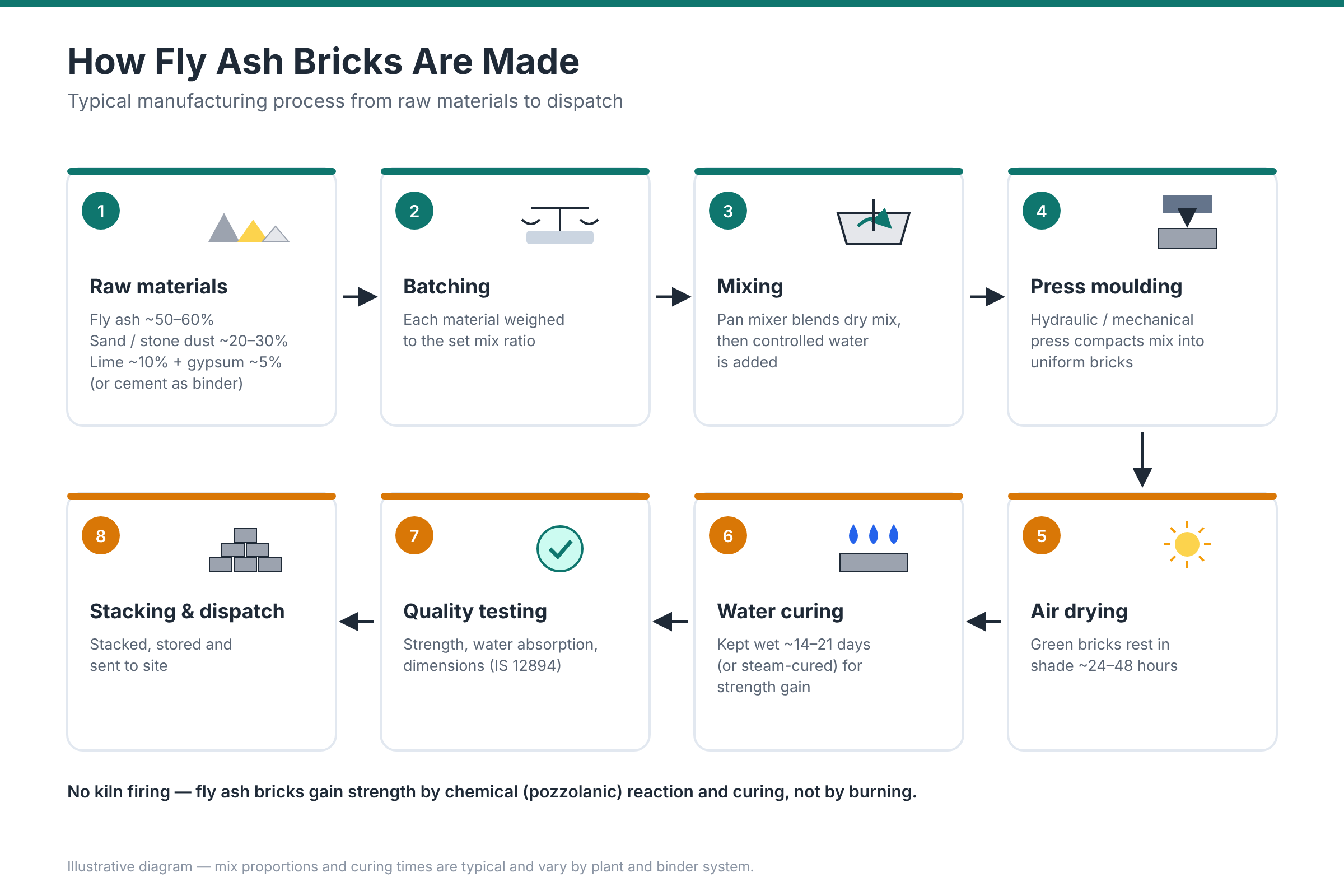
Fly ash bricks are made in three stages: mixing, high-pressure pressing and curing.
- Mixing: ash, binder, filler and water are blended to a damp, even mix.
- Pressing: a hydraulic or vibro-compaction machine squeezes the mix into moulds, giving dense bricks with sharp edges.
- Curing: bricks rest on pallets for about 2 days, then get water cured for 10–14 days, per the Odisha guidelines. Some plants steam-cure instead.
Curing is where cheap suppliers cut corners, and under-cured bricks crack later.
What Is the Size of Fly Ash Bricks, and What Do the Specs Mean?
The most common fly ash brick size in India is 230 × 110 × 75 mm, about 9 × 4 × 3 inches. IS 12894:2002 lists its own sizes, so ask your supplier for the actual dimensions.
Key IS 12894:2002 requirements
Pulverized fuel ash-lime bricks, tested to IS 3495| Property | What the standard says | Why it matters |
|---|---|---|
| Sizes | Modular 190 × 90 × 90 or 40 mm; non-modular 230 × 110 × 70 or 30 mm | Sets brick count and wall thickness |
| Strength classes Check first | 3.5, 5, 7.5, 10, 12.5, 15, 17.5, 20, 25 and 30 N/mm² (wet) | No single brick may be more than 20% below its class |
| Water absorption | Max 20% by mass up to Class 12.5; max 15% above it | Lower absorption means better damp resistance |
| Efflorescence | Not more than "moderate" up to Class 12.5; "slight" above it | Limits white salt patches on walls |
| Drying shrinkage | Average of three bricks max 0.15% | Controls shrinkage cracks |
Fly Ash Bricks vs Red Bricks: Which Is Better?
Fly ash bricks are the better default for most new walls: they are uniform, need less mortar and plaster, and come in tested classes. Red bricks still make sense when no reliable fly ash supplier is nearby.
Fly ash brick vs red clay brick vs AAC block
Qualitative unless stated| Factor | Fly ash brick | Red clay brick | AAC block |
|---|---|---|---|
| How it is made | Pressed and cured | Moulded and kiln-fired | Aerated and steam-cured under pressure |
| Size accuracy | High, sharp edges | Varies, often uneven | High |
| Weight | Dense | Dense | Light; cuts dead load |
| Plaster needed | Thinner coat | Thicker coat to level | Thin coat |
| Breakage in transport | Low if well cured | Higher | Edges chip |
| Best use | Load-bearing and general walls Default pick | Repairs, matching old work | Infill walls in RCC frames |
Use fly ash bricks for load-bearing, boundary and parapet walls. Use AAC blocks for upper-floor infill where you want less weight on the frame.
How Much Do Fly Ash Bricks Cost, and Do They Save Money?
Fly ash bricks cost about ₹6–8 per brick in Bengaluru, based on InfraLens dealer data from May 2026. That is about ₹6,000–8,000 per 1,000 bricks before transport.
Price moves with transport distance, strength class, order size and unloading charges.
The real saving comes from the wall: thinner joints, less plaster and fewer broken bricks. Some sellers claim 40–50% less mortar and plaster. Treat that as a claim and check it on your first wall.
Mortar, labour and transport are extra. Recalculate with your supplier's actual size.
GST: Fly ash bricks fall under HSN 6815. From 22 September 2025, Notification 14/2025-Central Tax (Rate) lists them at 6% CGST plus 6% SGST, or 12% in total. Check the rate on your supplier's invoice.
Materials for your brick walls
Order masonry materials with a GST invoice and delivery across Bengaluru.
What Are the Disadvantages of Fly Ash Bricks?
The main disadvantages of fly ash bricks are uneven quality between suppliers, shrinkage cracks when under-cured and poor plaster grip on very smooth faces.
- Variable quality: small plants may skip proper curing or lab testing.
- Shrinkage cracks: under-cured bricks keep shrinking in the wall.
- Chipping: corners break if bricks are thrown off trucks.
- Plaster adhesion: the smooth face needs roughening or a bonding coat.
- Efflorescence: white salt patches can appear on damp walls in the monsoon.
Efflorescence means water is getting in. Fix the source first, as in our guide to fixing damp patches on walls.
How Do You Check Fly Ash Brick Quality on Site?
You check fly ash brick quality by inspecting a sample from each load before unloading it all.
- Look: even grey colour, sharp edges, flat faces, no cracks or lime spots.
- Measure: line up 10 bricks and compare with the stated size.
- Ring test: strike two bricks together; a clear ring is good, a dull thud is not.
- Drop test: drop one from about shoulder height onto firm ground; it should not crumble.
- Soak test: weigh a dry brick, soak it 24 hours and reweigh; a gain over 20% fails the lower classes.
- Paperwork: ask for the IS 12894 class and a recent lab report.
For a large order, send samples to a lab for IS 3495 testing.
How Do You Lay Fly Ash Bricks Correctly?
Lay fly ash bricks lightly damp, with thin, even cement-sand mortar joints, and cure the wall before plastering.
Damp, do not soak
Sprinkle bricks with water. Unlike red bricks, they do not need a long soak.
Mix mortar
Use the cement-sand ratio your engineer specifies for the wall.
Keep joints thin
Aim for about 10 mm, the standard joint in IS 2212:1991, the code for brickwork.
Stagger the bond
Offset vertical joints in each course and fix bands where drawings show them.
Cure, then plaster
Keep cement mortar wet for at least 7 days. Roughen or bond-coat the face before plastering.
Are Fly Ash Bricks Right for Your House?
Fly ash bricks are right for most Bengaluru homes, from load-bearing ground-floor walls to infill in RCC frames.
- Load-bearing walls: use a class your structural engineer approves. See our explainer on what masonry means.
- Multi-storey or seismic work: wall thickness and bands are an engineer's call.
- Policy: under the MoEFCC (Ministry of Environment, Forest and Climate Change) ash notification of 31 December 2021, amended in January 2024, projects within 300 km of a coal or lignite power plant must use ash products such as ash bricks, if priced within the Schedule of Rates.
Next, get a brick count from your plan, compare quotes and check samples before a bulk order.