On this page
- What Is a Vastu Shastra Chart and What Does It Show?
- How Is a Vastu Chart Laid Out: 9-Zone Grid or 16 Directions?
- Which Deity and Purpose Does Each of the 8 Directions Have?
- How Do the Five Elements Map to Directions in a Vastu Shastra Chart?
- How Do You Find True Directions Before Using the Chart?
- How Do You Overlay a Vastu Shastra Chart on Your Floor Plan?
- What Does the Vastu Chart Say for Each Room?
- Where Should the Main Entrance Go by House Facing?
- Which Colours, Mirrors, Plants and Water Features Suit Each Direction?
- How Do You Use a Vastu Chart in a Flat, Rented Home or Irregular Plot?
- What Vastu Corrections Can You Make Without Demolition?
- How Does the Vastu Chart Apply to Offices, Shops and Factories?
- Is the Vastu Shastra Chart Backed by Science?
- What Is the Simplest Plan to Apply Your Vastu Chart?
- A vastu shastra chart maps directions to rooms, deities and elements; it is a traditional guide, not a building code.
- Charts come as a 3 × 3 grid (9 zones) or a 16-direction wheel with 22.5° per zone.
- The chart only works if you first find true directions with a compass, away from steel and wiring.
- Most charts agree on the basics: kitchen south-east, master bedroom south-west, pooja north-east, centre open.
- Sources disagree on finer points such as entrance padas, colours and planets, so treat details as one school's view.
- Fix easy items first (furniture, colour, lighting, clutter) and let structure, safety and bye-laws come before Vastu.
A vastu shastra chart is a direction map that tells you which room, activity or element traditionally suits each part of a house. You lay it over your floor plan from the centre, line it up with north, and read which zone each room falls in.
This guide shows you how to read the chart, find true directions and apply it to an existing home without demolition. It treats Vastu as a tradition: what practitioners hold, not proven fact.
What Is a Vastu Shastra Chart and What Does It Show?
A vastu shastra chart is a diagram of directions that links each zone of a plot to a deity, an element and a suitable room or activity. People also call it a Griha Vastu chart (griha means home), a Vastu direction chart or a Vastu map.
Vastu Shastra in one paragraph
Vastu Shastra is the traditional Indian science of architecture and building layout. Its rules sit in classical texts such as the Brihat Samhita of Varahamihira (about the 6th century CE), the Mayamata, the Manasara and the Samarangana Sutradhara.
These texts cover site choice, proportion, orientation and room placement. Modern Vastu charts condense parts of them into a single page.
The Vastu Purusha Mandala explained simply
The Vastu Purusha Mandala is the square grid behind every chart. Tradition pictures a cosmic being, the Vastu Purusha, lying face-down across the plot, with his head in the north-east and his feet in the south-west.
Deities govern the squares of the grid. The two best-known grids are the Manduka (8 × 8 = 64 squares) and the Paramasayika (9 × 9 = 81 squares).
The Mandala is the sacred grid and its mythology. The chart is the practical guidance drawn from it: kitchen here, bedroom there. Most homeowners only need the chart.
Vastu chart vs Vastu map vs floor plan
- Floor plan: the measured drawing of your home, with walls, doors and windows.
- Vastu chart: a generic table or wheel of directions and what suits each one.
- Vastu map: your floor plan with the chart drawn over it, so each room has a zone label.
Homes, offices, shops and factories all use the same chart. Printable Vastu chart PDFs, in English, Hindi or Marathi, are usually one of these three formats.
How Is a Vastu Chart Laid Out: 9-Zone Grid or 16 Directions?
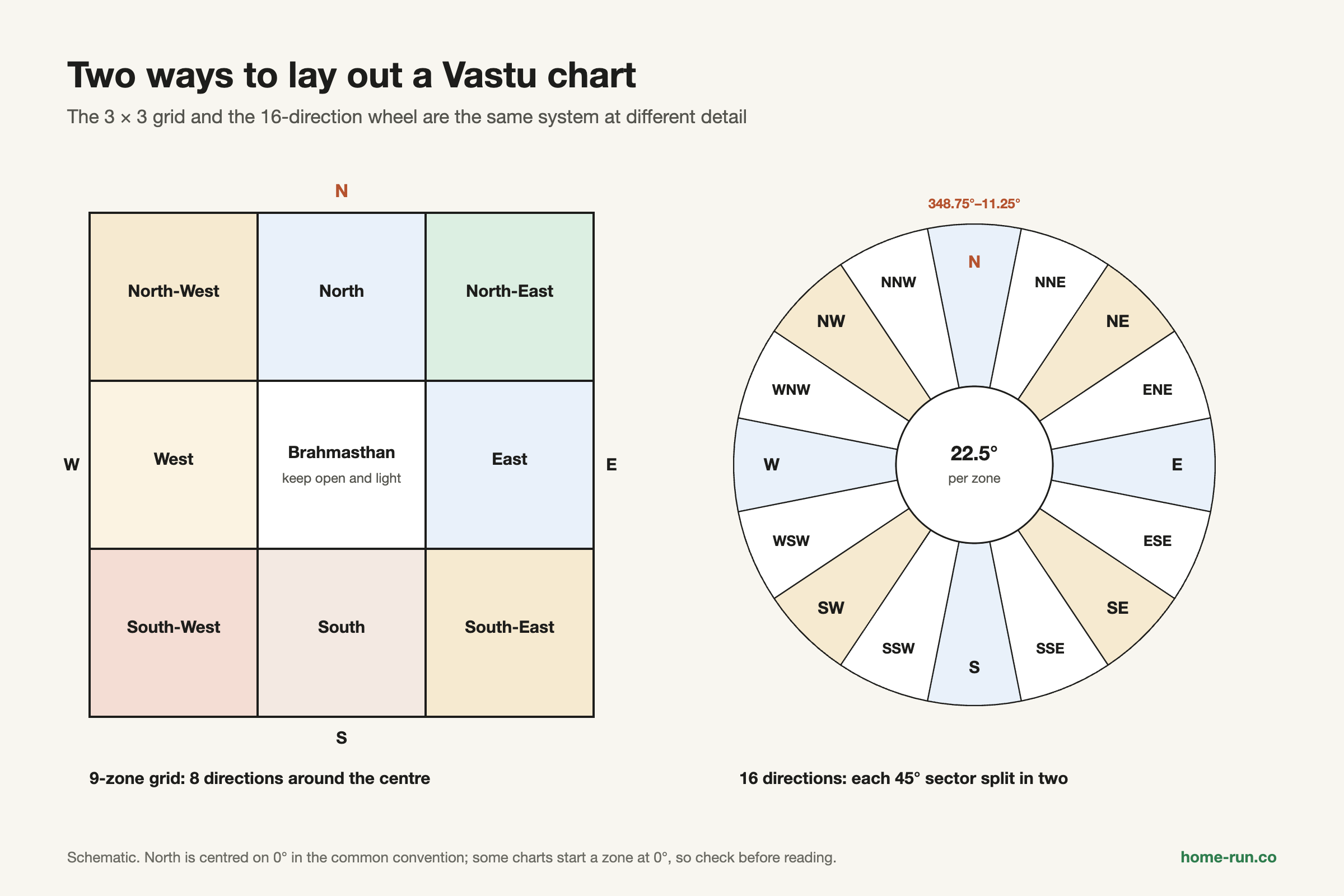
A Vastu chart is laid out either as a 3 × 3 grid of 9 zones or as a circle of 16 directions. The 16-direction chart is a finer split of the same system, not a different or "more correct" one.
The 9-zone grid and the Brahmasthan
The 9-zone grid divides the plot into three rows and three columns. The eight outer squares carry the eight directions. The centre square is the Brahmasthan, the core of the plan.
Almost every source says to keep the Brahmasthan open, light and free of heavy walls, columns, toilets or staircases.
The 16-direction chart and degrees
The 16-direction chart splits the 360° compass into 16 zones of 22.5° each (360 ÷ 16 = 22.5). It adds eight in-between zones such as north-north-east (NNE) and east-south-east (ESE).
The common convention centres north on 0°. North then runs from 348.75° to 11.25°. Some charts instead start a zone at 0°, so check which convention a chart uses before you read it.
Vastu direction chart with degrees (16 zones)
North centred on 0°| Zone | From (°) | To (°) | 8-direction group |
|---|---|---|---|
| North (N) | 348.75 | 11.25 | North |
| North-north-east (NNE) | 11.25 | 33.75 | North / North-East |
| North-east (NE) | 33.75 | 56.25 | North-East |
| East-north-east (ENE) | 56.25 | 78.75 | North-East / East |
| East (E) | 78.75 | 101.25 | East |
| East-south-east (ESE) | 101.25 | 123.75 | East / South-East |
| South-east (SE) | 123.75 | 146.25 | South-East |
| South-south-east (SSE) | 146.25 | 168.75 | South-East / South |
| South (S) | 168.75 | 191.25 | South |
| South-south-west (SSW) | 191.25 | 213.75 | South / South-West |
| South-west (SW) | 213.75 | 236.25 | South-West |
| West-south-west (WSW) | 236.25 | 258.75 | South-West / West |
| West (W) | 258.75 | 281.25 | West |
| West-north-west (WNW) | 281.25 | 303.75 | West / North-West |
| North-west (NW) | 303.75 | 326.25 | North-West |
| North-north-west (NNW) | 326.25 | 348.75 | North-West / North |
In the 8-direction model, each direction covers 45° (360 ÷ 8). North then spans 337.5° to 22.5°.
What each of the 16 zones governs
Practitioners of the 16-zone method give each zone a theme. One widely used set reads like this, though other schools label some zones differently:
- N: money and opportunities (the Kuber Sthan). NNE: health. NE: prayer and clarity. ENE: recreation.
- E: social connections. ESE: analysis and churning of ideas. SE: fire and cooking. SSE: confidence and strength.
- S: rest and fame. SSW: disposal, so a toilet is often allowed here. SW: stability and relationships. WSW: education and study.
- W: gains. WNW: letting go of negative emotions. NW: support and guests. NNW: attraction, often advised for a couple's bedroom.
Named zones such as Putra Sthan (children), Ratna Griha (valuables) and Aushadhi Griha (medicines) appear in some detailed charts only. Their placement is not uniform across sources, so treat them as school-specific labels.
Which Deity and Purpose Does Each of the 8 Directions Have?
Each of the eight directions in a Vastu chart has a guardian deity, called a Dikpala, and a set of qualities. The deity-to-direction match below is consistent across classical and modern sources.
The eight directions, deities and traditional associations
Planets vary by school| Direction | Sanskrit name | Deity | Planet (common chart) | Traditionally governs |
|---|---|---|---|---|
| North Kuber Sthan | Uttara | Kubera, keeper of wealth | Mercury | Money, careers, opportunity |
| North-East Most sacred | Ishan Kon | Ishana, a form of Shiva | Jupiter | Prayer, clarity, water |
| East | Purva | Indra, king of the gods | Sun | Health, social life, morning light |
| South-East | Agneya | Agni, god of fire | Venus | Cooking, energy, cash flow |
| South | Dakshina | Yama, god of dharma and death | Mars | Rest, strength, reputation |
| South-West | Nairutya | Nirruti | Rahu | Stability, the head of the family |
| West | Paschima | Varuna, god of water | Saturn | Gains, children, dining |
| North-West | Vayavya | Vayu, god of wind | Moon | Movement, guests, support |
North and Kubera
The north is the Kuber Sthan, the place of wealth. Charts advise keeping a locker or cash box here, opening towards the north, and keeping the zone open and uncluttered.
North-East (Ishan Kon) and Ishana
The north-east is the most sacred zone. Charts reserve it for a pooja room, an open courtyard, a window or underground water. They advise against toilets, kitchens and heavy storage here.
East and Indra
The east receives the morning sun. Charts favour an east entrance, a living room or a study here, with large windows.
South-East and Agni
The south-east is the fire zone. Charts place the kitchen, the stove and electrical equipment such as the main panel here.
South, Yama and South-West, Nirruti
The south and south-west are the heavy, stable zones. Charts place the master bedroom, heavy wardrobes, an overhead tank or a staircase here, and keep openings small.
West and Varuna
The west suits a dining room, a children's room or a study. Charts treat it as a zone of gains and results.
North-West and Vayu
The north-west is the zone of air and movement. Charts suggest a guest room, a store for finished goods or a toilet here.
Ishan (NE), Agneya (SE), Nairutya (SW) and Vayavya (NW) are corners with their own deities and elements. Advice for "north" does not automatically apply to the north-east. Mixing up Ishana (NE) with Agni (SE) or Nirruti (SW) reverses the advice.
How Do the Five Elements Map to Directions in a Vastu Shastra Chart?
The five elements of Vastu, the Panchmahabhuta, are earth, water, fire, air and space. Each one is tied to a part of the vastu shastra chart, and the chart tries to keep each element in its home zone.
Panchmahabhuta: element-to-direction reference
Most commonly shown mapping| Element | Sanskrit | Zone | Deity of that zone | What the chart puts there |
|---|---|---|---|---|
| Water | Jal | North-East (some charts: North) | Ishana | Sump, borewell, water feature, pooja |
| Fire | Agni | South-East | Agni | Kitchen, stove, electrical panel |
| Earth | Prithvi | South-West | Nirruti | Master bedroom, heavy storage |
| Air | Vayu | North-West | Vayu | Guest room, windows, ventilation |
| Space | Akash | Centre (Brahmasthan) | Brahma | Open area, courtyard, skylight |
The logic is simple: keep opposing elements apart. A kitchen (fire) in the north-east (water) is the classic clash that charts warn about.
Astro-Vastu charts add a planet to each direction, and they do not agree.
One common chart gives Jupiter to the north-east, Venus to the south-east and Rahu to the south-west. Another source pairs the north-east with the Moon and Jupiter, the south-east with Mars and Ketu, and the south-west with Venus and Saturn. If a remedy depends on the planet, ask which school the consultant follows.
How Do You Find True Directions Before Using the Chart?
You find true directions by taking several compass readings near the centre of the home, away from metal and electronics. A chart laid over the wrong north shifts every zone, so this step matters more than any other.
Compass vs phone app
A magnetic compass and a phone compass app both point to magnetic north. A phone app uses a small magnetometer chip and can correct to true north if you allow location access.
Use both if you can. If they disagree by more than a few degrees, something nearby is skewing the reading.
- Stand near the centre of the house or flat, not next to a wall.
- Move away from steel almirahs, the fridge, the inverter, the TV and the main electrical board.
- Hold the phone or compass flat, at waist height.
- Calibrate the phone by moving it in a slow figure-of-eight until the app stops warning.
- Take three readings in different spots and use the average.
- Note the angle your main door faces, not only "north" or "east".
Reading near metal and electrical interference
Reinforced concrete (RCC) columns, steel rebar, grilles and wiring can make a compass swing. In a flat, take the reading in an open balcony or the middle of the largest room.
Magnetic vs true north in India
Magnetic declination is the angle between magnetic north and true north. It changes with place and year, so look up the current figure for your city on the NOAA magnetic declination calculator before you draw zone lines.
Most practitioners read the chart against the compass needle, which means magnetic north. A few correct to true north. The difference matters only when a wall or door sits close to a zone boundary, so note the exact degree and ask which reference your chart uses.
Handling irregular or angled plots
Many plots in Bengaluru layouts are not square to the compass. If your plot is turned, draw the chart from the true centre and let the zones cut across the rooms at an angle. Do not rotate the chart to match the walls.
Sale brochures often draw a north arrow that is approximate. Take your own reading on site before you decide anything based on facing.
How Do You Overlay a Vastu Shastra Chart on Your Floor Plan?
You overlay a vastu shastra chart by marking north on a scaled floor plan, finding the centre, drawing the 9 or 16 zones from that centre, and noting which zone each room falls in. You need a plan, a compass, a ruler and a protractor.
Get a scaled plan
Use the approved building plan, the builder's flat plan or your own sketch to scale, such as 1 cm = 1 ft.
Mark north
Take the compass reading on site and draw a north arrow at the exact angle on the plan.
Find the centre
For a rectangle, join opposite corners; the crossing point is the centre.
Draw the zones
Divide into a 3 × 3 grid, or draw 16 lines from the centre at 22.5° intervals from north.
Map the rooms
Label each room with its zone and mark any mismatch against the room chart below.
Finding the centre of an irregular shape
For an L-shaped or cut plan, the centre is harder to find. One practical method is to trace the outline on card, cut it out and find the point where it balances on a pin.
A second method is to complete the shape into the smallest rectangle around it, then judge the cut or extension as a zone defect. Practitioners differ on which method to use, so state the one you used if you consult anyone.
Dividing into 9 vs 16 zones
- 9 zones: split the length and the width each into three equal parts. Use this for a quick check of a house or flat.
- 16 zones: draw 16 lines out from the centre, 22.5° apart, starting 11.25° either side of north. Use this when a room sits on a boundary.
The numbers are illustrative. The example shows why the same house can be "north-facing" on one chart and "north-north-east facing" on another.
Marking each room and noting mismatches
Write the zone name inside each room on your plan. Then list every room that sits in an "avoid" zone from the table in the next section. That list is your Vastu map, and it tells you where to focus.
What Does the Vastu Chart Say for Each Room?
The vastu chart for rooms places the kitchen in the south-east, the master bedroom in the south-west, the pooja room in the north-east and keeps the centre open. The table below sticks to placements most charts agree on and marks where they differ.
Vastu direction chart for home: room by room
Save or print this table| Room | Ideal | Acceptable | Avoid |
|---|---|---|---|
| Main entrance | North, east or north-east | Favoured padas on west or south | South-west |
| Living room | North, east or north-east | North-west | Heavy furniture in the north-east |
| Kitchen Widely agreed | South-east | North-west | North-east, south-west, centre |
| Master bedroom Widely agreed | South-west | South or west | North-east, south-east |
| Children's room | West or north-west | East | South-west (kept for the head of the family) |
| Guest room | North-west | East | South-west |
| Pooja room Widely agreed | North-east | East or north | South, under stairs, beside a toilet |
| Dining | West | Next to the kitchen, east or south | No firm rule across sources |
| Study | East, north or north-east | West-south-west (16-zone charts) | Facing a blank south wall |
| Bathroom and toilet Disputed | North-west or west | South-south-west (16-zone charts) | North-east, centre |
| Staircase | South, west or south-west | South-east or north-west | North-east, centre |
| Locker or cash box | North zone, opening to the north | East | North-east, south-east |
For a fuller room-by-room plan, read our guide to Vastu for home layout and entrance tips.
Kitchen: stove, sink and storage
- Place the stove in the south-east part of the kitchen, so the cook faces east
- Keep the sink or water purifier away from the stove, towards the north-east of the kitchen
- Put the fridge and heavy storage on the south or west wall
- Keep a window or exhaust fan on the east or north wall
Bedrooms and sleeping direction
The master bedroom goes in the south-west, and the bed sits in the south-west part of the room with the head to the south. Our guide on bed direction as per Vastu covers head direction, headboard walls and walk space.
Pooja room placement
The pooja room or shelf goes in the north-east, with the idol facing west or east so you face east or north while praying. In a small flat, a wall shelf in the north-east corner of the living room is a common answer.
Bathrooms and toilets
- A toilet in the north-east corner, the zone most charts protect
- A toilet or bathroom in the exact centre of the home
- A toilet sharing a wall with the pooja room or the kitchen stove
- A toilet seat facing east or west, which many charts discourage
Staircases and the centre of the home
Charts place the staircase in the south, west or south-west and keep it out of the Brahmasthan and the north-east. Our guide on Vastu for staircases covers step counts and turning direction.
Where Should the Main Entrance Go by House Facing?
The main entrance is best placed in a favoured pada, one of 32 equal segments around the outer edge of the vastu shastra chart. Each side of the plot has 8 padas of 11.25° each (360 ÷ 32 = 11.25).
North, East, South and West facing houses
- North-facing: widely favoured; the door is usually advised in the middle of the north side. See the HomeRun guides on north-facing and south-facing house Vastu for full plans.
- East-facing: widely favoured for morning light; read our east facing house Vastu plan.
- West-facing: acceptable when the door sits in a favoured pada.
- South-facing: the most debated facing; some texts favour no south pada at all.
The 32 padas in brief
Sources agree on the 32-pada idea but not on which padas are good. The table compares a classical text with a widely used modern 16-zone method.
Favoured entrance padas: two sources compared
Numbering conventions differ| Side | Brihat Samhita (ch. 53, v. 72–75) | Modern 16-zone practice |
|---|---|---|
| North | 3 of 8 padas favoured | N3 (Mukhya), N4 (Bhallat), some add N5 (Soma) |
| East | Padas 3 and 4 (Jayanta, Indra) | E3 (Jayant), E4 (Indra) |
| South Sources disagree | None favoured | S3 (Vitatha), S4 (Grihakshat) |
| West | 2 of 8 padas favoured | W3 (Sugreeva), W4 (Pushpadanta) |
Building new or renovating
You can chooseWhen the door position is still open.
- Measure the side into 8 equal parts and mark the padas
- Pick a pada most charts favour, such as E3 or N4
- Check the door against setbacks and the approved plan
- Keep the path to the door clear and well lit
Living in an existing home
Door is fixedWhen moving the door is not practical.
- Find which pada the door sits in before you worry
- Remember sources disagree, so one chart's "bad" pada may be another's good one
- Keep the entrance clean, bright and free of clutter
- Avoid costly fixes sold as a cure for a door position
A door roughly in the middle of a north or east side suits nearly every chart. Corner doors, especially in the south-west, draw the most warnings.
Which Colours, Mirrors, Plants and Water Features Suit Each Direction?
Vastu colour charts tie light colours to the north and east and stronger colours to the south. Colour is also the part of the chart where sources vary the most.
Vastu shastra colour chart by direction
One published chart; others differ| Direction | Suggested colours |
|---|---|
| North | Green |
| North-East | Yellow, cream |
| East | White |
| South-East | Silver, white |
| South | Pink, coral, red |
| South-West | Green (other charts suggest earthy tones) |
| West | Blue |
| North-West | White |
Mirrors: where and where not
Charts place mirrors on the north or east wall and advise against a mirror facing the bed. A mirror facing the main door is another common warning.
Plants and indoor water features
Charts favour small water features and a tulsi plant in the north or north-east. Tall, heavy plants go to the south or west, and thorny plants are kept outside the house.
Overhead tank, borewell, sump and septic placement
- Overhead tank: south-west or west, on the heavy side of the roof.
- Underground sump or borewell: north-east, north or east.
- Septic tank or soak pit: charts often suggest the north-west, away from the north-east.
The distance between a septic tank and a borewell, sump or well is a health issue, not a Vastu one. In Bengaluru, follow BWSSB (Bangalore Water Supply and Sewerage Board) connection rules and your plumber's advice before any chart.
How Do You Use a Vastu Chart in a Flat, Rented Home or Irregular Plot?
You use a vastu chart in a flat by applying it to your own unit, not the whole building, and by focusing on movable things. In most city apartments you cannot choose the facing, so the chart becomes a furniture and use plan.
Flats and apartments in Indian cities
- Take the compass reading inside your flat and find the flat's own centre
- Check the three zones most charts care about: kitchen, master bedroom and north-east
- Keep the centre of the flat free of heavy furniture
- Use the north-east corner for a pooja shelf, plants or a reading chair
- Sleep with your head to the south or east
Rented homes and temporary fixes
In a rented home, stick to changes you can undo: bed and desk position, a pooja shelf, lighting, rugs and decluttering. Avoid drilling, rewiring or structural work without the owner's written consent.
Fix what you can move. A bed turned to face south costs nothing; a wall pulled down to suit a chart can cost lakhs and weaken the building.
HomeRun Team
Square, rectangular and irregular plots
Charts favour square plots, and rectangular plots with a length up to about twice the width. A missing corner is called a cut; a corner that juts out is an extension.
A cut in the north-east and an extension in the south-west draw the most warnings. An extension in the north-east is usually treated as acceptable.
Slope and plot cuts
Charts say the ground should slope down towards the north or east, so rainwater drains that way. Ground higher in the south and west is considered favourable. Drainage design for your site should still come from your engineer.
What Vastu Corrections Can You Make Without Demolition?
Most Vastu corrections need no demolition: you move furniture, change colours and lighting, and clear the centre of the home. Practitioners usually suggest these before any structural change.
Furniture, colour and lighting adjustments
- Turn the stove so the cook faces east, even if the kitchen is not in the south-east.
- Move the bed to the south-west part of the bedroom.
- Repaint a mismatched zone in a colour from the chart.
- Add brighter lights in a dark north-east corner.
- Shift heavy almirahs to the south or west walls.
Decluttering the Brahmasthan
Clearing the centre of the home is the most common free correction. Move tables, storage and shoe racks out of the middle zone, and keep the floor there open.
What if my kitchen is in the wrong zone?
A kitchen in the "wrong" zone is common and rarely needs rebuilding. Practitioners suggest moving the stove to the kitchen's own south-east corner, facing east while cooking, and keeping the zone clean and well ventilated.
Traditional vs commercial remedies
Traditional remedies change the layout, light, colour or use of a space. Commercial remedies are products, such as pyramids, crystals, metal strips and yantras, sold as fixes.
- A remedy that costs more than the problem it claims to fix
- A promise of guaranteed health, wealth or results
- Pressure to buy a product from the same person who diagnosed the "defect"
- Advice to break walls or columns before cheaper options are tried
- No explanation of which text or school the advice comes from
When a consultant is and isn't worth it
A consultant can help when you plan a new house or a major renovation and want the layout checked once. For a rented flat or small changes, the chart and this guide are usually enough.
Never cut a beam, column or load-bearing wall for a Vastu change without a structural engineer's written approval. Structural safety comes before every chart.
How Does the Vastu Chart Apply to Offices, Shops and Factories?
The vastu chart applies to offices, shops and factories with the same zones: the owner sits in the south-west, cash sits in the north and heavy stock sits in the south-west. Work flow, safety and fire rules still come first.
Commercial Vastu placement guide
Traditional guidance| Space or item | Office | Shop | Factory |
|---|---|---|---|
| Owner or manager | South-west cabin, facing north or east | South-west, facing north or east | South-west office block |
| Reception or entry | North-east, north or east | North or east entrance | North or east gate |
| Cash or accounts | North zone | Cash counter in the north, cashier facing north or east | North zone |
| Heavy storage | South-west or west | Stock in the south-west | Raw material in the south-west |
| Pantry or heat source | South-east pantry | South-east | Furnaces, boilers in the south-east |
| Finished goods | Not applicable | Display near the north or east | North-west, so goods move out |
Is the Vastu Shastra Chart Backed by Science?
No scientific study has shown that following a vastu shastra chart causes health, wealth or harmony. Some of its advice does match sound design, and that overlap may explain why many people find it useful.
Where Vastu and good design agree
- Large openings to the east let in morning light.
- Thicker, more closed south and west walls cut afternoon heat in a hot climate.
- An open centre or courtyard helps light and cross-ventilation.
- A clean, uncluttered home is easier to live in.
Where they can conflict
Vastu can clash with a small plot, a shared wall, the building's structure or local rules. A door moved to a "good" pada may break a setback; a toilet moved out of the north-east may need a long, poorly sloped drain.
Local building codes come first
In Bengaluru, setbacks, coverage, floor area and approvals come from the BBMP (Bruhat Bengaluru Mahanagara Palike) building bye-laws. Light and ventilation guidance comes from the National Building Code of India (NBC) 2016 and your local bye-law, which commonly asks for window area of about one-tenth of a room's floor area.
What the evidence says
Critics such as astronomer Jayant Narlikar have said Vastu's claimed benefits have "no logical connection to environment". The Federation of Indian Rationalist Associations calls it a pseudoscience.
Some architects reply that the classical texts mainly describe flexible principles of sunlight, air flow and function. A fair reading is to use Vastu as a cultural framework and to judge each change on comfort, cost and safety.
If following the chart gives your family peace of mind, that is a real benefit. It does not need to be a scientific one to matter to you.
What Is the Simplest Plan to Apply Your Vastu Chart?
The simplest plan is five steps: find true north, overlay the grid, mark mismatches, fix the easy ones, and call a professional only for major changes.
- Find north: take three compass readings near the centre and average them.
- Overlay the chart: draw the 9-zone grid, or the 16 zones if a room sits on a boundary.
- Mark mismatches: list rooms in an "avoid" zone from the room table.
- Fix the easy ones: furniture, bed and stove direction, colour, lighting and clutter.
- Get advice for big changes: an engineer for structure, a plumber for wet areas, and a consultant only if you want one.
What to fix first
Start with the centre of the home, then the north-east, then the kitchen stove and the master bed. These four items appear on almost every chart and cost little to change.
Before you consult a Vastu expert: what to bring
- A scaled floor plan with room names and sizes
- Your compass reading in degrees, and where you took it
- The direction and pada of the main entrance
- How each room is used today, and what you can change
- Your budget, and whether the home is owned or rented
Making Vastu changes at home?
Get paint, lighting, tiles and plywood delivered across Bengaluru with a GST invoice.