On this page
- What Is Vastu Shastra and How Do Colours Fit In?
- How Do Colours Affect Energy and Mood in Vastu?
- Which Vastu Colours Suit Each Direction of Your Home?
- Which Vastu Colours for Home Suit Each Room?
- Which Colours Should You Avoid in Your Home as per Vastu?
- How Do Traditional and Modern Vastu Colour Choices Compare?
- How Do You Apply Vastu Colours for Home, Step by Step?
- Where Should You Start With Vastu Colours at Home?
- Vastu colours for home follow direction first, room second: each of the 8 directions has a traditional colour family.
- Most guides agree on earthy browns in the south-west, warm oranges in the south-east and light, calm shades in the north-east.
- Sources disagree on north, south and west walls, so treat any single chart as one tradition, not a rule.
- Keep bedrooms, pooja rooms and staircases light; save strong colours for accent walls.
- Vastu is a traditional practice, not a tested science; pick shades you also like.
Vastu colours for home are the wall shades that Vastu Shastra, the traditional Indian system of architecture, links to each direction and room. The advice is simple: light, calm shades in the north and east, warm and earthy shades in the south and south-west.
This guide covers paint choices only. For room placement, entrances and layout, read our guide to Vastu for home room by room.
What Is Vastu Shastra and How Do Colours Fit In?
Vastu Shastra is an ancient Indian design tradition that aligns a home with directions and natural forces. Colour is its easiest tool: you can repaint without moving a wall.
It rests on Panchatatva, the five elements: earth, water, fire, air and space. Each is linked to a zone and a colour family.
Panchatatva: the five elements and their colours
Traditional associations| Element | Zone usually linked | Colour family |
|---|---|---|
| Water (Jal) | North and north-east | Blues, sea green |
| Fire (Agni) | South-east | Red, orange, pink |
| Earth (Prithvi) | South-west | Brown, beige, yellow |
| Air (Vayu) | North-west | White, grey, pastels |
| Space (Akash) | Centre (Brahmasthan) | White, cream |
Vastu colour advice follows where a room sits, not its name. A south-west bedroom and a north-east bedroom get different shades.
To find your true directions and map zones on a floor plan, use our Vastu Shastra chart guide.
How Do Colours Affect Energy and Mood in Vastu?
Vastu treats colour as a way to strengthen or calm the element of each zone. Warm shades are said to add energy; cool and light shades are said to settle a room.
- Blue and green: calm, rest and growth, so they suit bedrooms and the north.
- Yellow and cream: warmth and focus, common in living and pooja rooms.
- Orange and red: activity and appetite, tied to fire and the south-east kitchen zone.
- Brown and beige: stability, tied to earth and the south-west.
Use the light version of any Vastu colour on full walls. Keep the deep version for one accent wall, cushions or a door.
These links are traditional beliefs. They overlap with everyday colour psychology, but no controlled study shows that a wall colour changes a home's "energy".
Which Vastu Colours Suit Each Direction of Your Home?
Each direction has a Vastu colour family, and most guides agree on the north-east, south-east and south-west. The table shows where they differ.
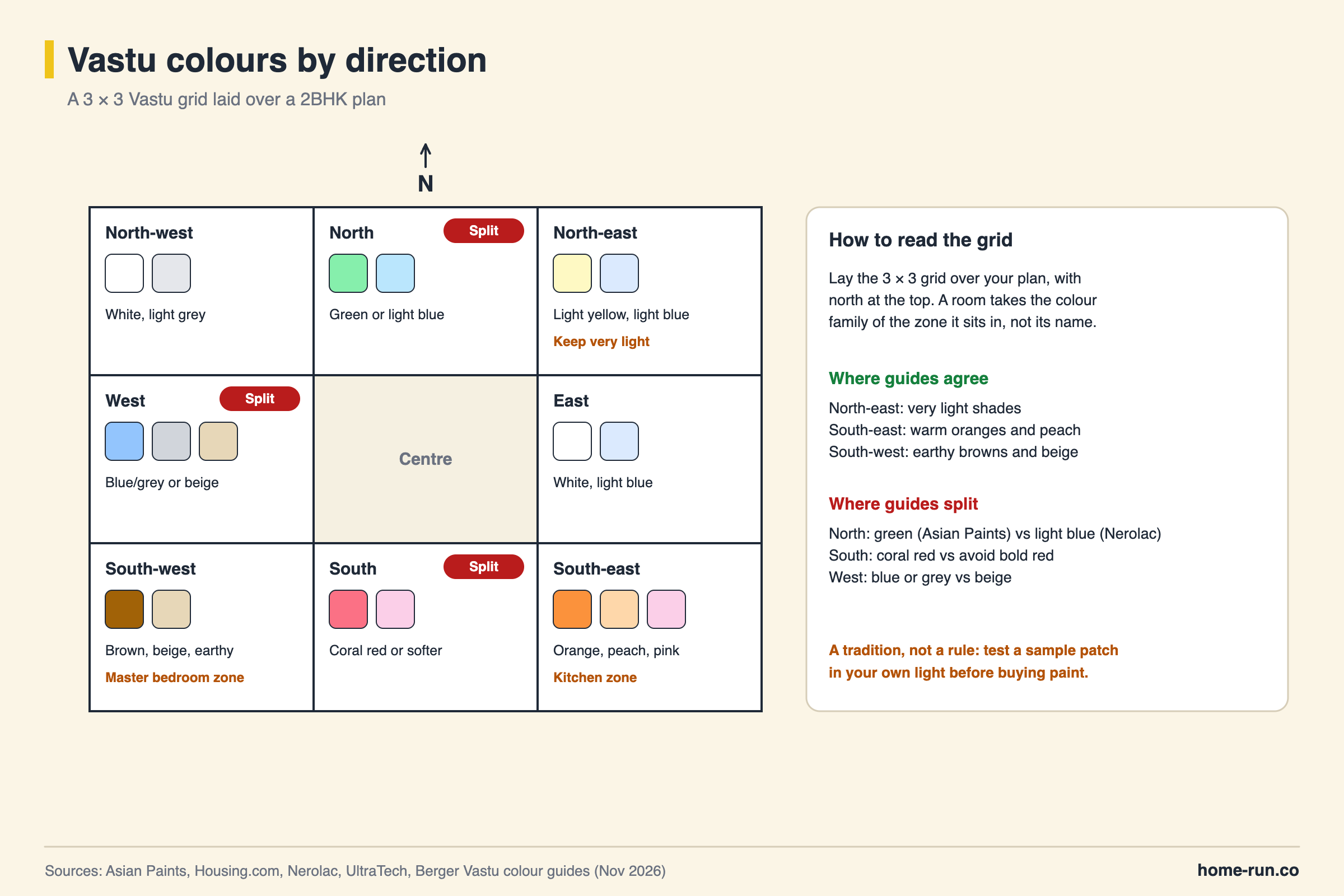
Vastu colour chart by direction
Compared across 5 published guides| Direction | Most cited colours | Also suggested | Sources agree? |
|---|---|---|---|
| North | Green, light blue | Pista green, aqua, cream | Split: green vs light blue Check |
| North-east | Light yellow, light blue | White, cream, soft green | Mostly; all keep it very light |
| East | White, light blue | Light yellow, pink, green | Mostly |
| South-east | Orange, peach, pink | Silver, light terracotta | Yes Consistent |
| South | Coral red, pink | Orange, pastel yellow | Split: red vs avoid bold red Check |
| South-west | Brown, beige, earthy tones | Peach, ochre, yellow | Yes Consistent |
| West | Blue, grey | White, beige, cream | Split: blue vs beige Check |
| North-west | White, light grey | Cream, silver | Mostly |
Asian Paints gives green for the north; Nerolac gives light blue. UltraTech gives red or coral for the south; Nerolac advises against bold reds there. For the west, guides list blue, grey or beige.
Which Vastu Colours for Home Suit Each Room?
The best Vastu room colours are light, calm shades for rest and prayer, and warmer shades for cooking and gathering. Adjust each pick to the room's direction.
Room-wise Vastu colour guide
Traditional picks; adjust by direction| Room | Recommended shades | Usually avoided |
|---|---|---|
| Living room | White, cream, beige, light green, soft yellow | Black, deep red, heavy dark grey |
| Master bedroom (south-west) | Brown, beige, earthy pink, soft blue | Bright or excess red |
| Other bedrooms | Light blue, light green, pink, lavender | Dark shades on all four walls |
| Children's room | Light yellow, light green, light blue, pastels | Dark blue, red |
| Guest room | White, light pink, sky blue, soft yellow | Dark tones |
| Kitchen | Orange, peach, yellow (south-east) | Black, dark blue, dark grey |
| Pooja room | White, light yellow, pale cream | Black, bold red |
| Bathroom | White, light blue, light grey | Dark walls and cabinets |
| Staircase | White, beige, light grey, pale blue | Red, black |
| Exterior walls | Off-white, cream, light beige, light brown | Black, very dark shades |
Bedroom colours as per Vastu
Bedroom colours as per Vastu stay soft: blue and green for calm, earthy shades for a south-west master bedroom. Housing.com also suggests light pink or yellow for newly married couples. For bed position and layout, see our bedroom Vastu tips.
Kitchen colours as per Vastu
Kitchen colours as per Vastu lean warm, because the kitchen sits in the fire zone. Our full guide to kitchen colour as per Vastu covers each direction and slab colours.
Which vastu colours for home exteriors work best?
Vastu colours for home exteriors are light: off-white, cream and beige, with brown or terracotta trims. In Bengaluru's sun, light shades also reflect more heat than dark ones.
Repainting to Vastu colours?
Interior and exterior paints, primer and putty delivered across Bengaluru.
Which Colours Should You Avoid in Your Home as per Vastu?
Vastu guides advise against large areas of black, dark grey and deep red in most rooms. The concern is that dark, heavy shades make a room feel closed and "heavy".
- Black or charcoal on full walls, especially in the pooja room, kitchen and staircase
- Deep red across a whole bedroom or children's room
- Blue or dark blue in a south-east kitchen, which guides say clashes with fire
- Dark grey in living rooms, which can look dull and cramped
- An all-white house with no warm accents, which Housing.com notes some practitioners avoid
Small touches, such as a red cushion, are rarely treated as a problem.
How Do Traditional and Modern Vastu Colour Choices Compare?
Traditional Vastu picks bright, symbolic colours by direction; modern practice keeps the same colour families but uses softer tints and accents.
Traditional approach
StrictFollows the direction chart wall by wall.
- Full-strength colours on whole walls
- Every wall painted for its direction
- Few neutrals mixed in
- Chart followed even if the room feels dark
Modern approach
RecommendedKeeps the colour family, softens the shade.
- Light tints on main walls, deep shades on one accent
- Vastu colour carried in decor, doors or upholstery
- Neutral base of white, cream or beige
- Shade tested in the room's real daylight
How Do You Apply Vastu Colours for Home, Step by Step?
You apply Vastu colours for home in six steps. Plan the whole house before buying paint.
Find true directions
Stand at the centre of the house with a compass and mark north on your floor plan.
Mark each room's zone
Split the plan into a 3 × 3 grid and note which zone each room falls in.
Pick a colour family
Read the zone colour from the direction chart, then check the room table.
Choose the shade
Pick a light tint for main walls and, if you want, a deeper accent.
Test on the wall
Paint a sample patch and check it in morning, afternoon and night light.
Prepare and paint
Repair cracks, apply putty and primer, then two coats of the final colour.
Example: in a 2BHK with a south-west master bedroom, paint that room light beige with one brown accent wall, and a north-east children's room pale yellow.
Where Should You Start With Vastu Colours at Home?
Start with the rooms you use most: the master bedroom, the living room and the pooja room. Repaint one room, see how it feels, then move on.
If you follow a Vastu consultant, bring your floor plan and compass readings. Their chart should settle the north, south and west walls.