


On this page
- What Is Vastu for Home, and What Are Its Basic Rules?
- How Do You Check the Vastu of Your Home?
- Which Direction Is Best for a House as per Vastu?
- Where Should the Main Entrance and Open Spaces Go?
- Which Direction Suits Each Room in Vastu for Home?
- How Do Colours, Plants and Water Fit Into Vastu?
- Can You Follow Vastu in a Flat or Rented Home?
- What Are the Most Common Vastu Mistakes to Avoid?
- What Should You Do Next When Planning or Moving In?
- Vastu Shastra is a traditional Indian design system, not a building code or proven science.
- Everything depends on reading the facing direction correctly, so check it first.
- Common picks: kitchen south-east, master bedroom south-west, pooja room north-east.
- Keep the north-east and the centre (Brahmasthan) light and uncluttered.
- In a flat, prioritise entrance, kitchen and bedroom, then use no-construction fixes.
Vastu for home is the traditional Indian practice of arranging a house by direction: where the main door sits, which corner holds the kitchen, and where you sleep and pray. It is a belief system drawn from old texts, so treat its rules as guidance to weigh alongside safety, light and budget.
What Is Vastu for Home, and What Are Its Basic Rules?
Vastu for home applies Vastu Shastra, an old Hindu system of architecture, to the layout and direction of a house. Its rules come from texts such as the Manasara and Mayamata, which scholars date to roughly the 5th to 7th century CE.
The core ideas are simple:
- Directional zones: each of the eight directions suits certain uses.
- Five elements: water in the north-east, fire in the south-east, earth in the south-west, air in the north-west.
- Vastu Purusha Mandala: a planning grid (often 8 × 8 or 9 × 9) laid over the plot.
- Brahmasthan: the central zone, kept open and light.
Vastu claims about health, wealth or luck are traditional beliefs, not measured effects. Astronomer Jayant Narlikar, for example, has said its claimed effects on fortune have no logical link to the environment. Its advice on light and air is where it overlaps with good design.
How Do You Check the Vastu of Your Home?
You check Vastu by finding your home's facing direction, mapping it into zones, then comparing each room with its traditional zone.
- Find the facing: stand at the main door, look outward and read a compass. The direction you face is the facing.
- Note the shape: mark any cut or extended corners on the plot or flat.
- Grid the plan: sketch the floor plan and divide it into a 3 × 3 grid of eight zones around a centre.
- Tick off rooms: compare each room with the table further down.
Steel doors, grills, fridges and electronics throw off phone compasses. Step away from metal, take three readings and average them. Facing is the direction of the door side, not the way you face while walking in.
Which Direction Is Best for a House as per Vastu?
Most Vastu sources lean towards north and east facing homes, but no facing is ruled out. What matters more is where the door sits on that side and how the rooms are placed.
The four facings in traditional Vastu
Interpretations vary between practitioners| Facing | What tradition says | Common caution or remedy |
|---|---|---|
| North Widely favoured | Often linked with prosperity; an open north side is preferred | Door position on the wall (pada) still matters |
| East Widely favoured | Morning sun; often called the most auspicious facing | Door position on the wall (pada) still matters |
| South Depends on layout | Often called unlucky online, but accepted with a well-placed door | Door position (pada) matters most; keep south walls solid |
| West Depends on layout | Considered workable by most sources | Check door section; avoid the south-west end |
If two options are otherwise equal, a north or east facing plot satisfies more Vastu rules by default. If a south-facing plot is better on light, access or price, a good layout can address most traditional concerns.
Where Should the Main Entrance and Open Spaces Go?
Vastu traditionally prefers the main entrance on the north or east, with a light, open north-east and a clear centre. Sources differ on exact door positions, because each wall is split into padas that charts rate differently.
- Main door is the largest door, solid and opens inward
- Entrance is well lit, clean and free of shoes and clutter
- North-east corner is light, open and uncluttered
- Centre (Brahmasthan) has no pillar, toilet, staircase or heavy furniture
- Staircase sits in the south, west or south-west, not the north-east
Which Direction Suits Each Room in Vastu for Home?
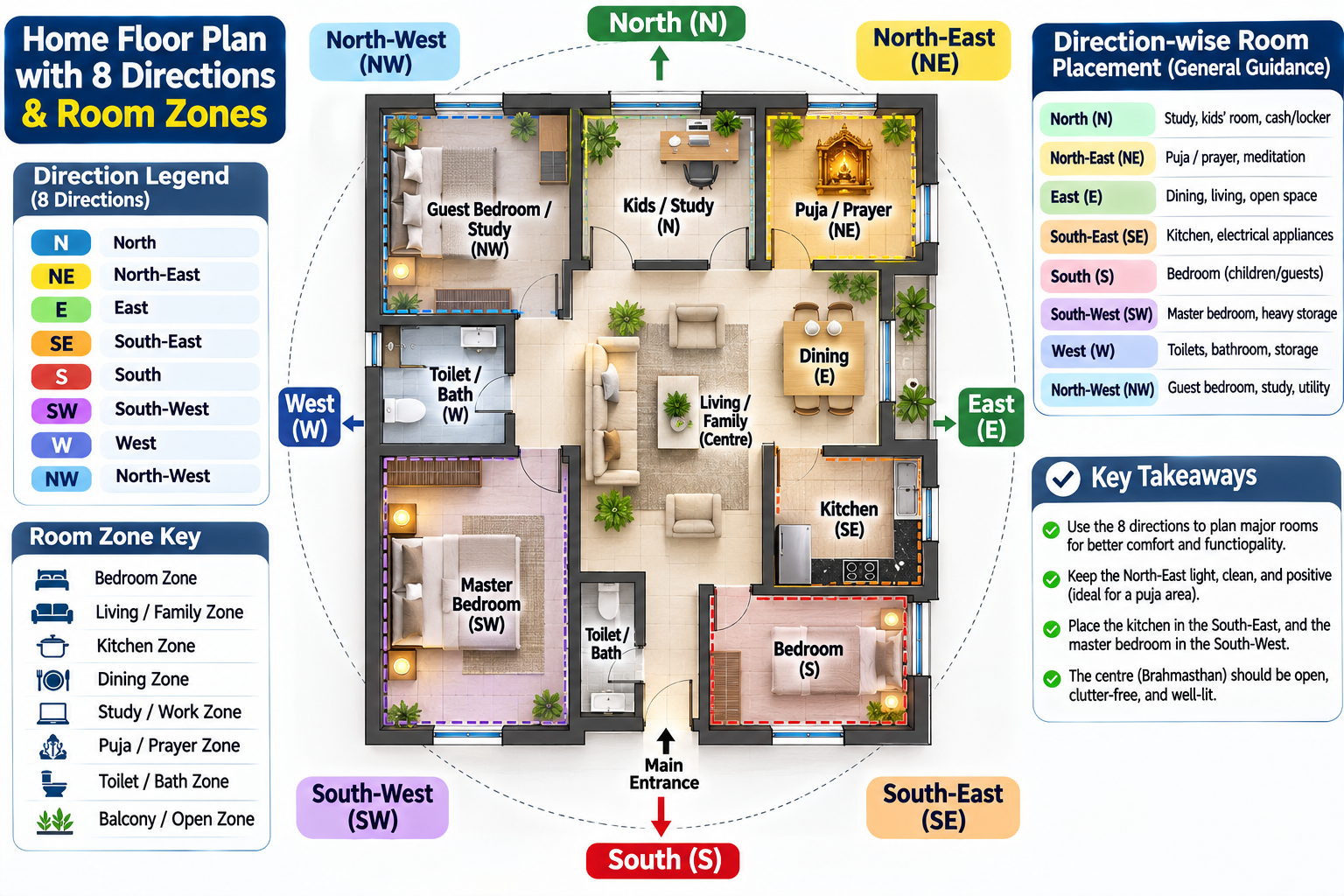
Vastu for home places the kitchen in the south-east, the master bedroom in the south-west and the pooja room in the north-east. Other rooms have more flexible advice, and the sources disagree on several.
Room-wise Vastu directions
Common view across sources; alternatives vary| Room | Preferred zone | Also cited | Usually avoided |
|---|---|---|---|
| Living room | North or east | North-west | South-west |
| Kitchen | South-east | South, east | North-east |
| Master bedroom | South-west | South, west, north | North-east (common view) |
| Kids' bedroom | West | East, north-west | Varies |
| Pooja room | North-east | North, east | Next to a toilet |
| Toilet and bath | West or north-west | South, south-east | North-east, centre |
| Storeroom | North-west | Varies | North-east |
Kitchen
Many sources suggest cooking while facing east and keeping the stove and sink apart, since they stand for fire and water.
Master bedroom
Sleep with your head to the south or east; north is commonly avoided. See our guide to sleeping direction as per Vastu for where traditions differ.
Toilet and pooja room
Keep toilets out of the north-east and the centre. Keep the pooja area away from any wall shared with a toilet.
- Toilet or kitchen in the north-east
- Toilet, staircase or pillar in the centre of the home
- Pooja shelf on a wall shared with a toilet
How Do Colours, Plants and Water Fit Into Vastu?
Colours, plants and water placement are the low-cost side of Vastu, and you can change them without touching walls.
Wall colours by direction
One common chart; others vary| Direction | Suggested shades |
|---|---|
| North | Light blue, light green |
| North-east and east | White, cream, light blue |
| South-east | Orange, pink, light terracotta |
| South | Soft red, coral pink |
| South-west | Yellow, brown, ochre |
| West and north-west | Blue, grey, white, silver |
- Plants: tulsi is usually kept in the north, east or north-east. Money plant (pothos) is popular but harmful to pets if chewed.
- Water: sources favour the north-east for underground water such as a sump or rainwater harvesting pit, and the west for an overhead tank.
- Mirrors and clocks: commonly placed on north or east walls; avoid a mirror facing the bed.
Can You Follow Vastu in a Flat or Rented Home?
You can follow parts of Vastu in a flat, but few flats meet every rule. Prioritise the entrance, kitchen and bedroom, then use small changes that need no construction.
Simple remedies first
Try firstLow cost, reversible, renter-friendly.
- Move the bed head to south or east
- Declutter and brighten the north-east
- Repaint in lighter shades by direction
- Shift the pooja shelf to a north-east wall
Structural changes
Only when rebuildingCostly, needs approval and an engineer.
- Moving a door, kitchen or toilet
- Needs society and landlord consent
- Must not touch columns or load-bearing walls
- Best done at the plan stage of a new home
Do not pay for expensive remedy products or demolition on one consultant's word. India has no single government licence for Vastu consultants, so advice and quality vary widely.
What Are the Most Common Vastu Mistakes to Avoid?
The most common Vastu mistakes are misreading the facing and putting Vastu ahead of safety, daylight or ventilation.
- Reading the compass near a steel door or fridge
- Confusing the way you face on entry with the house facing
- Cluttering the north-east with storage or shoes
- Blocking windows, fire exits or vents to follow a rule
- Cutting into structure for a remedy without an engineer
Building codes, structural safety, light and ventilation come first. Apply Vastu within them, never instead of them.
What Should You Do Next When Planning or Moving In?
Work in order: check the facing, map the zones, sort the entrance, kitchen and bedroom, then handle colours and decor.
Check the plan
Confirm facing and room zones before you buy or sign.
Fix big items
Settle door, kitchen and bedroom positions with your architect.
Set up the home
Paint, place the pooja area and arrange furniture by zone.
Griha Pravesh
Many families choose the move-in date with their priest; that timing comes from Jyotish, not Vastu.
Materials for a Vastu-friendly makeover
Paints, tiles, plywood and hardware from trusted brands, delivered across Bengaluru. Genuine stock, GST invoice.