On this page
- Is a West Facing House Good as per Vastu?
- How Do You Confirm That Your House Faces West?
- What Are the Advantages and Disadvantages of a West-Facing House?
- Which Rashi Suits a West Facing House?
- Where Should the Main Door Be in a West Facing House?
- Room-by-Room West Facing House Vastu Layout
- How Should You Plan the Brahmasthan and West Windows?
- Which Colours and Plants Suit a West-Facing Home?
- What Are the Vastu Remedies for a West Facing House?
- What Should You Check Before Buying or Building on a West-Facing Plot?
- Vastu tradition does not call a west-facing house bad. The main door slot and the room zoning decide the verdict.
- The west wall has 8 padas in the 32-pada system. Most practitioners favour pada 3 (Sugriva) and pada 4 (Pushpadanta), counted from the south-west corner.
- Keep the main door away from both ends of the west wall: padas 1 and 2 near the south-west, padas 7 and 8 near the north-west.
- Usual zoning: kitchen south-east, master bedroom south-west, pooja north-east, with the north and east kept lighter and more open.
- The real-world drawback is strong afternoon sun on the west wall. Shading and light exterior colours handle it.
- Vastu is a traditional belief system, not a building code. Any wall or door change needs a structural engineer.
West facing house vastu is the set of traditional Vastu Shastra guidelines for a home whose main entrance opens toward the west. Vastu treats the west as a workable, often favourable direction. The verdict depends on where the door sits on the west wall and how the rooms are zoned.
This guide uses the same 32-pada scheme as our north facing house Vastu guide and south facing house Vastu guide, so you can compare plots directly.
Is a West Facing House Good as per Vastu?
A west-facing house is good as per Vastu when the main door sits in a favoured pada and the layout follows the usual zoning. Vastu Shastra, the traditional Indian system of design rules, does not rank the west as an inauspicious direction.
In Vastu tradition, the west belongs to Varuna, the god of water and rain, one of the eight guardian deities of the directions. Many Vastu writers also link the west with the planet Saturn (Shani) and describe it as a zone of gains and stability. These are beliefs, not guarantees.
A plot on a west road can have its main door on the north. A flat in a west-facing tower can open into an east corridor. Vastu reads the direction you face when you stand at the main door looking out.
Buyer sentiment still matters. In 2024, the Bangalore Development Authority (BDA) said a lack of Vastu-compliant designs was one reason over 3,500 of its flats stayed unsold, alongside connectivity and build quality.
How Do You Confirm That Your House Faces West?
Your house faces west if a compass reads close to 270° when you stand at the main door looking out. In the 16-zone Vastu compass, each zone spans 22.5°, so the west zone runs from about 258.75° to 281.25°.
- Stand just outside the main door with your back to the house.
- Hold a magnetic compass or calibrated phone compass flat at waist height.
- Step about a metre away from steel gates, grills, cars and electrical panels.
- Take readings at two or three points along the front wall and average them.
- Check the result against the north arrow on your approved site plan.
A reading near 315° is north-west (Vayavya) and one near 225° is south-west (Nairutya). Vastu advice for these two corners is very different, so do not round them to "west".
What Are the Advantages and Disadvantages of a West-Facing House?
The main advantages of a west-facing house are Vastu's positive reading of the direction and bright evening light. The main disadvantage is practical: the west wall takes hot, low-angle afternoon sun.
Advantages
Belief and practicalWhat owners and Vastu writers cite.
- Vastu links the west with gains and stability
- Often described as suiting business-minded households
- Bright evening light in front rooms
- Cool, shaded front rooms in the morning
Disadvantages
ManageableMostly about heat and layout.
- Strong afternoon sun on the front wall
- Front rooms warm up by evening in summer
- Door near the south-west end is a Vastu concern
- Some buyers wrongly see the facing as unlucky
Low-angle sun heats walls far more than high midday sun, which is why long west walls get hot by evening. Here is how a west-facing home behaves through a typical summer day:
Front in shade
The west facade sits in the building's own shadow, so front rooms stay cool.
Sun high overhead
The roof takes most of the heat. A horizontal sunshade (chhajja) cuts the high sun.
Low sun on the front wall
Direct sun strikes the west wall and glass. This is the hottest stretch for front rooms.
Stored heat, warm light
Walls release heat into rooms after sunset. Good shading and pale paint reduce this.
Two common myths need a correction:
- "West-facing means money loss." Vastu texts tie outcomes to the door pada and the south-west corner, not to the facing alone.
- "West, north-west and south-west are the same." They are three separate facings with separate rules.
Which Rashi Suits a West Facing House?
A west-facing house is most often linked with Kumbha (Aquarius) rashi, and some astrologers add Mithuna (Gemini) and Tula (Libra). There is no single agreed table.
Rashi (moon sign) matching comes from astrology layered on top of Vastu, not from core Vastu rules. Lists differ by astrologer, so ask a qualified consultant to read your own chart rather than rely on a generic list.
Where Should the Main Door Be in a West Facing House?
The main door of a west-facing house should sit in pada 3 (Sugriva) or pada 4 (Pushpadanta) of the west wall, counted from the south-west corner. Doors at either end of the wall are widely avoided.
A pada is one equal division of a wall in the Vastu Purusha Mandala, the grid Vastu lays over a plot. The 32-pada system gives each wall 8 padas, and each pada covers 11.25° of the compass.
West wall padas for the main door
Counted from the south-west corner to the north-west corner| Pada | Traditional name | Common Vastu view |
|---|---|---|
| W1 Avoid | Pitru (Nirriti) | Avoided; at the south-west corner |
| W2 Avoid | Dauvarika | Widely advised against |
| W3 Favoured | Sugriva | Favoured by most modern practitioners |
| W4 Favoured | Pushpadanta (Kusumadanta) | Most widely favoured |
| W5 Accepted | Varuna | Often accepted; classical text rates it well |
| W6 Mixed | Asura | Opinions differ |
| W7 Avoid | Shosha (Shesha) | Widely advised against |
| W8 Avoid | Papayakshma | Avoided; at the north-west corner |
The Brihat Samhita, a 6th-century Sanskrit text by Varahamihira, gives the best west-side results for pada 4 (sons, wealth and strength) and pada 5 (opulence). It rates pada 3 poorly. Modern practitioners usually favour padas 3 and 4.
If the drawing puts the door within 7.5 ft of either corner on a 30 ft wall, shift it toward the middle before the foundation is marked. After construction, the same move means cutting a wall.
If your main door already sits in a poor pada, do not force it onto another wall. Practitioners suggest light, threshold and symbolic fixes first (see the remedies section). Door details that Vastu guides commonly add:
- The main door is the largest door in the house and opens inward.
- A raised threshold and a well-lit, uncluttered entry.
- A clear name plate beside the door.
- Earthy door finishes such as wooden brown, off-white or beige.
Room-by-Room West Facing House Vastu Layout
In a west-facing house, Vastu puts the kitchen in the south-east, the master bedroom in the south-west, the pooja room in the north-east and the living room on the north or north-east side.
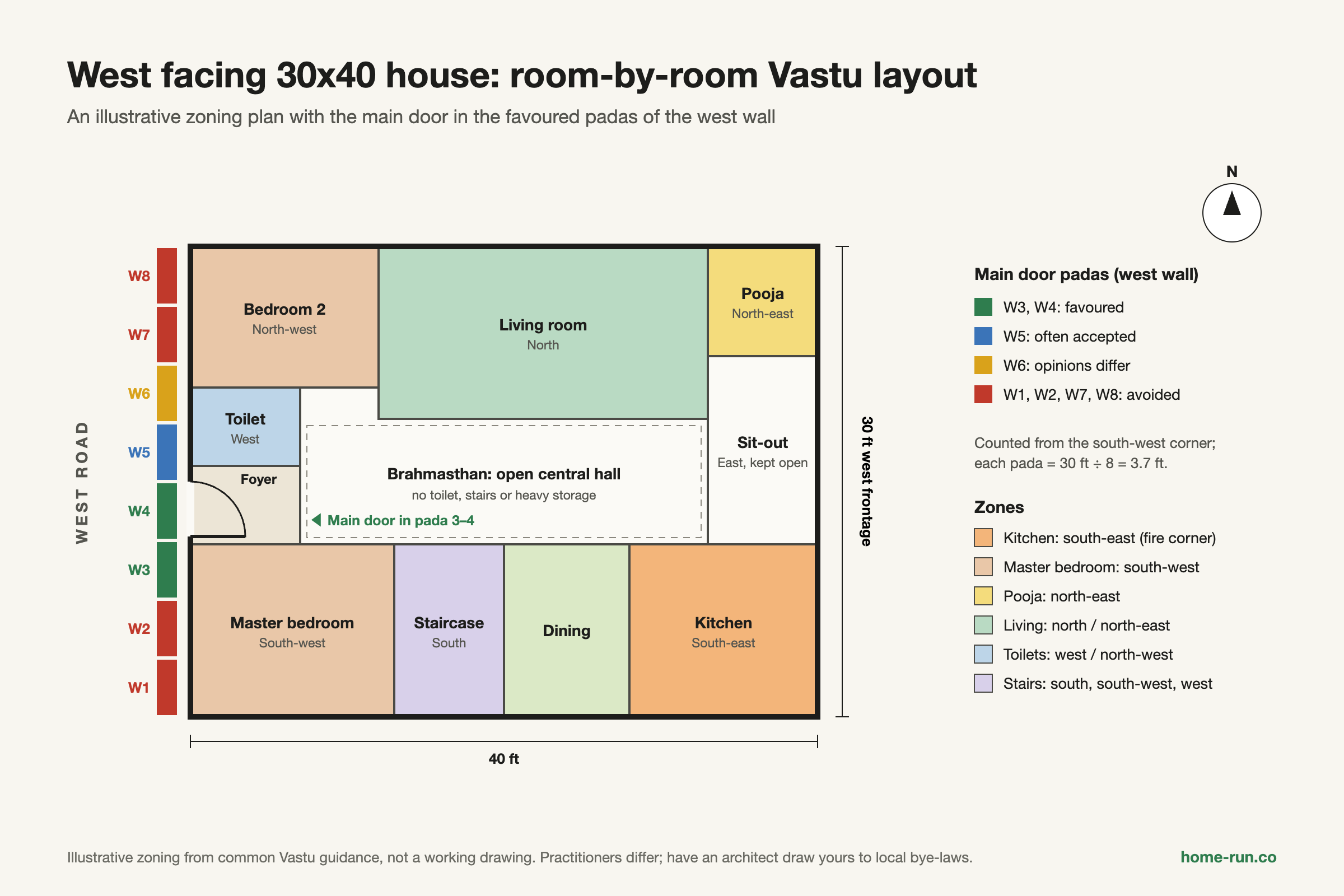
Room-to-direction summary for a west-facing house
Ideal zone and what to avoid; schools differ on details| Room | Ideal zone | Avoid |
|---|---|---|
| Living room | North-east or north | South-west |
| Kitchen | South-east (north-west second) | North-east |
| Master bedroom | South-west | North-east, south-east |
| Other bedrooms | West or north-west | North-east |
| Pooja room | North-east | Under stairs, beside a toilet |
| Staircase | South, south-west or west | North-east, centre |
| Toilet and bath | West or north-west | North-east, next to kitchen |
| Underground sump or borewell | North-east | South-west |
| Overhead water tank | South-west | North-east |
Kitchen
The kitchen belongs in the south-east, the fire corner, with the cook facing east. The north-west is the usual second choice.
Master bedroom
The master bedroom goes in the south-west, which Vastu links with stability. For bed and head position, see sleeping direction as per Vastu. Other bedrooms suit the west or north-west.
Pooja room
The pooja room sits in the north-east, with idols facing east or west. Keep it away from a wall shared with a toilet.
Staircase
The staircase goes in the south, south-west or west, rising clockwise. Keep stairs out of the north-east and the centre.
Bathrooms and toilets
Toilets go in the west or north-west, away from the kitchen and the north-east.
Living room
The living room fits the north-east or north. Put heavy sofas and cabinets against the south or west walls.
In a 2BHK flat you cannot move the kitchen or toilets. Judge the door pada and the south-west bedroom first, and accept small compromises elsewhere.
How Should You Plan the Brahmasthan and West Windows?
Vastu keeps the Brahmasthan, the central zone of the plan, open, light and free of toilets, heavy storage or stairs. On the west side, the practical rule is small, well-shaded windows.
- Leave the centre of the house as an open hall, courtyard or circulation space.
- Keep west windows smaller than north and east windows, as Vastu and climate advice agree here.
- Add vertical fins or side baffles to block low afternoon sun, plus a chhajja for midday sun.
- Use curtains, blinds or heat-reflective glass on large west panes.
For frame and glass options, see our guide to window designs for home.
Which Colours and Plants Suit a West-Facing Home?
Vastu guides commonly suggest white, off-white, cream, beige, soft yellow and light brown for a west-facing house. Light shades also reflect afternoon sun, which keeps the west wall cooler.
Colour and planting guide for a west-facing house
Common Vastu suggestions with the practical reason| Element | Suggested | Why |
|---|---|---|
| Exterior walls | White, cream, beige | Reflect afternoon heat |
| Interior walls | White, soft yellow, light brown | Calm, bright rooms |
| Main door | Wooden brown, off-white, beige | Earthy tones in Vastu guides |
| Tall trees | South and west sides | Shade the hot walls |
| North and east | Lawns, low plants | Keep these sides open |
What Are the Vastu Remedies for a West Facing House?
Vastu remedies for a west facing house start with free, non-structural fixes at the entrance and in the south-west. Remedies are traditional practices with no scientific proof.
- Light the entrance well, clear clutter and add a raised threshold.
- Move heavy furniture and storage to the south-west.
- Keep the north-east open, clean and light.
- Repaint the door or gate in an earthy, light shade.
- Place mirrors on the north or east walls, not facing the main door.
- Practitioners also suggest brass pyramids, Vastu strips or yantras at a door in an avoided pada. These are symbolic only.
Things to avoid in a west-facing home:
- A main door at the south-west end of the west wall
- Toilet or septic tank in the north-east
- Borewell, sump or water pump in the south-west
- A plot or roof sloping down toward the south-west
- Large unshaded glass on the west wall
- A kitchen directly above or below the pooja room or a toilet
Shifting a door or opening a wall can affect beams and load paths. Get a structural engineer to check before any change, and skip a structural fix whose only benefit is symbolic.
Materials for your entrance and heat fixes
Order paint, doors, plywood and electricals with a GST invoice and delivery across Bengaluru.
What Should You Check Before Buying or Building on a West-Facing Plot?
Before you buy a west-facing plot, check its slope, the road in front and whether the plan can place the door in pada 3 or 4. Vastu prefers a plot that slopes down toward the north-east.
- Compass reading taken at the planned main door, away from metal
- Door in pada 3 or 4, not within one-quarter of the wall from either corner
- Plot slopes toward the north-east, not the south-west
- No T-junction road pointing straight at the main door
- Regular square or rectangular plot with no cut south-west corner
- Compound wall higher on the south and west than on the north and east
On a 30x40 or 30x60 plot, first confirm which side faces west; the first figure is not always the frontage. If the 30 ft side faces west, the pada maths above applies. A rotated east-facing plan will not fit. Have an architect draw yours to local bye-laws, then ask a Vastu consultant which pada scheme they follow.