


On this page
- What Makes a Good Window Design for an Indian Home?
- Which Window Designs for Home Are Most Common, and Where Does Each Work Best?
- Which Traditional Indian Window Designs Still Work Today?
- Which Modern Window Design Ideas Suit Indian Weather?
- Which Frame Material Is Best: Wood, Aluminium, uPVC or Steel?
- What Glass Should You Choose: Toughened, Laminated, Double-Glazed or Low-E?
- How Do You Choose Window Designs for Home by Climate and Room?
- How Do Grills, Mesh and Child Safety Fit Into Window Design?
- What Do Window Designs for Home Cost in India?
- How Do You Replace Old Windows and Get a Good Installation?
- What Does Vastu Say About Window Placement?
- How Do You Shortlist the Right Window Design?
- The most common window designs for home in India are sliding and casement windows.
- Pick the type by room need: airflow, light, privacy, noise or space.
- Pick the frame by climate: aluminium or uPVC near the coast, sealed frames in dusty cities.
- NBC 2016 asks for window area of at least 1/10 of floor area in habitable rooms.
- India price guides put uPVC at about ₹450–850 per sq ft standard and wood at ₹1,000 and up (May 2026).
The best window designs for home in India balance five jobs: light, airflow, security, weather protection and looks. This guide walks through 11 window types, the frame and glass options behind them, and current prices, so you can shortlist the right window for each room.
What Makes a Good Window Design for an Indian Home?
A good window design lets in light and air while keeping out heat, rain, dust, noise and intruders. Most Indian homes want big glass, but they also face strong sun, monsoon rain and city dust.
Six parts decide how a window performs:
- Frame: the fixed outer box set into the wall.
- Sash: the moving panel that holds the glass.
- Glazing: the glass itself, single or double.
- Hardware: hinges, rollers, handles and locks.
- Sill: the ledge below, which sheds rainwater.
- Mesh: the insect screen, fixed or sliding.
A flat on a busy Mumbai road needs sealing and noise control. A hill-station house needs insulation. A Bengaluru bedroom mainly needs cross-ventilation and a mosquito mesh. The right design follows the room and the climate, not a photo gallery.
Which Window Designs for Home Are Most Common, and Where Does Each Work Best?
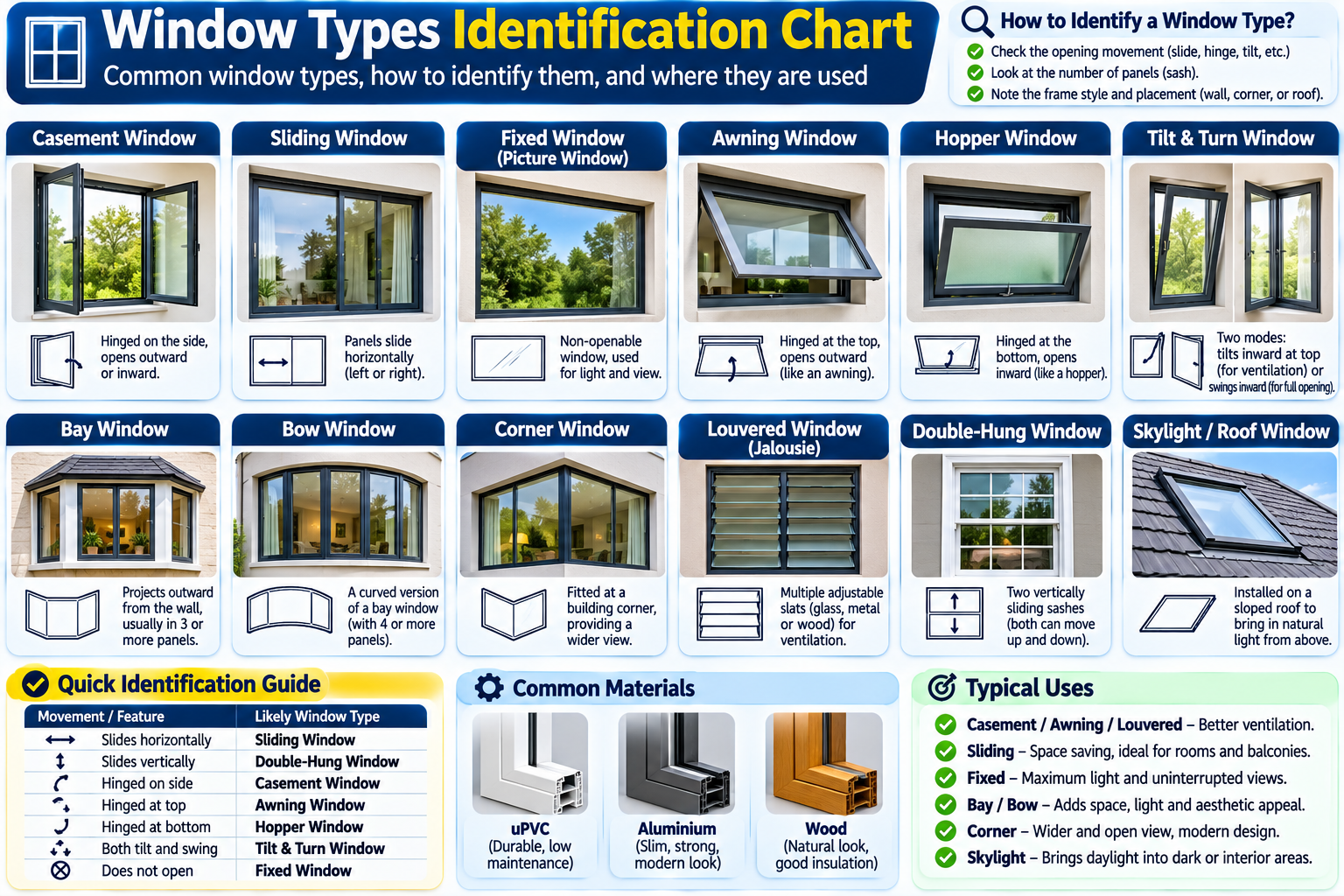
Sliding and casement windows are the most common window designs for Indian homes, with fixed, awning and louvre windows used for specific rooms. Here are 11 types, how each opens and where it fits.
1. Casement window
A casement window is hinged on one side and swings open with a handle. It opens fully, so airflow is excellent, and it presses against its seals when shut. It suits bedrooms, kitchens and dusty or noisy areas, but needs clear swing space.
2. Sliding window
Sliding window panels glide sideways on a track and take no swing space. They are the default choice for balconies, passages and compact rooms, and are usually the cheapest openable type. Only about half the opening can be open at once, and worn tracks let in dust and rain.
3. Tilt and turn window
A tilt and turn window tips inward from the top for safe airing, or swings in fully like a door. It seals well and is easy to clean from inside. It needs inward swing space, so curtains and furniture must stay clear. Do not confuse it with a parallel opening window, whose sash pushes straight out and then slides.
4. Awning window
An awning window is hinged at the top and pushes outward from the bottom. The open sash acts like a small roof, so you can keep it open in light rain. It works well above kitchen counters and in bathrooms.
5. Fixed or picture window
A fixed window does not open; it exists only for light and view. It is the cheapest and best-sealed design, but gives no ventilation by itself. Pair it with an openable casement or sliding section.
6. Floor-to-ceiling window
Floor-to-ceiling glazing turns a wall into a view and floods the room with daylight. It needs safety glass, careful shading and usually a sliding or casement panel for air. On west and south walls, it can make rooms hot without low-E glass or overhangs.
7. Bay and bow windows
Both project outward from the wall. A bay uses three or so flat, angled panels, while a bow forms a gentle curve from several narrower panels. They add light, a seating ledge and character to living and dining rooms, but cost more and need structural support.
8. French window
A French window is a tall, door-like pair of casements that opens onto a balcony or garden. It gives a classic look and full-height airflow. It needs secure locking and, on upper floors, a railing.
9. Louvre window
Louvre windows use horizontal glass or wooden slats that tilt open together. They let air in while limiting rain and direct sun, which suits bathrooms and utility areas. The slats do not seal tightly, so avoid them in AC rooms or on noisy roads.
10. Clerestory, corner and skylight windows
Clerestory windows sit high on a wall to bring in light and let warm air out without losing privacy. Corner windows wrap glass around a corner for a wider view. A skylight sits in the roof instead of a wall. All three help light hard-to-reach spaces such as stairwells and inner rooms.
11. Single-hung and double-hung (sash) windows
Both have two stacked panels that slide up and down. In a single-hung window only the bottom panel moves; in a double-hung window both do. They suit period-style facades but are uncommon in India, so check local availability before you design around them.
Window types compared
Relative performance, for shortlisting| Type | Airflow | Sealing | Swing space | Best room |
|---|---|---|---|---|
| Casement Default pick | Full opening | Tight | Needed | Bedroom, kitchen |
| Sliding Budget | About half | Moderate | None | Balcony, living room |
| Tilt and turn | Full or tilted | Tight | Inward | AC bedroom, noisy road |
| Awning | Partial | Tight | Outward, small | Kitchen, bathroom |
| Fixed / picture | None | Best | None | Living room view wall |
| Bay / bow | Side panels only | Depends on panels | Projects out | Living, dining |
| French | Full height | Moderate | Needed | Balcony, garden |
| Louvre Not for AC rooms | Partial, constant | Loose | None | Bathroom, utility |
Use sliding where swing space is tight, such as balconies and passages. Use casement where you want maximum airflow and a tight seal. Add a fixed panel when you want more light without more hardware.
Which Traditional Indian Window Designs Still Work Today?
Traditional Indian window designs such as the jharokha, arched windows, carved wood and jaali screens still work because they were built for heat, glare and privacy.
- Jharokha: a projecting, balcony-like window with a canopy. It shades the glass and gives a private view of the street.
- Arched windows: a curved top over a casement or fixed panel, common on independent house fronts.
- Carved wooden windows: teak or sheesham frames with carved panels, suited to traditional elevations.
- Jaali or lattice: a perforated stone, wood or metal screen that cuts glare and keeps privacy while air passes through.
To bring them into a modern home, fit a jaali screen in front of a slim aluminium window, or set one carved panel into a modern frame. You keep the look without the upkeep of a fully wooden window.
Which Modern Window Design Ideas Suit Indian Weather?
Modern window design ideas suit Indian weather when you pair the look with shading and the right glass.
- Slim aluminium frames: narrow sightlines for large openings and sliding walls.
- Panoramic glass: big views, but big heat gain without low-E glass or an overhang.
- Black or dark frames: a sharp modern look, but dark finishes absorb more heat in direct sun.
- Corner glazing: opens up a view from two sides; needs a structural design that frees the corner.
- Smart or switchable glass: turns from clear to opaque at a switch. It is a niche, premium option.
A large west-facing window without shading or heat-control glass can make a room hot through the afternoon and push up your AC bill. Plan the overhang, chajja or glass type together with the window size.
Which Frame Material Is Best: Wood, Aluminium, uPVC or Steel?
uPVC and aluminium are the best all-round frame materials for most Indian homes; wood suits traditional looks and steel suits tight budgets and grills. Profile thickness and hardware matter as much as the material name.
Window frame materials compared
Relative, not lab-tested ratings| Material | Strengths | Watch out for | Best suited to |
|---|---|---|---|
| uPVC Default pick | Good sealing, low upkeep, does not rot or rust | Cheap profiles can fade or chalk; check steel reinforcement | Noisy roads, AC rooms, coastal homes |
| Aluminium | Slim, strong, suits large glass | Conducts heat unless it has a thermal break | Large sliding openings, modern facades |
| Wood | Warm look, carving, good insulation | Termites, swelling in monsoon, regular polishing | Traditional elevations, hill homes |
| Steel Budget | Strong, grill-friendly, low first cost | Rust, especially near the coast | Utility areas, budget builds |
| Wood-aluminium | Wood inside, weatherproof aluminium outside | Premium price, fewer makers | High-end homes |
uPVC is unplasticised PVC: a rigid plastic made for window frames. It is not the flexible PVC used for pipes and cables.
uPVC windows
Better sealingMulti-chamber plastic profile, often steel-reinforced.
- Tight seals for dust, rain and noise
- Good choice for AC rooms
- Rot- and rust-proof near the coast
- Frames are bulkier than aluminium
Aluminium windows
Slimmer lookExtruded metal profile, powder-coated or anodised.
- Slim frames suit large glass
- Strong for wide sliding panels
- Conducts heat without a thermal break
- Coating quality decides corrosion life
Hardware and finishes for windows
Hinges, handles, locks, sealants and paints for frames and sills, from trusted brands across Bengaluru.
What Glass Should You Choose: Toughened, Laminated, Double-Glazed or Low-E?
Choose glass by the main risk: toughened for breakage safety, laminated for security and noise, double-glazed for insulation and low-E for heat.
- Toughened glass is heat-treated to be stronger. If it breaks, it shatters into small blunt pieces.
- Laminated glass bonds two sheets with a plastic layer. It cracks but stays in place, which helps security and noise.
- Double-glazed unit (DGU): two panes with a sealed gap that slows heat and noise.
- Low-E glass: carries a thin, near-invisible coating that reflects heat. It is often, but not always, used inside a DGU.
- Tint and reflective film: budget ways to cut glare and heat on existing windows.
Glass prices in Bengaluru
₹ per sq ft, glass only, InfraLens (updated 12 Aug 2026)| Glass | Typical | Range | Use it for |
|---|---|---|---|
| Plain glass, 5 mm Budget | 46 | 37–54 | Small upper-floor windows |
| Toughened glass, 12 mm | 160 | 127–192 | Large panes, low-level glazing, doors |
How Do You Choose Window Designs for Home by Climate and Room?
Choose window designs for home by first matching the frame and glass to your climate, then the window type to each room's main need.
- Hot and dry: smaller west-facing glass, deep overhangs, low-E or tinted glass.
- Coastal and humid: uPVC or well-coated aluminium; avoid unprotected mild steel.
- Heavy monsoon: drainage slots, sealed joints, awning or hooded designs; watch wood for swelling.
- Cold hills: double glazing and tight seals; wood or uPVC frames insulate better.
- Dusty cities: tight-sealing casement or tilt and turn over loose sliders, plus fine mesh.
Bengaluru's mild climate favours cross-ventilation, so openable windows on two walls usually matter more than heavy insulation. Monsoon seepage around frames is a common cause of damp patches on walls, so get the sealing and sill slope right.
Room-by-room window picks
A starting point, not a rule| Room | Recommended type | Glass or material note | Avoid |
|---|---|---|---|
| Living room | Large fixed or sliding with a casement section | Toughened glass for large panes | All-fixed glass with no airflow |
| Bedroom | Casement or tilt and turn | Laminated or DGU on noisy roads | Loose sliders facing traffic |
| Kitchen | Awning or casement | Easy-clean frame; keep away from the stove flame | Curtains near the hob |
| Bathroom | Small louvre or awning | Frosted glass for privacy | Clear glass at eye level |
| Balcony | Sliding or folding | Toughened glass, child-safe locks | Outward-swinging sashes on upper floors |
How Do Grills, Mesh and Child Safety Fit Into Window Design?
Grills, mosquito mesh and child-safety locks should be planned with the window, not added later, so they fit the opening style.
- Grill styles: simple vertical bars, geometric patterns or decorative metal. Inside-mounted grills behind sliding windows keep the facade clean.
- Mosquito mesh: a third track on sliders, a fixed mesh outside inward-opening sashes, or a fly-screen on tilt and turn.
- Child safety: opening restrictors and window stoppers on upper floors and balconies.
- Fully fixed grills on every window with no openable section for escape in a fire
- Bar gaps wide enough for a child's head; ask your fabricator about safe spacing
- Low sills on upper floors with no restrictor or railing
What Do Window Designs for Home Cost in India?
Window designs for home cost roughly ₹300–3,500 per sq ft in India across published price guides, depending on material, type, glass and hardware. Price guides differ widely, so use these ranges to compare quotes, not to fix a budget.
Window cost per sq ft by frame material
₹ per sq ft, national price guides| Material | Houseyog (May 2026) | Aecord (Aug 2026) |
|---|---|---|
| Steel Budget | Not listed | 400–900 |
| Aluminium | 300–950 (basic to powder-coated) | 500–1,200 |
| Aluminium sliding system | 650–1,800+ | Not listed |
| uPVC | 450–850 (premium 850–1,400+) | 800–2,000 |
| Wood | 1,000–3,000+ | 1,500–3,500 |
Type changes the price too. Fixed windows have the least hardware, while casements, tilt and turn and bay windows need more hinges, locks and fabrication.
- Profile thickness and steel reinforcement
- Glass type, thickness and DGU
- Hardware brand: hinges, rollers, locks
- Mesh, grills and finish colour
- Installation, old-frame removal and plaster repair
How Do You Replace Old Windows and Get a Good Installation?
A good window replacement starts with an installer's site measurement and ends with sealed, drained and tested frames.
- Site survey: let the installer measure every opening. Do not order from your own measurements.
- Choose profile and glass: confirm profile series, glass type and hardware brand in writing.
- Get a written quote: with sizes, specs, lead time and warranty terms.
- Remove old frames: expect dust and some plaster damage; cover furniture.
- Install and seal: fix the frame square, seal the gap and keep drainage slots open.
- Finish: repair plaster and repaint; see our home painting tips.
- Uneven sealing gaps or visible light around the frame
- Sashes that rattle, drag or need force to lock
- Thin, flexing profiles or loose, unbranded hardware
- No drainage slots at the bottom of sliding tracks
Most housing societies control exterior changes such as frame colour, grill projection and balcony enclosures. Check your bylaws or get committee approval before you order. Enlarging an opening in any home needs a structural engineer's check.
For upkeep, do a quick check before each monsoon:
- Clean tracks and drainage slots on aluminium and uPVC
- Lubricate hinges, rollers and locks
- Look for termite trails and swelling on wooden frames
- Treat rust spots on steel frames and grills early
- Reseal cracked joints around the frame
What Does Vastu Say About Window Placement?
Vastu guidance commonly favours windows on the east and north walls for morning light, though practitioners differ. Treat it as cultural preference, not a building code.
It overlaps with practical sense: east windows bring gentle morning light, while large west-facing glass brings harsh afternoon heat. If you follow Vastu in other rooms too, our guide on sleeping direction as per Vastu covers bed placement.
How Do You Shortlist the Right Window Design?
Shortlist a window design by answering three questions for each room: what it needs most, what your climate demands and what your budget allows.
- Room need: airflow, light, privacy or noise control
- Climate: heat, coast, monsoon, cold or dust
- Budget: material, glass and hardware level
Then collect two or three written quotes with full specs, and see a working sample of the exact profile before you order.