On this page
- What Is the Meaning of Wainscoting?
- What Is the Original Meaning of Wainscot?
- What Are the Different Types of Wainscoting Panels?
- Which Wainscoting Materials Suit Indian Homes?
- What Are the Benefits of Wainscoting?
- Should You Install Wainscoting Yourself or Hire a Carpenter?
- How Much Does Wainscoting Cost in India?
- Wainscoting vs Paneling: What Is the Difference?
- Where Should You Install Wainscoting for Maximum Impact?
- Wainscoting is panelling or moulding fixed to the lower part of a wall, finished differently from the wall above.
- The word comes from Middle Dutch wagenschot, a name for fine oak boards (Merriam-Webster).
- Main styles: raised panel, flat panel, beadboard, board and batten and picture-frame moulding.
- In humid Bengaluru rooms, choose PVC, WPC or moisture-resistant boards and fix any damp first.
- Panel material alone runs about ₹150–400 per sq ft for MDF and ₹50–350 for PVC (Design Cafe, Aug 2026).
The wainscoting meaning is simple: wainscoting is decorative panelling fixed to the lower part of an interior wall. It usually rises to about one third of the wall, ends in a horizontal rail, and protects the wall from scuffs while adding texture.
What Is the Meaning of Wainscoting?
Wainscoting is a lining of panels, boards or moulding on the lower part of an interior wall. Merriam-Webster defines the related noun wainscot as "the lower three or four feet of an interior wall when finished differently from the remainder of the wall".
The word also names the material itself. In everyday use, "wainscoting", "wainscot" and "wainscotting" (British spelling) mean the same thing.
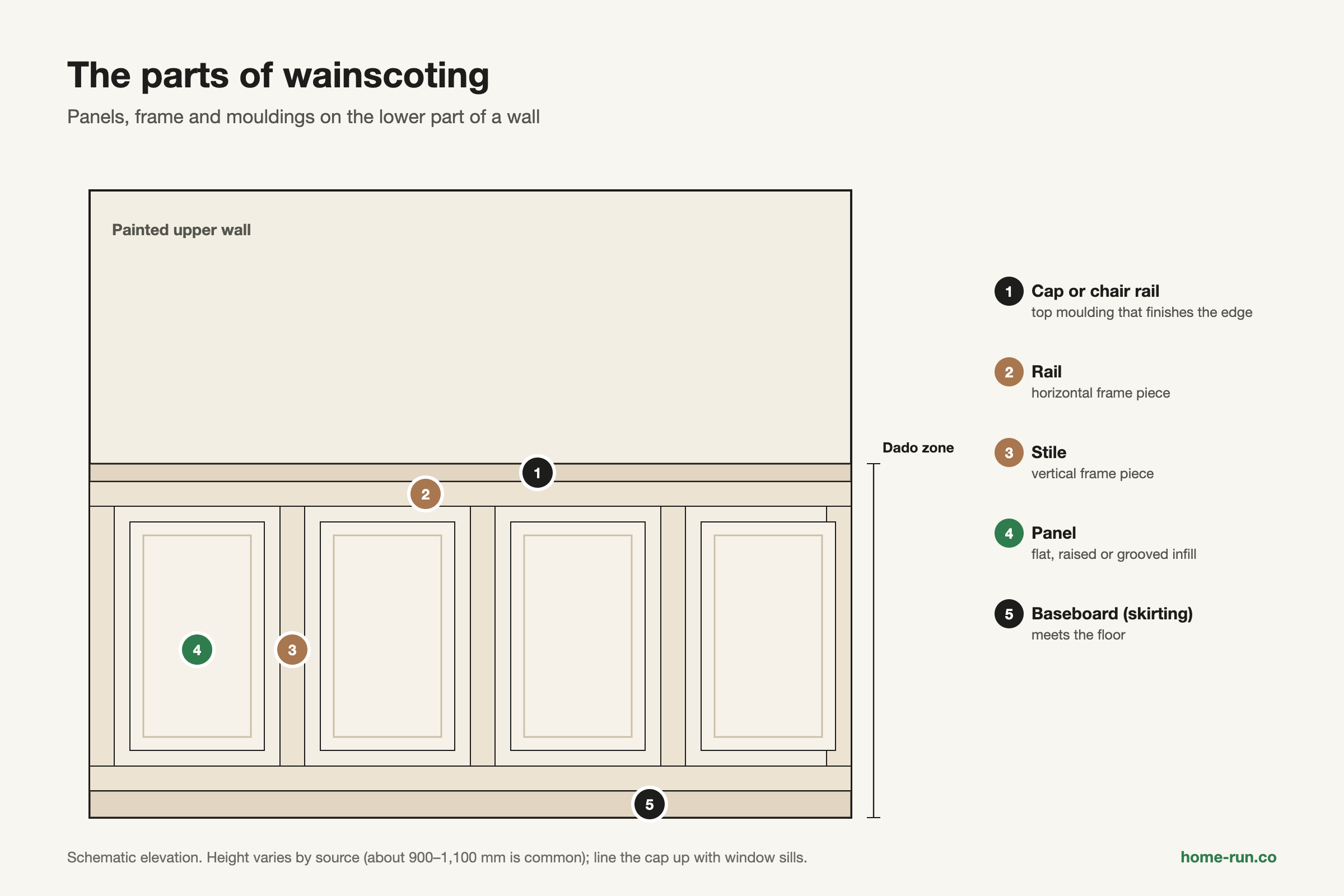
A typical wainscot has four parts:
- Baseboard (skirting): the bottom strip that meets the floor.
- Stiles and rails: the vertical (stile) and horizontal (rail) frame pieces.
- Panels: the flat, raised or grooved infill between the frame pieces.
- Cap or chair rail: the top moulding that finishes the edge.
In British and Indian usage, the lower wall zone is often called the dado, and the top moulding is a dado rail. A chair rail is a single moulding strip, with or without panels below it. Wainscoting is the full treatment below that line. In Hindi dictionaries, wainscoting appears as काष्ठास्तरण (kashthastaran), meaning a wooden wall lining.
What Is the Original Meaning of Wainscot?
Wainscot comes from the Middle Dutch word wagenschot, probably from wagen (wagon) and schot (a board or crossbar), according to Merriam-Webster. In Britain, wainscot first meant a fine grade of imported oak used for woodwork.
Over time, the name moved from the oak to the panelling made from it. Merriam-Webster dates the noun to the 14th century and the verb "to wainscot" to 1570.
English dictionaries give the pronunciation as roughly "WAYN-skut" or "WAYN-skot". Close synonyms are wall panelling, dado panelling and wood lining.
Early wainscoting was practical. In cold European houses it added a layer of insulation and shielded fragile plaster from knocks (MasterClass). Today it is mostly decorative, and factory-made panels have replaced hand-cut oak.
What Are the Different Types of Wainscoting Panels?
The five common types of wainscoting panels are raised panel, flat panel, beadboard, board and batten, and picture-frame (applied) moulding.
Wainscoting styles compared
Qualitative guide| Style | How it looks | Skill needed | Suits |
|---|---|---|---|
| Raised panel | Bevelled panels that stand proud of the frame | High, usually a carpenter | Formal living and dining rooms |
| Flat panel (Shaker) Default pick | Flat recessed panels inside a simple frame | Medium | Modern and minimal interiors |
| Beadboard | Narrow vertical grooves with a small bead | Low to medium | Bathrooms, kitchens, kids' rooms |
| Board and batten | Wide flat boards with vertical battens over joints | Low to medium | Hallways, bedrooms, staircases |
| Picture-frame moulding DIY friendly | Moulding boxes fixed straight onto a painted wall | Low | Rental flats, accent walls |
Modern wainscoting designs in Indian flats lean towards flat panels and picture-frame moulding, painted the same colour as the wall or one shade darker.
Which Wainscoting Materials Suit Indian Homes?
MDF and PVC are the most common wainscoting materials in Indian homes because they are cost-effective and easy to maintain, according to JK Cement (2026). Solid wood, plywood and WPC fill premium or damp-area needs.
MDF (medium-density fibreboard) is an engineered board made from wood fibres and resin. PVC (polyvinyl chloride) is a type of vinyl plastic. WPC (wood-plastic composite) blends wood flour with plastic.
Wainscoting materials at a glance
Relative ratings for Indian conditions| Material | Moisture | Termites | Finish | Best use |
|---|---|---|---|---|
| MDF Default pick | Poor unless moisture-resistant grade | Needs treated board | Very smooth, paints well | Living rooms, bedrooms |
| Plywood with moulding | Fair; good in BWR or BWP grades | Needs treated board | Paint, laminate or veneer | Custom designs |
| Solid wood Premium | Can swell or crack | Teak resists well; others need treatment | Natural grain, polish | Formal rooms, heritage look |
| PVC Wet zones | Good | Not affected | Printed or plain; plastic sheen | Bathrooms, kitchens, balconies |
| WPC | Good | Resistant | Fluted or wood-look | Humid rooms, ground floors |
Buy MDF with the ISI mark. IS 12406 is the Bureau of Indian Standards (BIS) specification for general-purpose MDF boards, and the Wood-Based Boards Quality Control Order, 2023 makes BIS certification compulsory for them.
Planning a wainscot wall?
Get boards, adhesive and paint delivered across Bengaluru with a GST invoice.
What Are the Benefits of Wainscoting?
Wainscoting protects the lower wall from daily wear and adds depth to plain walls. It also hides minor wall flaws.
- Shields paint from chair backs, bags, pets and children's hands
- Wipes clean, which helps in dusty Indian cities
- Covers hairline cracks and uneven plaster on the lower wall
- Adds texture without the cost of full-height panelling
- Lets you use a darker, washable colour below and a light one above
Keep wainscoting at about one third of the wall height. Indian guides suggest 900–1,100 mm for traditional wainscoting and 1,200–1,500 mm for a half-wall look (JK Cement, 2026). US sources quote lower figures, 26–32 inches (660–810 mm) in the Journal of Light Construction. Lining the cap up with window sills gives a clean line.
Should You Install Wainscoting Yourself or Hire a Carpenter?
Picture-frame moulding and peel-and-stick PVC panels are DIY jobs. Raised panels, custom MDF frames and staircase wainscoting need a carpenter.
DIY installation
Small wallsPre-made panels or moulding boxes.
- Saves labour cost
- Needs a level, mitre saw and adhesive
- Corners and joints are hard to get tight
- Suits one accent wall
Professional installation
Whole roomsA carpenter builds or fixes the panels.
- Adds labour to the quote
- Brings jigs, nailers and spray finish
- Scribes panels to uneven walls and floors
- Suits raised panels and staircases
Either way, the job runs in the same order: fix damp, measure, mark a level line, fit the base, fix panels and rails, fill joints, then prime and paint.
Covering a damp wall traps moisture and leads to mould behind the panels, so find the cause first with our guide to causes of wall dampness. Other frequent errors are following a sloping floor instead of a level line, uneven panel spacing at corners, and forgetting cut-outs for switches and sockets.
How Much Does Wainscoting Cost in India?
Wainscoting in India costs the panel material plus labour, priced per sq ft of covered wall. Design Cafe (updated Aug 2026) puts MDF wall panelling at ₹150–400 per sq ft and labour at ₹20–150 per sq ft.
Wall panelling material rates in India, 2026
₹ per sq ft| Material | Rate per sq ft |
|---|---|
| PVC Budget | ₹50–350 |
| MDF Default pick | ₹150–400 |
| WPC | ₹200–600 |
| Solid wood | ₹500–2,500 |
| Labour, by complexity | ₹20–150 |
Raised panels, curved stair runs and PU or duco paint finishes push you to the top of the range. Simple picture-frame moulding on a painted wall sits at the bottom. Ask for itemised quotes that show material brand, finish, labour and GST separately.
Wainscoting vs Paneling: What Is the Difference?
Wainscoting covers only the lower part of a wall, while wall panelling can cover the full height. Panelling 4 to 6 feet high counts as wall panelling rather than wainscot, according to the Journal of Light Construction.
Wainscoting and wall panelling side by side
Design, purpose, installation| Point | Wainscoting | Wall panelling |
|---|---|---|
| Coverage | Lower third of the wall | Half to full height |
| Top edge | Cap or chair rail | Ceiling trim or cornice |
| Main purpose | Protect the wall and add detail | Feature wall or full room finish |
| Installation | Fewer panels, levelled to a rail line | More material, often on a back frame |
Where Should You Install Wainscoting for Maximum Impact?
Wainscoting works best where walls take knocks or where a room needs a focal point.
- Dining room: chair backs hit the wall at rail height
- Hallway and entrance: bags, shoes and hands touch the lower wall
- Living room: one panelled wall behind the sofa or TV unit
- Staircase: follows the stair slope and guards the wall from scuffs
- Kids' room: washable lower wall, brighter colour above
- Bathroom: PVC beadboard only, away from direct shower spray
Keep the same cap height across connected rooms so the line runs through the house.