On this page
- What Is Crown Moulding and What Does It Do?
- Which Material Suits Your Home: PVC, PU, POP, Wood or MDF?
- What Size Looks Right for Your Ceiling Height?
- Which Design Ideas Work in Indian Homes?
- How Is the Trim Installed?
- What Drives the Cost of Crown Moulding in India?
- How Do You Maintain Crown Moulding, and What Goes Wrong?
- Crown moulding hides the wall-ceiling joint and frames the room.
- PVC and PU handle humidity; MDF and wood suit dry rooms.
- Go slim on 8 ft ceilings and deeper above 10 ft.
- Buy the room perimeter plus 10% for corner cuts.
Crown moulding is a decorative strip fixed at an angle where a wall meets the ceiling. Crown moulding covers the uneven joint and hairline cracks there, and can hide LED strips for cove lighting.
What Is Crown Moulding and What Does It Do?
Crown moulding is the ceiling-line trim; skirting runs along the floor and architrave frames doors. Crown leans across the corner at its spring angle, usually 38° or 45° from the wall, which sets your saw angles.
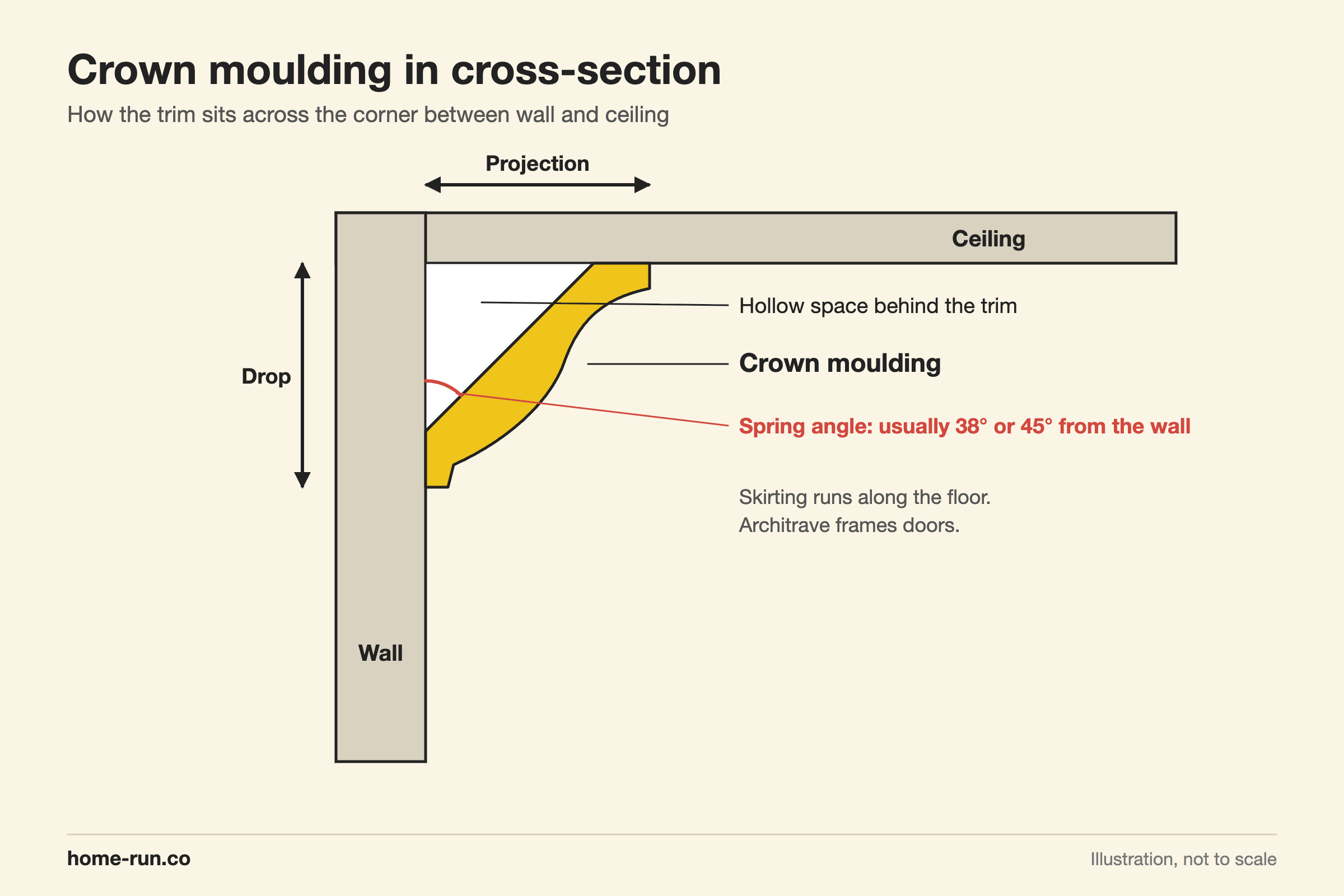
Indian contractors often call this trim a "POP cornice"; coving is one plain curved style. Our cornice meaning explainer covers the terms.
Which Material Suits Your Home: PVC, PU, POP, Wood or MDF?
Pick PVC or PU for humid rooms and easy fixing, POP for custom profiles, and wood or MDF board only in dry rooms. Monsoon damp punishes materials that absorb water.
Crown moulding materials compared
Qualitative; check the product datasheet| Material | Moisture | DIY-friendly? | Best for |
|---|---|---|---|
| PVC (polyvinyl chloride) Wet rooms | Does not absorb water | Yes, straight runs | Bathrooms, kitchens, balconies |
| PU (rigid polyurethane foam) Living rooms | Water-resistant | Yes, with adhesive | Detailed profiles, cove lighting |
| POP (plaster of Paris) / gypsum | Weakens with persistent damp | No, needs a fixer | Custom profiles, false ceiling edges |
| Solid wood | Moves with humidity; termite risk | Needs carpentry skill | Dry rooms, classic look |
| MDF (medium-density fibreboard) Avoid in wet areas | Swells when wet | Moderate | Dry bedrooms, wardrobe tops |
What Size Looks Right for Your Ceiling Height?
Taller ceilings carry deeper crown moulding; low ceilings need slim, simple profiles. These bands come from a US millwork maker.
Crown height by ceiling height
Horner Millwork guidance| Ceiling height | Crown height |
|---|---|
| 8 ft (2.44 m) | 2.5–6 in (64–152 mm) |
| 9 ft (2.74 m) Close to NBC minimum | 3–7.5 in (76–190 mm) |
| 10 ft+ (3.05 m+), casual room | 4 in (102 mm) minimum |
| 10 ft+ (3.05 m+), formal room | 9 in (229 mm) minimum, up to 24 in (610 mm) built-up |
Profiles run from plain cove to stepped and ornate (dentil, egg-and-dart). Ornate ones need height and floor area to avoid looking heavy.
Single-piece crown
Up to 9 ftPoint
- One profile, fewer joints
- DIY-friendly, lower cost
Built-up crown
10 ft and abovePoint
- Two or more stacked profiles
- Needs a carpenter, costs more
Which Design Ideas Work in Indian Homes?
The most popular crown moulding design hides an LED strip behind the trim, so light washes up across the ceiling.
- Cove-lit crown: warm white LED behind PU or POP. See false ceiling types for recesses.
- False ceiling edge: crown finishes the step to the wall.
- Cabinet tops: a small crown closes the gap to the ceiling.
- Colour: match the ceiling, or contrast to frame the room.
Skip deep trim in small rooms and 2.4 m ceilings; it makes the room feel lower.
How Is the Trim Installed?
Crown moulding is installed by marking a line, cutting corners, fixing each length and filling joints.
- Acclimatise: leave PU or wood in the room for 48–72 hours.
- Mark: chalk a line at the moulding's bottom edge.
- Cut: mitre outside corners; cope inside corners, since walls are rarely square.
- Dry-fit every joint before gluing.
- Fix: adhesive for PVC and PU, plus finishing nails for wood and MDF. POP needs a trained fixer.
- Finish: caulk joints and nail holes, then paint.
What Drives the Cost of Crown Moulding in India?
Crown moulding cost depends on material, profile size, running length, labour and extras like LED strips and painting. Suppliers quote per running foot, metre or piece, so convert before comparing.
Check whether a quote is supply-only or supply-and-fix, and whether it covers filling and painting.
How Do You Maintain Crown Moulding, and What Goes Wrong?
Dust the trim, wipe PVC and PU with a damp cloth, and repaint POP and wood when dull. After each monsoon, check for:
- Open gaps at corner joints
- Hairline cracks along POP runs
- A section sagging or pulling off the wall
- Damp stains or peeling paint near the ceiling
- Termite tracks or hollow sound on wood or MDF
Fix any damp source before repairing the trim.
Finishing a ceiling edge?
Boards, fixings, primer and paint delivered across Bengaluru.