On this page
- What Is Joint Compound and What Is It Used For?
- Jointing Compound vs Wall Putty vs Plaster: What Is the Difference?
- What Are the Types of Joint Compound?
- How Do You Tape and Finish Gypsum Board Joints?
- What Are the Common Jointing Problems and Fixes?
- How Much Joint Compound Do You Need, and What Does It Cost?
- How Should You Store Jointing Powder and Ready-Mix?
- Joint compound is made for gypsum board joints, not for brick or cement plaster walls.
- The wall putty sold by paint brands is a different product.
- Choose setting-type powder for fast or damp jobs, air-dry types for relaxed finishing.
- Apply three thin coats, each wider than the last, and sand lightly.
- Always prime the finished joints before you paint.
Joint compound is a gypsum- or polymer-based paste that fills the seams, screw heads and dents on gypsum board. Once sanded and primed, the boards look like one smooth surface ready for paint.
What Is Joint Compound and What Is It Used For?
Joint compound is the filler that turns separate gypsum boards into a single wall or ceiling. In India, shops usually sell it as "jointing compound" or "jointing powder". "Drywall mud" is the US name for the same thing.
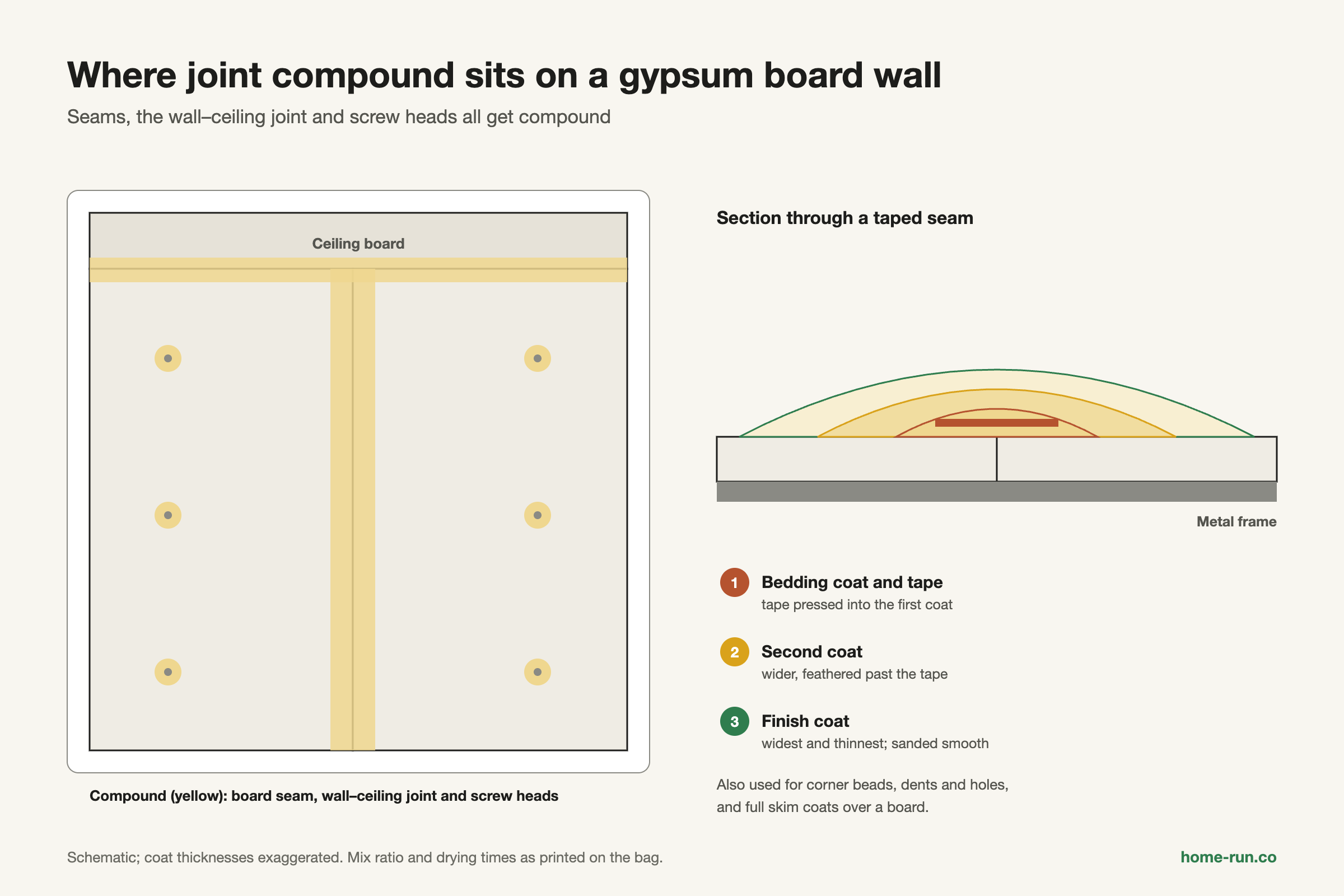
Joint compound is used on gypsum partitions, false ceilings and wall lining for four jobs:
- Bedding the joint tape over board seams
- Covering screw heads and corner beads
- Patching dents and small holes in the board
- Skim coating, a thin layer spread over a whole board surface
Ready-mix types contain limestone as filler, expanded perlite for lightness, ethylene-vinyl acetate (EVA) polymer as binder and attapulgite clay as thickener. Setting types are based on Plaster of Paris.
The compound only performs as well as the board under it. Read our guides to gypsum board properties and types of false ceiling before you buy.
Jointing Compound vs Wall Putty vs Plaster: What Is the Difference?
Joint compound bonds to gypsum board paper and tape. Wall putty is a thin white cement or acrylic finish for plastered masonry. Plaster is a thick levelling coat.
Joint compound vs wall putty vs plaster
Qualitative comparison| Point | Joint compound | Wall putty | Cement or gypsum plaster |
|---|---|---|---|
| Base | Gypsum or vinyl polymer | White cement or acrylic | Cement and sand, or gypsum |
| Surface | Gypsum board | Plastered brick or concrete | Brick and block masonry |
| Layer | Thin coats over joints | Thin skim over the whole wall | Thick levelling coat |
| Sanding | Easy | Moderate | Not sanded |
| Board joints Key test | Yes, with tape | No | No |
Board walls get joint compound. Brick and plaster walls get wall putty. Do not use joint compound in place of cement plaster.
What Are the Types of Joint Compound?
Joint compound types differ in two ways: how they are supplied (ready-mix or powder) and how they harden (air-drying or setting).
Joint compound types at a glance
Check the data sheet| Type | How it hardens | Best for |
|---|---|---|
| Air-dry (ready-mix or powder) Beginners | Water evaporates, up to 24 h | Relaxed finishing, topping coats |
| Setting-type powder ("hot mud") Fast | Chemical set, 5–120 min | Deep gaps, quick repairs, humid weather |
| All-purpose | Air-dry | Every coat, with some compromise |
| Taping | Air-dry or setting | Bedding tape, strongest bond |
| Topping (finishing) | Air-dry | Final coats, smoothest sanding |
| Lightweight | Air-dry | Ceilings; about 25–30% lighter |
Ready-mix compound
EasiestWet, in a bucket, used as-is.
- No mixing, so no lumps
- Stays workable while the bucket is sealed
- Slower to dry, shrinks more
- Spoils if the lid is left open
Setting-type powder
FastestDry, in a bag, mixed on site.
- Next coat the same day
- Low shrinkage in deep fills
- Harder to sand once set
- Mixed batch cannot be reused
In India, Gyproc sells Pro-Fill and the Easi-Fill range (Easi-Fill 90, Quick Set and Hydro) in 10–25 kg bags. Knauf sells an all-purpose ready-mix compound.
Finishing a gypsum wall or ceiling?
Primers, paints and tools delivered across Bengaluru.
How Do You Tape and Finish Gypsum Board Joints?
You apply joint compound in three thin coats, each wider than the one before, and sand only the last coat. Gyproc India's method looks like this:
- Mix. Add powder to clean water and stir for 10–15 minutes until smooth. Take the water ratio from the bag, since Gyproc's own web page gives two conflicting ratios.
- Tape coat. Fill the tapered edge, press paper tape in without trapping air, then spread a thin coat 100–150 mm wide.
- Fill coat. Once dry (up to 24 hours for air-dry types, longer in monsoon humidity), spread a second coat 200–250 mm wide.
- Finish coat. Feather the third coat at least 50 mm past the second.
- Sand and prime. Sand lightly along the joint, check for no gap over 1 mm under a 200 mm ruler, then prime.
Pair mesh tape with setting compound, since air-dry types can bond weakly to it. Fix a corner bead on outside corners.
What Are the Common Jointing Problems and Fixes?
Most joint compound defects come from thick coats, rushed drying or skipped primer.
- Tape bubbles or peels: too little compound under the tape; cut out and re-bed
- Cracks along the joint: coat too thick or boards moving; re-tape and fix loose boards
- Ridges: coat not feathered wide enough; scrape and add a wider coat
- Pinholes: air in the mix; fill with a thin skim coat
- Flashing (joints showing through paint): unprimed compound; prime and repaint
How Much Joint Compound Do You Need, and What Does It Cost?
You need about 14 kg of joint compound per 100 m of flat taped joint for the tape and first finish coats, by one Gyproc data sheet.
The 20% allowance is our assumption; check your product's data sheet. One November 2026 trade listing prices a 25 kg jointing compound bag at ₹847 plus 18% GST.
How Should You Store Jointing Powder and Ready-Mix?
Store joint compound sealed, dry and off the floor, and wear a dust mask when sanding.
- Keep bags on dry timber pallets, never on a damp floor in the monsoon
- Reseal opened ready-mix buckets tightly
- Use stock in date order (one Gyproc data sheet gives powder 6 months); reject damp, crusted or sour-smelling stock
- Ventilate the room and wear a dust mask while sanding
- Let leftovers harden and bin them; never wash compound down a drain
Use joint compound on cement board only if the board maker approves it. For large ceilings or a Level 5 finish (a full skim coat), hire a gypsum board finisher.