On this page
- What Are Skirting Tiles and Why Do Floors Need Them?
- What Types of Skirting Tiles Can You Buy?
- Which Material Is Best for Skirting Tiles?
- What Is the Standard Skirting Tile Height and Size?
- Should Skirting Tiles Match the Floor or the Wall?
- Where Should You Use Skirting Tiles, and Where Can You Skip Them?
- How Do You Calculate Skirting Tiles for a Room?
- How Are Skirting Tiles Installed?
- What Mistakes Should You Avoid with Skirting Tiles?
- How Much Do Skirting Tiles Cost in India?
- Skirting tiles hide the floor-wall joint and protect wall paint from mops, feet and furniture.
- The usual height in Indian homes is 100 mm (4 inches); go 75 mm in small rooms and up to 150 mm in tall ones.
- The safest choice is skirting cut from your floor tile, bought in the same batch.
- Vitrified and porcelain skirting handle wet mopping best; soft ceramic wall tile suits dry rooms.
- Buy skirting by running length plus about 10% for cuts, not by square feet.
Skirting tiles are narrow strips of tile fixed along the bottom of a wall, where the wall meets the floor. They cover the rough edge of the floor tiles and protect the wall from water and knocks.
What Are Skirting Tiles and Why Do Floors Need Them?
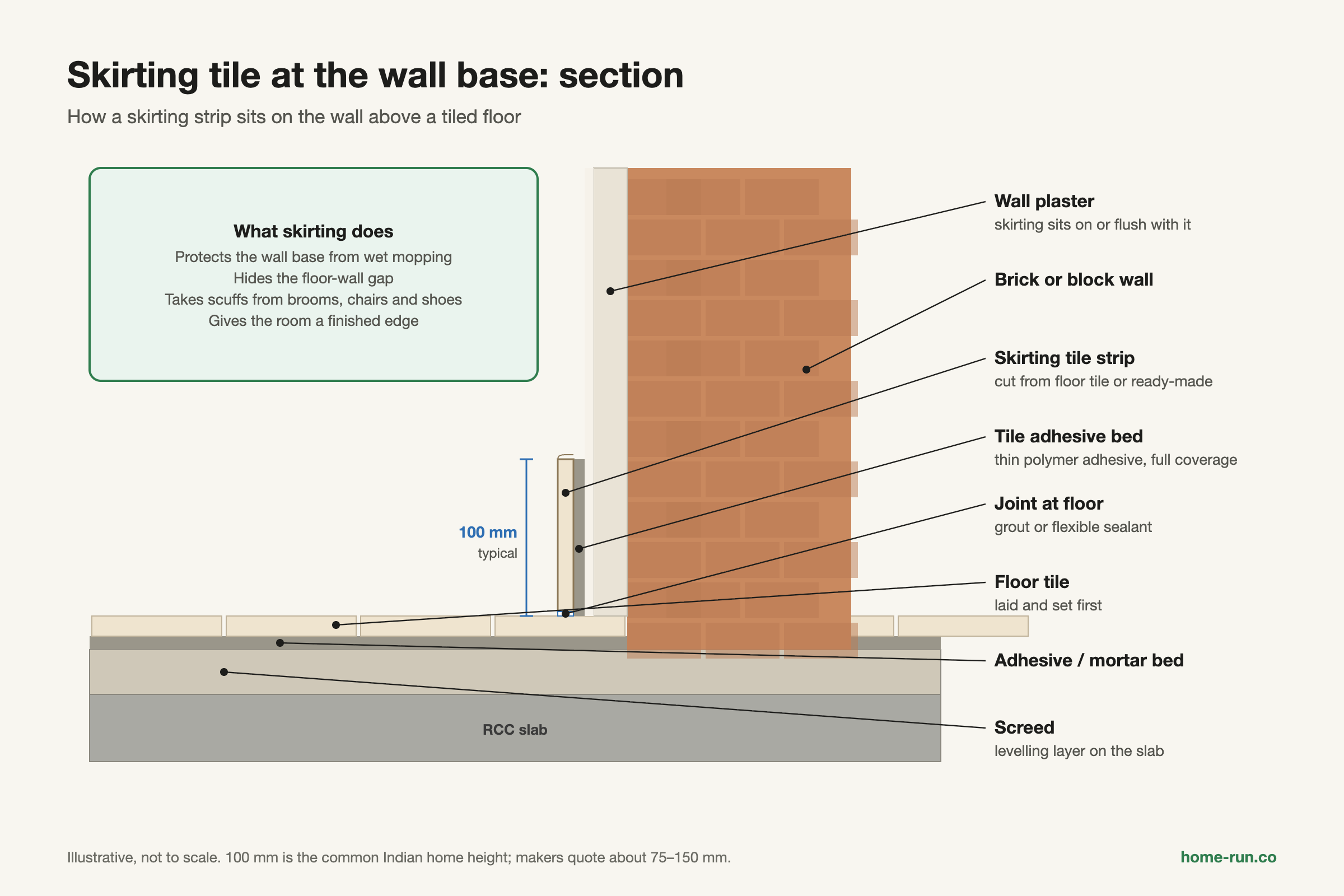
Skirting tiles are a finishing strip at the base of a wall. In India, masons often just call this "skirting". Skirting does four jobs.
1. Protects walls from wet mopping
Most Indian homes wet-mop floors daily. Without skirting, mop water stains the wall base and peels the paint. A tile strip takes that water instead.
2. Hides the floor-wall gap
Floor tiles rarely end in a clean line against the wall. Skirting covers the cut edges and the small gap left for tile movement.
3. Takes knocks from feet and furniture
Chair legs, brooms and shoes scuff the wall base first. Tile is far harder than paint, so the damage stops at the skirting.
4. Gives a finished, easy-to-clean edge
A neat skirting line makes a room look complete, and dust wipes off tile in one pass.
Skirting is a low strip, usually 75 to 150 mm high. A dado is a taller band of wall tile, such as kitchen wall tiling or full bathroom walls. A border is a decorative strip that runs across a wall. Name the right one when you order.
What Types of Skirting Tiles Can You Buy?
The main types of skirting tiles are cut-from-floor-tile, ready-made, flush and cove or bullnose skirting.
1. Skirting cut from the floor tile
The mason slices spare floor tiles into strips on site. Colour and pattern match the floor exactly. The cut top edge stays raw unless it is polished.
2. Ready-made skirting tiles
Ready-made (readymade) skirting tiles are factory-cut strips with a finished top edge. Some tile series offer matching skirting; many do not. Check the series name before you assume a match.
3. Flush or shadow-line skirting
Flush skirting sits level with the wall plaster instead of standing out from it. A shadow-line version leaves a small recess above the tile. Both need planning before plastering, because the wall must be built back to make room.
4. Cove and bullnose skirting
Cove skirting has a curved base that blends into the floor, so dirt has no sharp corner to sit in. Bullnose skirting has a rounded top edge that resists chipping.
Three ways to source skirting
Compare before you order| Route | Match with floor | Edge finish | Wastage | Best for |
|---|---|---|---|---|
| Cut from floor tile Default pick | Exact, if same batch | Raw unless polished | Higher; blade cuts and breakage | Most homes |
| Ready-made skirting | Only within the same series | Factory finished | Low | Neat lines, less site cutting |
| Separate wall tile Budget | Contrast or wall match | Factory edge | Low | Dry rooms, contrast designs |
Which Material Is Best for Skirting Tiles?
The best skirting tile material is usually the same material as your floor. Water absorption is the next filter. Tiles are grouped by how much water they soak up under ISO 13006, which India follows through IS 15622, the Indian standard for pressed ceramic tiles.
1. Ceramic skirting tiles
Ceramic skirting tiles are glazed clay tiles. Ceramic wall tiles are soft and absorb more water than floor tiles, so keep them to dry rooms. Read our guide to ceramic tiles for grades and finishes.
2. Vitrified, porcelain, GVT and PGVT skirting
Vitrified and porcelain tiles are dense and absorb very little water. GVT (glazed vitrified tile) and PGVT (polished glazed vitrified tile) are the printed versions sold in most Bengaluru showrooms. This group suits kitchens, bathrooms and balconies. See our porcelain tiles guide for the difference.
3. Granite and marble skirting
Granite and marble skirting is cut from the same slabs as a stone floor. Marble etches with acidic cleaners, so use a pH-neutral cleaner.
4. Terracotta and Athangudi skirting
Terracotta and Athangudi skirting suit traditional and heritage-style homes. Athangudi tiles are handmade cement tiles from the Chettinad region of Tamil Nadu, cured in water and sun-dried rather than kiln-fired. Both are porous and need sealing in wet areas.
Skirting tile materials compared
Qualitative ratings| Material | Water resistance | Hardness | Best rooms |
|---|---|---|---|
| Vitrified / GVT / PGVT Wet areas | High | High | All rooms, kitchens, bathrooms |
| Porcelain | High | High | Bathrooms, balconies |
| Ceramic wall tile Budget | Low to medium | Medium | Bedrooms, dry areas |
| Granite | High | Very high | Stairs, foyers, granite floors |
| Marble | Medium | Medium | Marble floors, pooja rooms |
| Terracotta / Athangudi Seal first | Low unless sealed | Medium | Traditional living spaces |
Match the skirting to the floor material. Deviate only for a planned contrast design, and never use a soft ceramic wall tile as skirting in a wet room.
What Is the Standard Skirting Tile Height and Size?
The standard skirting tile height in India is 100 mm (4 inches) for homes. Indian tile makers and cement companies quote a working range of about 75 to 150 mm, with 150 mm common in commercial spaces.
Some UK sources quote up to 300 mm, which reflects timber skirting boards in tall rooms rather than Indian tile practice.
Skirting tile height by room
Starting points, not rules| Room or space | Height (mm) | Height (inches) |
|---|---|---|
| Compact rooms, low ceilings | 75 | 3 |
| Standard bedrooms and living rooms Default pick | 100 | 4 |
| Large rooms, villas, tall ceilings | 125–150 | 5–6 |
| Offices, shops, lobbies | 150 | 6 |
Skirting length follows the floor tile. A 600 mm floor tile gives 600 mm skirting strips. A 1200 mm tile gives 1200 mm strips with fewer joints.
Thickness is usually 9 to 12 mm. Cut-from-floor skirting is as thick as the floor tile.
Should Skirting Tiles Match the Floor or the Wall?
Skirting tiles that match the floor are the safest choice, because the floor appears to run up the wall and the room looks larger. Contrast skirting suits bold, modern rooms but shows dirt more.
1. Matching the floor
Matching skirting comes from the same floor tile batch and works with any wall colour.
2. Black or dark contrast skirting
White tiles with black skirting give a sharp outline. Dark skirting shows dust and white mop marks from hard water, so it needs frequent wiping.
3. White or wall-matched skirting
Skirting that matches a white or pale wall gives a clean, gallery-style look. White skirting shows shoe scuffs, so pick a glossy finish that wipes easily.
4. Wooden-look and metallic strips
Wooden-look tile skirting gives a timber look without termite or water risk. Thin metal strips suit minimal interiors.
Matching skirting
Safe defaultSame tile, same batch as the floor.
- Room looks larger and calmer
- Hides dust and mop marks well
- No extra product to buy
- Works with any wall paint
Contrast skirting
Design statementBlack, white or metallic edge.
- Outlines the room sharply
- Shows dust or scuffs more
- Needs a separate product order
- Must suit the wall colour too
Finish matters as much as colour. A glossy skirting beside a matt floor can look mismatched even in the same shade. For more room ideas, see our guide to bedroom floor tile designs.
Where Should You Use Skirting Tiles, and Where Can You Skip Them?
Use skirting tiles in every room where the floor is tiled and the wall above is painted. Skip them only where wall tiles already reach the floor.
- Living room and bedrooms: skirting from the floor tile at 100 mm.
- Kitchen: vitrified skirting on walls without dado tiles, as kitchen floors are mopped often.
- Bathroom: usually not needed when wall tiles run to the floor; use vitrified or porcelain skirting if the walls are painted.
- Balcony and utility area: vitrified or granite skirting that handles rain and washing water.
- Foyer and stairs: granite or vitrified skirting; stair skirting follows the step profile.
- Pooja room: match the floor, often marble or granite.
- Offices and shops: 150 mm hard-wearing skirting for machine cleaning.
Floor tiles without skirting work, but the wall base will need regular repainting. You can skip skirting behind fixed wardrobes and kitchen cabinets.
How Do You Calculate Skirting Tiles for a Room?
Calculate skirting tiles by running length: measure the room perimeter, subtract door openings, add wastage, then divide by the length of one strip.
A 600 mm tile gives at most six 100 mm strips in theory. Each blade cut removes a few millimetres, so plan on five full-height strips per tile.
Skirting is priced and measured by running foot (rft) or running metre. A quote in square feet for skirting can hide a very different quantity, so ask the dealer which unit they used.
How Are Skirting Tiles Installed?
Skirting tiles are installed after the floor tiles are laid and set, and before the final coat of wall paint. The whole job takes at least two days, including adhesive set time.
Lay and set the floor
Finish the floor tiling first so the skirting can sit on the finished floor line.
Prepare the wall and mark a level line
Clean dust and loose putty from the wall base. Mark the top line with a spirit level.
Cut the strips
Cut strips to height and mitre the corners. Polish any cut edge that will show.
Fix with tile adhesive
Apply adhesive to the tile back and the wall, press in place and check the line. Use spacers for even joints.
Wait, then grout
Leave the adhesive for at least 24 hours, then grout the joints and wipe off the residue.
Final paint coat
Paint the wall above once the grout has set, so tile work does not damage fresh paint.
Use a polymer tile adhesive that meets IS 15477:2019, the Indian standard for tile adhesives, rather than a thick cement mortar bed. Adhesive keeps the strip thin and avoids hollow spots. Follow the maker's open time and bed thickness.
Signs of poor skirting work to check before the mason leaves
- Hollow sound when you tap the strip
- Wavy or uneven top line along the wall
- Gaps between skirting and wall
- Skirting joints that do not line up with floor joints
- Rough, chipped cut edges on show
What Mistakes Should You Avoid with Skirting Tiles?
The most common skirting tile mistakes are shade mismatch, poor adhesive coverage and the wrong height.
- Wrong shade or batch: buying skirting separately from the floor tiles.
- Hollow tiles: dabs of adhesive instead of full coverage; the strip cracks when kicked.
- Height out of proportion: 150 mm skirting in a small room looks heavy; 75 mm in a large hall looks thin.
- Fixing too early: fitting skirting before the floor tiles have set.
- Ignoring door frames: skirting that hits the frame without a neat stop end.
To clean skirting, wipe it with a damp cloth and mild cleaner. Seal cement grout in kitchens, or use epoxy grout where stains and moisture are a concern.
How Much Do Skirting Tiles Cost in India?
Skirting tile cost in India depends on material, size, finish, brand and labour. Ask for rates per running foot or metre, and get the date on every quote, as tile prices change often.
- Material: ceramic costs least; vitrified, granite and marble cost more.
- Source: cutting from floor tiles uses tiles you already buy but wastes some; ready-made pieces cost more but save cutting.
- Finish and size: long 1200 mm strips and designer finishes cost more per foot.
- Labour: masons usually charge skirting per running foot, often separate from floor tiling.
Tile skirting vs PVC and timber skirting
Tile skirting handles wet mopping and termites better than timber, MDF or laminate. PVC skirting is light and quick to fit; timber looks warm but needs protection from water.
Before you buy, check these points:
- Skirting tiles from the same batch and shade as the floor
- Same finish as the floor: glossy, matt or satin
- Height chosen for the room size
- Material rated for wet areas where needed
- Quote given per running foot, with date
Fixing skirting tiles in Bengaluru?
Order floor tiles, tile adhesive and grout together, with a GST invoice and delivery across Bengaluru.