On this page
- What Are Decorative Laminates and Where Are They Used?
- Who Makes Merino, Greenply and Century Laminates?
- Merino vs Greenply vs Century Laminates: Which Specs Differ?
- Which Laminate Thickness and Grade Suit Each Part of a Home?
- How Do You Choose Between Merino, Greenlam and Century Laminates?
- How Should Laminates Be Installed and Maintained?
- Greenply Industries no longer sells decorative laminates: its laminate business moved to Greenlam Industries in 2014.
- Merino, Greenlam and Century all sell high-pressure laminates (HPL) in 8 x 4 ft sheets, with 1 mm as the usual furniture thickness.
- Greenlam's brochure lists EN 438, NEMA LD3 and IS 2046 compliance; ask Merino and Century dealers for the test sheet of your exact product.
- Greenlam and Century both claim 99.99% antimicrobial action on treated lines; these are manufacturer claims, not BIS ratings.
- Warranty terms differ by product line and are not printed on every sheet, so get the warranty in writing.
Merino vs Greenply vs Century laminates is mostly a comparison of three Indian decorative laminate makers: Merino Industries, Greenlam Industries (which took over the laminate business once run by Greenply) and Century Plyboards. All three sell high-pressure laminates in similar thicknesses and the standard 8 x 4 ft sheet.
The real differences sit in each brand's product lines, published test data, special finishes and warranty terms. This page compares only what each company documents. Costs are left out, since they vary by dealer, thickness and finish.
What Are Decorative Laminates and Where Are They Used?
A decorative laminate is a thin, hard surface sheet bonded onto plywood, MDF or particle board to give furniture its colour, texture and wear resistance. Most home furniture uses high-pressure laminate, often called HPL or "sunmica" after an old brand name.
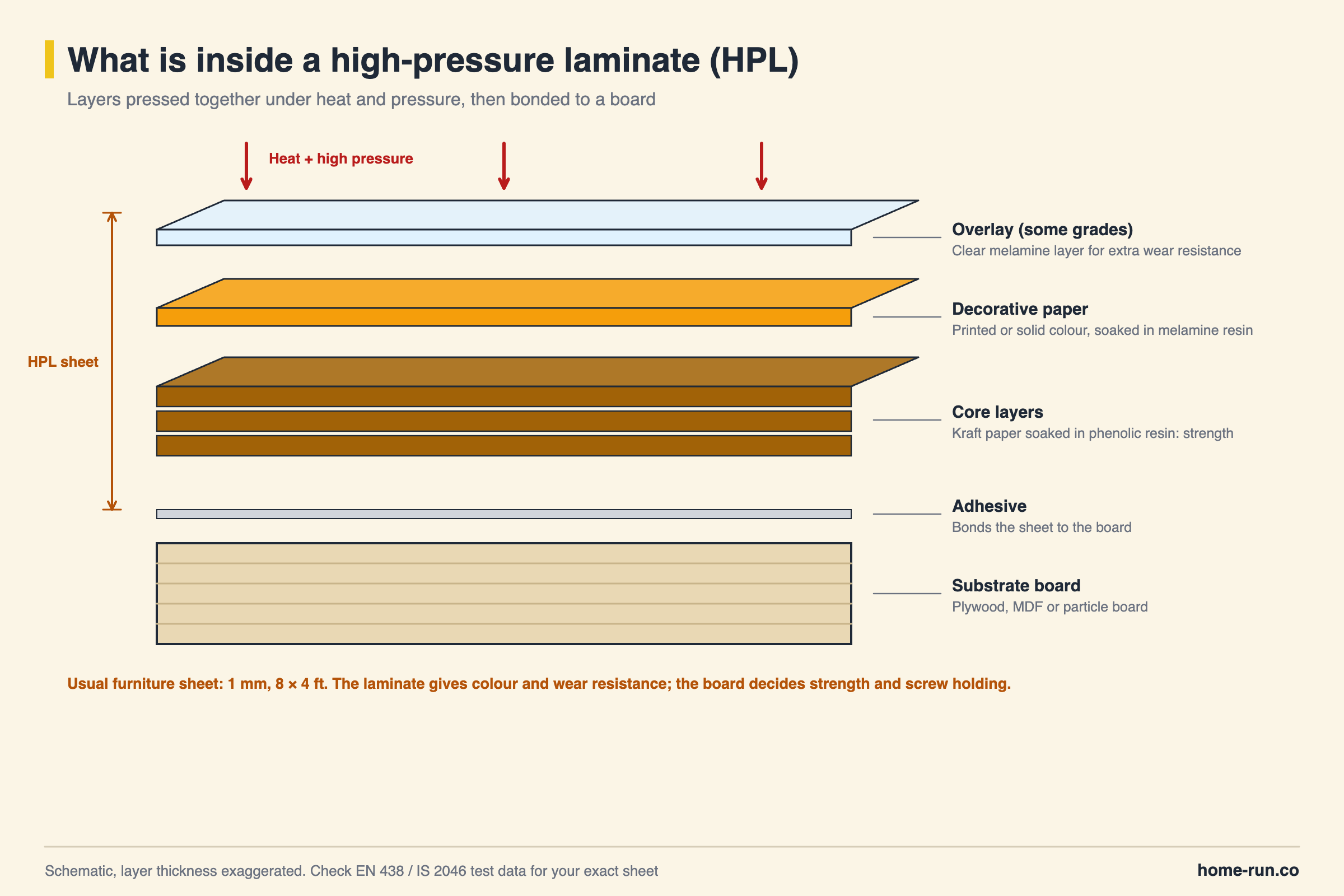
HPL is made by pressing layers together under heat and high pressure:
- Core layers: kraft paper soaked in phenolic resin, which gives the sheet its strength.
- Decorative layer: a printed or solid-colour paper soaked in melamine resin.
- Overlay (on some grades): a clear melamine layer on top for extra wear resistance.
In a home, laminates cover kitchen shutters, wardrobes, TV units, study tables, doors and wall panels. They resist scratches, stains and moisture better than paint or bare veneer, and they need little upkeep.
A laminate does not add structural strength. The board underneath decides how a shutter holds screws and handles moisture. See our Greenply vs CenturyPly plywood comparison for the board side of the choice.
Who Makes Merino, Greenply and Century Laminates?
Merino laminates are made by Merino Industries, "Greenply" laminates today come from Greenlam Industries, and Century laminates come from Century Plyboards (India). Each company also makes other panel products.
- Merino Industries: the Merino Group started with plywood in 1974 and moved into high-pressure laminates in the early 1980s. The company lists laminate plants at Hapur (Uttar Pradesh), Rohad (Haryana) and Dahej (Gujarat), and reports a presence in over 80 countries.
- Greenlam Industries: Greenply Industries demerged its decorative business, "comprising of laminates and allied products", into Greenlam, with a record date of 27 November 2014. Greenlam reports five manufacturing facilities in India and customers in over 120 countries.
- Century Plyboards (India): the maker of CenturyPly plywood sells laminates under the CenturyLaminates name, alongside plywood, MDF and other boards.
Greenply's current range covers plywood, blockboard, doors, veneers, MDF and laminate wooden flooring, but not decorative laminate sheets. If a quote says "Greenply laminate", ask whether it means a Greenlam product and check the brand printed on the back of the sheet.
Other laminate brands sold in India include Formica, Stylam, Royale Touche, Virgo and Durian. This page covers only the three brands in the title.
Merino vs Greenply vs Century Laminates: Which Specs Differ?
Merino vs Greenply vs Century laminates differ most in how much test data each brand publishes, the special finishes on offer and the warranty wording. Core sheet thickness and size are similar across all three.
Documented specs: Merino vs Greenlam (ex-Greenply) vs Century laminates
From manufacturer websites, brochures and data sheets, Nov 2026| Spec | Merino | Greenlam (ex-Greenply) | Century |
|---|---|---|---|
| Maker | Merino Industries | Greenlam Industries | Century Plyboards (India) |
| Thickness stated | 0.5 mm to 30 mm across all surface products | 0.7–1.5 mm HPL; 0.6 mm post-forming; 1–4 mm fire retardant | 0.6, 0.8, 1 and 1.5 mm |
| Sheet size | 11 sizes listed | Varies by range | 8 x 4 ft |
| Design range stated | 500+ designs, 35+ finishes | 500+ HPL decors, 24+ textures | 1,000+ varieties |
| Standards named | EN 438 on a published compact-board test sheet | BS EN 438, NEMA LD3-2005, IS 2046-1995 | "International norms", not named on pages checked |
| Certifications named | ISO 9001, ISO 14001, ISO 45001 (all facilities) | GREENGUARD Gold, Green Label, GRIHA, GreenPro, NSF | DST certificate for ViroKill |
| Hygiene claim | Anti-bacterial laminates in range | 99.99% virus and bacteria reduction in 24 h | ViroKill: kills 99.99% of pathogens |
| Special lines | Finguard anti-fingerprint, compacts | Post-forming, fire retardant, compacts | Lucida, Monocore, Flexo, Magnetic, liner grade |
| Warranty stated | Not stated on pages checked | 10 years on Mikasa range | 10 years (blog) or 7 years (ViroKill page) |
How Durable Are the Three Brands' Laminates?
Durability is measured by standard surface tests, and the brands publish different amounts of this data. EN 438, the European standard for high-pressure decorative laminates, tests wear, scratch, impact, heat and stain resistance.
- Greenlam: its 0.7 mm data sheet lists EN 438-2 results, including 150 revolutions minimum surface wear, scratch rating 5, and a large-ball impact of 1,000 mm against an 800 mm minimum.
- Merino: a published EN 438 test sheet for a 12 mm Merino compact board lists surface wear above the 150-revolution minimum, rating 5 for boiling water and rating 5 for dry heat at 220°C. That sheet is for a compact board, not a 1 mm sheet.
- Century: states heat resistance up to 180°C with 90% gloss retention, and markets Lucida as a high-scuff-resistant gloss laminate.
IS 2046 is the Bureau of Indian Standards (BIS) specification for decorative thermosetting synthetic resin bonded laminated sheets. NEMA LD3 is the equivalent US standard from the National Electrical Manufacturers Association.
How Do the Finishes and Designs Compare?
All three brands offer wood grains, solid colours, stone looks and textured surfaces in gloss, matt and suede finishes. The differences are in the special ranges each one promotes.
- Merino: lists 500+ designs, 35+ finishes and 11 sizes, plus the Merinolam premium range and Finguard anti-fingerprint laminates, launched in 2017.
- Greenlam: lists 500+ HPL decors with 24+ textures, 365+ post-forming decors and 200+ digital laminate decors, with custom prints on request.
- Century: lists Lucida (gloss), Monocore (the core matches the surface colour, so edges show no dark line), Flexo (bendable), Magnetic and Opulenza (European design papers).
Gloss finish
Bright, reflective- Reflects light, so small rooms look brighter
- Shows fingerprints and fine scratches more
- Suits kitchen shutters and feature walls
- Pick a high-scuff gloss line for daily use
Matt or suede finish
Low sheen- Hides smudges and minor scuffs better
- Feels softer and looks closer to real wood
- Suits wardrobes, beds and study tables
- Pick an anti-fingerprint line for dark shades
What Do the Brands Claim for Hygiene, Fire and Emissions?
Greenlam and Century both make specific antimicrobial claims, and Greenlam lists the most third-party environmental certifications. Treat every figure here as a manufacturer claim and ask for the test report.
- Antimicrobial: Greenlam's brochure claims a 99.99% reduction of viruses and bacteria in 24 hours. Century's ViroKill laminates claim to kill 99.99% of pathogens using a silver-nano surface treatment. Merino lists anti-bacterial laminates in its range.
- Fire retardant: Greenlam's FR grade laminates (1 mm to 4 mm) are stated to meet BS 476, with a Class 1 rating only when used with fire-retardant adhesive and substrate.
- Indoor emissions: Greenlam lists GREENGUARD Gold, a UL certification for low chemical emissions indoors. Neither Merino nor Century lists GREENGUARD on the pages checked.
Century explains that in the flame-spread test, Class 1 allows a spread of not more than 75 mm and Class 2 not more than 170 mm. A lower spread means slower flame travel across the surface.
Which Laminate Thickness and Grade Suit Each Part of a Home?
A 1 mm decorative laminate is the usual choice for visible furniture surfaces, with thinner liner grades inside cabinets. Match the grade to the job before you compare Merino vs Greenply vs Century laminates by brand.
Laminate grade by use
General practice; confirm with your carpenter and the brand's data sheet| Where it goes | Grade | Typical thickness (mm) |
|---|---|---|
| Kitchen and wardrobe shutters Common | Decorative HPL | 1.0 |
| Cabinet insides and shelves | Liner or inner laminate | 0.6–0.8 |
| Curved edges and rounded tops | Post-forming or flexible | 0.6 |
| Kitchen countertops | Countertop HPL or compact | 0.7–1.0 |
| Doors, wall panels, high-traffic tables | Heavy-duty decorative HPL | 1.0–1.5 |
The board under the laminate matters as much as the sheet. Our guide to HDHMR boards for furniture covers a moisture-resistant option for kitchens, and the particle board explainer covers lighter-duty furniture.
How Do You Choose Between Merino, Greenlam and Century Laminates?
Choose the product line that matches your room, finish and hygiene needs, then confirm its test data and warranty. On documented specs, the three brands overlap closely for standard 1 mm furniture laminates.
- Room and use: kitchen shutters need stain and heat resistance; wardrobes need scratch and fingerprint resistance.
- Thickness: 1 mm for visible faces, a liner grade inside, post-forming for curved edges.
- Finish: gloss for bright rooms, matt or suede for low upkeep, anti-fingerprint for dark shades.
- Standards: ask which of IS 2046, EN 438 or NEMA LD3 the product is tested to, and see the report.
- Special needs: an antimicrobial line for kitchens and children's rooms, an FR grade near a stove or in a lift lobby.
- Warranty: get the term, coverage and claim process for that product line in writing.
- Sample check: see a full sheet or large sample in daylight, since small chips can look different on a wall.
A Century Lucida gloss sheet and a Greenlam gloss sheet are closer to each other than either is to the same brand's liner grade. Compare matching product lines across brands.
For a wider look at board choices before you pick a laminate, read our engineered wood vs plywood comparison.
How Should Laminates Be Installed and Maintained?
Laminates last longest when they are pasted on a clean, dry, flat board with the right adhesive and pressed evenly. Most early failures come from installation, not from the sheet itself.
- Pasting on a damp board: trapped moisture causes bubbles and lifting later.
- No balancing laminate: one-sided pasting makes shutters bow.
- Uneven pressing: air pockets show up as soft spots on the surface.
- Open edges: unsealed edges let water reach the board, especially near the sink.
- Sharp cuts without support: cutting face down without a backing strip can chip the decorative layer.
Wipe laminates with a soft damp cloth and mild soap. Abrasive pads, scouring powder and strong solvents can dull a gloss finish and scratch the top layer. Use a trivet under hot pans, even on heat-resistant lines.
Follow the brand's own pasting guide where one is available. Greenlam, for example, publishes a laminate pasting guideline manual for carpenters.
Planning kitchen or wardrobe work?
Laminates, plywood, adhesives and hardware delivered across Bengaluru.