On this page
- What Is Decorative Beading, and What Is a Beading Patti?
- What Are the Main Types of Decorative Beading?
- Which Beading Material Is Best: Wood, MDF, PVC, Foam or Metal?
- Where Can You Use Decorative Beading in an Indian Home?
- How Do You Choose the Right Beading Size and Profile?
- How Do You Install Decorative Beading?
- How Much Decorative Beading Do You Need for a Room?
- How Is Decorative Beading Priced, and What Should You Check Before Buying?
- Decorative beading is a narrow shaped strip that adds lines and frames to walls, doors and furniture.
- Pick the material for the room first: wood or MDF indoors, PVC or PU near water.
- Plain MDF swells when wet, so keep it out of bathrooms and away from damp walls.
- Join corners with a 45° mitre; fix with adhesive, plus pins on hardwood.
- Order 5–10% extra length to cover cutting errors and offcuts.
Decorative beading is a narrow strip of wood, MDF, PVC or similar material fixed to a wall, door or cabinet in lines or frames to add raised detail. In Indian hardware and timber shops, the same strip is usually sold as beading patti or moulding patti.
What Is Decorative Beading, and What Is a Beading Patti?
A beading patti is the trade name for a decorative beading strip. Shops use "beading", "patti" and "moulding" almost interchangeably.
Beading hides joints and gaps, protects exposed edges and adds shadow lines to a flat wall.
Moulding is the wider family of shaped trims; beading is its slim member. The larger trim where a wall meets the ceiling is covered in our guides to crown moulding and the meaning of cornice.
What Are the Main Types of Decorative Beading?
The main types of decorative beading are flat, half-round, quarter-round, bead and reel, carved and reeded profiles. A profile is the cross-section shape of the strip.
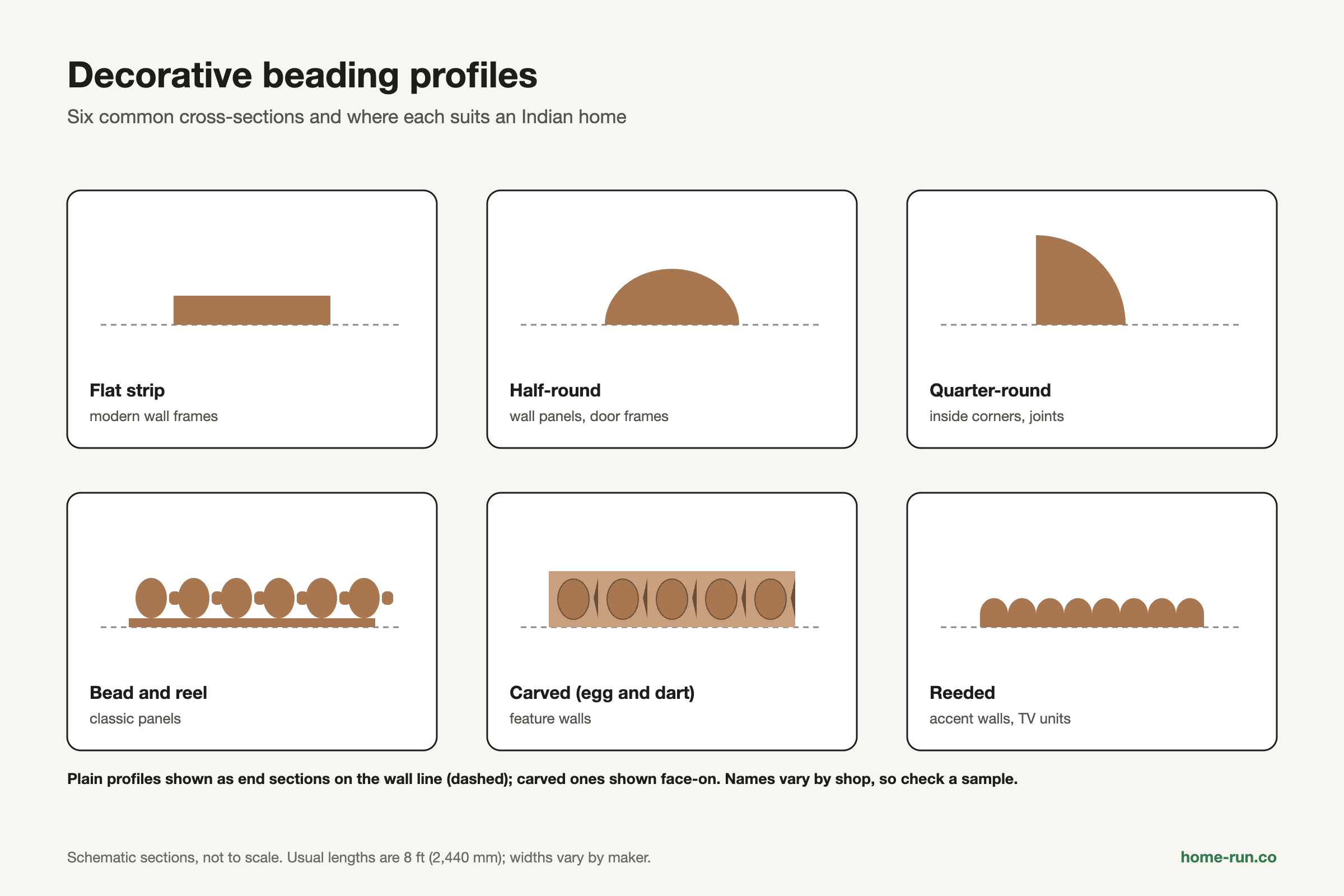
Decorative beading profiles and where they suit
Names vary between shops| Profile | Look | Typical place |
|---|---|---|
| Flat strip Most versatile | Plain, square-edged band | Modern wall frames, furniture edges |
| Half-round | Soft, rounded face | Wall panels, door frames |
| Quarter-round (quadrant) | One curved face, two flat backs | Inside corners, floor and cabinet joints |
| Bobbin or bead and reel | Row of beads, like a string | Classic panels, wardrobe doors |
| Egg and dart, dentil, carved leaf | Repeating carved pattern | Feature walls, high ceilings |
| Reeded or ribbed | Parallel raised lines | Accent walls, TV units, cabinet fronts |
Which Beading Material Is Best: Wood, MDF, PVC, Foam or Metal?
MDF or solid wood is the best beading material for dry rooms, and PVC or PU foam is best near water. In Bengaluru, monsoon humidity and termites make this choice matter more than the profile.
Decorative beading materials compared
Ratings are relative| Material | Moisture tolerance | Finish | Best for |
|---|---|---|---|
| Solid wood (teak, sal, pine) Polish finish | Medium, if treated | Polish, stain or paint | Doors, furniture, living rooms |
| MDF or HDF Default for paint | Low; swells when wet | Paint only | Painted wall frames in dry rooms |
| PVC or WPC Wet areas | High; termite resistant | Pre-finished or paint | Bathrooms, kitchens, damp walls |
| PU or polystyrene foam | High | Paint | Light, detailed wall and ceiling frames |
| Brass or metal inlay | High | Polished or antique | Premium accents, furniture inlays |
| Self-adhesive strip Light duty | Varies | Pre-finished | Quick, rented-home updates |
MDF or HDF beading
For painted wallsEngineered board, often pre-primed.
- Smooth face takes paint evenly
- Crisp carved detail at a lower cost
- No knots, grain or warping
- Swells if fixed on a damp wall
Solid wood beading
For polished woodTeak, sal or pine.
- Natural grain under polish or stain
- Strong enough for door and furniture edges
- Quality and cost vary by species
- Untreated timber attracts termites
Compare board grades in our guide to MDF board types and prices.
Where Can You Use Decorative Beading in an Indian Home?
Decorative beading is used most on living-room walls and door frames, then on wardrobes, cabinets and furniture.
- Wall frames and wainscoting: rectangles on a feature wall, or panels on the lower wall only.
- Dado or chair rail: a horizontal line at chair-back height, often splitting two colours.
- Picture rail: a line high on the wall for frame hooks or a paint edge.
- Door frames and casing: beading where the frame meets the wall; see our door jamb guide.
- Wardrobe and cupboard doors: slim frames on flat shutters.
- Furniture and shelf edges: strips that cover plywood edges.
How Do You Choose the Right Beading Size and Profile?
Choose the beading size by room scale: slim, plain profiles suit compact rooms, and wider, carved profiles suit high ceilings and large feature walls.
Hold a sample on the wall and step back across the room. If it disappears, go wider; if it looks heavy, go slimmer.
- Use one profile family in a room, and across rooms that open into each other
- Flat or reeded strips suit modern homes; bead and reel or carved strips suit classic ones
- Keep furniture beading slimmer than wall beading
- Buy the full quantity from one lot so the colour and profile match
How Do You Install Decorative Beading?
You install decorative beading by marking the layout, mitring corners, dry-fitting, fixing, then filling and painting.
- Check the wall. The plaster must be dry, sound and flat. Fix any damp first.
- Let the strips settle. Leave wood and MDF strips in the room before cutting so they adjust to its humidity.
- Mark the layout. Use a spirit level and pencil for every line and frame.
- Cut and dry-fit. Cut corners at 45° in a mitre box or saw, and use square ends on straight runs.
- Fix. Use construction adhesive for MDF, PVC and foam. Add fine panel pins for hardwood, set just below the surface.
- Fill and finish. Fill pin holes and joints, caulk the wall edge, sand, then prime and paint or polish.
Wall moisture swells MDF and loosens adhesive. Treat seepage first, or use PVC on that wall.
How Much Decorative Beading Do You Need for a Room?
The beading you need equals the total run length plus 5–10% extra, divided by the piece length and rounded up.
How Is Decorative Beading Priced, and What Should You Check Before Buying?
Decorative beading is priced per running foot or per piece, and finished panel work is often quoted per square foot of wall. The rate depends on material, profile detail and finish.
Before comparing quotes, confirm the unit and whether fixing and painting are included.
- Strips that bow or twist when laid on a flat floor
- Swollen, soft or flaking edges on MDF stock
- Uneven carving, or a profile that changes along the length
- Colour or grain that differs between bundles
- Untreated softwood with no anti-termite treatment
Planning a beading wall?
Get boards, adhesive, fixings and paint delivered across Bengaluru with a GST invoice.
Pick the material for the room, then the profile for the wall. Measure your runs, work out the pieces and ask for a price list.