On this page
- What Is Oxide Flooring?
- What Is an Oxide Floor Made Of?
- Which Oxide Flooring Colours and Types Can You Choose?
- Which Finishes and Designs Work Best?
- What Are the Advantages and Disadvantages of Oxide Flooring?
- How Is an Oxide Floor Laid?
- How Much Does Oxide Flooring Cost in India?
- Which Rooms Suit an Oxide Floor?
- Oxide Flooring vs Tiles: Which Should You Pick?
- How Do You Keep an Oxide Floor Looking Good?
- Oxide flooring is a cement topping tinted with mineral pigment, trowelled and polished on site.
- Red, yellow, brown and black come from iron oxides. Green and blue use costlier chromium and cobalt pigments.
- One Indian pigment maker advises only red, yellow, chocolate and black for floors in direct sun.
- Main advantages: jointless look, cool feel, on-site repairs. Main drawbacks: skilled labour, slow curing, hairline cracks.
- Coloured oxide floors cost about ₹60–120 per sq ft before GST, per 2026 guides.
Oxide flooring is a cement floor finish coloured with mineral oxide pigment, laid wet on site and trowelled into a smooth, often glossy surface. Oxide flooring comes in reds, yellows, greens, greys, blues and blacks.
It suits homeowners who want a jointless, traditional look at a moderate cost, and who can accept some hand-made variation.
What Is Oxide Flooring?
Oxide flooring is a coloured version of IPS (Indian Patent Stone), the in-situ cement concrete floor finish found in many Indian homes. A mason lays a cement base, then a thin pigmented topping, and polishes it by hand.
IS 2571, the Indian code of practice for laying in-situ cement concrete flooring, covers the plain IPS method. Studio Matrx puts a typical IPS floor at 20–40 mm thick.
The look has deep roots in South India. Kaavi flooring of Kerala and coastal Karnataka is an older cousin, made from lime, iron oxide and water and polished with coconut oil.
An oxide floor is cast on site as one continuous layer. Athangudi tiles from Chettinad, Tamil Nadu, are handmade cement tiles with oxide colour, laid with joints. Epoxy is a resin coating, and red oxide primer is a rust paint for steel.
What Is an Oxide Floor Made Of?
An oxide floor is made of three layers: a sound concrete base, a cement-sand screed, and a thin topping of cement mixed with oxide pigment.
- Base: the existing slab, or a PCC (plain cement concrete) bed on the ground.
- Screed: a cement-sand layer that sets the finished level and slope.
- Coloured topping: cement and pigment, dry-mixed, then trowelled to a dense face.
- Finish: wax, oil or sealer to deepen the colour and resist stains.
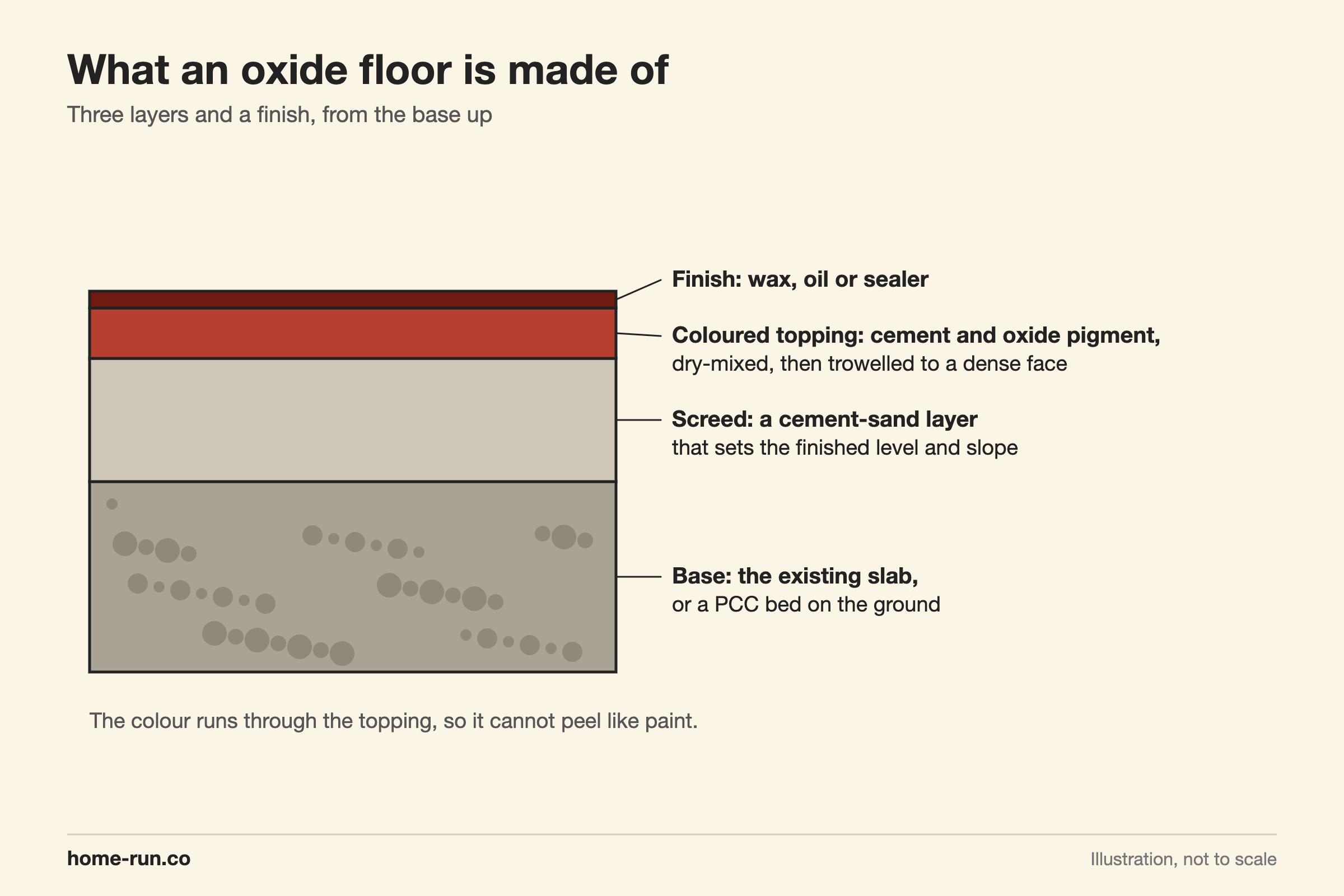
The colour runs through the topping, so it cannot peel like paint. Grey cement gives deep, earthy shades. White cement gives bright and pastel shades, according to Golchha Pigments.
Pigment dose needs care. ASTM C979, the US specification for pigments in integrally coloured concrete, caps pigment at 10% of cement weight, since extra pigment adds no colour and can weaken the mix.
Indian floor-oxide makers quote much richer mixes for the thin topping: Tata Pigments gives 1 part oxide to 4–5 parts cement, and Golchha 1:4 to 1:8. Follow your pigment's datasheet and test a sample patch first.
Which Oxide Flooring Colours and Types Can You Choose?
Oxide flooring types are named by colour, and each colour comes from a different mineral pigment. Golchha Pigments, an Indian supplier, lists 16 shades, from red and chocolate to pearl grey, aquamarine and white.
Oxide flooring colours compared
Sun advice from Golchha Pigments| Colour | Pigment | Look | Direct sun | Best rooms |
|---|---|---|---|---|
| Red Most popular | Red iron oxide | Warm, traditional maroon | Suitable | Living rooms, bedrooms, verandahs |
| Yellow | Yellow iron oxide | Bright, earthy ochre | Suitable | Bedrooms, puja rooms, accents |
| Chocolate | Brown iron oxide blends | Deep and warm; hides dust | Suitable | Living areas, corridors |
| Black | Black iron oxide or carbon black | Bold and modern; shows dust | Suitable | Living rooms, borders |
| Grey | Maker's grey blends | Calm, contemporary | Not advised | Bedrooms, studies |
| Green Costlier | Chromium oxide | Sage to bottle green | Not advised | Bedrooms, covered courtyards |
| Blue Costlier | Cobalt-based pigment | Statement colour | Not advised | Accent rooms, borders |
| White and pastels | White cement with light pigment | Bright; shows stains | Not advised | Low-traffic rooms |
Red oxide: the traditional choice
Red is the most common oxide floor in Indian homes, from Kerala to Kolkata. Our red oxide flooring guide covers its mix, laying and curing in detail.
Grey and black: modern looks
Grey and charcoal floors suit minimal interiors and pair well with wood and white walls. Black looks striking but shows dust, footprints and scratches quickly.
Green, blue and yellow: statement floors
Green and blue need chromium and cobalt pigments, which cost far more than iron oxides. Studio Matrx lists yellow, green, grey and black oxide floors at ₹70–150 per sq ft, against ₹60–110 for standard red.
White and light shades: handle with care
Light shades need white cement, which sets fast, so the mason must work quickly. Pale oxide floors also show stains and patchy colour more than dark ones.
Mixing colours: borders and inlays
Two colours can share one floor when divider strips separate the panels. Masons lay each colour in its own panel to form borders, chequers or simple geometric inlays.
Which Finishes and Designs Work Best?
Oxide floors come in two main finishes: a matte trowel finish and a high-gloss polished finish.
- Matte finish: less glare and better grip when wet. Suits verandahs, utility areas and homes with elderly people.
- Polished or waxed finish: a deep sheen that grows with regular waxing. Slippery when wet.
Popular oxide flooring designs a site crew can deliver:
- A contrast border around the room, such as a red field with a black edge
- Chequer or strip patterns in two colours
- One accent room, such as a yellow puja room
- Shaded sit-outs in red or chocolate
Intricate inlays need an applicator with past oxide work. For marble-chip patterns instead, see our explainer on mosaic flooring types and benefits.
What Are the Advantages and Disadvantages of Oxide Flooring?
The biggest advantages of oxide flooring are a jointless surface, a cool feel underfoot and easy repairs. The biggest disadvantages are its reliance on skilled masons, slow curing and a risk of hairline cracks.
Advantages
- Jointless surface with no grout lines to trap dirt
- Feels cool underfoot in warm weather
- Wide colour choice, including borders and two-tone designs
- Cracks and dull patches can be repaired and re-polished on site
- Sheen deepens with age and regular waxing
- Made from cement, sand and mineral pigment, with no resin
Disadvantages
- Needs an experienced mason; results vary a lot between crews
- Slow job: about a week of curing and drying before polishing
- Hairline cracks appear if curing is rushed or the base moves
- Shade varies slightly across a room and between batches
- Polished finishes get slippery when wet
- Most colours other than iron-oxide shades are not advised for direct sun
- Acidic spills and harsh cleaners can etch the surface
Choose oxide flooring if you value a continuous, hand-made look and accept small colour variation. Choose tiles if you need a fast job, a uniform finish or a wet-area floor.
How Is an Oxide Floor Laid?
An oxide floor is laid in six stages, and the steps are the same for every colour. Only the pigment changes.
- Prepare: clean, repair and level the sub-floor, then let it dry fully.
- Screed: lay a cement-sand bed to the finished level and slope.
- Test: cure a small sample patch to see the true shade.
- Top: dry-mix cement and oxide, add water, and trowel each room in one stretch.
- Cure: start wetting after about 24 hours and keep the floor damp.
- Polish: after about a week of drying, sand rough spots, then wax and buff.
For the day-by-day curing plan and pigment quantities per cement bag, read our step-by-step guide to laying red oxide flooring. The same method applies to other colours.
How Much Does Oxide Flooring Cost in India?
Oxide flooring costs about ₹60 to ₹120 per sq ft, laid and finished, before 18% GST, according to 2026 guides from Studio Matrx. Labour skill, colour, finish and pattern set the final rate.
Indicative cement floor rates
₹ per sq ft, laid and finished, 2026| Floor type | Rate | Basis |
|---|---|---|
| Plain grey IPS, sealed Budget | ₹40–80 | Studio Matrx, before GST |
| Pigmented IPS (oxide colour) | ₹60–120 | Studio Matrx, before GST |
| Red oxide, standard finish | ₹60–110 | Studio Matrx, before GST |
| Yellow, green, grey or black oxide | ₹70–150 | Studio Matrx, before GST |
| Red oxide, premium artisan finish | ₹100–150 | Studio Matrx, before GST |
| Mid-range vitrified tile, Bengaluru | ₹120–220 | Studio Matrx, GST included |
Get two or three dated quotes from Bengaluru masons. Check whether each rate covers base repair, screed, pigment, polishing, wax and GST, because quotes often leave out one of these.
Laying a coloured cement floor?
Get cement, white cement and sand delivered across Bengaluru with a GST invoice.
Which Rooms Suit an Oxide Floor?
Oxide floors suit dry indoor rooms best: living rooms, bedrooms, corridors, puja rooms and covered verandahs.
- Living rooms and bedrooms: low spill risk and cool underfoot
- Corridors and landings: one jointless run from room to room
- Covered verandahs and sit-outs: in red, yellow, chocolate or black
- Cafés and small shops: a character floor, if staff wax it regularly
Kitchens need quick clean-up, because oil, turmeric and lemon can stain or etch the surface. Bathrooms need a matte finish for grip and waterproofing below the floor.
Sun, rain and heat cycles cause fading and cracks on exposed floors. Tata Pigments rates its floor oxide for indoor use, while Golchha Pigments allows four colours in direct sun. Ask your pigment supplier before you go outdoors.
Oxide Flooring vs Tiles: Which Should You Pick?
Pick oxide flooring for a jointless, character floor in dry rooms. Pick vitrified or ceramic tiles for speed, a uniform finish and wet areas.
Oxide flooring
Character and repairsLiving rooms, bedrooms, verandahs.
- One continuous surface, no grout
- Hand-made shade varies slightly
- About a week before polishing
- Cracks repaired and re-polished on site
Vitrified tiles
Speed and uniformityKitchens, bathrooms, busy homes.
- Grout lines at every tile joint
- Factory-uniform colour and size
- No long wet curing of the surface
- A broken tile needs a matching spare
Oxide vs tiles, epoxy and plain cement
Qualitative comparison| Factor | Oxide flooring | Vitrified tiles | Epoxy | Plain IPS |
|---|---|---|---|---|
| Look | Jointless, hand-made | Uniform, many designs | Glossy, jointless | Plain grey |
| Joints | None, or divider strips | Grout lines | None | Divider strips |
| Repair | Patch and re-polish | Replace the tile | Recoat the area | Patch |
| Wet areas | Matte only, with care | Good with anti-skid tiles | Needs a textured coat | With care |
| Skill needed | High | Moderate | Specialist applicator | Moderate |
If the room stays dry and you want character, choose oxide. If water, heavy traffic or a tight deadline is involved, choose tiles. Our guide to types of tiles compares the options, and the epoxy flooring guide covers resin floors.
How Do You Keep an Oxide Floor Looking Good?
You keep an oxide floor looking good with daily sweeping, damp mopping with a pH-neutral cleaner and regular waxing.
- Sweep or dry-mop daily so grit does not scratch the polish
- Mop with plain water or a mild pH-neutral cleaner
- Wipe oil, turmeric and lemon spills straight away
- Re-wax or oil every few months to once a year, then buff
- Keep spare pigment from the original batch for repairs
Acidic cleaners, bleach and harsh floor chemicals etch the cement and dull the colour. Test any new cleaner on a hidden corner first.