On this page
- What Is Plumbing, and What Does It Cover?
- What Are the Main Parts of a Plumbing System?
- How Does Water Reach Your Tap in an Indian Home?
- How Does Wastewater Leave the House, and What Do Traps and Vents Do?
- Which Pipe Materials Are Used in Plumbing in India?
- What Are Fixtures, Fittings and Valves in Plumbing?
- What Are the Three Types of Plumbing?
- What Does a Plumber Do, and When Should You Call One?
- Which Plumbing Standards and Rules Apply in India?
- Plumbing is the network of pipes, fittings, valves and fixtures that supplies clean water and removes wastewater.
- Every system has three parts: water supply, drainage and venting. Rainwater runs in its own separate line.
- Indian homes store water in a sump and an overhead tank, because municipal supply is often intermittent.
- Traps hold a water seal that blocks sewer gas, and vents stop that seal from being sucked dry.
- Most Indian homes use CPVC or PPR for hot and cold supply and uPVC SWR pipes for drainage.
Plumbing is the system of pipes, fittings, valves and fixtures that brings potable (drinkable) water into a building and carries wastewater out of it. Knowing what plumbing is helps you plan a new house, a renovation or a repair.
In an Indian home, plumbing runs from the municipal line or borewell, through a sump and an overhead tank, to every tap. It then carries used water to a sewer or septic tank.
What Is Plumbing, and What Does It Cover?
Plumbing covers both sides of a building's water: the clean supply side and the dirty drainage side. Many explainers describe only the taps, but drains, traps and vents are half the system.
- Plumbing: the full water supply, drainage and vent network inside and around a building.
- Sanitary work: the toilets, basins and their waste connections. On Indian sites, "plumbing and sanitary" is usually quoted as one package.
- Drainage: the pipes, chambers and traps that carry wastewater away.
- MEP: mechanical, electrical and plumbing services, the umbrella term for building services on larger projects.
A plumber is called a plumber because of lead. The word comes from plumbum, Latin for lead, since the first effective pipes in the Roman era were lead pipes.
The Indus Valley civilisation used standardised earthen pipes by 2700 BC, and Mesopotamia had clay sewer pipes around 4000 BCE. Modern homes use plastic, but the idea of supply in and waste out has not changed.
What Are the Main Parts of a Plumbing System?
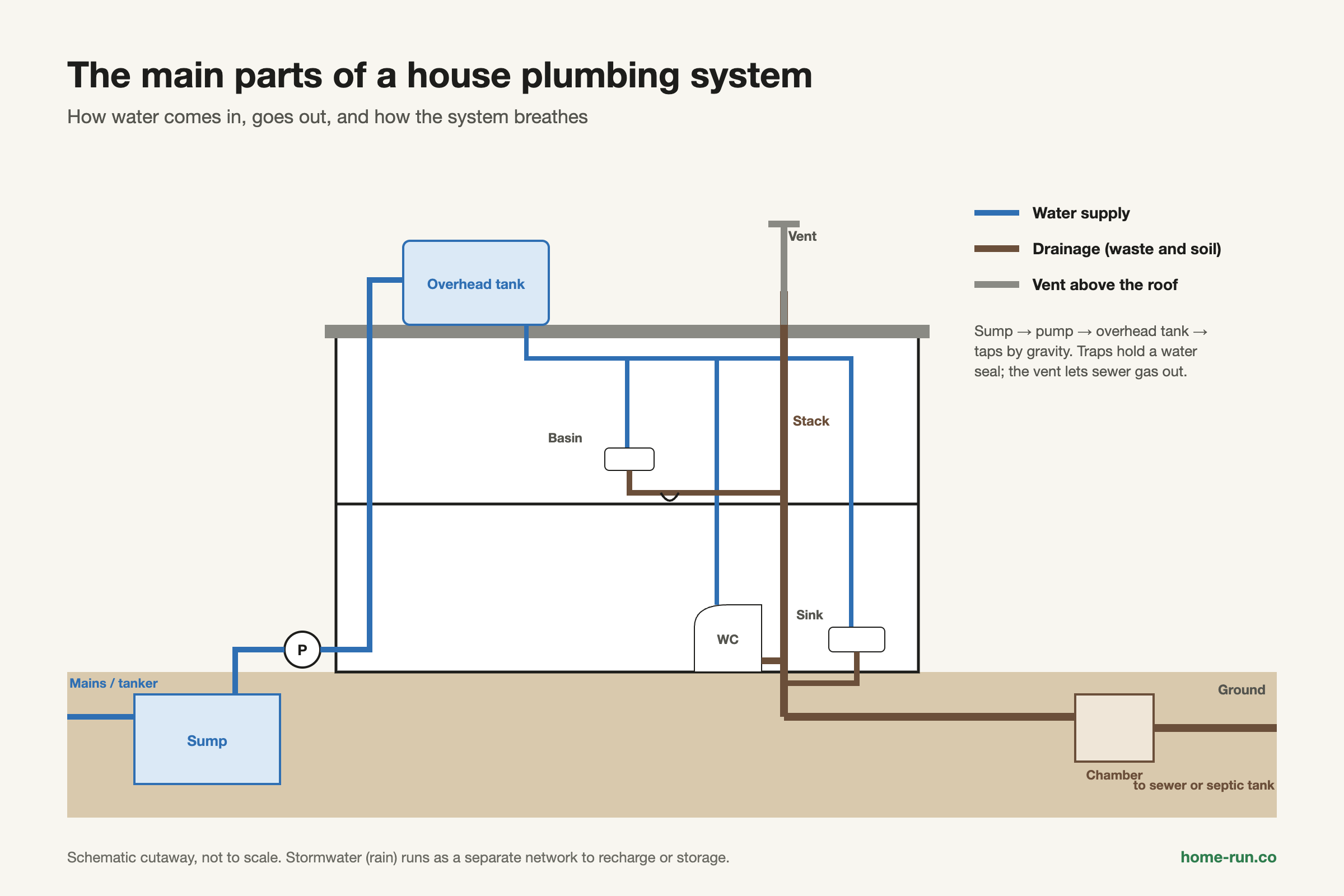
A plumbing system has three main parts: water supply, drainage and venting. Stormwater drainage is a fourth, separate network for rain.
The parts of a house plumbing system
What each subsystem does| Subsystem | Job | Typical components |
|---|---|---|
| Water supply | Brings clean water in, under pressure or by gravity | Meter, sump, pump, overhead tank, pipes, taps, geyser |
| Drainage (sanitary) | Carries wastewater and sewage out | Traps, waste and soil pipes, stack, gully trap, chambers |
| Venting | Lets air in and sewer gas out | Vent pipe above the roof, vent branches |
| Stormwater | Carries rain off roofs and open areas | Rainwater pipes, roof outlets, recharge or storage |
How Does Water Reach Your Tap in an Indian Home?
Water reaches your tap in five stages: source, sump, pump, overhead tank and gravity supply lines.
- Source: a municipal connection, a borewell, or a water tanker in some areas.
- Sump: an underground tank stores water when the municipal supply arrives.
- Pump: a motor lifts water from the sump to the roof.
- Overhead tank: a rooftop tank holds the day's water. A float valve stops it overflowing.
- Supply lines: gravity feeds cold water to taps, WCs and the geyser, which sends hot water to the bathroom.
Indian homes need this storage because municipal water often comes on set days or hours, not round the clock. In Bengaluru, BWSSB (Bangalore Water Supply and Sewerage Board) supplies the city, and many houses also keep a borewell as back-up.
Valves let you shut off each branch for repairs. Our guide to ball valves explains the quarter-turn valve used on most supply lines.
Apartment blocks share a large sump and terrace tanks. Pipes run up and down vertical shafts, and each flat takes its own branch line. Taller buildings may add booster pumps to keep pressure on upper floors.
How Does Wastewater Leave the House, and What Do Traps and Vents Do?
Wastewater leaves through traps under each fixture, then branch pipes, a vertical stack and an outdoor chamber, before reaching a sewer or septic tank.
- Soil pipe: carries toilet waste (WC discharge).
- Waste pipe: carries water from basins, sinks, showers and floor drains.
- Stack: the vertical pipe that collects branches from each floor.
A trap is a curved pipe section that holds a small pool of water, called the water seal. The seal blocks sewer gas from rising into the room. IS 5329, the Indian code of practice for sanitary pipe work above ground, sets a 50 mm seal for WCs and floor traps.
Types of plumbing traps
Where you find each one| Trap | Shape or form | Common place |
|---|---|---|
| P-trap | U-bend with a horizontal outlet into the wall | Wash basins, sinks, wall-outlet WCs |
| S-trap | U-bend with a vertical outlet into the floor | Floor-outlet WCs, older installations |
| Bottle trap | Compact cylinder under the basin | Exposed basins, where looks matter |
| Floor (nahani) trap | Grated floor inlet with a seal | Bathroom and balcony floors |
| Gully trap | Trapped outdoor chamber | Where kitchen and bath waste lines meet outside |
Water rushing down a stack pulls air behind it. Without a vent pipe, that suction can siphon the water out of nearby traps, which causes gurgling and sewer smells. The vent pipe lets air in and carries gas out above the roof.
Wastewater ends at one of two places. The choice depends on whether your plot has a public sewer connection.
Municipal sewer
Most city plotsWaste leaves the plot through a city network.
- Maintained by the city utility, such as BWSSB
- No on-site tank to empty
- Needs a sanctioned sewer connection
- Blockages inside the plot are still your job
Septic tank
Plots without a sewerWaste is settled and treated on your plot.
- Maintained by the owner
- Needs periodic desludging
- Usually paired with a soak pit
- Wipes, oil and chemicals harm the tank
For sizing and layout, read our septic tank design guide and the soak pit guide. Rainwater stays out of the sewage line. It goes to storage or a recharge pit, as our rooftop rainwater harvesting explainer shows.
Which Pipe Materials Are Used in Plumbing in India?
Indian homes mostly use CPVC or PPR pipes for hot and cold water, uPVC for cold water, and uPVC SWR (soil, waste and rainwater) pipes for drainage.
Plumbing pipe materials compared
Typical use in Indian homes| Material | Typical use | Hot water | Indian standard |
|---|---|---|---|
| CPVC Default pick | Hot and cold supply | Yes | IS 15778 |
| PPR | Hot and cold supply, heat-fused joints | Yes | Check maker's datasheet |
| uPVC pressure pipe | Cold and drinking water | No Avoid on geyser lines | IS 4985 |
| uPVC SWR | Soil, waste and rainwater drainage | Not a supply pipe | IS 13592 |
| GI (galvanised iron) | Older supply lines, some outdoor runs | Yes, but corrodes over time | IS 1239 (Part 1) |
| Copper | Premium hot-water runs | Yes | Check maker's datasheet |
| Cast iron | Older soil stacks | Not a supply pipe | Check maker's datasheet |
Any pipe that carries hot water from the geyser should be CPVC, PPR or copper. Buy pipes with the BIS ISI mark and the IS number printed on the pipe wall.
Planning a plumbing job?
Get pipes, fittings, tanks and taps delivered across Bengaluru with a GST invoice.
What Are Fixtures, Fittings and Valves in Plumbing?
Fixtures use water, fittings join and control pipes, and valves start, stop or direct the flow.
- Fixtures: WC, wash basin, kitchen sink, shower and health faucet.
- Fittings: elbows, tees, couplers, unions, reducers and taps such as the bib cock.
- Ball valve: shuts flow with a quarter turn.
- Gate valve: raises or lowers a gate; suits a main line.
- Check (non-return) valve: lets water flow one way only, for example after a pump.
- Pressure-reducing valve (PRV): lowers high line pressure to protect fittings.
- Diverter: switches water between a tap and a shower.
Most new Indian homes use concealed piping, laid in chases cut into walls. Exposed piping is cheaper to repair but less tidy.
What Are the Three Types of Plumbing?
The three types of plumbing are residential, commercial and industrial.
- Residential: houses and apartments, with tanks, bathrooms and kitchens.
- Commercial: offices, malls and hospitals, with heavier use and more fixtures.
- Industrial: factories with process water and specialist piping, often handled by pipefitters.
Plumbing is also split into interior work inside the walls and exterior work such as chambers, sewer lines and rainwater pipes.
What Does a Plumber Do, and When Should You Call One?
A plumber installs, repairs and maintains water supply, drainage and fixtures. Typical jobs include fixing leaks, clearing drains, fitting geysers and laying new lines.
Small jobs you can usually handle yourself:
- Replacing a worn tap washer or cartridge
- Clearing a basin or floor trap with a plunger
- Cleaning a tap aerator clogged by hard-water scale
- Tightening a loose connection under a sink
Call a professional for these signs:
- Damp patches from a concealed pipe inside a wall
- Low pressure across the whole house
- Geyser installation or hot-water pipework
- Repeated blockages or sewer smell from the drains
Which Plumbing Standards and Rules Apply in India?
Plumbing in India follows the national building code, BIS product standards and local bye-laws.
- Building code: Part 9 (Plumbing Services) of NBC 2016, the National Building Code of India, was the long-standing reference. BIS withdrew NBC 2016 on 30 April 2026 and replaced it with the National Building Construction Standards 2026 (SP 7:2026).
- BIS standards: IS 1172 sets basic water supply and sanitation needs. IS 5329 covers sanitary pipe work. Pipes carry their own IS numbers.
- Local rules: in Bengaluru, BWSSB requires rainwater harvesting on houses built since 2009 on 30 × 40 ft sites and larger.
Before a renovation, trace your own supply path from sump to tap, check the pipe material, and ask a plumber to review the drains. Confirm current code clauses with your architect or local authority.