On this page
- What Are Plumbing Fixtures and How Do They Work?
- What Are the Common Types of Plumbing Fixtures?
- Which Material Lasts Longest for Taps, Sinks and WCs?
- What Are the Standard Mounting Heights in a Bathroom?
- How Should You Install Taps, Basins and WCs?
- How Do You Maintain Fixtures in Bengaluru's Hard Water?
- Which Water-Efficient Plumbing Fixtures Save the Most?
- What Red Flags Should You Check Before Buying?
- What Should You Decide Before Plumbing Starts?
- Plumbing fixtures use water (taps, sinks, basins, showers, WCs); fittings only join pipes.
- Every fixture that drains needs a trap holding about 50 mm of water against sewer gas.
- For hard borewell water, pick chrome-plated brass or SS 304 taps and ISI-marked sanitaryware.
- Mark heights from the finished floor: basin rim 800–850 mm, shower arm about 2,100 mm.
- Aerators and dual-flush cisterns can roughly halve water use per point.
Plumbing fixtures are the devices in a home that take in water, deliver it for use and send the used water to the drain. Taps, sinks, wash basins, showers, bathtubs, toilets and health faucets are all plumbing fixtures.
Each fixture connects to two systems: the water supply pipes that feed it and the waste pipes that carry water away.
What Are Plumbing Fixtures and How Do They Work?
A plumbing fixture is any device connected to the plumbing system that uses water and discharges waste. The fixture sits at the point where you actually use water.
- Supply side: a 15 mm branch pipe, usually CPVC (chlorinated polyvinyl chloride), feeds the fixture through an angle valve or a flexible connector.
- Waste side: a trap below the fixture holds water, then a waste pipe carries water to the drain. WCs connect to a 100–110 mm soil pipe.
- Vent: vent pipes let air into the drains so flowing water does not siphon the trap dry.
Fixtures use water; fittings such as elbows, tees and valves join and control pipes. For the pipe side, see our plumbing materials list.
What Are the Common Types of Plumbing Fixtures?
The common types of plumbing fixtures in Indian homes are taps, sinks, wash basins, showers, toilets, health faucets and, less often, bathtubs.
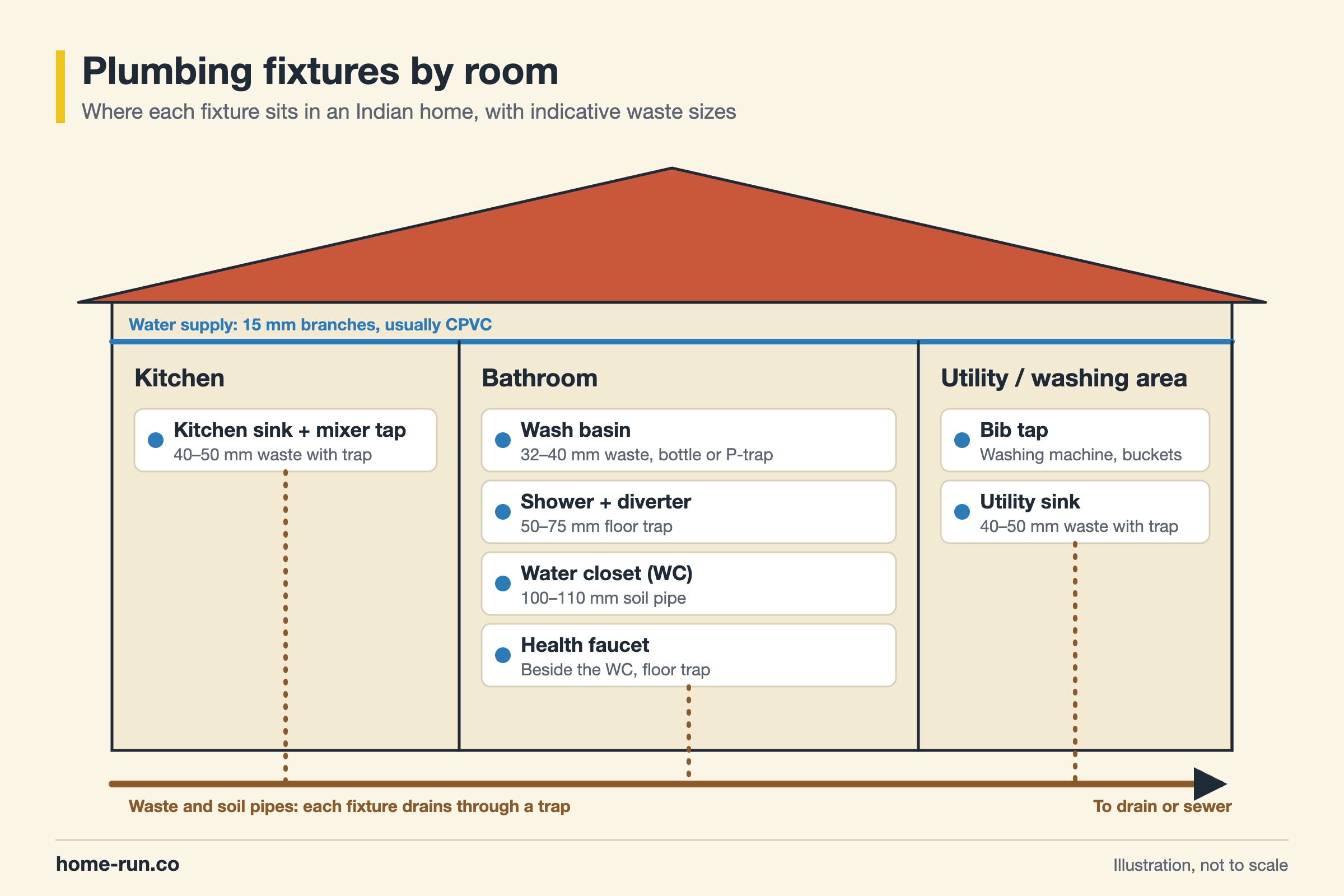
List of plumbing fixtures in an Indian home
Typical pipe sizes| Fixture | Where | Waste connection | Indian notes |
|---|---|---|---|
| Taps and faucets | Kitchen, basin, washing area | Through the sink or basin below | Pillar, bib, wall-mixer and sink-mixer taps |
| Kitchen sink | Kitchen, utility | 40–50 mm waste with a trap | Mostly stainless steel; quartz for heavy use |
| Wash basin | Bathroom, dining area | 32–40 mm waste with a bottle or P-trap | Wall-hung, pedestal or counter-top |
| Shower | Bathroom | 50–75 mm floor trap | Overhead shower plus hand shower, with a diverter |
| Water closet (WC) | Bathroom | 100–110 mm soil pipe | Western (EWC) or Indian squatting pan |
| Health faucet | Beside the WC | Floor trap | Common in place of a separate bidet |
| Bathtub | Larger bathrooms | Floor trap or own waste | Rare in Indian homes |
Which Material Lasts Longest for Taps, Sinks and WCs?
Chrome-plated brass is the best all-round material for taps and showers, SS 304 stainless steel suits sinks, and vitreous china suits WCs and basins.
Chrome-plated brass
Taps, mixersPoint
- Heavy, solid body that handles high pressure
- Chrome finish resists scale when wiped often
- Costs more than steel or plastic taps
SS 304 stainless steel
Sinks, tapsPoint
- About 18% chromium and 8% nickel, so it resists rust
- No plating to peel, so a scratch does not rust
- Lighter taps can feel less solid than brass
Plumbing fixture materials compared
For Indian water conditions| Material | Used for | Watch for |
|---|---|---|
| Chrome-plated brass Best taps | Taps, mixers, showers | Thin plating that flakes |
| SS 202 | Budget sinks | Less nickel; can spot-rust in humid kitchens |
| Vitreous china | WCs, basins | Chips under impact; check the ISI mark |
| PTMT or ABS plastic Budget | Taps in utility and outdoor areas | Brittle threads, short life under pressure |
What Are the Standard Mounting Heights in a Bathroom?
Standard plumbing fixture heights in Indian bathrooms put the basin rim at 800–850 mm and the overhead shower arm at 2,000–2,150 mm, measured from the finished floor.
Plumbing fixtures standard height
Point centre, from finished floor| Point | Typical | Common range |
|---|---|---|
| Wash basin rim or counter | 820 mm | 800–850 mm |
| Shower mixer body | 1,050 mm | 1,000–1,150 mm |
| Overhead shower arm | 2,100 mm | 2,000–2,150 mm |
| Health faucet | 300 mm | 200–350 mm |
| Washing-area bib tap | 900 mm | 800–1,000 mm |
| WC inlet (angle valve) | 200 mm | 150–250 mm |
How Should You Install Taps, Basins and WCs?
Install plumbing fixtures after concealed pipes pass a pressure test and wet-area waterproofing is done.
- Concealed lines pressure-tested and holding with no drop
- Waterproofing finished in bathrooms and washing areas
- Angle valves fitted at every basin, WC and sink point
- Thread-seal (PTFE) tape, silicone sealant and the right spanners ready
- Marking point heights from the rough slab instead of the finished floor
- Over-tightening plastic or chrome nuts until they crack
- Skipping the trap under a basin or sink, which lets sewer smell in
- Laying the floor without a fall towards the floor trap
For the full bathroom layout and pipe runs, read our bathroom plumbing guide.
How Do You Maintain Fixtures in Bengaluru's Hard Water?
Descale fixtures every month in Bengaluru, because borewell water in many areas is hard and leaves white deposits.
- Aerators and shower heads: unscrew and soak in diluted white vinegar to clear scale.
- Chrome taps: wipe dry; avoid acid cleaners and steel wool.
- Traps: clear hair and grease from basin and floor traps before they block.
- Leaks: replace a dripping cartridge or washer early.
IS 10500, the Indian drinking water standard, sets an acceptable total hardness of 200 mg/L. Test your borewell water and consider a softener if readings run far above that.
Fitting out a bathroom or kitchen?
Sanitaryware, bath fittings and pipes delivered across Bengaluru.
Which Water-Efficient Plumbing Fixtures Save the Most?
Aerated taps, low-flow showers and dual-flush WCs are the water-efficient plumbing fixtures that save the most, roughly halving use at each point.
Conventional vs water-efficient fixtures
Indicative flow at test pressure| Fixture | Conventional | Water-efficient |
|---|---|---|
| Basin tap | 8–12 L/min | 4–6 L/min |
| Overhead shower | 12–20 L/min | 6–9 L/min |
| WC full flush | 10–13 L | 6 L |
| WC half flush | None | 3–4.5 L |
Start with an aerator on every tap and a dual-flush cistern. Both cost little, fit existing points and save water from day one.
BWSSB (Bangalore Water Supply and Sewerage Board) ordered tap aerators in apartments and commercial buildings during the 2024 water crisis. In October 2025 it reported about 15 lakh aerators saving some 10 crore litres a day.
What Red Flags Should You Check Before Buying?
Check weight, markings and finish before you pay; cheap copies look the same in the box.
- Very light "brass" taps: often zinc alloy or plastic under thin chrome.
- No ISI mark on WCs, basins or cisterns.
- Bubbles, pits or uneven chrome on the body.
- No grade stamp on a "stainless steel" sink.
What Should You Decide Before Plumbing Starts?
Decide every fixture before plumbing starts, so your plumber sets each point to the chosen model.
- List each point by room.
- Pick material and model, favouring water-efficient ones.
- Share cut-sheets with your plumber before marking heights.
Read our explainer on what plumbing is to see how supply, drainage and venting connect.