On this page
- What Is a Soak Pit and How Does It Work?
- Soak Pit vs Septic Tank vs Leach Pit: Which Do You Need?
- Is Your Soil Right for a Soak Pit?
- How Big Should a Soak Pit Be?
- What Materials Go Inside a Soak Pit?
- How Do You Build a Soak Pit Step by Step?
- How Much Does a Soak Pit Cost in India?
- How Do You Maintain a Soak Pit and Spot Problems?
- A soak pit disperses wastewater into the soil. It does not treat sewage.
- Send it greywater or septic tank effluent only, never raw toilet waste.
- Do a percolation test first: over 30 minutes per 25 mm means the soil will not work.
- Size it by side wall area: daily flow ÷ the soil's allowable rate from IS 2470.
- Keep it 18 m or more from wells and 6 m from the house, and fit a grease trap upstream.
A soak pit is a covered pit in the ground, lined with open-jointed brick or stone and filled with stones or brick bats, that lets wastewater seep slowly into the surrounding soil.
It is used where there is no sewer line.
What Is a Soak Pit and How Does It Work?
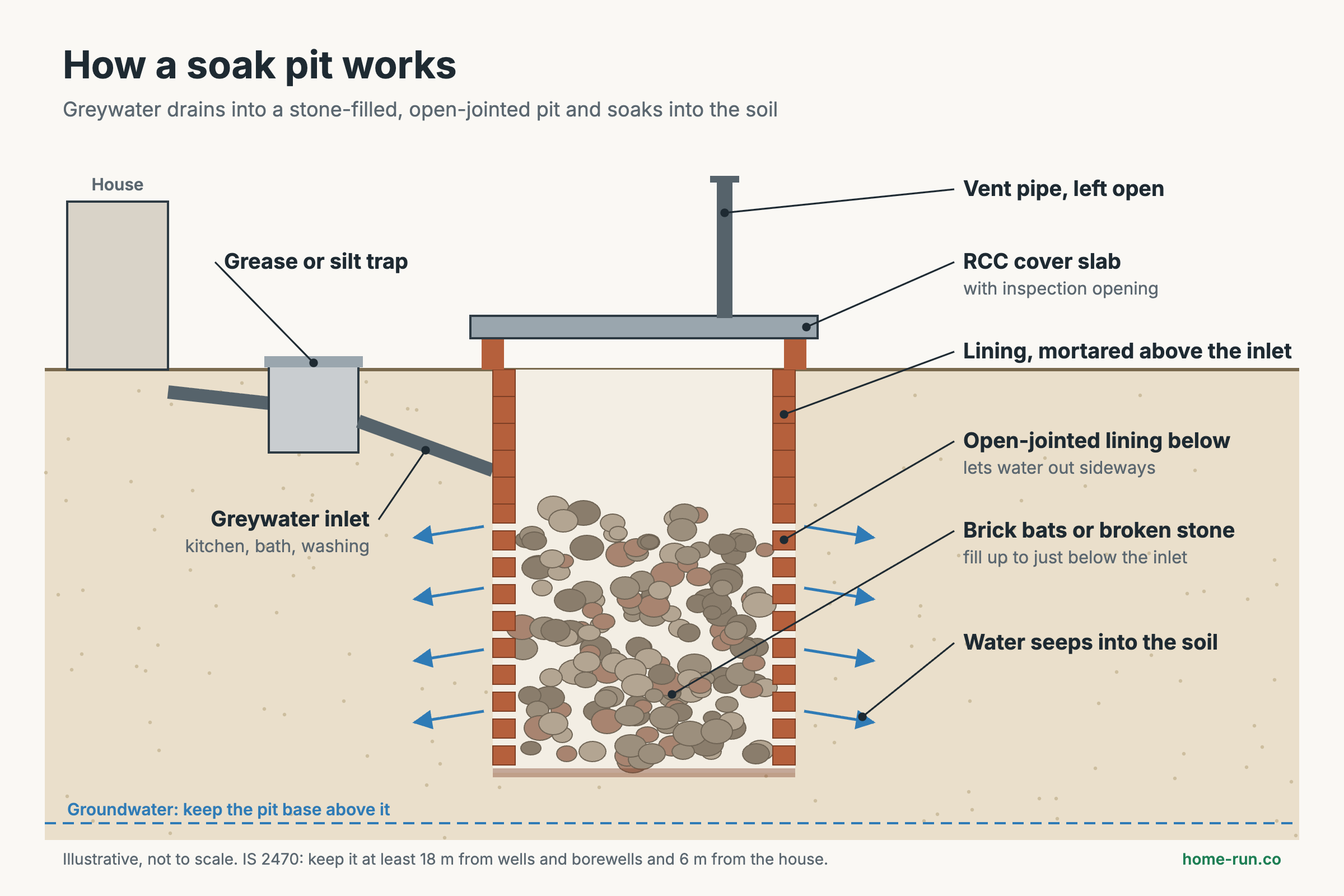
A soak pit holds wastewater between its stones until it soaks out through the walls and base. Soakaway, soak well and seepage pit mean the same thing.
- Can go in: greywater from kitchens, baths and washing, and settled effluent from a septic tank.
- Must stay out: raw toilet waste, bulk oil and grease, paints and chemicals, and roof rainwater.
Cleaning happens in the surrounding soil and the septic tank or grease trap. That is why well distance rules exist.
Soak Pit vs Septic Tank vs Leach Pit: Which Do You Need?
A soak pit only disposes of liquid. If a toilet drains into it, a septic tank must come first.
Three on-site systems compared
Choose by what the wastewater contains| System | Takes | What it does |
|---|---|---|
| Soak pit Greywater | Greywater, septic tank effluent | Spreads liquid into the soil |
| Septic tank | Toilet waste plus other wastewater | Settles and partly digests solids; effluent still needs a soak pit or trench |
| Twin leach pit Rural toilets | Pour-flush toilet waste | Two lined pits used in turn so one can rest and dry |
Is Your Soil Right for a Soak Pit?
Your soil suits a soak pit if water falls 25 mm in 30 minutes or less in the percolation test of IS 2470 (Part 2):1985, the BIS code for disposing of septic tank effluent.
- Dig a hole 100–300 mm wide to the planned pit depth. Scratch the sides and add 50 mm of coarse sand or fine gravel.
- Fill with water to at least 300 mm and leave it for 24 hours.
- Top up to 150 mm. Measure the drop every 30 minutes for 4 hours; in sandy soil, every 10 minutes for 1 hour.
- Work out the minutes taken for a 25 mm drop. Repeat at more than one spot and average.
Percolation time and allowable loading
From IS 2470 (Part 2), Table 2| Minutes per 25 mm | Allowable rate (L/m²/day) | Verdict |
|---|---|---|
| 1 or less | 204 | Fast: sandy soil |
| 5 | 90 | Good |
| 10 | 65 | Good |
| 30 | 37 | Limit for a soak pit |
| Over 30 Avoid | n/a | Use a dispersion trench or another system |
How Big Should a Soak Pit Be?
Soak pit size depends on daily wastewater flow and the soil's allowable rate. IS 2470 counts only the side wall area from 150 mm below the inlet pipe down to the base.
This is a safe upper estimate. With shallow groundwater, build two shallower pits instead.
What Materials Go Inside a Soak Pit?
A soak pit needs a porous lining, coarse fill, an inlet, a vent and a cover.
- Lining: brick, stone or concrete blocks laid with dry open joints, or perforated concrete rings
- Fill: brick bats or broken stone, plus 75 mm of coarse aggregate behind the lining
- PVC inlet pipe from a grease or silt trap
- Vent pipe, left open
- RCC cover slab with an inspection opening, and a masonry ring at the top
The open-jointed lining is simple masonry work.
How Do You Build a Soak Pit Step by Step?
Build a soak pit in six steps, in this order.
- Site: keep it at least 18 m from wells and borewells and 6 m from the house. A pit close to the wall can cause damp and seepage.
- Dig: to the sized depth, keeping the base above groundwater.
- Line: open joints below the inlet, mortar above.
- Fill: pack stones or brick bats up to just below the inlet.
- Connect: bring the inlet in through a grease trap. IS 2470 allows taking it down 0.9 m from the top to deter mosquitoes.
- Cover: fit the vent and slab, with the top ring above ground.
Roof water belongs in a recharge pit. See our guide to rainwater harvesting.
How Much Does a Soak Pit Cost in India?
Soak pit cost depends on pit volume, lining and local labour rates. Ask for line-item quotes for excavation, bricks or perforated rings, fill, pipes, cover slab and labour. A septic tank costs more, and an unsewered home with toilets needs both.
Soak pit materials
Order bricks, aggregate, cement and pipes with a GST invoice across Bengaluru.
How Do You Maintain a Soak Pit and Spot Problems?
A well-sized soak pit lasts about 3 to 5 years before the fill needs replacing, according to the Sustainable Sanitation and Water Management (SSWM) toolbox.
- Slow drains or water backing up into the trap
- Wet ground or standing water around the cover
- Foul smell or mosquitoes near the pit
- Monsoon overflow on clay or high water table plots
Clean the grease trap often. If flags persist, replace the fill or add a second pit.