On this page
- Why Do Indian Homes Need a Water Storage Tank?
- What Are the Types of Water Tanks for Home by Material?
- Where Can a Home Water Tank Be Installed?
- Which Shapes Do the Types of Water Tanks for Home Come In?
- What Capacity Water Tank Does a Home Need?
- Underground vs Overhead Water Tank: Which Is Better?
- What Should You Check Before Buying a Water Tank?
- Which Water Tank Brands Are Popular in India?
- How Do You Maintain a Water Tank for a Long Life?
- The main types of water tanks for home are plastic (polyethylene), RCC, stainless steel and FRP.
- By location, homes use an overhead tank, an underground sump, a loft tank, or a mix.
- Plastic overhead tanks should carry the ISI mark under IS 12701; RCC tanks are designed to IS 3370.
- Size the overhead tank for about one day's use and the sump for the gap between supply days.
- Clean tanks about twice a year and keep lids shut to stop dust, insects and algae.
The types of water tanks for home fall into four materials (plastic, RCC, stainless steel and FRP) and three locations (overhead, underground and loft). Most Indian homes pair an underground sump with a plastic overhead tank.
This guide lists each option and how to choose. For exact sump sizing, see our sump capacity calculation guide.
Why Do Indian Homes Need a Water Storage Tank?
A water storage tank is a container that holds water between supply times so taps keep running when the mains are off. Most Indian cities supply water intermittently, not 24 hours a day.
Many Bengaluru areas get BWSSB (Bangalore Water Supply and Sewerage Board) Cauvery water on alternate days, often at no fixed time. That is why most houses build a sump to catch the supply and pump it to an overhead tank.
What Are the Types of Water Tanks for Home by Material?
The four materials used for home water tanks are polyethylene plastic, reinforced cement concrete (RCC), stainless steel and fibre-reinforced plastic (FRP).
1. Plastic (polyethylene) tanks
A plastic water tank is a one-piece container made by rotational moulding, where polyethylene powder is melted inside a spinning mould. IS 12701:1996, the Indian Standard for rotational moulded polyethylene water storage tanks, covers these tanks.
They are light, cheap and quick to fit. Makers sell them as 3-, 4- or 6-layer tanks, with a dark outer layer against sunlight and a white inner layer.
- Best for: overhead and loft tanks.
- Watch: IS 12701 tanks are not meant for burial; buy a tank sold specifically as an underground model if you need one.
2. RCC (concrete) tanks
An RCC tank is a reinforced cement concrete box built on site, usually as an underground sump. Engineers design it to IS 3370, the code for concrete structures for the storage of liquids.
RCC is permanent and holds large volumes, but needs good waterproofing and curing.
3. Stainless steel tanks
A stainless steel tank is a welded or sectional steel tank that does not support algae and is easy to clean. Grade 304 is the usual choice for drinking water.
Grade 316L adds molybdenum and resists chlorides better. It suits coastal air or water with high chloride content.
4. FRP (fibreglass) tanks
An FRP tank is made from glass fibres set in resin, often as bolted panels that are assembled on site. Panels suit terraces where a one-piece tank cannot be lifted in.
CPVC (chlorinated polyvinyl chloride) and UPVC (unplasticised PVC) are used for pipes and fittings, not tanks. Brand names such as Sintex and Vectus are makers, not tank types.
Water tank materials compared
Qualitative comparison for homes| Material | Usual location | Upfront cost | Weight | Standard |
|---|---|---|---|---|
| Polyethylene Most homes | Overhead, loft | Low | Light | IS 12701 |
| RCC | Underground sump | Medium | Very heavy | IS 3370 |
| Stainless steel 304 / 316L Premium | Overhead, terrace | High | Medium | Maker's spec |
| FRP panels | Terrace, large homes | Medium to high | Light | Maker's spec |
Where Can a Home Water Tank Be Installed?
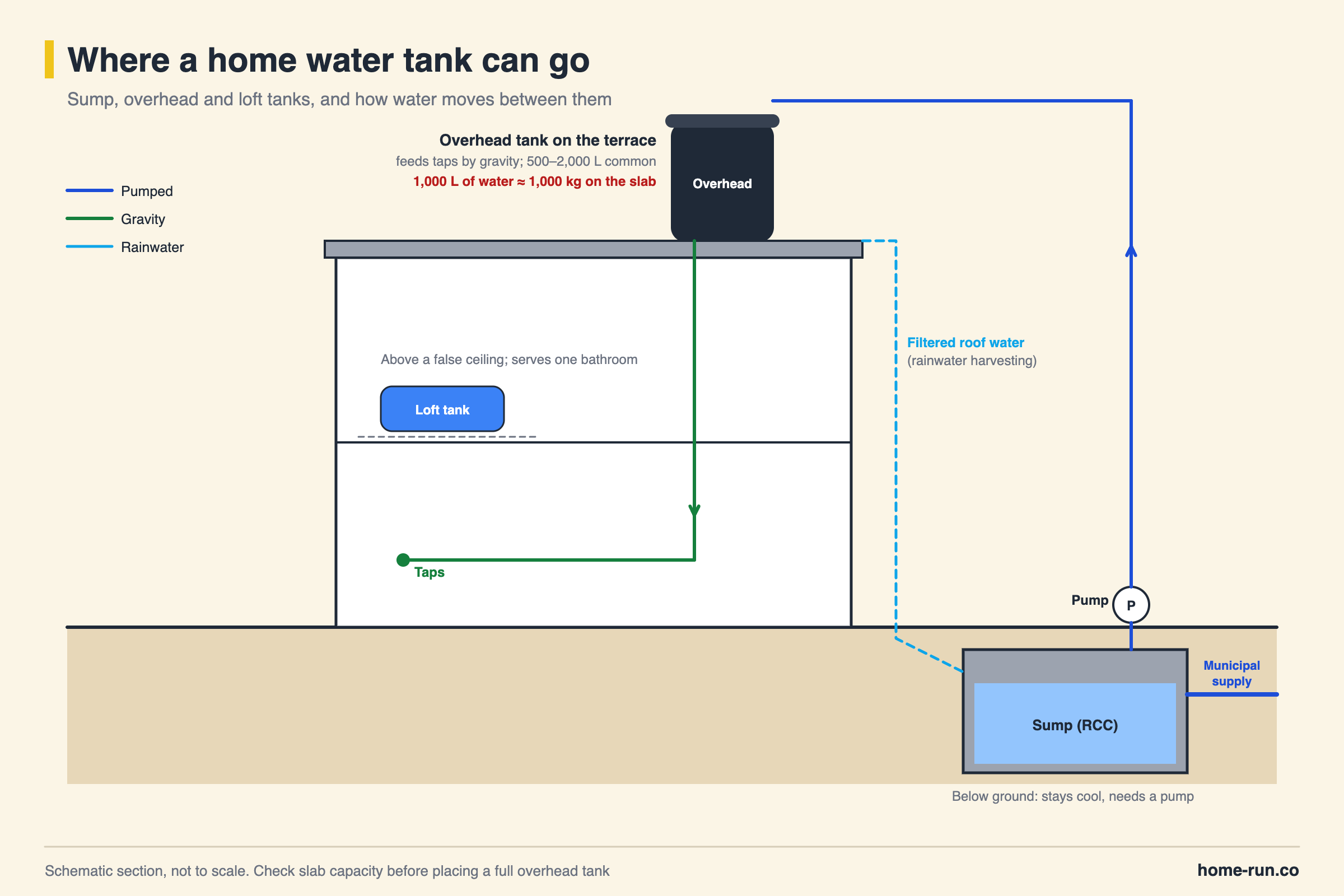
A home water tank can sit on the roof (overhead), below ground (sump) or inside the house above a ceiling (loft). Many homes use two of these together.
5. Overhead tanks
An overhead tank sits on the terrace or a raised stand and supplies taps by gravity. Plastic tanks of 500 to 2,000 litres are common on houses. Check that the slab can carry the full weight, since 1,000 litres of water weighs about 1,000 kg.
6. Underground tanks (sumps)
A sump is a tank below ground that receives the municipal supply or tanker water. It stays cool and saves roof space, but needs a pump. Many Bengaluru homes also route filtered roof water into it; see our guide to rooftop rainwater harvesting.
7. Loft tanks
A loft tank is a small tank above a false ceiling or bathroom loft that serves one floor or bathroom. Leave access for cleaning.
Which Shapes Do the Types of Water Tanks for Home Come In?
Water tanks come in vertical cylindrical, horizontal capsule, rectangular and sectional panel shapes.
- Vertical cylindrical: the standard overhead tank; most capacity for the price.
- Horizontal or capsule: low height for lofts and spaces under a staircase.
- Rectangular (cuboid): fits along walls and lofts; also the usual shape for RCC sumps.
- Sectional panel: bolted steel or FRP panels assembled on site in any size.
What Capacity Water Tank Does a Home Need?
A home needs an overhead tank that holds about one day's use and a sump that covers the gap between supply days. Start from daily use: the CPHEEO (Central Public Health and Environmental Engineering Organisation) planning figure is 135 litres per person per day for cities with sewerage, and 150 litres for metro cities.
Daily use = people × 150 litres. Overhead tank = at least one day's use. Sump = daily use × days between supplies, plus one spare day for a missed supply. Round up to the next standard tank size.
Add capacity for a garden or tenants.
Underground vs Overhead Water Tank: Which Is Better?
Neither is better on its own: an underground sump stores bulk water cheaply and stays cool, while an overhead tank delivers it to taps by gravity. Most homes on intermittent supply need both.
Underground sump
Bulk storage- Catches low-pressure mains and tanker water
- Water stays cooler and out of sunlight
- Needs digging, waterproofing and a pump
- Leaks and seepage are harder to spot
Overhead tank
Daily supply- Feeds taps by gravity with no pump running
- Quick to install and replace
- Adds load to the roof slab
- Water warms up in summer sun
What Should You Check Before Buying a Water Tank?
Check the ISI mark, capacity, layers, lid, fittings and warranty before you buy.
- ISI mark with IS 12701 on plastic tanks, and the licence number printed on the tank.
- Capacity sized from your family's daily use and supply gap.
- Opaque, UV-stabilised outer layer so sunlight cannot grow algae inside.
- Food-grade inner layer for drinking water.
- Tight, lockable lid and a mesh-covered vent and overflow.
- Correct inlet, outlet and overflow sizes; match them to your plumbing materials list.
- Written warranty and a level, fully supported base.
Red flags when buying a water tank
- No ISI mark, or a mark with no licence number.
- Light passes through the wall when you shine a torch inside.
- A strong plastic smell from the inner surface.
- An above-ground tank sold for burial as a sump.
Which Water Tank Brands Are Popular in India?
Sintex, Vectus and Plasto are among the best-known plastic water tank brands in India, and each sells several layer and capacity options.
- Compare like for like: same capacity, same number of layers.
- Read the warranty: note what it covers and for how long.
- Confirm the ISI licence: it applies to the model, not the whole brand.
How Do You Maintain a Water Tank for a Long Life?
You maintain a water tank by cleaning it about every six months, keeping it sealed and checking it for leaks. Sintex advises cleaning every three months in dusty or hard-water areas, and a professional sump clean at least once a year.
- Drain: use the stored water first, then close the inlet and empty the tank.
- Scrub: remove silt and slime with a soft brush; avoid wire brushes on plastic.
- Disinfect and rinse: follow the maker's dose for bleaching powder or chlorine, then rinse well.
- Inspect: check the lid, vent mesh, overflow, float valve and base for cracks.
A faulty float valve wastes water through the overflow. Our guide to the ball valve explains how it works.
Leaving the lid loose, skipping the sump because it is out of sight, and using harsh acids on plastic all shorten tank life. Never let anyone enter a closed sump alone; foul air can collect inside.
Setting up your water storage?
Tanks, pipes and fittings delivered across Bengaluru.