On this page
- What Is a Septic Tank for Home and How Does It Work?
- What Are the Types of Septic Tanks?
- Which Type of Septic Tank Is Best for Your Home?
- What Are the Benefits of a Septic Tank for Home?
- How Much Does a Septic Tank Cost in India?
- How Do You Maintain a Septic Tank?
- A septic tank for home treats sewage on site where no sewer reaches.
- Its liquid outflow must go to a soak pit, never an open drain.
- Main types: RCC, brick, plastic and FRP, plus bio septic tanks.
- A two-chamber RCC tank suits most new houses.
- Get it desludged every 2–3 years by a mechanised operator.
A septic tank for home is a watertight underground chamber that treats toilet and household wastewater on site, where no sewer line reaches. Solids settle, bacteria digest them, and the cleared liquid flows on to a soak pit.
About 38% of urban Indian households had septic tanks at the 2011 Census, says the Ministry of Urban Development. For sizes and dimensions, see our septic tank design guide.
What Is a Septic Tank for Home and How Does It Work?
A septic tank holds sewage long enough for solids to separate and anaerobic bacteria (bacteria that work without oxygen) to break them down.
- Inlet: waste enters behind a baffle, a wall or tee that slows the flow.
- Settling: solids sink as sludge; grease floats as scum.
- Digestion: bacteria reduce the sludge, and gases leave through a vent pipe.
- Second chamber: partly cleared liquid settles further.
- Outlet: effluent flows to a soak pit, where the soil absorbs it.
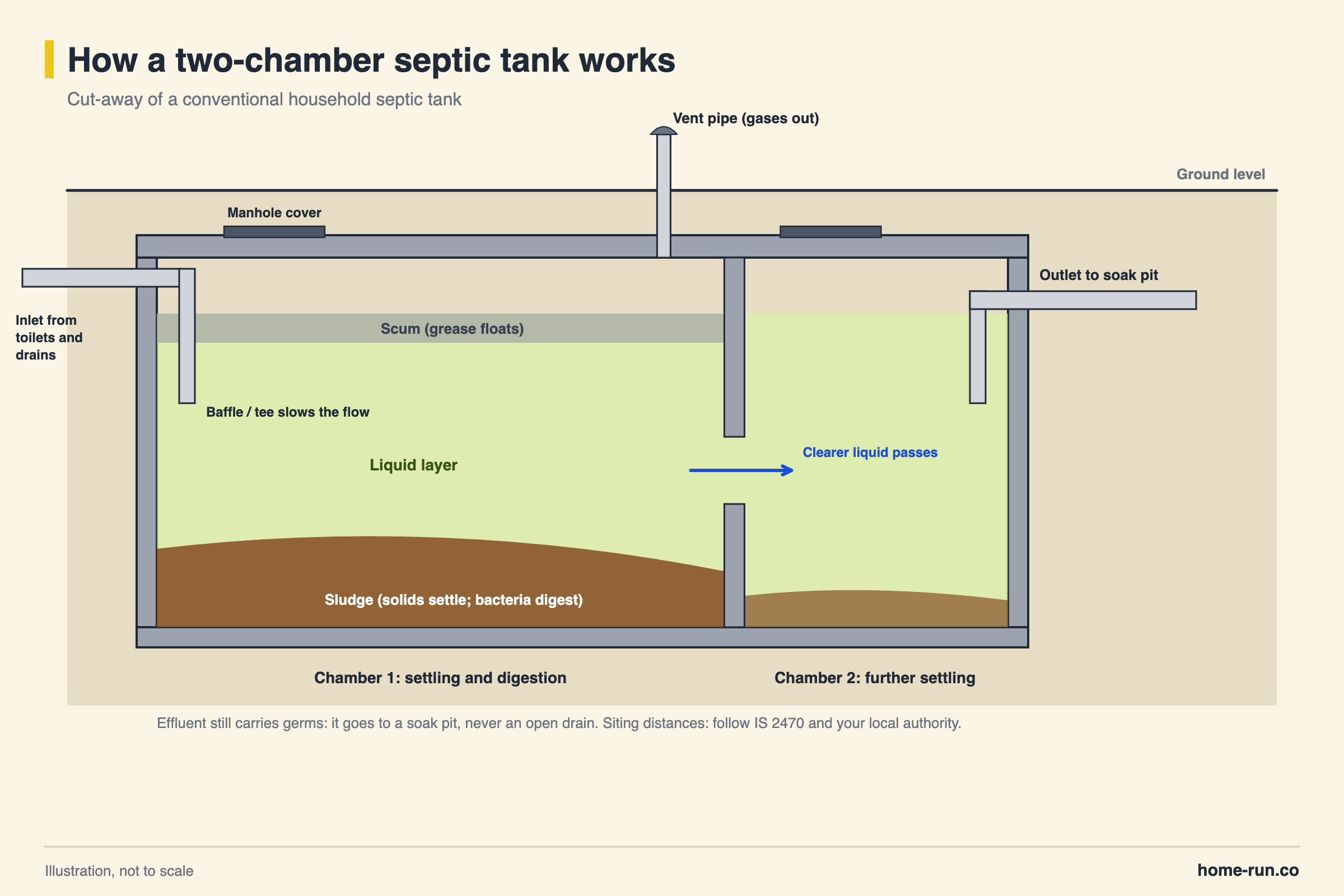
Tank effluent still carries germs, so it needs a soak pit, never an open drain. Our soak pit guide shows how to build one.
What Are the Types of Septic Tanks?
Septic tanks are grouped by material and by treatment method. IS 2470 (Part 1):1985, the Bureau of Indian Standards (BIS) code for septic tank design and construction, covers tanks built on site.
Septic tank types by material
Independent houses in India| Material | Strengths | Watch for |
|---|---|---|
| RCC (cast on site) Default pick | Strong, any size, long life | Needs curing and waterproofing |
| Brick masonry | Low cost, local skills | Leaks if the plaster cracks |
| Plastic (HDPE, LLDPE) | Light, readymade, quick to fit | Can lift if not anchored |
| FRP (fibre-reinforced plastic) | Stiff, does not corrode | Costs more than plastic |
| Steel Avoid | Rare in homes | Corrodes in sewage gases |
Types by treatment method
- Conventional: two or three chambers, settling and anaerobic digestion only. Most Indian homes use this.
- Bio septic tank (biodigester): charged once with a bacterial culture (inoculum) that digests waste faster. DRDO (Defence Research and Development Organisation) developed the best-known design; BIS covers it in IS 18150.
- Aerobic treatment unit (ATU): pumps in air for cleaner effluent, but needs electricity and servicing.
Sintex, a tank maker, claims normal tanks cut BOD (biochemical oxygen demand, the organic load in water) by about 40% and its bio tank by up to 70%.
Which Type of Septic Tank Is Best for Your Home?
A two-chamber RCC tank built to IS 2470 is the best choice for most new houses. A readymade plastic or FRP septic tank for home suits small households and quick retrofits.
RCC tank built on site
Most new housesPoints
- Built to your household's exact size
- Heavy and stable in high groundwater
- Slower to build; must cure first
- Needs a skilled mason
Readymade plastic or FRP
Small homes, retrofitsPoints
- Fixed sizes, such as Sintex's 800–6,000 L
- Light, needs less site labour
- Fitted much faster than a cast tank
- Must be anchored in high groundwater
- Users: size for everyone in the house, using the IS 2470 chart in our design guide.
- Soil: clay drains slowly and a high water table limits soak pits.
- Wells: keep the distances IS 2470 and local bylaws set from wells and borewells.
- Sewers: in Bengaluru, ask BWSSB (Bangalore Water Supply and Sewerage Board) whether a sewer serves your street. Many of the 110 villages added to the city still await connections.
What Are the Benefits of a Septic Tank for Home?
The main benefit of a septic tank for home is safe, low-cost sanitation where no sewer exists.
- No sewer needed: suits plots outside the BWSSB network.
- Low running cost: the main expense is desludging every 2–3 years.
- Protects groundwater: when watertight and paired with a soak pit.
- No power: conventional and bio tanks have no pumps or motors.
- Some recover energy: the DRDO biodigester gives off biogas with 50–70% methane.
A septic tank vents its gas; a biogas plant captures it for cooking. See our biogas plant for home guide.
How Much Does a Septic Tank Cost in India?
A readymade 1,000 L plastic septic tank lists at about ₹10,300–19,000 on IndiaMART (November 2026), before installation.
Septic tank for home price in India
Seller listings, IndiaMART, Nov 2026| Tank | Listed price (₹) |
|---|---|
| 1,000 L plastic (HDPE, LLDPE) Budget | 10,300–19,000 |
| 1,000 L FRP | 22,000 |
| 2,000 L plastic | 28,000–58,000 |
An RCC tank's cost depends on size and material rates, so get a written contractor quote.
Building a septic tank this month?
Cement, steel and drainage pipes delivered across Bengaluru.
How Do You Maintain a Septic Tank?
Have a septic tank desludged every 2–3 years, or once sludge fills a third of it, as the Ministry of Urban Development's 2013 septage advisory recommends.
- Use a mechanised vacuum truck, often called a "honey sucker".
- Never let anyone enter the tank. Its gases can kill, and the Manual Scavengers Act, 2013 bans hazardous manual cleaning.
- Keep the vent pipe open and its mesh cap in place.
- Keep wipes, pads, diapers, oil and chemicals out of drains.
Signs your septic tank needs attention
- Slow or gurgling drains: the tank or outlet may be full or blocked.
- Sewage smell: a cracked cover or blocked vent.
- Soggy ground over the soak pit: the soil has stopped absorbing.
- Backflow in the lowest floor trap: the system is overloaded.
Planning the pipes too? See our plumbing materials list.