


On this page
- What Is Rainwater Harvesting and Why Does It Matter in India?
- What Are the Main Types of Rainwater Harvesting?
- What Are the Components of a Rooftop Rainwater Harvesting System?
- How Much Rainwater Can Your Roof Actually Collect?
- How Do You Set Up a Rooftop Rainwater Harvesting System Step by Step?
- How Big Should the Tank or Recharge Structure Be?
- Is Harvested Rainwater Safe to Use?
- What Does Rainwater Harvesting Cost, and Is It Worth It?
- Is Rainwater Harvesting Mandatory in India?
- Where Should You Start With Rainwater Harvesting?
- Rainwater harvesting means collecting rain where it falls. You either store it in a tank or send it into the ground to recharge groundwater.
- A rooftop system has six parts: roof, gutters and downpipes, first-flush diverter, filter, tank or recharge pit, and an overflow.
- Your yield is roof area × rainfall × runoff coefficient. A 100 m² roof in Bengaluru can collect about 86,000 litres in a normal year.
- Harvested rain is fine for gardens, flushing and washing after basic filtering. Drinking needs proper treatment and testing.
- In Bengaluru, BWSSB makes harvesting mandatory for new buildings on sites of 1,200 sq ft and above, and for older buildings on 2,400 sq ft and above.
Rainwater harvesting is the practice of collecting rain from a roof or open ground and either storing it for use or guiding it into the soil to recharge groundwater. For an Indian home, a rooftop rainwater harvesting system is the simplest version. It cuts tanker and borewell dependence and is mandatory in many cities.
This guide explains the methods, the parts of a system, how to calculate your roof's yield, how to size a tank or pit, and what the rules say.
What Is Rainwater Harvesting and Why Does It Matter in India?
Rainwater harvesting is collecting rain where it falls, before it runs off into drains. The collected water has two possible outcomes: storage for direct use, or recharge into the aquifer, the underground layer of sand, gravel or rock that feeds wells and borewells.
India needs both outcomes. Most of the year's rain falls in a few monsoon months, so water is plentiful for weeks and scarce for months. India is also the world's largest user of groundwater, drawing over a quarter of the global total, according to the National Water Mission.
The Central Ground Water Board (CGWB) assessment cited by the National Water Mission puts India's stage of groundwater extraction at 63%. It classed 1,186 of 6,881 assessment units as over-exploited. Harvesting puts some of that water back.
A storage tank gives you water to use directly. A recharge pit or well gives you nothing to draw from the pit itself; it tops up the groundwater your borewell or neighbourhood relies on. Harvesting where the rain falls (in situ) and moving it to a tank elsewhere (ex situ) need different designs.
What Are the Main Types of Rainwater Harvesting?
The main types of rainwater harvesting are surface storage and groundwater recharge. Sources list anywhere from four to seven "types" because they split these two groups differently. This guide groups the methods by what they do with the water.
Rainwater harvesting methods compared
What each one does with the water| Method | Stores or recharges | Best suited to |
|---|---|---|
| Rooftop storage tank Homes | Stores | Independent houses and apartments that want water for daily use |
| Recharge pit | Recharges | Plots with permeable soil and roofs of about 100 m² |
| Recharge trench | Recharges | Long, narrow open areas and larger compounds |
| Recharge well or borewell recharge | Recharges | Sites where permeable layers lie deeper, or with an existing borewell |
| Surface runoff harvesting | Both | Societies, campuses and farms collecting from paved or open ground |
| Check dams and farm ponds | Both | Villages and agricultural land |
Traditional Indian methods
India has region-specific harvesting systems that still work today:
- Taanka and kund: covered underground tanks in the Thar desert of Rajasthan that store rain for drinking.
- Johad: earthen check dams in Rajasthan, such as those revived across Alwar district, that slow runoff and recharge groundwater.
- Baoli (stepwell): stepped wells in north and west India that reach the water table.
- Eri: interconnected irrigation tanks in Tamil Nadu that store monsoon runoff.
Active harvesting uses tanks, pipes and pumps. Passive harvesting shapes the land, with swales, permeable paving and pits, so rain soaks in without being stored.
What Are the Components of a Rooftop Rainwater Harvesting System?
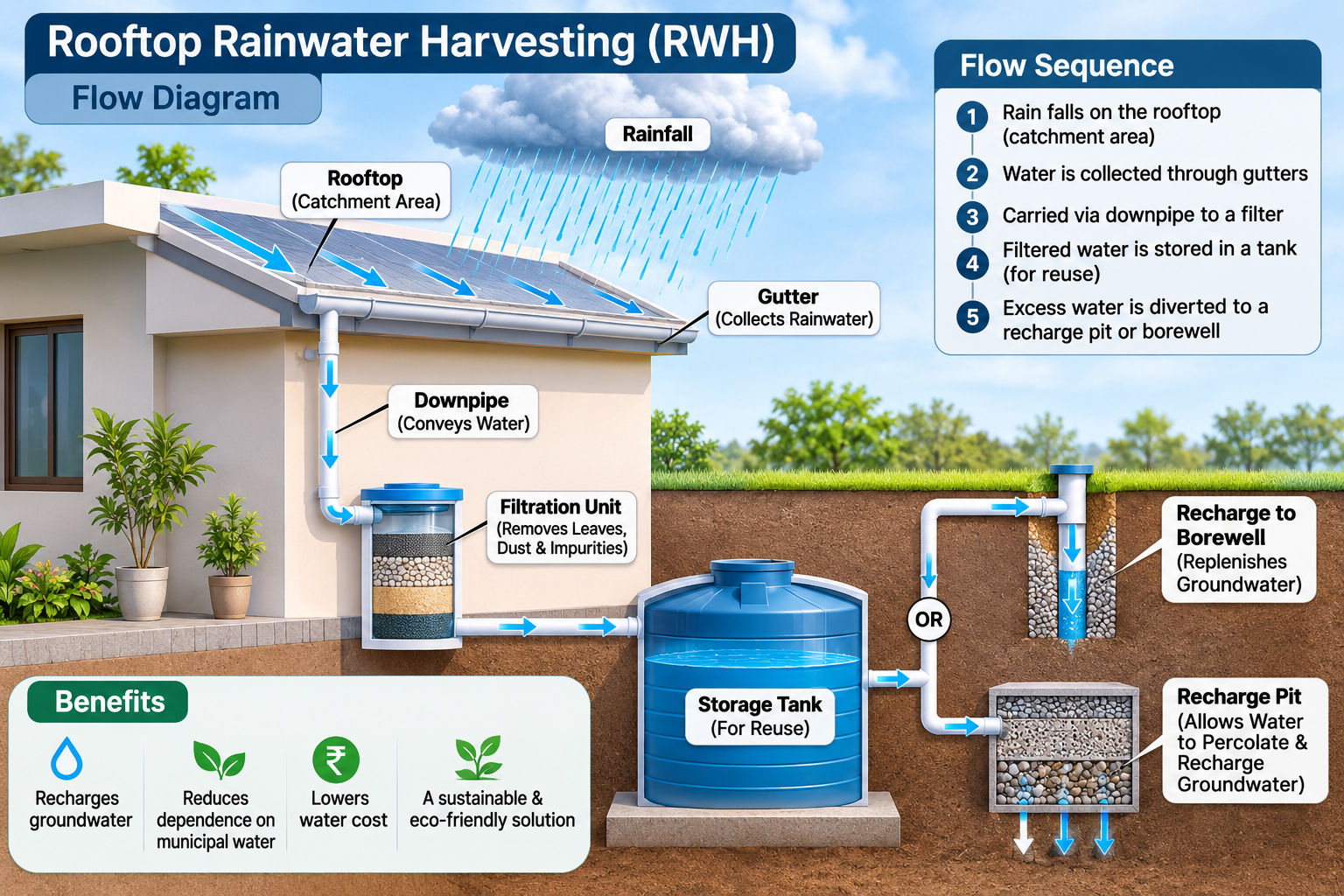
A rooftop rainwater harvesting system has six components. Here they are in the order the water flows through them:
- Catchment (roof). The surface that collects rain. A clean RCC or tiled roof gives the cleanest water.
- Gutters and downpipes. These carry water off the roof. Undersized pipes overflow in heavy bursts.
- First-flush diverter. This device discards the first, dirtiest rain from each shower. It is not a filter.
- Filter unit. A mesh, sand or cartridge filter removes leaves, grit and fine silt before storage.
- Storage tank or recharge structure. The tank holds water for use; the pit or well sends it underground.
- Overflow outlet. When the tank is full, excess water goes to a recharge pit or the storm drain, never back against the building.
Divert the first two to three showers of the season entirely. The National Water Mission's guidance recommends a bypass for this first runoff because it carries the dust and bird droppings that built up during the dry months.
How Much Rainwater Can Your Roof Actually Collect?
Your roof can collect its area in square metres, multiplied by the rainfall depth in metres, multiplied by a runoff coefficient. The runoff coefficient is the share of rain that actually runs off rather than splashing, soaking in or evaporating.
This is a theoretical maximum. Real collection is lower because tanks overflow in heavy bursts, first-flush water is discarded and gutters spill. Use your city's normal rainfall from the India Meteorological Department (IMD), not a figure from another region.
How Do You Set Up a Rooftop Rainwater Harvesting System Step by Step?
You set up a rooftop system in eight steps, and the sequence is the same whether you build it yourself or hire an installer:
- Assess the roof and plot. Measure the roof area, count the downpipes and note where water already flows.
- Decide storage, recharge or both. Storage suits regular use; recharge suits borewell homes and small budgets.
- Size the system from your roof yield and your local rules (see the next section).
- Fit gutters and downpipes and connect all roof outlets to one collection line.
- Install the first-flush diverter and filter at an accessible height for cleaning.
- Build the tank or recharge pit, with a covered, mosquito-proof opening.
- Connect the overflow to a recharge pit or the storm drain.
- Inspect before the first monsoon shower and watch the system during the first rain.
Do not send rainwater into a borewell or a deep recharge well without filtering it, and check local geology first. Unfiltered water can clog or contaminate the aquifer, and recharge does little where the water table is already high.
A year of rainwater harvesting in Bengaluru
Pre-season check
Sweep the terrace, clear gutters, clean the filter and desilt the pit before the first showers.
First showers
Divert the first two to three showers. Then start collecting.
Monsoon
Check the filter after heavy rain and keep the overflow clear.
Peak season
Bengaluru's wettest season. Tanks fill fastest and overflow most, so recharge matters most now.
Dry months
Draw down stored water, then clean and inspect the tank before it runs empty.
How Big Should the Tank or Recharge Structure Be?
Size a storage tank to your roof yield and your household's use during the dry gap. Size a recharge structure to handle the peak downpour and your soil's ability to absorb it.
Tank materials and placement
General trade-offs| Option | Strength | Watch for |
|---|---|---|
| RCC underground sump | Large capacity, saves ground space, stays cool | Needs waterproofing and a pump; leaks are hard to find |
| Ferrocement tank | Cheaper than RCC for mid-size tanks | Needs a skilled mason for thin, crack-free walls |
| Plastic (HDPE) tank | Quick to install, easy to add later | Limited size; choose opaque tanks to stop algae |
For recharge pits, the National Water Mission's guidance suggests a pit 1–2 m wide, 2–3 m long and 2–3 m deep for a roof of about 100 m². The pit is filled with boulders, then gravel, then coarse sand. Recharge trenches are typically 0.5–1 m wide, 1–1.5 m deep and 10–20 m long.
BWSSB sets a minimum storage or recharge capacity per square metre of roof and paved area. Older rules used 20 litres per m² of roof and 10 litres per m² of other paved area. A 2024 summary of current BWSSB guidelines cites 60 and 30 litres. Confirm the figure in force with BWSSB before you size your system.
Is Harvested Rainwater Safe to Use?
Harvested rainwater is safe for gardening, toilet flushing and washing after basic filtering. It is not safe to drink without proper filtration, disinfection and testing against IS 10500, the Indian standard for drinking water.
Rain itself is fairly clean. The roof is the problem: dust, leaves, bird droppings and debris wash into the system with every shower.
Signs your system needs attention
- Stored water smells, looks cloudy or turns green
- Mosquito larvae in the tank or around the inlet
- Leaves and silt building up in the filter or first-flush chamber
- Water standing in the recharge pit long after rain stops
- Gutters overflowing during ordinary showers
Matching treatment to use
General guidance| Use | Minimum treatment |
|---|---|
| Garden and car washing | Mesh filter and first-flush diversion |
| Toilet flushing | Mesh filter, clean roof and grating at the roof inlet |
| Laundry and cleaning | Sand or cartridge filtration |
| Drinking and cooking Caution | Filtration plus disinfection, and lab testing against IS 10500 |
What Does Rainwater Harvesting Cost, and Is It Worth It?
Rainwater harvesting cost depends on roof size, the choice between storage and recharge, tank material, digging and filtration. A recharge-only system usually costs less than a storage system, because it skips the tank and pump.
Recharge-only system
Lower costFilter plus recharge pit or well. No stored water to use.
- No tank, pump or plumbing changes
- Recharges the groundwater your borewell uses
- Meets most municipal rules
- Low maintenance: yearly desilting
Storage system
Higher costFilter, tank and pump, usually with overflow to recharge.
- Water you can use directly every day
- Fewer tanker purchases in the dry months
- Needs space, waterproofing and a pump
- Regular tank cleaning and mosquito-proofing
The payback comes from fewer tanker loads, a borewell that holds up longer, and avoiding Bengaluru's water-bill penalty for non-compliance. Get at least two written quotes that list each component separately.
Plumbing materials for your harvesting system
Pipes, fittings, cement and waterproofing for gutters, downpipes, sumps and recharge pits, delivered across Bengaluru. Genuine stock, GST invoice.
Is Rainwater Harvesting Mandatory in India?
Rainwater harvesting is mandatory in many Indian states and cities, but the rules come from state laws and municipal bye-laws, not one national code. Requirements depend on your city, plot size and building type.
- Bengaluru (BWSSB): the Bangalore Water Supply and Sewerage (Amendment) Act makes harvesting mandatory for new buildings on sites of 1,200 sq ft and above, and existing buildings on 2,400 sq ft and above. Owners without a system pay an extra charge on their water and sanitary bills until one is installed, starting at 25% and rising after three months.
- Tamil Nadu: a 2003 state ordinance made rooftop harvesting compulsory for buildings across the state, building on Chennai's earlier rules.
- National campaigns: Jal Shakti Abhiyan's "Catch the Rain, where it falls, when it falls" promotes harvesting. It is an awareness campaign, not a building code.
Thresholds, capacity norms and penalties are revised over time. Confirm the current requirement with your municipal corporation or water board before you finalise your building plan.
Every litre your roof sends into a tank or a recharge pit is a litre your borewell or a tanker does not have to supply.
HomeRun Team
Where Should You Start With Rainwater Harvesting?
Start by measuring your roof and checking your local rule. Then take these steps:
- Measure your roof area and count the downpipes
- Check the BWSSB or municipal requirement for your plot size
- Decide on storage, recharge or both, using the yield formula above
- Get two written quotes that list each component and the pit or tank size
- Book the installation before March, so the system is ready for the first showers