On this page
- What Is a Ball Valve and How Does It Work?
- What Are the Main Parts Inside the Valve?
- What Are the Different Types of Ball Valves?
- Which Material Should You Choose: Brass, Stainless Steel, UPVC or CPVC?
- Where Are Ball Valves Used in Plumbing?
- What Are the Advantages and Limitations, and Can It Control Flow?
- Ball Valve vs Gate Valve: Which Should You Use?
- How Do You Choose the Right Ball Valve?
- A ball valve is a quarter-turn shut-off valve: a drilled ball rotates 90° to open or close the line.
- It is different from the float "ball valve" (ballcock) that stops an overhead tank overflowing.
- Full bore valves pass the full pipe flow; reduced bore valves are cheaper but restrict flow slightly.
- Pick the body by the water: UPVC for cold lines, CPVC or brass for hot, stainless steel for corrosive or food-grade use.
- Use it fully open or fully closed, and close it slowly on pump lines to avoid water hammer.
A ball valve is a shut-off valve with a ball inside that has a hole drilled through it. Turn the handle a quarter turn and the hole either lines up with the pipe (open) or sits sideways to it (closed).
It is the most common isolation valve on Indian water lines, tank outlets and pump lines.
What Is a Ball Valve and How Does It Work?
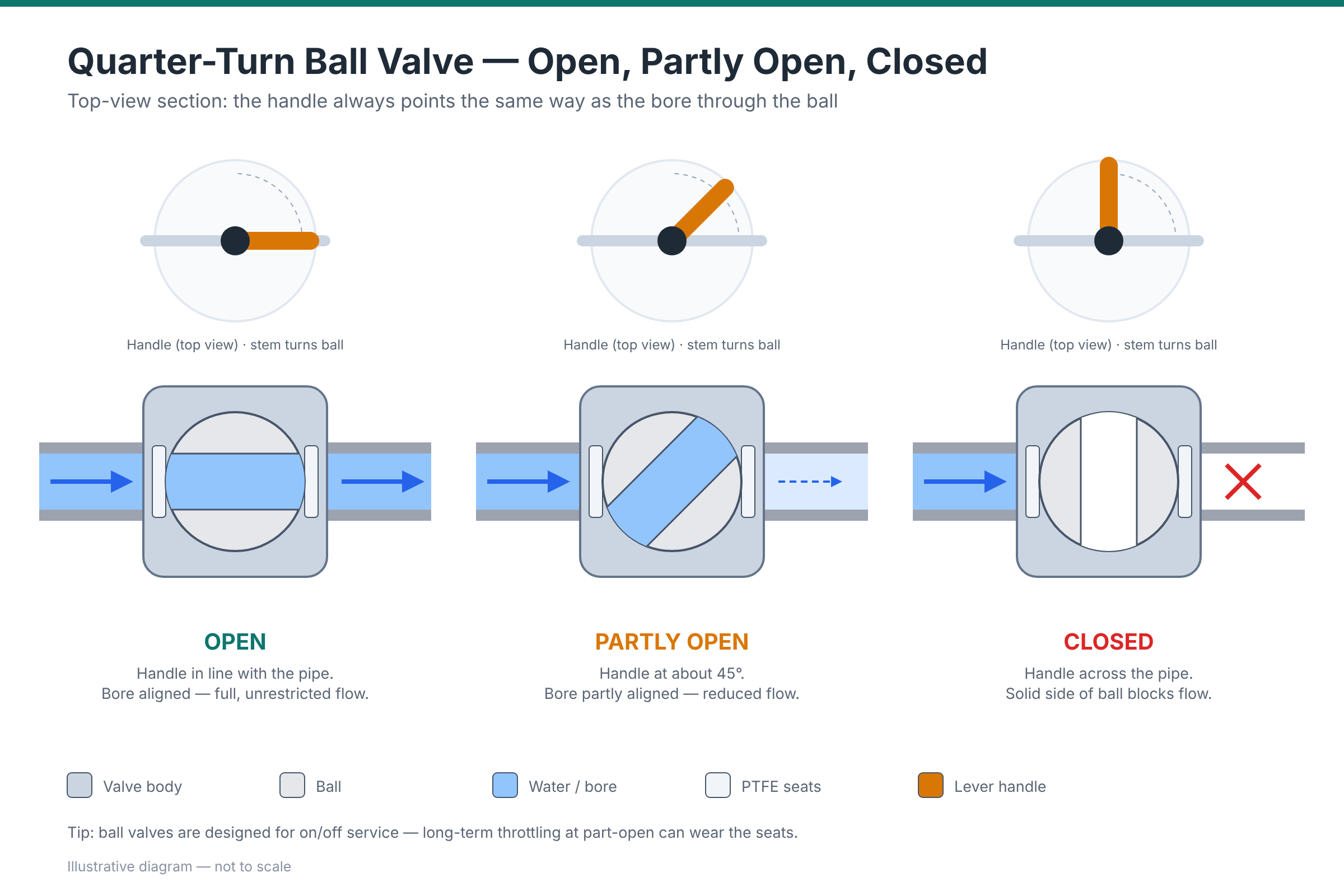
A ball valve works by rotating a bored ball through 90° between two seats. With the bore facing the flow, water passes straight through. With the solid side facing it, the seats seal and the line is shut.
- Handle in line with the pipe: the valve is open.
- Handle across the pipe: the valve is closed.
The handle always shows the valve state. It is called a quarter-turn valve because 90° is its full travel.
The float valve (ballcock) in an overhead tank or cistern has a floating ball on an arm that shuts the inlet as water rises. It is a different product, though shops use the same name.
What Are the Main Parts Inside the Valve?
A ball valve has six main parts: body, ball, stem, seats, seals and handle.
Ball valve parts and what goes wrong
Use this to read a product listing| Part | What it does | Sign of a poor part |
|---|---|---|
| Body and ends | Holds the parts and connects to the pipe | Thin walls, rough threads, no markings |
| Ball | Opens or blocks flow through its bore | Pitted or dull surface that scores the seats |
| Stem | Links the handle to the ball | Play or wobble, leaks at the stem |
| Seats | Soft rings (PTFE, EPDM) that seal on the ball | Drips when fully closed |
| Seals and packing | Stop leaks around the stem and body joints | Weeping at the handle nut |
| Handle or actuator | Turns the stem by hand or by motor | Loose handle, stiff or uneven turn |
What Are the Different Types of Ball Valves?
Ball valves are grouped by bore size, flow pattern, body construction, ball mounting and how they are operated.
- Full bore (full port): the ball's hole matches the pipe size, so flow is not restricted. Use it on pump and main lines.
- Reduced bore (reduced port): a smaller hole; cheaper, fine for branch lines.
- Three-way (L-port or T-port): a third port. An L-port sends water to one of two outlets; a T-port can also mix or feed both.
- One-piece, two-piece and three-piece body: one-piece bodies cannot be repaired; a three-piece centre section lifts out without cutting the pipe.
- Floating vs trunnion-mounted ball: home valves are floating, held by the seats; trunnion valves anchor the ball on shafts for large, high-pressure lines.
- Manual vs actuated: a motor or air actuator turns the ball, as in water treatment plants.
Two 1-inch ball valves can pass different flows. Check full or reduced bore before comparing prices.
Which Material Should You Choose: Brass, Stainless Steel, UPVC or CPVC?
Choose the ball valve material by the water temperature, what flows through it and where it is fitted. For cold-water home lines, UPVC is the usual pick; for hot lines, CPVC.
Ball valve body materials compared
Confirm ratings on the maker's datasheet| Material | Best for | Avoid for |
|---|---|---|
| UPVC / PVC Default pick | Cold water, tank outlets, garden and irrigation lines | Hot water and geyser lines |
| CPVC Hot water | Hot and cold lines in CPVC plumbing | Metal pipework without an adaptor |
| Brass | GI and metal lines, pump outlets, geyser inlets | Aggressive water unless it is DZR brass |
| Stainless steel (SS 304/316) | Corrosive water, RO plants, food and chemical lines | Tight budgets on simple home lines |
| PP / PVDF Specialist | Chemical dosing and aggressive fluids | General home plumbing |
Plastic valve ratings drop as temperature rises. Astral rates its socket UPVC/CPVC ball valves at 16 kg/cm² at 23 °C, lower when hot, with EPDM or FKM (Viton) seals.
Where Are Ball Valves Used in Plumbing?
Ball valves are used wherever you need to isolate part of a water system quickly.
- Overhead tank and sump outlets: UPVC full bore, to shut the house supply for repairs. Many Bengaluru homes have both.
- Pump and borewell delivery lines: brass or UPVC full bore, close to the pump.
- Geyser inlet: CPVC or brass, rated for hot water.
- Garden, irrigation and rainwater harvesting lines: UPVC, often a three-way valve to divert flow.
- RO plants, HVAC, gas and process lines: stainless steel or actuated valves.
What Are the Advantages and Limitations, and Can It Control Flow?
A ball valve gives fast, tight shut-off with little resistance to flow. It is a poor choice for fine flow control.
- Opens or closes in a quarter turn
- Soft seats give a tight seal
- Full bore types cause very little pressure loss
- Handle position shows open or closed at a glance
- Compact, with few moving parts
- Wears quickly when left half open
- Not suited to sandy or fibrous water, which scores the seats and ball
- Water can stay trapped in the body cavity when closed
- Shutting it fast can cause water hammer
Forbes Marshall advises against running ball valves partly open; use a globe or V-port ball valve for flow control. Close valves slowly while a pump runs to limit water hammer.
Ball Valve vs Gate Valve: Which Should You Use?
Use a ball valve for quick, reliable shut-off on home lines. Gate valves, common in older Indian homes, take several turns and can stick.
Ball valve
Home defaultQuarter-turn, rotating ball.
- Opens or shuts in 90°
- Handle shows the valve state
- Tight seal from soft seats
- Not for throttling
Gate valve
Older linesMulti-turn, sliding gate.
- Needs several handwheel turns
- State is hard to see
- Can seize after long periods
- Not for throttling either
Ball valve and other common valve types
Quick decision guide| Valve | Operation | Shut-off | Flow control |
|---|---|---|---|
| Ball Default pick | Quarter turn | Tight | Poor (V-port: good) |
| Gate | Multi-turn | Good when new | Poor |
| Globe | Multi-turn | Good | Good, with higher pressure drop |
| Butterfly | Quarter turn | Moderate | Fair, for large pipes |
| Check (non-return) Not a shut-off | Automatic | One-way only | None |
How Do You Choose the Right Ball Valve?
Choose a ball valve in this order: fluid, pressure and temperature, size, bore, body style and end connection.
- Fluid: cold water, hot water, RO water or chemicals. This decides the material.
- Pressure and temperature: read the rating on the body (PN in bar, Class, or WOG for water, oil, gas). PN and Class are different systems.
- Size: match the pipe's nominal size, such as ½, ¾ or 1 inch. The inch size names the pipe, not the measured hole.
- Bore: full bore for main and pump lines, reduced bore for branch points.
- Body style: two- or three-piece if you may need to service it.
- End connection: threaded, solvent-cement (socket) or flanged. Indian threaded fittings generally follow IS 554, the BSP-family pipe thread code. BSP and US NPT threads do not mix.
IS 9890:1981 is the BIS specification for general-purpose cast iron and carbon steel ball valves. For brass and plastic valves, check the code printed on the product.
- No brand, size or pressure rating stamped on the body
- Feels much lighter than other valves of the same size
- Loose or wobbly handle, or a gritty turn
- ISI mark with no licence number you can check on the BIS site
Price depends on material, size, bore, body style and brand. To fit a threaded valve, tape the male thread with PTFE and grip the valve body, not the handle, with a pipe wrench. Then pressurise and check for drips.
Ball valves, pipes and fittings
Order plumbing materials with a GST invoice and delivery across Bengaluru.