On this page
- What Is a Recharge Pit and How Does It Work?
- Is Your Plot Suitable for a Recharge Pit?
- Recharge Pit vs Shaft, Trench or Recharge Well: Which Do You Need?
- How Big Should a Recharge Pit Be?
- How Do You Build a Recharge Pit Step by Step?
- What Does a Recharge Pit Cost, and What Does BWSSB Require?
- How Do You Maintain a Recharge Pit?
- A recharge pit lets filtered roof rainwater soak down and refill groundwater.
- It recharges rather than stores, and it never takes wastewater.
- Common guidance: 1–2 m wide and 2–3 m deep, for a roof of about 100 m².
- BWSSB asks for 20 litres per m² of roof plus 10 litres per m² of paved area.
- Clean the silt trap and top sand layer before every monsoon.
A recharge pit is a small pit filled with boulders, gravel and sand that lets rooftop rainwater soak into the soil and refill the groundwater below. It suits individual houses on permeable soil and helps keep a borewell or open well from running dry.
What Is a Recharge Pit and How Does It Work?
A recharge pit works by catching roof runoff, cleaning it, and letting it seep slowly down to the aquifer. The aquifer is the underground layer of sand, gravel or rock that holds water.
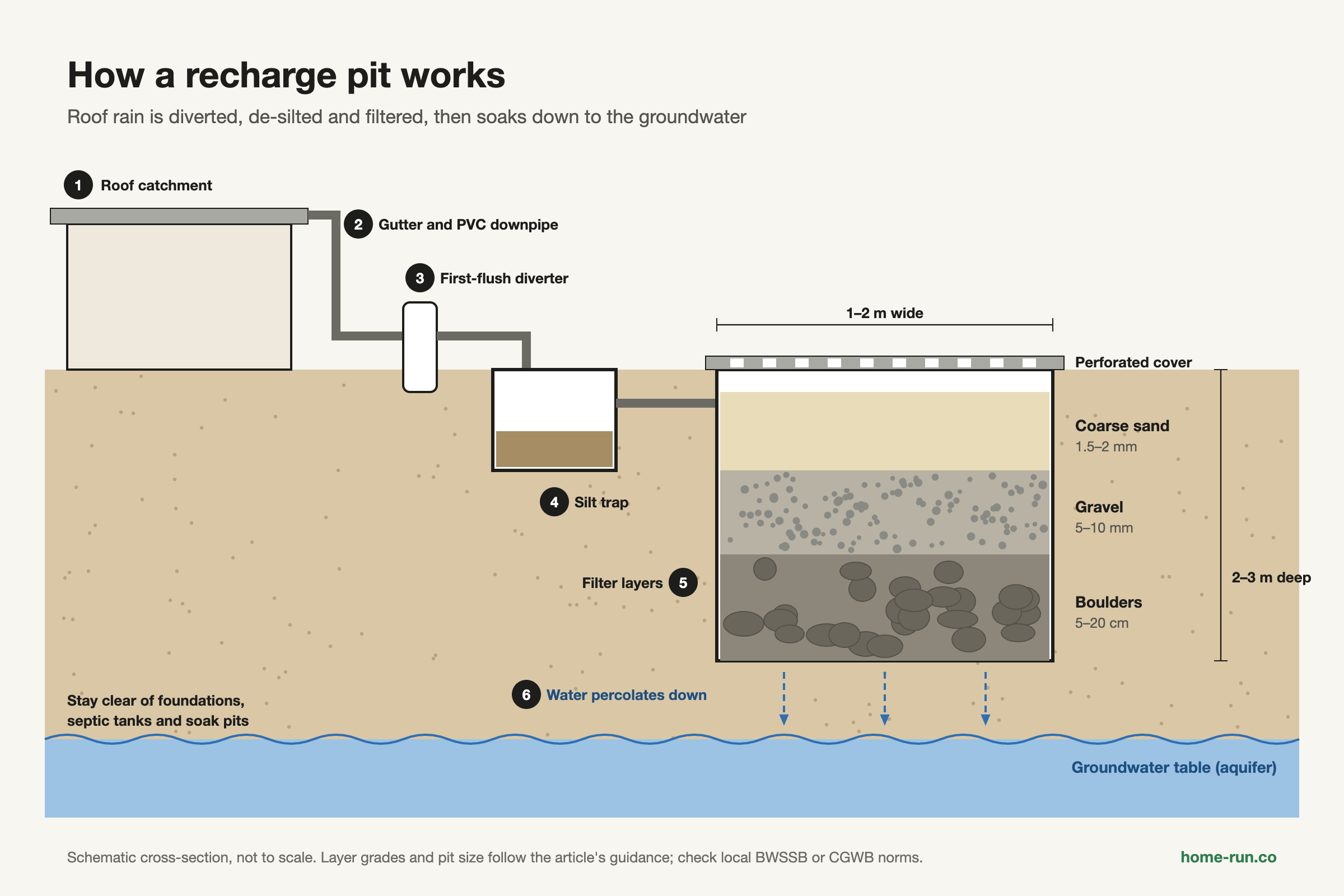
- The roof catchment collects rain.
- Gutters and PVC downpipes carry it to ground level.
- A first-flush diverter throws away the dirtiest first rain.
- A silt trap lets mud settle out.
- The pit's filter layers strain the water.
- Water percolates down to the groundwater table.
A storage tank keeps rain for later use; a recharge pit sends it into the ground. A soak pit takes wastewater from a kitchen, bathroom or septic tank, as our soak pit guide explains. Never route wastewater into a recharge pit.
Is Your Plot Suitable for a Recharge Pit?
Your plot suits a recharge pit if the soil drains quickly and the water table sits well below the pit bottom. Check these points first:
- A percolation test passes: dig a small hole, fill it with water and time how fast it drains
- Sandy or loamy soil, or weathered rock near the surface
- Groundwater stays well below the pit bottom, even in the monsoon
- The pit sits clear of foundations, septic tanks and soak pits
- Only roof water enters, not road or drain runoff
BWSSB advises against ground recharge where groundwater is very high or hard rock lies just below the surface. Use a sump or surface tank there. Heavy clay drains too slowly and needs a deeper shaft.
Recharge Pit vs Shaft, Trench or Recharge Well: Which Do You Need?
A recharge pit is the default for a single house with permeable topsoil; go deeper with a shaft or ring well when it is not.
Which recharge structure suits your site?
Qualitative guide| Structure | Form | Best for | Avoid when |
|---|---|---|---|
| Recharge pit Default pick | Wide, shallow, filled | Single houses, permeable topsoil | Clay at the surface |
| Recharge trench | Long, narrow, filled | Boundaries, driveways, larger plots | No open length |
| Recharge shaft | Narrow, deep, filled | Clay over a deeper sandy layer | Shallow hard rock |
| Recharge well BWSSB | Empty RCC ring well | Bengaluru homes meeting BWSSB rules | High water table |
How Big Should a Recharge Pit Be?
Size a recharge pit for one heavy shower, not the whole year's rain, because the soil keeps draining it between storms.
Over a normal year, the same roof sheds about 90 × 1,077 × 0.8, or roughly 77,500 litres.
Stone fill takes up space, so a filled pit holds less water than its size suggests. That is why the BWSSB recharge well stays empty.
How Do You Build a Recharge Pit Step by Step?
- Mark and dig. Dig 1–2 m wide and 2–3 m deep, clear of foundations and buried lines. Shore loose sides and never work alone.
- Line if needed. In loose soil, use perforated RCC rings or open-jointed brick, leaving the base open.
- Fill in grades. Boulders of 5–20 cm at the bottom, gravel of 5–10 mm next, coarse sand of 1.5–2 mm on top.
- Fit the silt trap and inlet. Run the downpipe through a desilting chamber with a first-flush bypass, as in a rooftop rainwater harvesting setup.
- Cover it. Use a perforated RCC slab or grating with mesh, strong enough to walk on.
What Does a Recharge Pit Cost, and What Does BWSSB Require?
Recharge pit cost depends on depth, lining, filter media and labour, so get two or three dated local quotes. On a small, built-up plot, a precast ring well under the driveway can replace an open pit.
BWSSB rules make rainwater harvesting mandatory on sites of 30 × 40 ft and above built after 2009, and 60 × 40 ft and above built earlier. Under the 2015 amendment, defaulters pay an extra 25% on water and sanitary charges for three months, then 50% until they comply. Confirm current rates with BWSSB.
Building a recharge pit?
Get PVC pipes, fittings, cement and bricks delivered across Bengaluru with a GST invoice.
How Do You Maintain a Recharge Pit?
Maintain a recharge pit with one check before the monsoon and a quick look after heavy storms.
- Clear gutters, roof mesh and the silt trap before June
- Replace the top sand layer if silt has caked it
- Check the cover, inlet and first-flush bypass
- Note your well water level before and after the monsoon
These signs mean the pit is failing:
- Water stands on top for hours after rain
- The inlet overflows
- Mosquito larvae appear in standing water
- Muddy water reaches the pit
If fresh sand does not fix drainage, call a contractor. For the wider system, read our rainwater harvesting explainer.