On this page
- What Are Manufactured Homes?
- What Are the Types of Manufactured Homes?
- Can You Buy Factory-Built Homes in India?
- Why Choose a Factory-Built Home?
- How Is a Prefab Home Built?
- Is Factory Building Better for the Environment?
- How Do You Buy a Manufactured Home in India?
- What Is Living in a Prefab Home Like?
- Manufactured homes are built in a factory and moved to the site in finished sections.
- The term comes from the US HUD Code; India has no separate manufactured home code.
- In India the closest options are prefab and modular homes, usually on light gauge steel frames.
- A permanent prefab home in Bengaluru needs the same plan sanction and title papers as a brick house.
- Get an itemised quote: GST, transport, foundation and site work are often extra.
Manufactured homes are houses built almost entirely inside a factory and then carried to the site in one or more finished sections. Walls, roof, wiring and plumbing are fitted before the home leaves the plant.
The term is American, but the idea is growing in India as prefab and modular housing. Here are the types, the build process and the approvals you need in Bengaluru.
What Are Manufactured Homes?
A manufactured home is a dwelling built to a fixed standard in a factory and transported to the site, ready to connect to water, power and drainage. Very little building happens on the plot.
In the US, the definition comes from the HUD Code, the federal standard set by the Department of Housing and Urban Development that took effect on 15 June 1976. It covers a home that is:
- transportable in one or more sections,
- at least 8 ft wide or 40 ft long in travelling mode, or 320 sq ft or more when set up,
- built on a permanent chassis, with or without a permanent foundation.
The HUD Code is US law and does not apply here. In India, a factory-built house is judged by the same Indian codes and local building bye-laws as any other building, such as IS 801 for cold-formed light gauge steel and IS 1893 for earthquake-resistant design.
Homes built before June 1976 are called mobile homes. Modern manufactured homes rarely move once placed.
What Are the Types of Manufactured Homes?
Manufactured homes are grouped by how many factory sections make up the house. More sections mean more floor area.
Types of manufactured homes
Grouped by number of sections| Type | How it is built | Suits |
|---|---|---|
| Single-section (single-wide) | One long unit, delivered in one piece | Small families, guest units, farm stays |
| Double-section (double-wide) Most flexible | Two units joined side by side on site | 2 to 3 bedroom family homes |
| Triple-section | Three units joined on site | Larger homes with open living areas |
| Park model Compact | Small single unit for part-time or seasonal use | Holiday homes, resort cottages |
| Luxury or custom | Multi-section with upgraded finishes and porches | Buyers wanting a site-built look |
Manufactured vs modular homes: which is right for you?
Modular homes are also factory-built, but they sit on a permanent foundation and follow local building codes, not the HUD Code. Most Indian prefab homes work this way.
Manufactured home
US termPoints
- Built to the US HUD Code
- Sits on a permanent steel chassis
- Foundation can be temporary or permanent
- Little design change once a model is chosen
Modular / prefab home
Fits IndiaPoints
- Built to local codes and bye-laws
- Fixed to a permanent foundation
- Treated like a regular building for approvals
- Layouts can be changed at design stage
Can You Buy Factory-Built Homes in India?
Yes, but in India manufactured homes are sold as prefab or modular homes rather than HUD-style units on a chassis. Private makers offer cottages, farmhouses and 1 to 3 BHK homes built in factories and assembled on the buyer's plot.
Government housing is testing factory methods too. Under the Global Housing Technology Challenge (GHTC-India), six Light House Projects build about 1,000 houses each, using systems such as prefabricated sandwich panels in Indore, precast concrete in Chennai and a steel frame with light gauge steel infill panels in Agartala.
Precast concrete is a close cousin of factory housing. Our guide to precast concrete explains how those elements are cast and joined.
A prefab home on a foundation is a building in law. Plan sanction now sits with the city corporation under the Greater Bengaluru Authority (GBA), which replaced BBMP, and e-Khata is mandatory for building licence, plinth and occupancy certificate applications from 1 July 2025. Check with your corporation or local panchayat before you order.
Why Choose a Factory-Built Home?
The main benefits are faster completion, steadier quality and less site waste. Lower cost is possible but not guaranteed in India.
- Speed: factory work and foundation work run at the same time.
- Quality control: parts are cut by machine under cover. BMTPC notes that CNC-made light gauge steel members can be accurate to about 1 mm.
- Cost in the US: the Manufactured Housing Institute puts the average new manufactured home at about $84 per sq ft against $169 for a site-built home.
- Lighter loads: steel frames weigh less than brick and RCC.
Compare prefab quotes on the total landed cost, not the base price. Transport, crane hire, GST, foundation, plumbing and electrical hook-ups can change the final figure a lot.
How Is a Prefab Home Built?
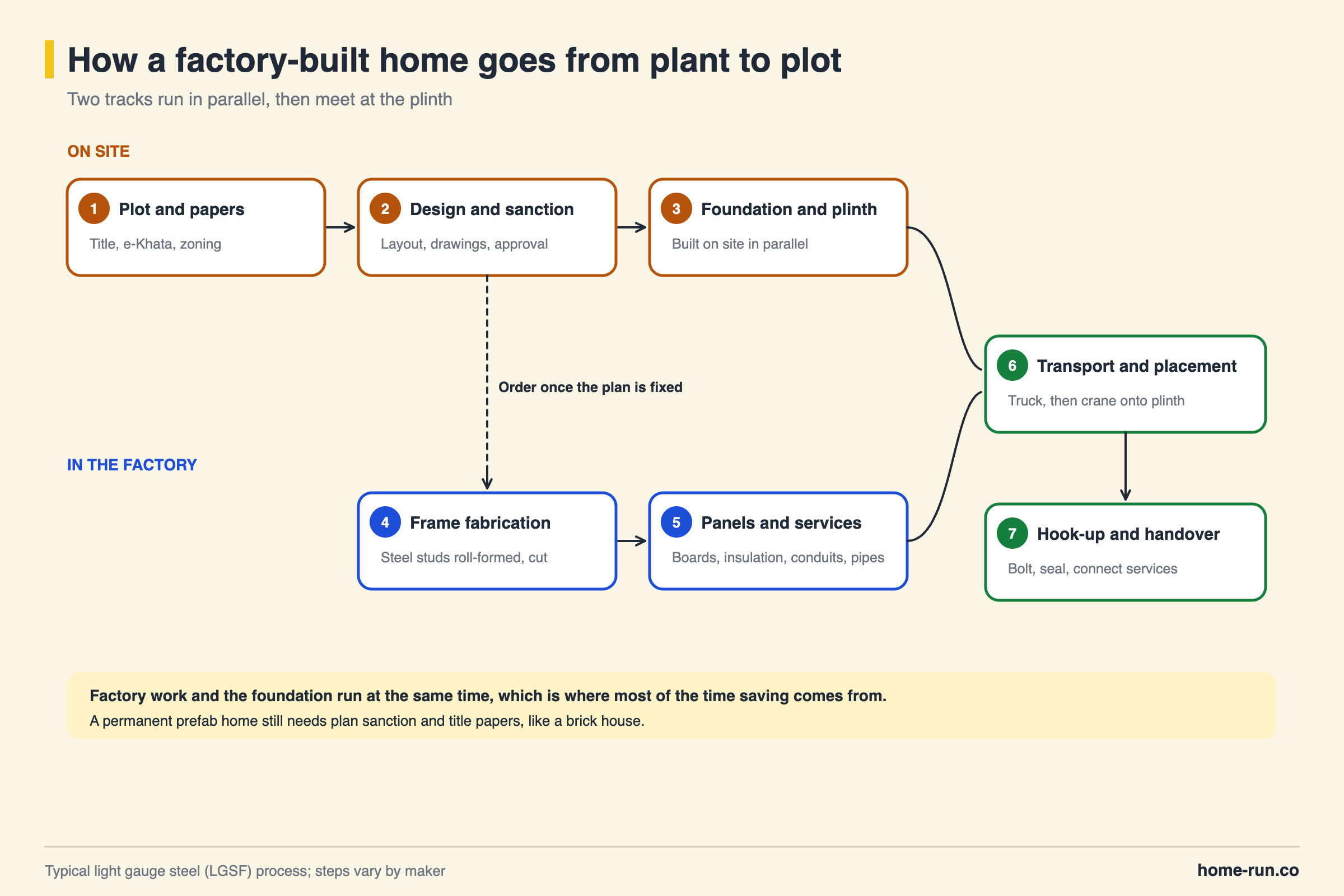
Manufactured homes are built in a factory on a production line, then trucked to the site and joined on a prepared base. In India most use Light Gauge Steel Framing (LGSF), a frame of thin, galvanised, cold-formed steel sections screwed or bolted together.
- Design: the maker fixes the layout and drawings for plan sanction.
- Foundation: the plinth is built on site while the factory works.
- Frame fabrication: steel studs and tracks are roll-formed and cut to size.
- Panels and services: walls get cement particle or gypsum boards, insulation, conduits and pipes.
- Transport and placement: sections travel by truck and a crane sets them on the plinth.
- Hook-up: sections are bolted, sealed and connected to water, power and drains.
BMTPC's LGSF technology profile says the system suits buildings of one to three storeys. For larger steel structures such as sheds and warehouses, see our pre-engineered building guide.
Is Factory Building Better for the Environment?
Factory building can cut site waste and dust because most cutting and fitting happens indoors, where offcuts are easier to collect and recycle.
- Less site waste: fewer broken bricks and less spilt mortar.
- Less water: dry steel and board walls need far less curing water than brick.
- Insulated walls: insulated panels can keep rooms cooler.
How Do You Buy a Manufactured Home in India?
You buy a manufactured home in India by securing a plot with clear title, getting the plan sanctioned, then ordering from a prefab maker. The house itself is often the quickest part.
Buying process timeline
Plot and papers
Confirm title, e-Khata, zoning and setbacks for your plot.
Shortlist makers
Compare designs, wall build-up, warranty and past homes you can visit.
Design and quote
Freeze the layout and get an itemised quote with GST and transport.
Plan sanction and loan
Submit drawings to the city corporation or panchayat and apply for finance.
Factory build and foundation
The factory makes the sections while the plinth is built on site.
Delivery and handover
Sections are placed, joined, connected and inspected before you move in.
Can you get a home loan for a prefab home?
Banks and housing finance companies offer self-construction loans on your own plot. Lenders typically ask for:
- Title and ownership papers for the plot, with a no-encumbrance certificate
- A plan approved by the municipal authority or gram panchayat
- A construction cost estimate certified by a civil engineer or architect
- Proof of your own contribution, since loans are released in stages as work progresses
Confirm early that your lender accepts a steel-framed prefab home and how it releases funds for factory-built work.
Building the plinth for a prefab home?
Foundation and service materials delivered across Bengaluru.
What Is Living in a Prefab Home Like?
A well-built manufactured home feels like any small, modern house. The differences show in heat, sound and how easily you can extend it.
A prefab unit can also work as a second dwelling beside the main house. Our accessory dwelling unit guide covers that layout and its planning limits.
"Prefab homes need no approval" is false for a permanent home on a foundation. "Prefab is always cheaper" is also not true in India; compare it with the house construction cost in Bangalore for the same area and finish.
- Weak roof insulation: thin metal roofs without insulation run hot in summer and loud in rain.
- Poor sealing at joints: gaps between sections let in water during the monsoon.
- Uncoated steel: frames without proper galvanising can rust where water collects.