On this page
- What Is an Occupancy Certificate and Why Does It Matter?
- Who Issues the OC in Bengaluru?
- Is an Occupancy Certificate the Same as a Completion Certificate?
- Who Is Eligible to Apply for an OC, and What Documents Are Needed?
- How Do You Apply for an Occupancy Certificate, Step by Step?
- Do Small Homes in Bengaluru Still Need an OC?
- What Is a Partial OC, and What Does It Cover?
- How Can You Check Whether an OC Is Genuine?
- What Happens If a Property Has No OC?
- What Can You Do If the Builder Does Not Provide the OC?
- Can an Older Building Without an OC Be Regularised?
- What Should Homebuyers Check Before Taking Possession?
- An occupancy certificate is the final approval to live in or use a building.
- It is issued only after an inspection shows the building matches the sanctioned plan.
- The Supreme Court (December 2024) tied utilities and bank loans to a completion or occupancy certificate.
- Karnataka now exempts many small homes in Bengaluru from the OC, with conditions.
- If a builder does not get the OC, you can complain to Karnataka RERA or a consumer commission.
An occupancy certificate (OC) is a document from the local planning authority. It confirms that a finished building follows its sanctioned plan and building bylaws, and is fit to occupy.
What Is an Occupancy Certificate and Why Does It Matter?
An occupancy certificate is the authority's sign-off that a completed building is legal and safe to use. It checks the building against the sanctioned building plan, the drawings approved before work began.
Four things usually depend on the OC:
- Legal occupation: the right to move in or rent out.
- Utilities: permanent electricity, water and sewerage connections.
- Home loans: lenders check it before funding.
- Resale and registration: buyers and banks ask for it.
No single national act sets OC rules. Each state's municipal and planning laws do. In Bengaluru that is now the Greater Bengaluru Governance Act, 2024.
Who Issues the OC in Bengaluru?
The occupancy certificate is issued by the authority that approved your building plan. Around Bengaluru, that is one of three bodies.
OC issuing authorities around Bengaluru
Confirm your property's jurisdiction first| Where the property is | Who issues the OC | How to apply |
|---|---|---|
| Greater Bengaluru limits (former BBMP area) Most homes | Greater Bengaluru Authority (GBA) and its five city corporations | Online, Building Plan Approval System (BPAS) |
| BDA-approved layouts | Bangalore Development Authority (BDA) | BDA office or portal |
| Outside GBA and BDA | Local planning authority, municipal council or panchayat | Varies by authority |
Is an Occupancy Certificate the Same as a Completion Certificate?
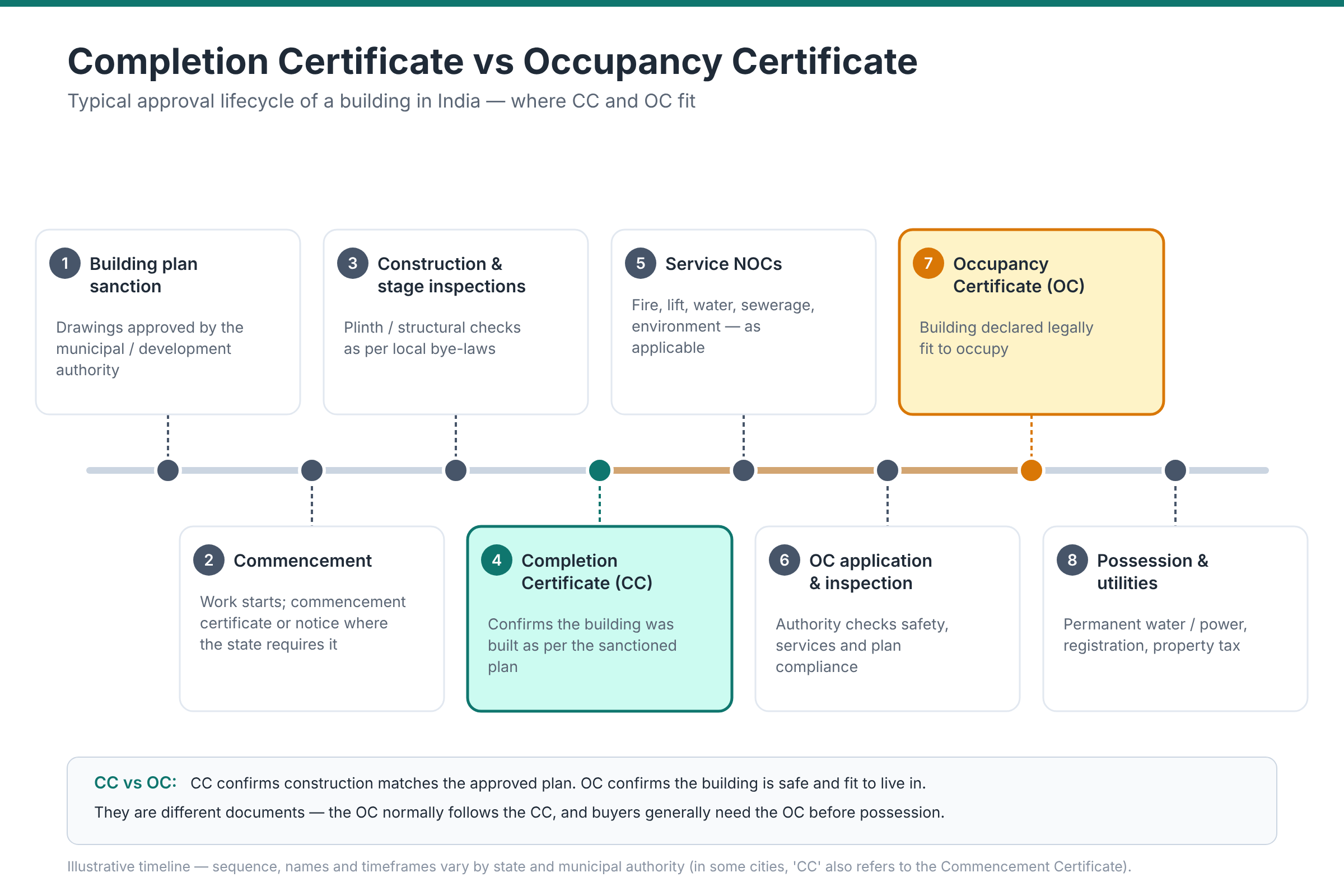
No, an occupancy certificate and a completion certificate (CC) are different documents. The CC confirms construction is finished as per plan. The OC confirms the building can be lived in.
Commencement, completion and occupancy certificates
In order of issue| Certificate | Stage | What it confirms |
|---|---|---|
| Commencement certificate | Before work starts | You may begin building on the approved plan |
| Completion certificate | When work ends | Construction is finished as per the sanctioned plan |
| Occupancy certificate Final step | After inspection | The building is safe and legal to occupy |
Who Is Eligible to Apply for an OC, and What Documents Are Needed?
Whoever built the building applies for the OC: the builder (promoter) for apartments, the owner for an independent house, and usually the developer or society in a redevelopment.
A typical Bengaluru document set includes:
- Sanctioned building plan and approval letter
- Commencement certificate
- Completion certificate or notice from a licensed architect
- Structural stability certificate from a structural engineer
- Latest property tax receipts
- Fire NOC from Karnataka State Fire and Emergency Services, for high-rise buildings
- Environmental or pollution board consent, where applicable
The exact list differs by authority, so get the current checklist before applying.
How Do You Apply for an Occupancy Certificate, Step by Step?
You apply for an occupancy certificate after construction ends, through the authority that sanctioned the plan.
Self-check against the plan
Compare floors, setbacks and built-up area with the sanctioned plan.
Collect documents
Get the architect's and engineer's certificates and any NOCs.
Submit the application
Apply online (BPAS within GBA limits) or at the authority's office.
Scrutiny and site inspection
Officials check papers and inspect the building.
Fix deviations
Correct or regularise any mismatch the inspection finds.
OC issued
Collect or download the certificate and keep certified copies.
Developer sources cite about 12 working days for BDA under the Karnataka Sakala Services Act; GBA timelines vary.
Extra floors, setback violations and built-up area beyond the permitted floor area ratio (FSI). The Supreme Court has said the OC should be deferred until such deviations are fixed.
Do Small Homes in Bengaluru Still Need an OC?
Many small homes in Bengaluru no longer need an OC, under 2025 and 2026 orders.
- 9 September 2025: a GBA notification exempted residential buildings on plots up to 1,200 sq ft, up to ground + 2 or stilt + 3 floors.
- 5 June 2026: the Urban Development Department extended this to plots up to 2,400 sq ft (with 20% variation), up to ground + 3.
- June 2026: a one-time 15-day window allowed permanent power connections without an OC for eligible buildings completed by 31 May 2026.
The exemption covers residential buildings only. An approved plan and setback, structural and fire rules still apply.
These rules have changed several times since 2025. Check the current order with your corporation or a property lawyer.
What Is a Partial OC, and What Does It Cover?
A partial occupancy certificate covers only finished parts of a large project, such as one tower, while others are still being built.
Ask which towers, floors and common areas the partial OC lists. Clubhouses and parking may still await clearance.
How Can You Check Whether an OC Is Genuine?
Check an OC by matching it with the issuing authority's records, online where the authority offers it.
- Note the certificate number, date and issuing office.
- Look it up on the authority's portal, or ask the office for a certified copy.
- Match the plot number, floors and built-up area with the sanctioned plan, and confirm your unit is covered.
- Builder shares only a photocopy, with no number
- Floors or area on the OC differ from the building
- Issuing authority does not match the plan sanction
- No record exists at the authority
What Happens If a Property Has No OC?
A property without a required OC is legally incomplete, and that brings practical risks.
Without an OC
RiskyUnless an exemption applies to your building.
- Possible temporary power and water only
- Lenders may refuse or delay the loan
- Harder resale at a lower price
- Exposure to action by the authority
With an OC
RecommendedThe building is cleared to live in.
- Permanent utility connections
- Smoother home loan approval
- Clean title for resale
- Proof the building matches its plan
What Can You Do If the Builder Does Not Provide the OC?
Under the RERA Act, 2016, the builder must obtain the occupancy certificate, so you can hold the builder to it.
- Send a written demand and keep your agreement and payment receipts.
- File a complaint with the Karnataka Real Estate Regulatory Authority (K-RERA).
- You may also approach a consumer commission under consumer protection law.
Section 18 of RERA lets buyers seek a refund with interest, or interest for each month of delay.
Can an Older Building Without an OC Be Regularised?
Sometimes, an older building without an OC can be regularised, if a current scheme covers its deviations. Minor deviations may be compounded for a fee.
Major violations, such as unapproved floors, often cannot be regularised. The Supreme Court has said regularisation should be a rare, one-time measure.
What Should Homebuyers Check Before Taking Possession?
Run these checks before the final instalment or possession.
- Under construction: confirm K-RERA registration and the promised OC date.
- Ready to move: get a copy of the OC and verify it with the authority.
- Partial OC: check it names your tower and floor.
- Plan match: compare built area and features, such as rainwater harvesting, with the sanctioned plan.
- Paperwork: keep every document, including any indemnity bond you sign.
Building your own home in Bengaluru?
Order construction materials with a GST invoice and delivery across Bengaluru.