


On this page
- Gypsum board is a gypsum core between paper facings, also called drywall or plasterboard.
- Indian boards come in 9.5, 12.5 and 15 mm, 1219 mm wide, to IS 2095 Part 1.
- Its core resists fire, but ratings belong to the tested system, not one board.
- Standard board is not moisture resistant; use MR board in kitchens and humid rooms.
- 12.5 mm board on a metal frame is the usual choice for home false ceilings.
A gypsum board is a building panel made of a set gypsum (calcium sulphate dihydrate) core pressed between two layers of heavy paper. It is also called drywall or plasterboard. In Indian homes, gypsum board is used mainly for false ceilings and dry partition walls because it is light, quick to install and gives a smooth, paintable finish.
What Is Gypsum Board Made Of?
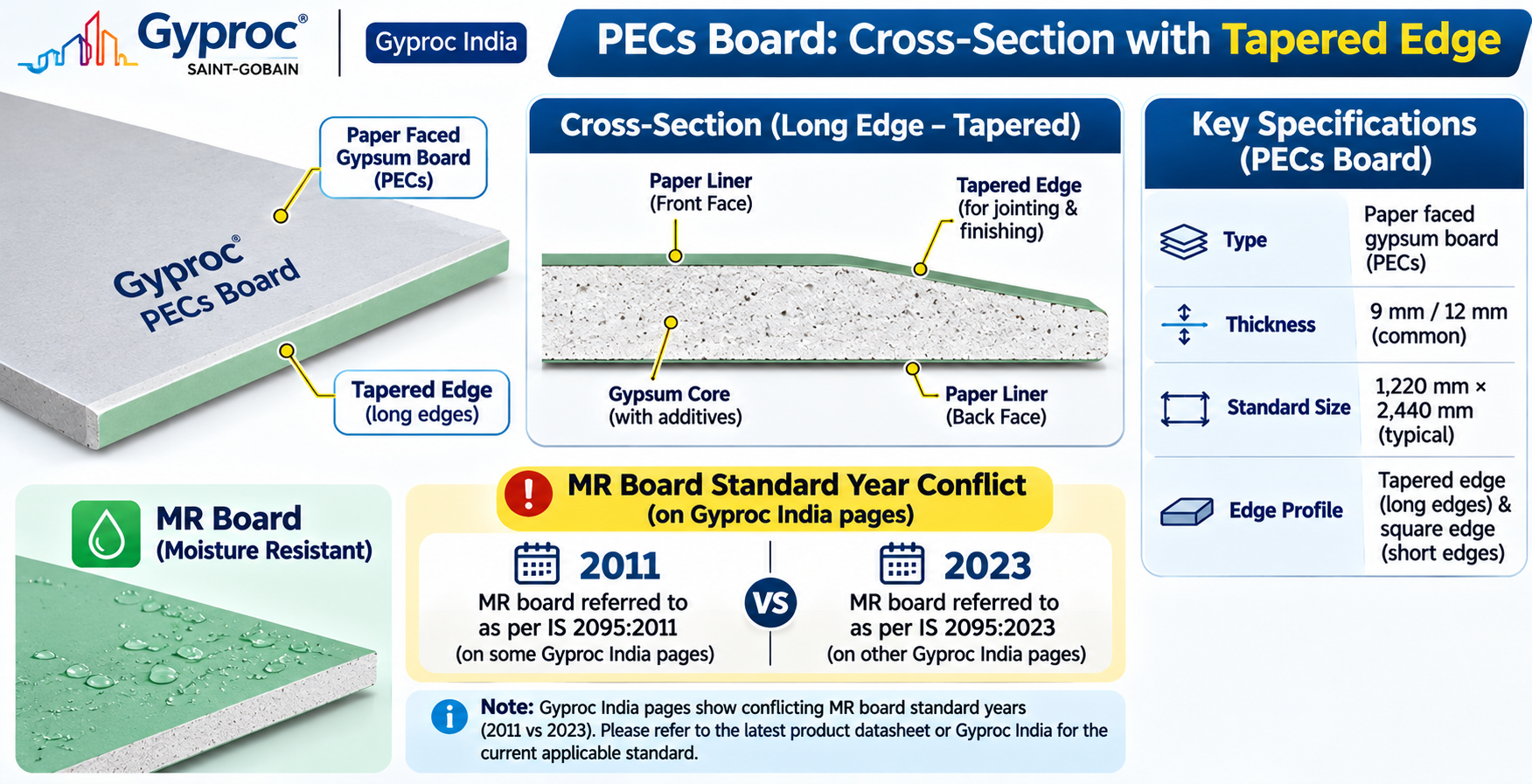
Gypsum board is made of a gypsum core with paper facing on both sides. The core gives stiffness and fire resistance, while the paper carries tension and provides the surface for paint.
Additives in the core create the special types: water repellents for moisture-resistant boards, glass fibres for fire-resistant boards, and denser cores for impact-resistant boards.
What Are the Key Properties of Gypsum Board?
The key properties of gypsum board are light weight, a smooth finish, built-in fire resistance and low moisture tolerance. Here is how the main board types compare:
Gypsum board types compared
Saint-Gobain Gyproc India ranges| Board type | Thickness (mm) | Best for | Indian standard |
|---|---|---|---|
| Standard (plain) Default pick | 9.5, 12.5, 15 | Living room and bedroom ceilings, dry partitions | IS 2095 Part 1, Type A |
| Moisture-resistant (MR) | 9.5, 12.5, 15 | Kitchens, humid rooms, bathroom ceilings | IS 2095 Part 1, Type H1 |
| Fire-resistant | 9.5, 12.5, 15 | Fire-rated partitions, shafts, beam encasement | EN 520 Type F and IS 2095 Part 1 |
How Does Gypsum Board Perform Against Fire?
Gypsum board slows fire because its core holds chemically bound water. When heated, that water is released as steam, which holds back heat until it is driven off.
Fire-resistant boards add glass fibres to keep the core intact for longer. Gyproc India's Fireline board is listed for up to 240 minutes in partition systems and up to 120 minutes in ceilings.
A fire rating applies to a tested assembly: the board, layers, frame, insulation and fixings together. A single board on its own does not carry a rating, so ask for the tested system detail.
Is Gypsum Board Moisture Resistant?
Standard gypsum board is not moisture resistant. It softens, sags and grows mould if it stays damp.
Moisture-resistant (MR) board has water-repellent additives. Gyproc's MR board limits total water absorption to under 5%. Even so, its data sheet warns against areas of constant high humidity or dampness, so it is not waterproof.
- Do not use standard board in bathrooms, wet kitchens or below terrace leaks
- Fix roof and plumbing leaks before installing any false ceiling
- In Bengaluru's monsoon and in coastal towns, choose MR board for kitchens and humid rooms
How Does Gypsum Board Handle Sound, Heat and Load?
Gypsum board's sound insulation depends on the whole wall or ceiling build, not the board alone. Two layers of board, a deeper cavity and mineral wool infill all raise sound reduction.
- Thermal: gypsum board has low thermal conductivity, about 0.16 W/m·K for Gyproc's plain board. Insulation in the cavity does most of the work.
- Strength: gypsum board is not structural. Fix heavy items such as TVs and cabinets to the frame or with board anchors rated for the load.
Which Gypsum Board Should You Choose?
Choose standard board for dry rooms, MR board for kitchens and humid areas, and fire-resistant board where a fire rating is required.
Is 12 mm board suitable for a ceiling? Yes. The 12.5 mm board is the usual choice for home false ceilings on a metal frame.
Gypsum vs PVC panels: PVC tolerates water better and suits bathrooms and balconies. Gypsum gives a smoother, jointless, paintable finish and better fire behaviour for living spaces.
What Are the Advantages and Disadvantages of Gypsum Board?
Gypsum board's main advantages are speed and finish; its main drawback is water sensitivity.
Advantages
Why it is popularFor ceilings and dry partitions.
- Smooth, jointless finish ready for paint
- Dry installation with no curing time
- Light, so it adds little load to slabs
- Built-in fire resistance from the core
Disadvantages
LimitsPlan around these.
- Damaged by leaks and constant damp
- Cannot carry heavy loads on its own
- Dents under hard impact
- Fine dust when cutting and sanding
Is gypsum board good for health? Finished, painted gypsum board is generally considered safe indoors. Wear a dust mask and ventilate the room while cutting and sanding joints.
False ceiling materials
Gypsum boards, ceiling channels, screws and jointing compound from trusted brands, delivered across Bengaluru. Genuine stock, GST invoice.