On this page
- What Is an Accessory Dwelling Unit (ADU)?
- What Types of ADUs Are There?
- Why Do Homeowners Build an ADU?
- What Are the Drawbacks of an Accessory Dwelling Unit?
- Can You Legally Build an ADU in India and Bengaluru?
- How Much Does an Accessory Dwelling Unit Cost in India?
- How Do You Build an ADU Step by Step?
- Can You Rent Out or Sell an ADU?
- ADU or Independent House: Which Should You Choose?
- What Should You Do Before Building an ADU?
- An accessory dwelling unit is a small home with its own entrance, kitchen and bathroom on the same plot as a main house.
- India has no ADU law; the unit is approved as part of your building under local bye-laws.
- In Bengaluru, FAR, setbacks and height limits decide whether a unit fits.
- Build only on a sanctioned plan; utilities and loans depend on it.
- You can rent an ADU but rarely sell it separately.
An accessory dwelling unit (ADU) is a small, self-contained home built on the same plot as a main house. It has its own entrance, kitchen and bathroom, so a tenant or relative can live there independently.
What Is an Accessory Dwelling Unit (ADU)?
An accessory dwelling unit is a secondary home that shares a plot, and often services, with the main house. The term comes from US planning; abroad it is also called a granny flat or in-law suite.
Indian homes already use the idea under other names:
- Barsati: a room or small flat on the terrace.
- Outhouse or servant quarter: a block at the rear of the plot.
- Ground-floor portion: a self-contained part let out below the owner.
- Independent floor: a full floor with its own entrance.
Most Indian building rules do not define an ADU. A second unit is approved as part of your building.
What Types of ADUs Are There?
ADUs come in three standard types, detached, attached and internal, plus the rooftop unit common on flat roofs.
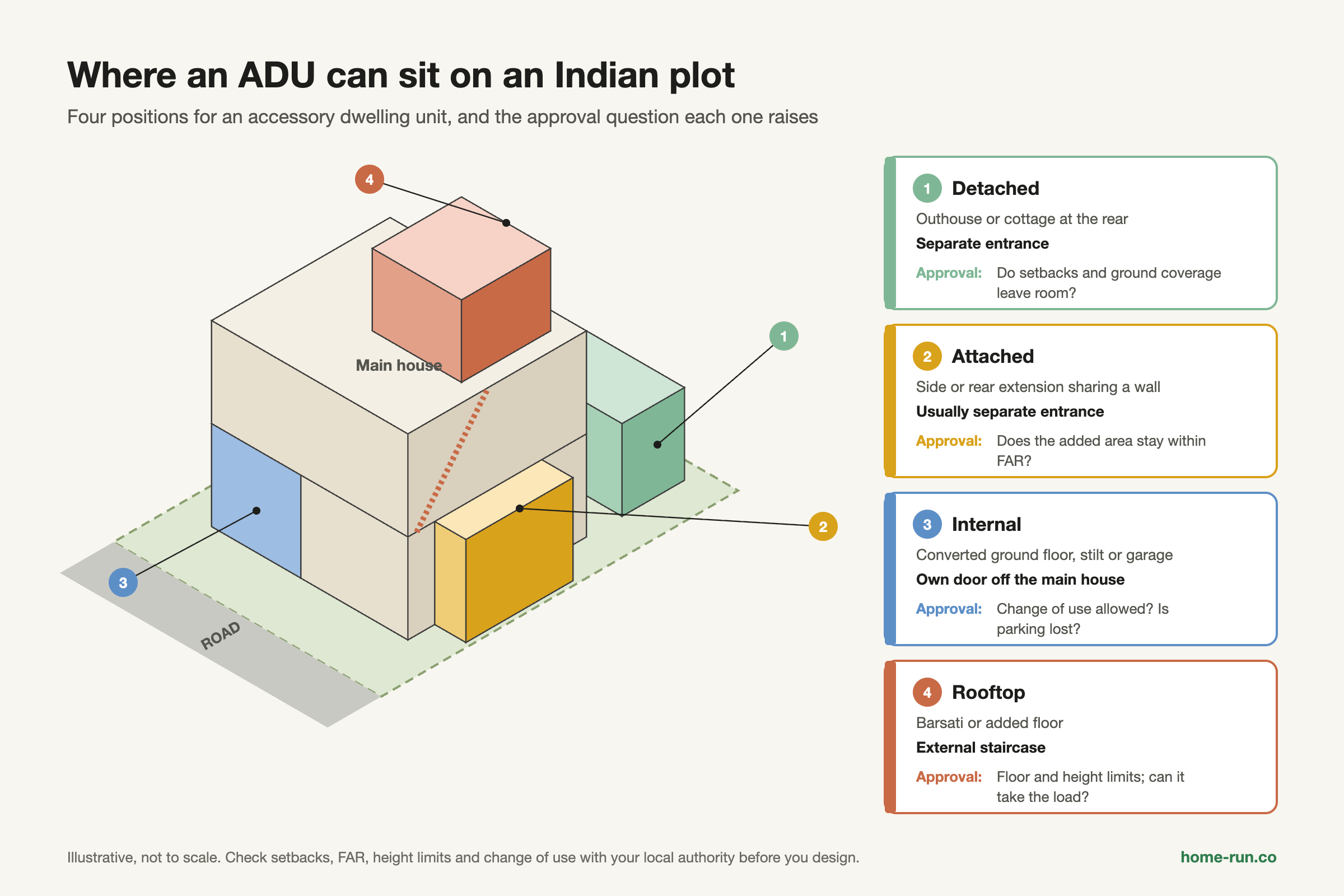
Accessory dwelling unit types on an Indian plot
Position decides privacy and approvals| Type | Indian example | Entrance | Main approval question |
|---|---|---|---|
| Detached | Outhouse or cottage at the rear | Separate | Do setbacks and ground coverage leave room? |
| Attached | Side or rear extension sharing a wall | Usually separate | Does the added area stay within FAR? |
| Internal | Converted ground floor, stilt or garage | Own door off the main house | Is the change of use allowed? Is parking lost? |
| Rooftop Familiar in India | Barsati or added floor | External staircase | Floor and height limits; can the structure take the load? |
Why Do Homeowners Build an ADU?
Homeowners build an ADU mainly for rental income or to keep family close with privacy.
- Rental income from a unit with its own entrance
- Ageing parents or grown children nearby
- A home office, studio or guest suite
- Possibly higher value, if built well and approved
What Are the Drawbacks of an Accessory Dwelling Unit?
The main drawbacks of an accessory dwelling unit are cost, lost open space and approval risk.
- Upfront cost and months of disruption
- Loss of garden, terrace or parking space
- Disputes over a shared sump, tank or meter
- Tenant management and less privacy
- Notices or penalties if the unit is built without sanction
Can You Legally Build an ADU in India and Bengaluru?
Yes, you can usually add a second dwelling if it fits your city's building bye-laws and appears on a sanctioned plan. No national ADU law exists; state and local rules apply.
In Bengaluru, the Zonal Regulations of the Revised Master Plan 2015 (RMP 2015) and Greater Bengaluru Authority (GBA) building rules set these limits, plus density caps:
- FAR (floor area ratio): total floor area allowed as a multiple of plot area; it varies by zone, road width and plot size.
- Ground coverage: the share of the plot the footprint may cover.
- Setbacks: open space to leave from each boundary.
- Height: 12 m, excluding the stilt floor, for plots up to 250 sq m.
The ADU's area counts toward FAR. Measure it the way the authority does; see carpet area vs built-up area.
Bengaluru setbacks for small plots
RMP 2015 amendment, January 2026| Plot area | Front | Rear | Sides |
|---|---|---|---|
| Up to 60 sq m | 0.75 m | None | 0.60 m on one side |
| Over 60 to 150 sq m | 0.90 m | 0.70 m | 0.70 m on one side |
| Over 150 to 250 sq m | 1.0 m | 0.80 m | 0.80 m on both sides |
Since April 2025, BESCOM has asked for an occupancy certificate before new power connections, citing a December 2024 Supreme Court order. An unsanctioned unit can block utilities, loans and resale.
A June 2026 order exempts homes on plots up to 2,400 sq ft, up to ground + 3 floors, from the occupancy certificate. An extra floor can push you outside it; see our occupancy certificate guide.
How many units does my plot allow? How much FAR is unused? Does a rooftop unit count as a floor? Flat owners also need RWA consent.
How Much Does an Accessory Dwelling Unit Cost in India?
An accessory dwelling unit's cost depends mostly on its built-up area and structure type, plus finishes, services and approval fees. Get two or three itemised local quotes.
What drives ADU cost
Compare quotes line by line| Cost driver | What changes the price |
|---|---|
| Built-up area | More sq ft, more structure and finishes |
| Structure | Brick and RCC frame, or factory-made prefab and modular units (still need a foundation and approval) |
| Kitchen and bathroom | Plumbing, drainage and waterproofing cost the most per sq ft |
| Utilities | Separate meter, water line and sewer connection |
| Approvals | Sanction, architect and engineer fees |
Loan interest lengthens payback. For funding, lenders offer home extension loans. HDFC's covers up to 90% of the construction estimate for loans up to ₹30 lakh, 80% up to ₹75 lakh and 75% above. It needs the sanctioned plan and an architect's estimate.
How Do You Build an ADU Step by Step?
You build an ADU by confirming the rules, then designing, getting sanction and building. Many owners also plan the layout using Vastu for home rules.
Check the rules
Confirm unused FAR, setbacks and floor limits.
Hire professionals
An architect draws the plan; an engineer checks loads. Many add Vastu for home layout rules.
Get plan sanction
Apply for approval. Do not start work before it.
Build
Run separate plumbing, drainage and wiring.
Waterproof
Treat the terrace and wet areas before finishes.
Connect and certify
Apply for power, water and, if needed, the OC.
Can You Rent Out or Sell an ADU?
You can rent out an ADU, but you usually cannot sell it separately. It shares the plot's title, so a sale generally needs a legal subdivision; confirm with a property lawyer.
- Agreement: the Registration Act, 1908 requires leases over one year to be registered; many owners use 11-month agreements.
- Tenant verification: Bengaluru City Police directs landlords to verify tenants, online via the Seva Sindhu portal.
- Property tax: Bengaluru's Unit Area Value rates for tenanted residential space are double the self-occupied rate.
- Income tax: rent is taxed as income from house property; ask a CA.
The Karnataka Rent Act, 1999 governs tenancies; amendments were proposed in August 2025.
ADU or Independent House: Which Should You Choose?
Choose an ADU for income or family space on land you own; choose an independent house when each household needs its own title.
Accessory dwelling unit
If FAR allowsPoints
- Shares the plot, title and often services
- No new land to buy
- Rentable, rarely sold alone
- Must fit the plot's unused FAR
Independent house
Separate titlePoints
- Own plot, title and connections
- Needs a land purchase
- Sold or mortgaged on its own
- Gets the full FAR of its plot
What Should You Do Before Building an ADU?
Confirm an ADU is allowed and priced before spending.
- Check FAR, setbacks and dwelling-unit limits for your plot
- Get drawings and a structural check
- Collect two or three itemised quotes
- Get the plan sanctioned before buying materials
Adding a unit to your home in Bengaluru?
GST-invoiced materials, delivered across Bengaluru.