


On this page
- What Are Roof Shingles and What Are They Used For?
- What Types of Roof Shingles Are Available in India?
- What Are the Pros and Cons of Shingles?
- How Much Do Roof Shingles Cost in India?
- How Long Do Shingles Last?
- How Do You Choose the Right Shingle for Your Home?
- How Is a Shingle Roof Installed?
- How Do You Maintain a Shingle Roof?
- Where Can You Buy Shingles and Get a Quote?
- Roof shingles are thin overlapping units that shed rain on a sloped roof.
- In India, shingles mostly means asphalt (bitumen) shingles on a fibreglass mat.
- They need a solid deck and a slope of at least 2:12; they do not suit flat RCC terraces.
- Seller listings show about ₹65–150 per sq ft for material alone (Oct 2026).
- Lifespan depends on the product, warranty terms and installation quality more than the type name.
Roof shingles are thin, flat roofing units laid in overlapping rows on a sloped roof, so each row sheds rain over the joints of the row below. In India, roof shingles usually means asphalt (bitumen) shingles, a light and decorative alternative to clay tiles for villas, farmhouses, resorts and hill homes.
What Are Roof Shingles and What Are They Used For?
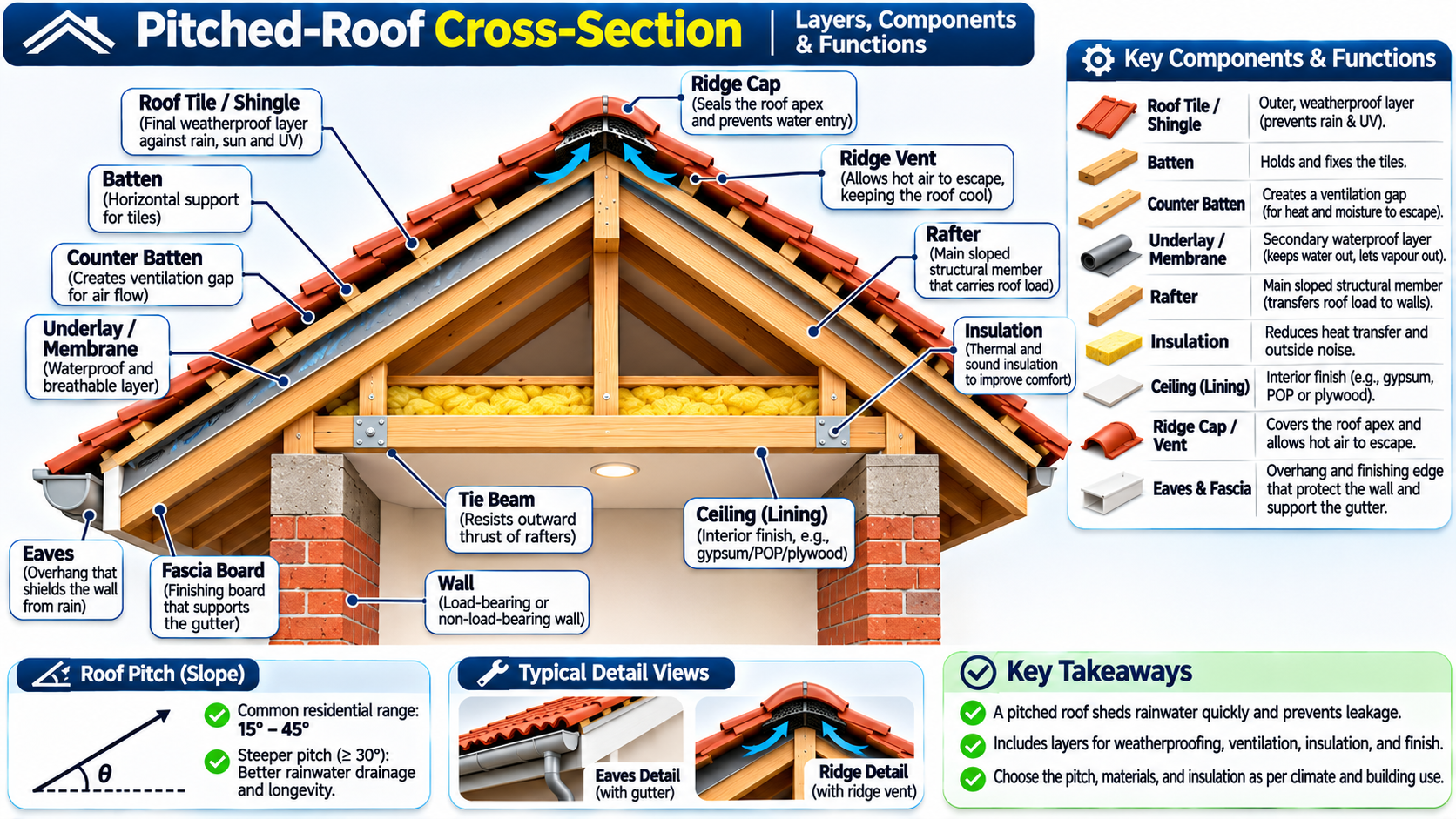
Roof shingles are a waterproof roof covering made of small units nailed to a deck in courses. Water runs down the slope from one shingle to the next and never reaches the joints underneath.
That overlap only works when the roof slopes and the base is solid. Shingles need a roof deck (a flat base of plywood, boards or concrete) to nail into, with an underlayment, a waterproof sheet, laid on top first.
A shingle is any small overlapping roof unit. Asphalt, metal, slate and wood shingles all share the shape but behave very differently, so always confirm the material before comparing prices. Also check the core: most modern asphalt shingles use a fibreglass mat, while older "organic" ones used felt.
What Types of Roof Shingles Are Available in India?
The roof shingles you can readily buy in India are asphalt (bitumen) shingles in 3-tab and architectural styles, with metal and composite shingles as less common options.
- 3-tab shingles: one flat layer cut into three tabs. Simple look, lower price.
- Architectural (laminated) shingles: two or more bonded layers for a thicker, textured look. Higher price, usually a longer warranty.
Roof shingle types compared
Relative terms; check the maker's data sheet| Type | Weight | Cost tier | Availability in India | Watch out for |
|---|---|---|---|---|
| Asphalt, architectural Default pick | Light | Medium | Widely sold by dealers | Algae streaks in wet, humid areas |
| Asphalt, 3-tab Budget | Light | Low | Widely sold | Flatter look; check wind rating |
| Metal / stone-coated steel | Light | Medium to high | Specialist suppliers | Rain noise without insulation |
| Composite / synthetic | Light | Medium to high | Limited | Few local installers |
| Slate, wood, solar | Slate heavy; others light | High | Mostly imported or niche | Structure, cost and service support |
What Are the Pros and Cons of Shingles?
Roof shingles are light, quick to lay and decorative, but they need a sloped solid deck and careful installation to cope with Indian sun and monsoon.
Advantages
Why people choose themOn a well-built sloped roof.
- Far lighter than clay or concrete tiles
- Many colours and textures
- Quieter in rain than bare metal sheets
- Small units make repairs easy
Disadvantages
LimitsPlan around these.
- Not for flat RCC terraces
- Strong UV and heat age the bitumen
- Algae and moss in high-rainfall regions
- Few trained installers in smaller towns
If your roof is a flat RCC terrace, shingles are the wrong product. Look at terrace waterproofing instead, or a sloped roof frame with sheets or tiles. A flat terrace also needs a proper parapet wall design for safety and drainage.
How Much Do Roof Shingles Cost in India?
Asphalt roof shingles cost about ₹65–150 per sq ft for the material alone, based on seller listings on IndiaMART in October 2026. Laminated (architectural) shingles sat mostly between ₹90 and ₹150 per sq ft.
Quotes may be per sq ft or per "square", which means 100 sq ft. Mixing the two gives a hundredfold error, so check the unit first.
- Underlayment, drip edge, flashing and ridge caps are often priced separately
- A deck or batten frame over an existing roof adds material and labour
- Labour and transport vary by city and site access
How Long Do Shingles Last?
Roof shingles last as long as the product grade, the climate and the installation allow, so the written manufacturer warranty is the most reliable guide. Architectural shingles usually carry longer warranties than 3-tab shingles.
Things that shorten shingle life in India:
- Intense UV and daily heat cycling, which dry out the bitumen
- Monsoon moisture and poor roof ventilation
- Wrong nail count or position, which lowers wind resistance
- Blocked valleys and gutters that hold water
How Do You Choose the Right Shingle for Your Home?
Choose roof shingles by checking roof slope first, then climate, budget and upkeep. A slope below 2:12 rules shingles out altogether.
Below 2:12, choose another roof covering. Between 2:12 and 4:12, shingles need double underlayment. In heavy-rain, humid areas such as coastal Karnataka and Kerala, ask for algae-resistant granules. Where wind is strong, insist on the maker's high-wind nailing pattern.
- Measure the roof slope as rise over a 12-unit run
- Confirm the deck or batten frame can take nails
- Pick 3-tab for budget or architectural for looks and longer cover
- Ask for the wind rating, fire rating and test standard in writing
- See the colour on a full sample, not a phone screen
Roofing and waterproofing supplies
Waterproofing membranes, sealants, roofing sheets and fixings from trusted brands, delivered across Bengaluru. Genuine stock, GST invoice.
How Is a Shingle Roof Installed?
Roof shingles are installed from the eaves upward over a prepared deck and underlayment, finishing at the ridge. This is a job for trained installers, but knowing the sequence helps you check the work.
Inspect and prepare the deck
Replace rotten boards, fix loose sections and confirm a flat, dry, nailable surface.
Lay underlayment
Roll it from the eaves up with overlaps; use a double layer on 2:12 to 4:12 slopes.
Fit drip edge and flashing
Metal edges at eaves and rakes; flashing at valleys, walls, chimneys and pipes.
Starter strip
A sealed first row at the eaves so the first course has no gaps.
Shingle courses
Nail each course on the maker's nail line with the stated overlap, staggering joints.
Ridge caps
Cap shingles close the top joint; check ridge ventilation if specified.
- Nails visible on the exposed part of shingles
- Uneven rows or joints lining up course to course
- No flashing at valleys or where the roof meets a wall
- Shingles laid straight onto a flat slab without a deck or slope
How Do You Maintain a Shingle Roof?
Maintain roof shingles with a check before and after every monsoon, and keep valleys and gutters clear so water never sits on the roof.
- Clear leaves and debris from valleys and gutters before June
- Look for granules in the gutters, curled edges or cracked tabs
- Check flashing after heavy storms
- Treat moss and algae with a cleaner the maker approves; never pressure-wash
- Call a professional for any work that needs you on the roof
Good gutters also let you collect the runoff. See our guide to rainwater harvesting for how rooftop water is filtered and stored.
Where Can You Buy Shingles and Get a Quote?
You buy roof shingles through brand dealers and authorised installers, and the best quote is a written, itemised one.
The product data sheet, warranty terms and who honours them, wind and fire ratings with the test standard, what the price includes (underlayment, flashing, ridge caps, labour) and whether the installer is trained by the brand.