On this page
- What Is a PUF Panel and What Is It Made Of?
- What Are the Main Types of PUF Panels, and Where Are They Used?
- What Properties Make PUF Panels Worth Their Price?
- How Much Does a PUF Panel Cost per Sq Ft in India?
- PUF Panel Price by Thickness: 30 mm to 100 mm
- What Pushes a PUF Panel Price Up or Down?
- PUF Panel vs PIR, EPS and Rockwool: Is PUF Worth the Cost?
- How Do You Work Out the Total PUF Panel Cost for a Project?
- How Do You Choose the Right PUF Panel and Get an Accurate Quote?
- A PUF panel is a polyurethane foam core bonded between two metal sheets.
- Listed rates run about ₹1,000–2,200 per sq m, usually before GST, freight and fitting.
- Thickness, foam density and steel sheet gauge move the price most.
- Always convert quotes to one unit: 1 sq m equals 10.76 sq ft.
- Ask for the datasheet and test reports before you compare two quotes.
PUF panel price in India usually falls between ₹1,000 and ₹2,200 per sq m on supplier listings checked in November 2026. That is roughly ₹93 to ₹204 per sq ft.
The rate depends on panel thickness, foam density, steel sheet gauge and brand. Treat every figure here as indicative and confirm it with current quotes.
What Is a PUF Panel and What Is It Made Of?
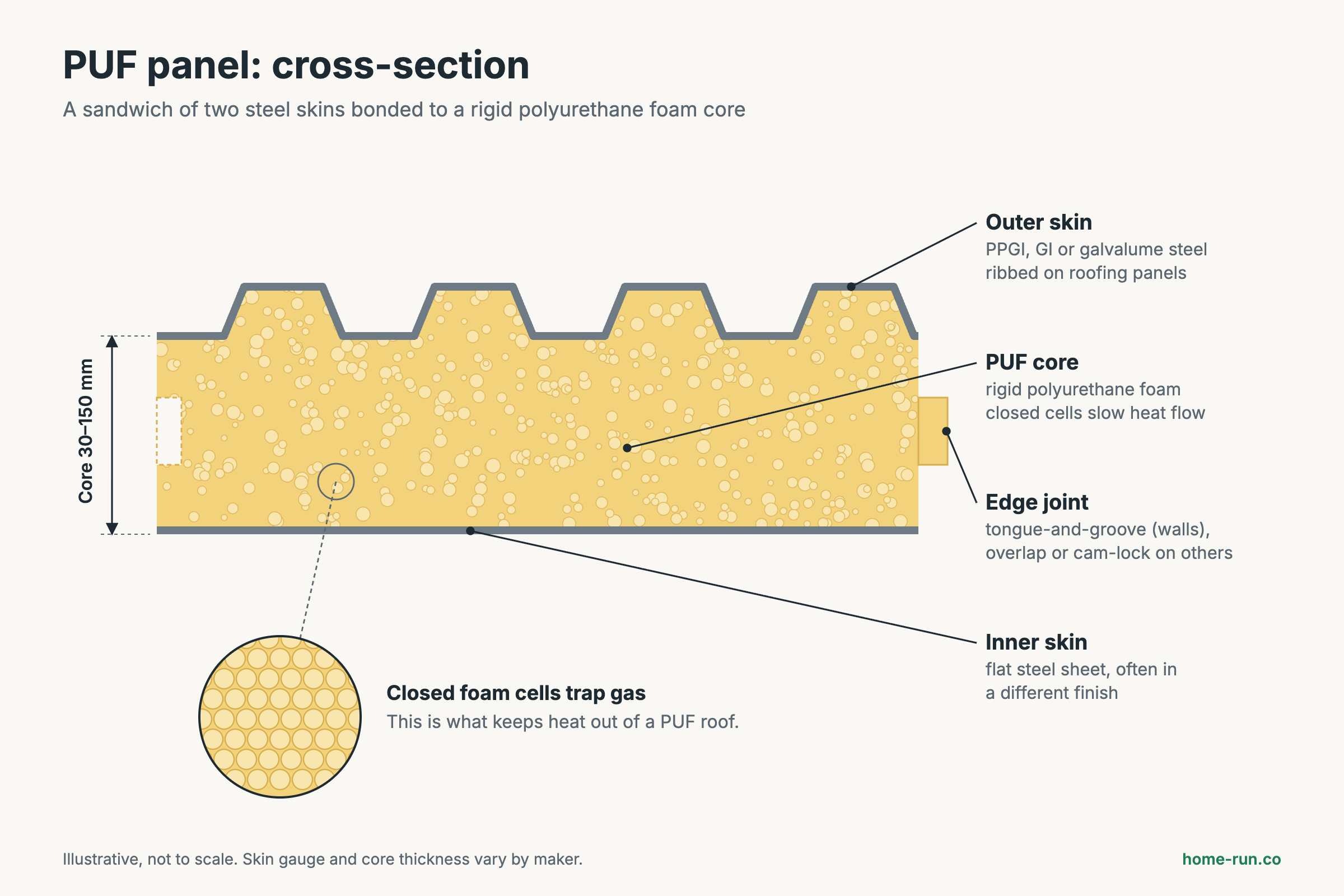
A PUF panel is a ready-made insulated board with a polyurethane foam (PUF) core between two thin metal sheets. The foam has tiny closed cells that trap gas and slow heat flow.
Every PUF panel has three main components:
- Outer skin: a steel sheet, usually PPGI (pre-painted galvanised iron), GI (zinc-coated steel) or galvalume (zinc-aluminium coated steel).
- Insulating core: rigid polyurethane foam, usually 30 mm to 150 mm thick.
- Inner skin: a second metal sheet, often flat, sometimes in a different finish.
Edges carry a joint, such as tongue-and-groove for walls or cam-locks for cold rooms.
Sandwich panels can have a PUF, PIR, EPS or rockwool core. Some dealers call any foam-core panel "PUF", so confirm the core material in writing.
What Are the Main Types of PUF Panels, and Where Are They Used?
PUF panels come in four main types: roofing, wall and partition, cold room and clean room panels.
PUF panel types by application
Relative cost, not exact rates| Type | Profile and joint | Common thickness | Used for |
|---|---|---|---|
| Roofing panel Default pick | Ribbed or trapezoidal top sheet, overlapping joint | 30–50 mm | Sheds, factories, terrace rooms, site offices |
| Wall and partition panel Budget | Flat or lightly ribbed, tongue-and-groove | 30–60 mm | Prefab cabins, partitions, warehouse walls |
| Cold room panel Highest cost | Flat skins, cam-lock joint for an airtight seal | 80–150 mm | Cold storage, food and pharma stores |
| Clean room panel Specialist | Smooth hygienic finish, flush joints | 50 mm and up | Labs, pharma and food processing rooms |
For homes, PUF panels mostly appear in terrace rooms, home offices and prefab extensions. For a lighter indoor ceiling, compare them with gypsum board properties and uses.
What Properties Make PUF Panels Worth Their Price?
PUF panels are worth their price mainly because of low heat transfer at a low weight.
Typical PUF panel properties
Check the datasheet for your panel| Property | Typical value | What it means for you |
|---|---|---|
| Core density | ~40 kg/m³ | Lower density cuts cost but weakens insulation and strength |
| Thermal conductivity (k-value) | ~0.022–0.023 W/m·K | Lower k-value means better insulation per mm |
| U-value, 50 mm core | 0.51 W/m²·K | Heat flow through the whole panel; thicker panels score lower |
| Panel weight, 50 mm core | ~10.6 kg/m² | Light enough for simple steel framing |
| Steel skin thickness | 0.40–0.70 mm | Thinner skins dent more easily and cost less |
The Indian specification for the foam itself is IS 12436:1988, "Rigid polyurethane foam for thermal insulation" from the Bureau of Indian Standards (BIS). Not every panel carries BIS certification, so ask for proof.
JK Cement's guide says a well-installed PUF roof can keep indoor temperatures about 8–12°C lower than a plain metal roof. It also gives a 20–30 year service life.
How Much Does a PUF Panel Cost per Sq Ft in India?
A PUF panel costs about ₹93–204 per sq ft (₹1,000–2,200 per sq m) on listings checked in November 2026. Single listings go higher, for example ₹210 per sq ft for a 50 mm panel in Thane.
Most listed rates exclude GST, freight and installation, and some are ex-factory (the price at the factory gate).
A ₹130 per sq ft quote and a ₹1,400 per sq m quote are almost the same price. A "12 ft sheet" price is for one sheet, so divide it by the sheet's area first.
PUF Panel Price by Thickness: 30 mm to 100 mm
PUF panel price rises with thickness, from about ₹1,200 per sq m at 30 mm to ₹2,200 per sq m at 60 mm and above.
Indicative PUF panel price by thickness
Checked Nov 2026, before GST| Thickness | ₹ per sq m | ≈ ₹ per sq ft | Typical use |
|---|---|---|---|
| 30 mm | 1,200–1,400 | 111–130 | Partitions, light cabins |
| 40 mm | Not published | — | Cabins, home roofing |
| 50 mm Default pick | 1,450–1,800 | 135–167 | Roofing and walls |
| 60 mm and above | 1,800–2,200 | 167–204 | Hotter roofs, cool rooms |
| 80–100 mm cold storage | ~1,346 | 125 | Cold rooms (one supplier's listing) |
Use 30–40 mm for partitions, 40–50 mm for most roofs and walls, and 80 mm or more for cold storage.
What Pushes a PUF Panel Price Up or Down?
Steel gauge and core thickness move a PUF panel price the most, followed by foam density, coating and brand.
- Steel sheet gauge: a 0.50 mm skin costs more than a 0.40 mm skin. Ask whether the figure is BMT (base metal thickness) or TCT (total coated thickness).
- Coating: PPGI, GI and galvalume differ in life and price.
- Core thickness and density: more foam, or denser foam, adds cost and insulation.
- Core type: PIR (polyisocyanurate) costs more than PUF for better fire behaviour.
- Brand: Kingspan Jindal, Tata, JSW and Lloyd usually price above local makers.
- Order size and freight: listings often set a 100 sq m minimum, and long sheets cost more to transport.
- No foam density stated on the quote
- Steel thickness quoted without saying BMT or TCT
- "Fire retardant" claim with no test report
- Rate far below other quotes for the same thickness
PUF Panel vs PIR, EPS and Rockwool: Is PUF Worth the Cost?
PUF is worth the cost when insulation matters most, such as roofs in hot weather or cold rooms. EPS is cheaper for basic sheds, and rockwool suits fire-sensitive buildings.
PUF panels vs other cores and roofing
Relative, from manufacturer material| Option | Insulation | Fire behaviour | Relative cost |
|---|---|---|---|
| PUF panel Default pick | Very good | Combustible; fire-retardant grades exist | Medium |
| PIR panel | Very good | Better than PUF | Higher |
| EPS panel Budget | Moderate | Limited | Lower |
| Rockwool panel | Moderate | Non-combustible | Higher |
| Plain metal sheet Hot roof | Poor | Non-combustible | Lowest |
For a pitched house roof with a finished look, see the roof shingles guide as another option.
How Do You Work Out the Total PUF Panel Cost for a Project?
Multiply the panel area in sq m by the rate per sq m, then add the extras.
Extras often missing from the first quote:
- Ridge caps, flashings and corner trims
- Self-drilling screws, washers and joint fittings
- Sealants for joints, a common spot for water seepage
- Installation labour and any crane or lifting
- Transport and unloading of long sheets
How Do You Choose the Right PUF Panel and Get an Accurate Quote?
Fix the specification first, then ask several suppliers to quote that exact panel.
- Define the use: roof, wall, cabin or cold room.
- Choose core thickness and confirm foam density.
- Set the steel gauge (BMT), coating and colour.
- Decide whether you need a tested fire rating or a PIR core.
- Send area, sheet lengths, site location and delivery date to at least three suppliers.
- Ask for the datasheet, test reports and an itemised quote with GST and freight shown.
Bengaluru has several local panel makers, so local quotes can save on freight for long sheets.
Fitting out a roof or cabin in Bengaluru?
Order roofing and fixing materials with a GST invoice and delivery across Bengaluru.