On this page
- What Goes on a Plumbing Materials List?
- Which Pipe Types Are Used in Indian Homes, and Where?
- PVC vs uPVC vs CPVC: What Is the Difference?
- What Are the Names of Common Plumbing Fittings and Valves?
- Which Bathroom and Kitchen Fixtures Do You Need?
- Which Tools and Consumables Get Left Off the List?
- What Plumbing Materials Does Each Job Need?
- How Do You Check Plumbing Material Quality Before You Buy?
- What Drives the Price of Plumbing Materials in India?
- How Do You Avoid Leaks Before the Tiles Go On?
- A plumbing materials list has five groups: pipes, fittings, valves, fixtures and consumables.
- Use CPVC or PPR for hot water, uPVC for cold supply and SWR pipe for drainage.
- Check the ISI mark and IS number printed on every pipe length: IS 15778 (CPVC), IS 4985 (uPVC), IS 13592 (SWR).
- Buy fittings from the same system and size standard as the pipe, or joints will not seat.
- Pressure-test concealed lines before anyone plasters or tiles over them.
A plumbing materials list is the full set of pipes, fittings, valves, fixtures and small consumables needed to bring clean water into a house and carry waste out. Getting the list right matters because most house plumbing ends up inside walls and under tiles, where a wrong pipe is expensive to fix.
What Goes on a Plumbing Materials List?
Every plumbing materials list for a house falls into five groups. Order them in this sequence, because pipes and fittings go in first and fixtures go in last.
- Pipes: the lines that carry water in (supply) and waste out (drainage).
- Fittings: connectors that join, turn, split or resize pipes.
- Valves and accessories: parts that start, stop or control flow, plus clamps.
- Fixtures: the visible items such as WCs, basins, taps, showers and sinks.
- Tools and consumables: solvent cement, thread tape, cutters and a test pump.
Concealed pipes sit behind plaster and tiles for decades. A cold-water pipe on a hot line can soften and leak, and the only fix is breaking the wall. Decide each line's pipe type before the walls are chased.
Which Pipe Types Are Used in Indian Homes, and Where?
Indian homes mainly use CPVC or PPR for hot and cold supply, uPVC for cold supply, SWR pipe for drainage and HDPE for underground lines. GI and copper still appear, mostly in older houses.
Plumbing pipe types compared
Confirm ratings on the maker's datasheet| Pipe | Typical use in a house | Hot water? | How it is joined | Indian standard |
|---|---|---|---|---|
| CPVC Default for hot lines | Hot and cold supply inside walls | Yes | Solvent cement | IS 15778 |
| PPR | Hot and cold supply | Yes | Heat fusion welding | IS 15801 |
| uPVC | Cold supply, overhead tank lines | No | Solvent cement or threads | IS 4985 (some ranges follow ASTM D1785) |
| SWR (uPVC) | Soil, waste and rainwater drainage | Drainage only | Rubber ring or solvent cement | IS 13592 |
| HDPE | Underground mains, borewell and garden lines | No | Fusion or compression fittings | IS 4984 |
| GI Avoid in new work | Older supply lines, some fire lines | Yes, but corrodes | Threaded fittings | IS 1239 (Part 1) |
| Copper | Rare in homes; some premium hot lines | Yes | Brazing or soldering | Check with the maker |
SWR (soil, waste and rain) is a drainage category, not a material. IS 13592 has two types: Type A for vent and rainwater lines and Type B for soil and waste. Use Type B on WC lines.
Hot supply gets CPVC or PPR. Cold supply gets uPVC, CPVC or PPR. Drains get SWR pipe. Never mix supply and drainage pipe on the same line.
PVC vs uPVC vs CPVC: What Is the Difference?
CPVC handles hot water and uPVC does not. "PVC" is the family name. The "U" in uPVC means unplasticised, so the pipe is rigid. The "C" in CPVC means chlorinated, which raises the heat the pipe can take.
CPVC
Hot and coldGeyser lines, shower mixers, kitchen hot tap.
- Rated for continuous hot water
- Usually sized in CTS: 15 mm is ½ inch
- Two pressure classes: SDR 11 and SDR 13.5
- Joined with CPVC solvent cement
uPVC
Cold onlyTank outlets, cold taps, garden points.
- Not rated for hot water
- Sized by schedule: Sch 40 or Sch 80
- Usually cheaper per metre than CPVC
- Joined with uPVC solvent cement or threads
A "½ inch" or "15 mm" pipe is a nominal size. The real outer diameter differs between CPVC CTS sizing, uPVC schedule sizing and metric PPR sizing. A CPVC fitting will not fit a uPVC pipe of the same nominal size, so buy pipe and fittings from one system.
What Are the Names of Common Plumbing Fittings and Valves?
Plumbing fittings join, turn, split or resize pipes, and valves control the flow. These are the names you will see on a plumber's order list.
Plumbing fittings and valves by name
Match each to the pipe system| Item | What it does | Where it goes |
|---|---|---|
| Elbow (90° or 45°) | Turns the pipe | Every change of direction |
| Tee | Splits one line into two | Branch to a tap or WC |
| Coupler (socket) | Joins two pipes in a straight line, fixed | Long runs |
| Reducer | Joins two pipe sizes | Main line to branch line |
| Union | Joins pipes but can be unscrewed | Next to pumps, geysers and valves |
| End cap / plug | Closes a pipe end | Future points, pressure tests |
| Threaded adaptor (MTA / FTA) | Changes a plain pipe end to a male or female thread | Tap, valve and tank connections |
| Ball valve | Quarter-turn on and off | Tank outlets, bathroom isolation |
| Gate valve | Multi-turn on and off on larger lines | Main lines, pump lines |
| Non-return (check) valve | Lets water flow one way only | Pump delivery lines |
| Angle cock | Small shut-off valve at a fixture | Under basins, behind WCs |
| Pipe clamp / saddle | Holds the pipe to a wall | Exposed runs and chases |
A coupler and a union look alike but behave differently: you can open a union for repairs, a coupler stays fixed. Read our explainer on the ball valve for how it compares with a gate valve.
Which Bathroom and Kitchen Fixtures Do You Need?
Fixtures are the visible half of the list: the items you use every day. Order them early so the plumber can set pipe outlets to each fixture's exact position.
Bathroom and toilet
- WC: wall-hung, floor-mounted or Indian-style pan
- Flush tank or concealed cistern, with flush valve
- Health faucet and its angle cock
- Wash basin, pillar tap or mixer, bottle trap and waste coupling
- Shower, diverter or mixer, and a bucket tap (bib cock)
- Floor drain (nahani trap) and grating
Kitchen
- Sink with sink coupling and waste pipe
- Sink tap or mixer
- Angle cock for a water purifier inlet
Also list the overhead tank connections: inlet, outlet, overflow and a drain-out valve. Ask your plumber to confirm the WC outlet type (floor or wall) and its distance from the wall before the floor is laid.
Which Tools and Consumables Get Left Off the List?
Small consumables are the items that most often run out mid-job. Add these to the order:
- Solvent cement: separate types for CPVC and uPVC; do not swap them.
- Primer or cleaner: where the pipe maker asks for it, for example on larger CPVC sizes.
- PTFE (Teflon) thread seal tape: for threaded joints only.
- Spare washers, gaskets and O-rings for taps and unions.
- Pipe cutter or hacksaw, plus a deburring tool to clean cut ends.
- Pipe wrench and adjustable spanner for threaded fittings.
- Measuring tape and spirit level for falls and outlet heights.
- Hand pressure-test pump with gauge for testing before concealment.
See our guide to the pipe wrench for sizes and jaw types.
What Plumbing Materials Does Each Job Need?
The plumbing materials list for a house is easiest to buy when you split it by job. Here is what each line needs.
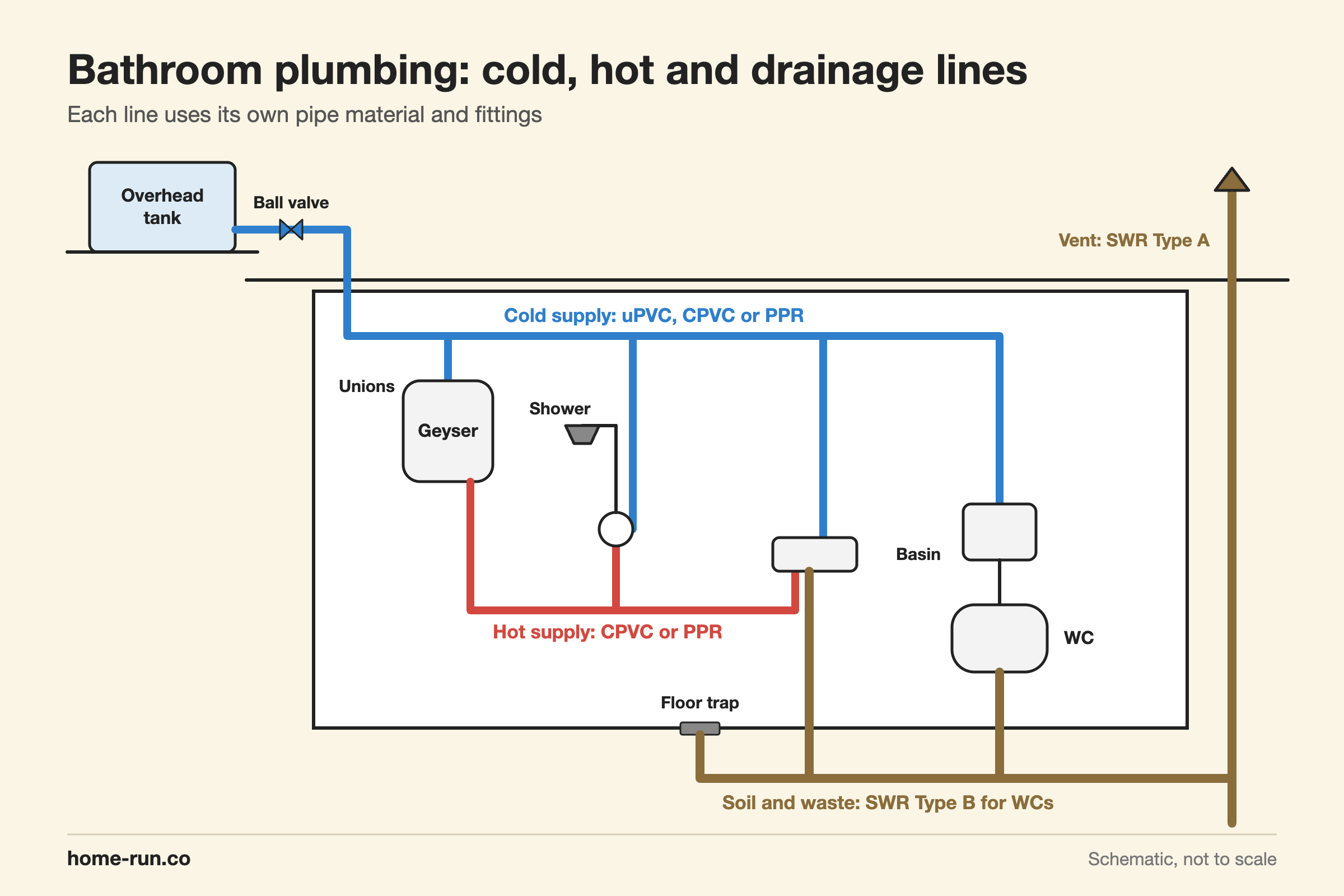
Cold-water supply
- uPVC, CPVC or PPR pipe from the overhead tank to each cold point
- Elbows, tees, reducers and threaded adaptors
- Ball valve at the tank outlet and one per bathroom
- HDPE pipe for underground lines from the sump or borewell
Hot-water supply
- CPVC or PPR pipe from the geyser to showers, basins and the kitchen
- Unions at the geyser for easy removal
- Brass-threaded elbows or adaptors at tap points
Soil, waste and vent drainage
- SWR Type B pipe for WCs, Type A for vents and rainwater
- Bends, tees, door bends and cleaning access
- Floor traps, gully traps and vent cowls
Concealed work before tiling
- Concealed diverter or mixer bodies and cistern frames
- End caps on every outlet for the pressure test
- Pipe clamps for chases
Your real quantities depend on your drawing and pipe routes. Count fittings point by point from the same drawing.
Ready to order your plumbing materials?
Get pipes, fittings, fixtures and consumables delivered across Bengaluru with a GST invoice.
How Do You Check Plumbing Material Quality Before You Buy?
Choose the pipe by the job first, then check the marking on every length. Ask four questions:
- Hot or cold? Hot lines need CPVC or PPR.
- Concealed or exposed? Concealed lines deserve the heavier pressure class.
- Supply or drain? Drains need SWR pipe, not supply pipe.
- Which brand system? Buy pipe and fittings from one brand and one system.
- ISI mark with the right IS number (IS 15778, IS 4985, IS 13592, IS 15801)
- Brand, size, pressure class or SDR and batch printed along the pipe
- Even colour and a smooth bore inside
Reject stock at the counter if you see
- No ISI mark, or an IS number for a different pipe type
- Faded, missing or hand-written size and batch print
- Uneven wall thickness when you look at the cut end
- Brittle, chalky or cracked ends
- A price far below other dealers for the same brand
If your house draws borewell or tanker water as well as BWSSB (Bangalore Water Supply and Sewerage Board) supply, test the water first. Hard water scales metal pipes and fittings, which is one more reason to avoid GI in new work.
What Drives the Price of Plumbing Materials in India?
The price of plumbing materials depends mainly on pipe material, diameter and pressure class, then on brand and fixture range. CPVC and PPR usually cost more per metre than uPVC of the same size.
- Material and size: larger diameters cost more per metre.
- Pressure class: SDR 11 CPVC has a thicker wall than SDR 13.5.
- Fitting count: a layout with many bends and branches needs more fittings.
- Fixture range: WCs, mixers and showers often swing the total more than pipes do.
Brand price lists change often and vary by city. Take your by-job list to the dealer and ask for a dated, itemised quote.
How Do You Avoid Leaks Before the Tiles Go On?
You avoid concealed leaks by fixing the layout early, joining pipes correctly and pressure-testing before anyone plasters over them.
Fix the layout
Mark every pipe route and fixture outlet on the drawing, matched to the tile layout.
Cut and deburr
Cut pipes square and remove burrs so the pipe seats fully in the fitting.
Join correctly
Solvent cement for CPVC and uPVC, heat fusion for PPR, thread tape on threads only. Do not thread CPVC pipe.
Let joints cure
Wait the cure time the pipe maker gives before you fill the line.
Pressure-test
Cap the outlets, fill slowly, bleed the air, pump to the maker's test pressure and watch the gauge.
Sign off, then plaster
Photograph every run and joint, then allow plastering and tiling.
Wet areas also need waterproofing under the tiles; our bathroom waterproofing guide covers the layers. For the waste side outside the house, see our septic tank design guide.